The West German Elections
BY TERENCE PRITTIE
London born and a graduate of Oxford, TERENCE PRITTIEwas a prisoner of war in Germany from 1940 to 1945. Following his release, he joined the staff of the MANCHESTER GUARDIAN and has been its correspondent in Germany ever since. He is the author of GERMANY DIVIDED, published last fall under the Atlantic—Little, Brown imprint.
FOR twelve years there has been something like one-party government in West Germany. After 1953, Konrad Adenauer’s Christian Democratic Union held very nearly half the seats in the Bundestag; since 1957 it has had an absolute majority there. Coalition partners have been condemned to minor roles. Often enough, government has looked like a one-man affair. For, during the last twelve years Adenauer has ruled with an iron will, and a delicacy of touch and timing mark him as one of the greatest European statesmen of all time. He has not merely headed the government of the Federal Republic; he has been that government.
Adenauer is in his eighty-sixth year. He has worked terribly hard during the last twelve years. His crystal clarity of vision, his precision and logic have not deserted him, but the old adage that “The Chancellor can’t go on forever” is at last acquiring a short-term significance. His health is not as good as it was three or four years ago; he has recurring bad colds, has to take more frequent holidays and spare himself by cutting down his working hours and receiving fewer visitors. He is as unwilling as ever to delegate duties to others, as confident as ever in his own powers of judgment. And he hopes that the Bundestag will elect him Chancellor for a fourth term just as soon as September’s federal elections are over. Political prophets expect him to succeed.
The odds, then, are that the Adenauer era will not end in September. But it became known last year that Adenauer, apparently ageless, does not count on governing until 1965, when he will be in his ninetieth year. In private, he had worked out his own plan for the succession. These were its main features.
Adenauer would continue to govern until 1963. If he felt so inclined, he would stay in office even after that. In due course, he would install a successor. This would not be Professor Ludwig Erhard, the Federal Minister of Economics and the most popular man in the Christian Democratic Party, but Dr. Heinrich Krone, the party’s parliamentary chairman. Krone would become caretaker Chancellor and would hold office only until the 1965 elections. Adenauer, the kingmaker, would decide on his permanent successor, who would become the party’s candidate in 1965. The trusty Krone would retire gracefully.
Adenauer’s plan was based on the belief that Erhard, so brilliantly successful for the past twelve years as Minister of Economics, has no real political talent. This belief was the origin of the fierce quarrel between the two men in 1959, when Erhard refused to run for the federal presidency and Adenauer himself first accepted the candidature and then rejected it. Early this year the two men were ostentatiously reconciled, a gesture made in the party interest in an election year. There is no reason to suppose that Adenauer’s distrust and Erhard’s resentment have been banished.
Adenauer has deliberately left open the question of a permanent successor. The time and opportunity, the Chancellor no doubt argues, will bring the right man to the fore. Adenauer has given no hint as to who this man may be. But the hint may be forthcoming in September. Adenauer believes that his permanent successor must know a great deal about foreign affairs. The present Federal Minister for Foreign Affairs, Heinrich von Brentano, lacks vitality, magnetism, and the instinct for leadership. This is why he may be replaced this autumn and transferred to a new Ministry for European Affairs, to contribute to the ironing out of economic differences in Europe and to the closer political coordination of the NATO powers. Brentano’s successor in the Foreign Office would become Adenauer’s probable successor.
A great many Christian Democrats believe that Franz-Josef Strauss, the Minister of Defense for the last five years, will become Foreign Minister. While Erhard is preoccupied with his present job, Strauss is full of ideas on broader political problems. He wants to build up NATO’s military strength and give NATO a “political content.”He wants coordinated European arms production and military supply lines. He is prepared to see the Bundeswehr equipped with nuclear weapons, if this is considered to be in the interest of the alliance as a whole.
Whereas Erhard would accept American leadership unquestioningly, Strauss would be ready to develop German ideas for breaking the political deadlock in Europe and solving the German problem. His aim would be to build up Western strength in order to convince the Soviet Union that a fair settlement in Europe, including German reunification in freedom, is desirable. He would give Adenauer’s present policies a more dynamic interpretation.
Most Christian Democrats would like to see Erhard succeed Adenauer. The Bavarian Christian Social branch of the party prefers its favorite son, Strauss. Erhard has a useful ally in the Free Democratic Party, whose votes may be valuable in a new coalition, and which sets a high value on his liberal trading policies and sturdy defense of middle-class interests. Strauss has a more obvious attraction for youth, for he is only forty-five years old. Erhard appeals to Germans desiring security, decent prosperity, and avoidance of political experiments; Strauss, to those who set a premium on vigor, vitality, and fresh ideas. There is no other Christian Democrat in the running, with the possible exception of Gerhard Schroeder, the fifty-one-year-old Minister of the Interior; ambitious, able, physically robust, and probably nearer to Adenauer in a personal sense than any other rival. But Schroeder holds the most awkward post in the Cabinet and has forfeited popularity as a result.
THE fluctuating fortunes of the good-natured Erhard, the meteoric rise of the ebullient Strauss, the subtle reflections of Adenauer — these have been features of the political scene for the last two years. Meanwhile, a new factor has been introduced, the emergence of a rejuvenated Social Democratic opposition, led by the Lord Mayor of West Berlin, Willy Brandt.
The Social Democrats have spent twelve years in the doldrums. The party carried a Marxist label, which made it suspect to a majority of Germans. Its doctrines of class warfare and state control of heavy industry were anathema during the long blossomtime of economic recovery and material prosperity. The party was badly led. Its first post-war chairman, Kurt Schumacher, opposed for opposition’s sake, alienated his friends among the Western powers, exhausted his flagging energies in dazzling but aimless rhetoric. His successor, the kindly, comfortable Erich Ollenhauer, lacks the spark of genius and the common touch of the popular leader. He grouped around him good and honest men with little flair or personality and few ideas.
The Social Democrats swam against the stream by opposing Adenauer’s steps to emancipate the Federal Republic from military occupation and bring it into the Western community as partner and friend. Almost all West Germans wanted security; this meant close alliance with the West and fulfillment of initial post-war conditions, followed by loyal cooperation. Adenauer understood this; the Social Democrats did not. This was the primary reason why the Social Democratic vote remained virtually static in three successive federal elections, in 1949, 1953, and 1957. It seemed doomed to stick at a point somewhere below one third of the poll. This offered no hope of breaking the Christian Democratic monopoly of political power.
In recent months, a new wind of optimism has been blowing through the Social Democratic ranks. These are the reasons, in inverse order ot importance: Adenauer’s age and unsettled succession, the arrival of 3,700,000 new voters at the polls this autumn, the reorganization of the party machine by the Social Democrats, their adoption of a new and moderate political program, and the candidature of Willy Brandt for the Chancellorship. Adenauer’s age and succession have an obvious tactical importance. The Social Democrats can portray a fourth Adenauer administration as being insecure. Adenauer, they can point out, will not have Erhard as his successor; this means a conflict between him and his party. The Russians might well choose such a moment to apply pressure on Berlin or threaten the Federal Republic’s security in some other way. A vote for Adenauer in 1961 could, in fact, be a vote in favor of an unsettled future.
The 3,700,000 new voters, who were not twenty-one in 1957, could have a big influence on this year’s election. Many of them may want a change. Many will be impressed by the fact that Brandt belongs to the same age group as President Kennedy. Many would welcome a Social Democratic government, which would spend more on technical training and education and give increased responsibilities to younger men.
The reorganization of the party machine — now managed by a triumvirate of Ollenhauer and his two deputy chairmen, Herbert Wehner and Waldemar von Knoeringen — will help more directly. So will the moderate party program adopted at the Hanover Congress last November. Then the Social Democrats jettisoned their demand for nationalization of basic industries (they substituted a vague plan for spreading share ownership by means of a government-run investment trust); they approved conscription, pledged their support of NATO, and promised to initiate German plans for reunification and disarmament. They also introduced a pale-pink social program: limited reform of the pensions scheme, the spreading of property, and the “protection of the interests of the family.” This middle-of-the-road program was denounced by a mere handful of left-wingers. (It was denounced far more fiercely by members of the British Labor Party, which likes to regard itself as a sort of senior cousin to German socialism.) The Social Democrats have moved far to the right to attract the middle-class vote. Marxist ideology, the red flag, nuclear unilateralism, and neutralist positions between East and West have all been discarded.
Yet, by far the most important factor in improving Social Democratic election prospects has been the appearance of the youthful, energetic Brandt as the party’s candidate for the chancellorship. Brandt represents the first real challenge to the Christian Democratic monopoly of power. In an age when success is worshiped, he offers a fascinating success story. This is its outline.
WILLY BRANDT was born, illegitimate, in December, 1913. His mother was a shop assistant in Lübeck. Brandt has never been told his father’s name. He was christened Karl Frahm and was much influenced by his maternal grandfather, Herbert Frahm, a stanch Social Democrat who lived in a village near Lübeck. Karl Frahm was a normal child, tough in body and mind, a trifle shy, and good at his books. He went to school in Lübeck and won a scholarship to the Johanneum grammar school there. His strength was application, not scholastic brilliance.
Earnest children without a normal family background often grow up fighters. Karl Frahm inherited his grandfather’s humanitarian ideas and his fierce partisanship for the underdog, themselves the product of revolt against the clash and glitter of the Wilhelmian era. His grandfather introduced him to other Social Democrats, and one of them, Julius Leber, gave Karl, at the age of seventeen, his first chance at writing for a newspaper, the Lübeck Volksbote. In the same year, 1931, he paid a visit to Norway. He had already been to Denmark, and he felt an immediate kinship with the Scandinavian peoples.
The 1930s were a stormy time for young Frahm, as they were for any young anti-Nazi. As a convinced Social Democrat, he became involved in fighting Nazism in the most obvious ways — first in lively discussion, then on the streets. He led fellow students in one light after another against gangs of the Hitler Youth. He was wiry and pugnacious and a born leader, but the Nazis came to power before he was twenty years old. He escaped with the aid of a fisherman to Denmark and moved on to Norway, where he took the Socialist Party name of Willy Brandt.
Brandt’s immediate aims were to complete his studies, learn to write as a journalist, and find a job during what he supposed would be a short Nazi interregnum. He learned Norwegian and began to write for Norwegian newspapers, but maintained contact with young Social Democrats still in Germany. In 1937 he even visited Berlin, traveling under an assumed name with forged papers. In 1937 he was given his first big job as a journalist, reporting the Spanish Civil War on the Republican side. What he saw in Spain led him to forsake journalism temporarily and join an association for aid to Spanish refugees. He was still working at this when World War II broke out, and the Norwegian trade unions sent him as a welfare worker to Finland when that country was invaded by the Russians at the end of 1939.
Early in 1940, Brandt was back in Norway. He was still a welfare worker when the Germans invaded. In May, 1940, the Norwegian army surrendered, and he was given forged papers and a Norwegian army uniform by his friends. He escaped detection when taken prisoner by his fellow Germans, was released after three months, and fled to Stockholm. There he worked for both the Norwegian and German undergrounds against Hitler, was married, divorced, and married again. His second wife, Rut Hansen, had become a member of the Norwegian underground at the age of twenty, and in 1941 had been arrested as a suspect by the Nazis. On her release in 1941 she escaped to Sweden, where she met Willy Brandt. Her charm, courage, and faith in him may well have been partly instrumental in the turn for the better which his career took.
Brandt returned to Germany in 1945 as a journalist, writing for Norwegian papers and acting for a time as Norwegian military attaché in Berlin. I have personal memories of the somewhat taut, shy young man who belonged, technically speaking, to the Occupation, but who disassociated himself utterly from its outward manifestations of hard drinking, freebooting, and casual arrogance. He re-established contact with his Social Democrat friends and reclaimed German citizenship in 1947. Political enemies today make much of the twoyear interval which elapsed between his return to Germany and registration as a German citizen. They suggest that it took him two years to remember his patriotic duty.
True, Brandt’s fellow exiles of the Social Democratic Party, Ollenhauer and Wehner, reclaimed German citizenship as soon as they returned from London and Stockholm. The Mayor of Hamburg, Max Brauer, did the same when he came back from New York. But these men remained exiles in the countries in which they sought refuge from Hitler. Brandt had become a full-fledged Norwegian. speaking the language perfectly and accepting Norway as his second home. This was his reason for hesitating to become a German again, not the drab hazards of day-to-day life in a defeated, hungry, and demoralized Germany. His loyalties were honestly divided.
THE Social Democrats quickly found work for Brandt. For two years he represented the party executive in Berlin. Then he became editor of the Berliner Tageblatt and a member of the Berlin City Assembly. He came into close contact with the Lord Mayor, Ernst Reuter, often acting as his personal representative, and years later, collaborated in writing his biography. From 1949 on he was Berlin’s leading spokesman in the Bundestag at Bonn, and in 1955 he was elected President of the Berlin City Assembly. Two years later he became Lord Mayor, when Otto Suhr died. In December, 1958, he stood for the mayoralty as Social Democratic candidate and was elected by a handsome majority.
During the past two years, Brandt has gained in political stature. The Soviet ultimatum of November, 1958, brought out the best in him. He was firm, articulate, unafraid. He had no illusions about Khrushchev’s idea of “peaceful coexistence.” The Soviet intention, he told me then, was not to give West Berlin the genuine and lasting status of a free city but to secure the withdrawal of Western garrisons and gradually to merge West Berlin with the surrounding East German Republic. The possession of Berlin, Brandt knew, could give the East German Republic real stability, could even make it the focus of German national aspirations. It could consolidate the satellite bloc and bring the Soviet dream of a unified, but Communist-controlled, German state one step nearer fulfillment.
Berlin absorbed most of Brandt’s attention in 1959. In I960 he switched to the arena of West German politics, for his party leaders guessed that he was the right man to spearhead a Social Democratic revival. The party executive settled on him as candidate for the chancellorship as early as March, 1960. It had his candidature ratified by the parliamentary party, then put it forward for final approval at last November’s Hanover Congress. There, support for Brandt was virtually unanimous.
Brandt’s speech of acceptance was typically workmanlike. He promised that a Social Democratic government would represent the whole community, not sectional interests. It would evolve a more constructive policy to secure reunification, but would seek the approval and advice of other parties, unlike the Adenauer administrations. Foreign policy would be based on undeviating loyalty to the West and present commitments to NATO. Economic policies would be “free and liberal” — strange words to Socialist ears — and the powers of the state would be held in check, another un-Socialist concept. The demand for nationalization of industry was shelved. Small wonder that the Christian Democrats complained that Brandt was trying to copy Adenauer’s programs without making due acknowledgment.
The Christian Democrats may have been more worried by his statement, “I shall not be the mere executor of the party. I must take all those decisions which are in the interest of the people myself, after mature consideration and on my own responsibility.” Here was the authentic note of authority and leadership, the hint of the youngbull ready to challenge the old leader of the herd.
What has Brandt got to offer West Germans to offset the vast experience, accumulated wisdom, and impeccable record of Adenauer? There is his youth, but voters may not be overimpressed by that. A time will surely come when a young man will be wanted at the helm. But Germans still feel a need for protection; the father figure of Adenauer satisfies that need. Brandt has huge energy. But that is offset by Adenauer’s knowledge of the arts of government. Adenauer has been much ridiculed because he turns to Robert Pferdemenges, the Cologne banker, for financial advice; to Hans Globke, State Secretary in the chancellery, for administrative manipulation; to Cardinal Frings of Cologne as moral tutor. But a Social Democratic Chancellor will have no ready-made “Elders of the Temple” available.
BRANDT has both the desire and impetus to produce new ideas to solve the German problem. But are there workable ideas at all, failing Soviet approval? Adenauer has at least perfected a technique for not kicking against the pricks of Soviet diplomacy. Can Brandt do any better? He has proclaimed the need for a “change of style” in government, of the kind introduced by President Kennedy, and for a more modern way of conducting politics. But the division of Germany remains a hard, frustrating fact.
It would be unwise to credit the German voter with too much foresight, perception, and reasoned pessimism. Youth, energy, and inventiveness are useful attributes. Brandt has them all, and he has a natural common sense which is a rare quality in Germans (their language contains no word for it). In a recent interview he dealt surely with leading questions that I asked him. What sort of socialism would he offer to the electorate? His answer: A socialism which searches for solutions, but no Pied Piper out to catch votes and no mirage of a welfare state. How could he improve on Adenauer’s foreign policy? His answer: By producing constructive ideas in a stable Western alliance.
Could he think out a German solution of the German problem? His answer: No, for our fate is interwoven with the East-West problem as a whole; our way out can only be sought in loyal cooperation with our friends. Brandt expanded this statement. He believes that the Federal Republic should try to build up relations with the Soviet Union and its satellites which would be based on facts and not on dogma. Such relations should be continuously explored and should not be allowed to stagnate. Exploration, Brandt thinks, implies counterpressure; stagnation means resignation to the status quo, which the Communists would always endeavor to exploit.
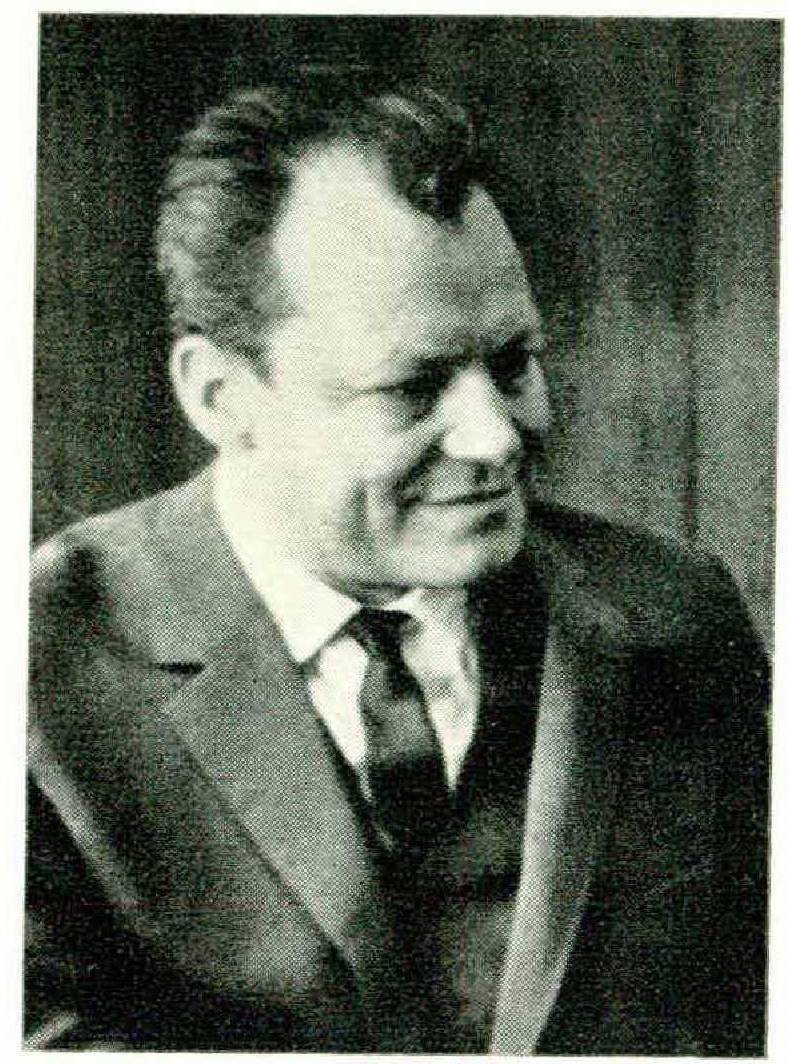
Brandt is not intellectually clever. This may worry people of superior intelligence, but it does not diminish Brandt’s ready appeal for the masses. They like the look of this homely, healthy man, and his party has wisely distributed a suitable memento of him to most West German households. On the cover of a brochure is Brandt’s face. It wears a firm, frank smile. It is surmounted by a useful crop of hair — retreating, it is true, but still sporting an aggressive forelock. The ears are close-set, the eyes wide apart, the chin a trifle fleshy, but strong. The lines on the forehead have not been smoothed away; they denote hard thinking. The corners of the generous mouth are turned upward. This is a bold, youthful, confident face, no longer overly youthful, nor overconfident.
Brandt has the charm of informal simplicity. He will talk to anyone he chooses, vary his hours, flout routine. He has simple tastes, is a beer-andsausage man, and spends little on his clothes. He reads voraciously, has no time for hobbies, and adores his family (he has sons of ten and eight). The Brandts live happily and unostentatiously in the Schlachtensee suburb of Berlin, where, as Rut Brandt says, “I can wash my car in the street like any other Berlin housewife.” Her good looks, gaiety, and unaffected manners are further assets to Brandt. So, too, may be the fact that a third child is expected this autumn.
Brandt is probably the most outstanding, certainly the most exciting political figure to appear on the German scene since Adenauer forced himself into the leadership of the Christian Democratic Union in 1946. Yet three factors will count against him at this year’s elections. The German people have become used to Adenauer teams and regimes and their aura of prosperous, comfortable confidence. The German political parties have got used to this situation, too, and the Social Democrats have no potential ally for a possible coalition government (they may get 40 per cent of the votes, but hardly more).
In the third place, Brandt has suffered from a vicious smear campaign. This was based on his opposition to the Nazis and his emigration to Norway and on false accusations that he fired on German soldiers in 1940 and wrote off his own nation’s chances of regeneration in some of his books. Leading Christian Democrats, like Strauss and the party whip, Hermann Hoecherl, have contributed to this unsavory campaign. Adenauer himself was slow to express guarded disapproval of it. It is a somber reflection that the campaign may have done Brandt real harm. In the eyes of some Germans, it is better to have been even a Nazi than to have been suspect of a lack of patriotism. It is this suspicion that Brandt’s enemies have managed to arouse.
Adenauer’s Christian Democrats should win the 1961 elections. They should continue to hold more than half of the seats in the Bundestag. Adenauer should be able to form his fourth administration and stay in office at least until 1963. All this implies no significant changes in West German policies. Yet, the rise of young men like Brandt and Strauss and the likely consolidation of a more active Social Democratic opposition will have some impact. This impact may be demonstrated in the following ways:
There will be a search, on both sides of the Bundestag, for possible paths leading toward reunification. There will be growing demands for German ideas on disarmament, the reorganization of NATO, and other world political problems. There will, if Brandt shows his mettle, be a return to the cut and thrust of the first two years of postwar parliamentary government. There will be increasing unanimity, however, among the parties on the Berlin question and on the need to present a united front in face of any pressure from the Communist bloc.
The Adenauer era is coming to a close, and this may end paternalistic government. It may prove a supreme paradox that Adenauer himself will contribute to this, by edging the substitute father figure of Erhard into the background and pushing forward the youthful gladiator, Strauss. In short, the new phase of West German history will offer the prospect of greater contrast and change and the introduction of German energy and dynamism into the political field. This is not to decry the performance of the Adenauer era, which has been to give more than fifty million Germans the chance to build up a stable form of democratic government. Fifteen years ago, this did not look dimly possible; in the interval since then, a new sort of German nation has been born.