Sick Transit, Etc
ED BENETT gave up newspapering to engage in free-lance editorial work. He lives in Lexington. Massachusetts.
Commuters have been disturbed recently by a series of disputes between the railroad and rapid transit unions and their various managements. Depending on their points of view, the riders (and the newspapers) are tempted to blame either labor or management, or both, for inconveniences over which neither has any control. Rather, the conditions are subject to certain immutable laws, like the one governing rainfall at picnics, and transit riders everywhere would do well to understand them.
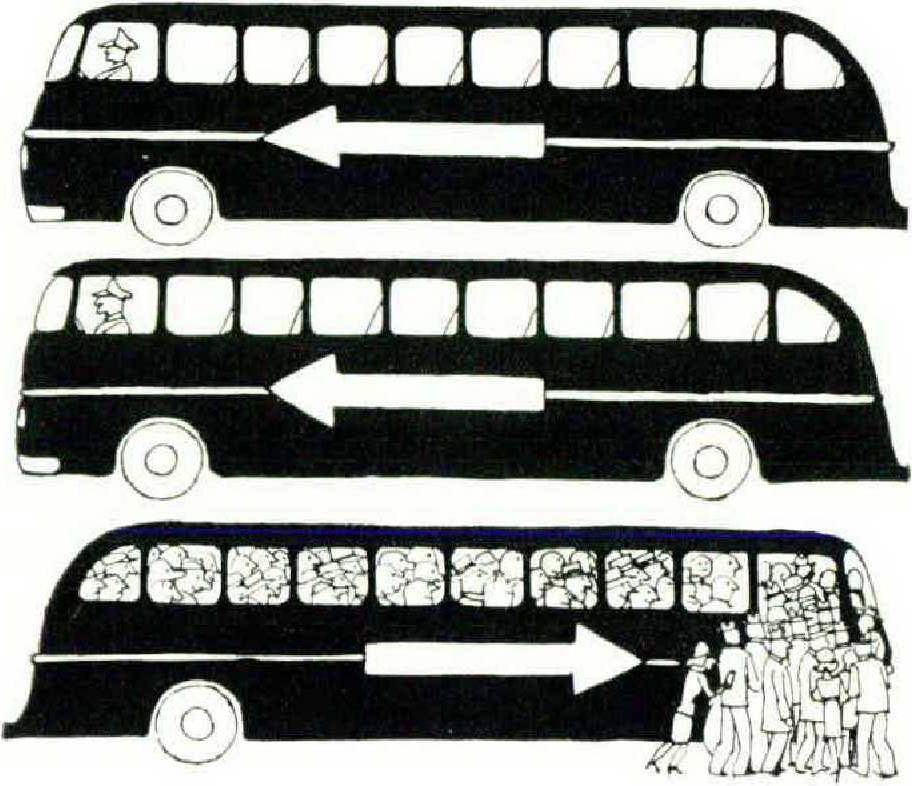
One situation over which transit systems have no control is best described by Bennett’s Law of Transit Frequency, stated as follows:
The frequency of transit service varies in inverse ratio to the direction of passenger travel by a factor of 2.1.
For example, a westbound transit rider must expect to see 2.1 eastbound transit units (trains, trolleys, buses) go by before his own unit arrives. This is true even when there is an eastbound rider waiting across the street, because the Law of Frequency does not apply to others, only to oneself. Simple observation will confirm this.
The frequency factor, F, applies also where two or more transit routes, R, are operating on the same street or trackage, and the number of unwanted units, U, can be found by the formula U = 2RF — F.
To illustrate, an eastbound A-line rider may expect to see 2.1 westbound A units, 2.1 eastbound B units, and 2.1 westbound B units, for a total of 6.3. If there are three lines, the total will be 10.5. (The unit represented by .5 will just be coming into view in the distance.)
By now it should be apparent that the operation of the Law of Frequency poses problems for transit managements and their employees as well as for passengers. When transit traffic in one direction is 2.1 times that in the other, the effect is a concentration of equipment at the terminal behind the direction of passenger travel. To relieve it requires the dispatching of great numbers of units labeled CAR BARN or NO STOPS in the direction of passenger travel. Experienced riders recognize that these units are merely redressing an imbalance and cannot carry passengers. To do so would be to do two things at the same time, and transit managements are confused already.
The basic frequency factor is not constant. It is increased by certain adversity factors at the rate of .08 for each element of bad weather or personal inconvenience. For example, a lightly clad rider with a head cold, an armful of bundles, and an empty stomach on a rainy winter night may expect a frequency factor of 2.66 on most lines.
It is not possible to take advantage of knowledge of the Law of Frequency by, say, hiring a small boy for a quarter to count passing transit units while the rider goes for a shoeshine. This is because of pressures of imbalance that have been built up by the operation of the frequency law. When a rider deserts his post he makes the law inoperative and permits 2.1 units, which have been lurking just over the hill in obedience to the frequency law, to start up and pass by his stop at a speed which increases at the rate of one mile per hour for each yard covered by the pursuing commuter.
An understanding of the foregoing should eliminate much superstition that now surrounds transit riding. A common type of believer in magic is the rider who lights a cigarette at a bus stop in the hope that he will have to throw it away immediately. It doesn’t work. The Law of Frequency must be satisfied. Besides, he didn’t want the cigarette in the first place. Of course, it is true that he will be lighting a new cigarette when his bus does arrive, but this time he will want and need it after an uncomfortable wait. He will get his nicotine, though — at second hand from the driver.
There are situations in which transit systems appear to have a measure of control over the operation of the Law of Frequency, but when they do, they arw subject to another law, economics. An example is found in the terminals of subway elevated lines, where bus lines fan out from assorted loading posts. If a dispatcher sees a crowd building up at post 13 for the Moot Point bus, he can send out one or more buses from each of the other loading posts while incoming trains increase the pressure on post 13. When the Moot Point bus does load, with passengers left over, it will leave with a maximum payload, contributing a minimum to the system’s financial deficit. The other buses can be charged to overhead.
Obviously, the Law of Frequency cannot apply to commuter railroad lines, many of which are already down to one one-car train a day in each direction. Here, too, the governing law is economics. Unless a train can leave its suburban terminal with would-be passengers left standing on the platform, it will operate at less than maximum efficiency.
Far from being brutal in their enforcement of economic law, the railroads appear to indulge in expensive compassion. They continue, for example, to provide seats, which offer an incentive for the first couple of dozen of the healthiest and most aggressive passengers. This tends to ensure the survival of the fittest and the improvement of our genetic stock. Removing the seats would increase the human cargo space considerably. Better still, the commuters could be stacked horizontally, like cord wood. The danger in this, though, lies in the possibility of some unfilled space near the ceiling, again suggesting less than maximum efficiency and the possible advisability of discontinuing the run.
The discontinuance of service is a necessary part of the operation of railroads and metropolitan transit systems. All forms of public transportation suffer deficits, estimated at so much per passenger. Therefore, a reduction in the number of passengers should result in a related reduction in the per capita deficit. Commuters can’t fight that kind of logic. Better to get into their cars and into line at the next traffic light.
Or, better still, stay home.