Yorkshire
JOHN BRAINE, who lives in Yorkshire, is one of the outstanding serious young writers to come out of postwar England. His first novel, ROOM AT THE TOP, which appeared in 1957, received much critical acclaim both in this country and abroad. His most recent book, FROM THE HAND OF THE HUNTER, was published by Houghton Mifflin last year.
THERE’S a story about an old Yorkshire farmer who, on his return from his first visit to London, was asked how he’d enjoyed himself. “It wor varry interesting,” he said. “But it’s grand to be back in England again.” One could, of course, substitute Devon or Dorset for Yorkshire, but it somehow isn’t the sort of story which other counties tell against — or, rather, in praise of—themselves. It’s rather like a Texas story, and, in fact, we in Yorkshire have much the same attitude toward England as Texans have to the United States. Yorkshire is the largest English county (so large that it is divided into three administrative areas — the North, East, and West Ridings) and it’s also the county with the strongest sense of regional identity. There the analogy ends, for Yorkshire’s boom days are over and those of Texas are just beginning.
The shift in British industry is from heavy to light, from north to south; British businessmen, like British writers, like to be as near London as possible. There isn’t, in consequence, any real development in Yorkshire; the pattern has hardly changed since the Industrial Revolution. Some of the towns in the West Riding, particularly in the South Yorkshire coal field, are so ugly as to be unreal; they are three-dimensional illustrations to J. L. and Barbara Hammond’s The Bleak Age. I once for a short time worked in the South Yorkshire area, and to this day the name of Barnsley, for instance, stabs me with depression and a totally unreasonable guilt.
At the time I first visited it, I was in charge of the branch library at Darton, a mining village nearby; there weren’t any houses available there, and Barnsley was within easy reach. But after one afternoon in Barnsley, my wife and I knew that it was impossible for us to live there. We went to Wakefield instead.
This meant two hours’ daily commuting, which cost more than I could afford in time and money, and Wakefield isn’t, to say the least, a garden city. But there was no alternative. The ugliness of Barnsley is too thoroughgoing; it’s not limited to the town itself but extends to all the country surrounding it — a country where green has been abolished by pit heads and spoil heaps and opencast mines. And over the town’s narrow streets hangs the smoke, yellow and acid and black and sooty, a compulsory cocktail for young and old, the olive the stink of gasoline and diesel exhausts. And though the town is now, like all mining communities, prosperous enough for most miners to afford motorcars and holidays abroad, it is grindingly poor in spirit, immobilized in the Paleotechnic Age. The habit of pleasure, the desire for festivals have been lost; the town has been in the firing line too long. In compensation, its people have the soldier’s virtues — toughness, cheerfulness, and a quick friendliness. People from Barnsley not only always talk to strangers on railway journeys but they share their sandwiches too.
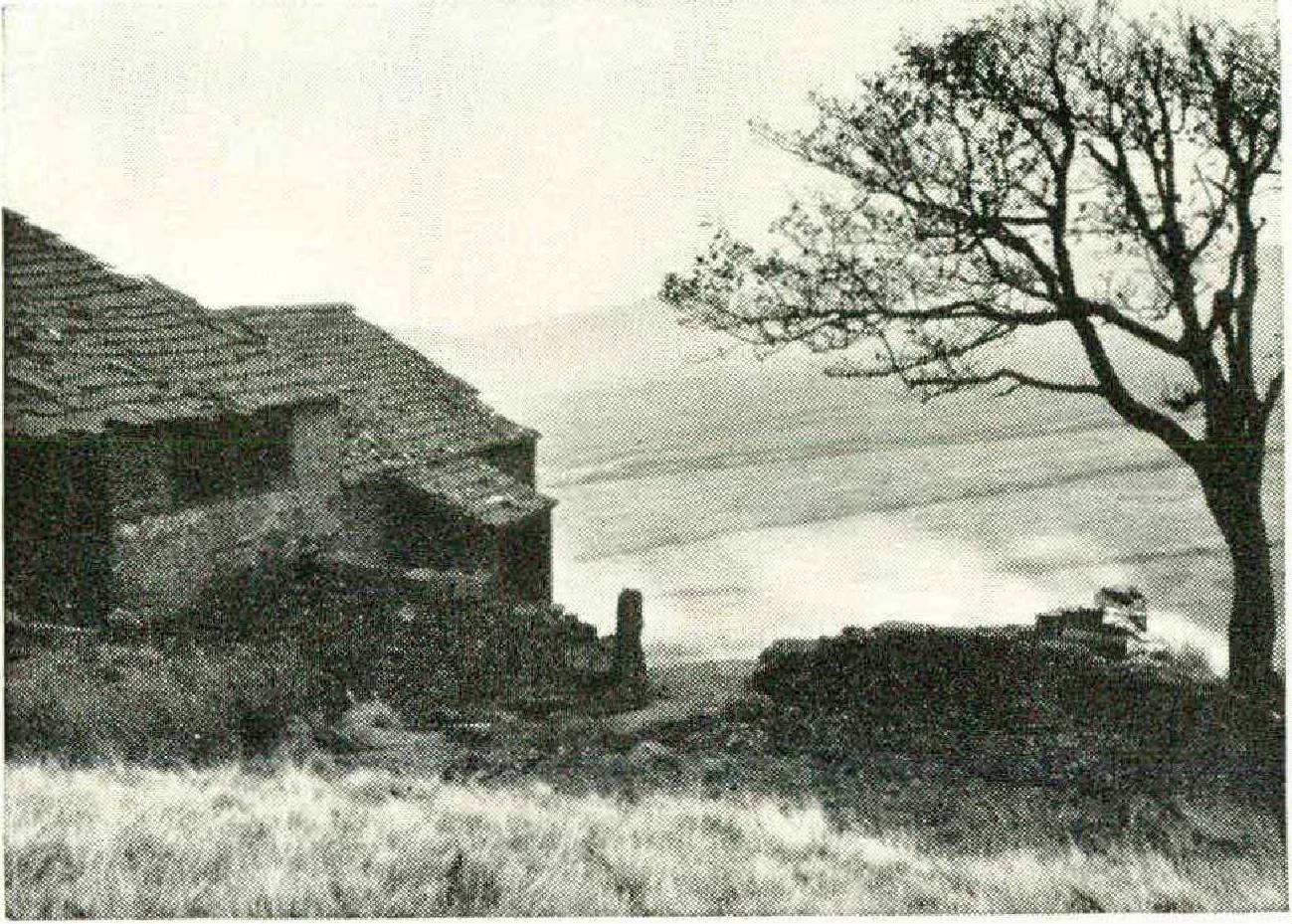
BARNSLEY, however, is only one side of the medal; the other is a village like Malham. north of Skipton. Here there was once a mining industry, but the lead and zinc and copper were worked out in the last century; it left as its memorial a few blocked-up pitshafts, a smelting tower, and waste dumps from which one can still pick out glittering fragments of malachite and azurite, bright green and bright blue like stage jewelry. The industry died as gracefully as any industry can die, leaving no scars on the landscape or bitterness in the memory. It’s difficult now to believe that Malham was ever a mining village. Malham has grown around the open village green. Without benefit of Town and Country Planning Act, its low-built stone houses, the trees and fields around it, the clear becks running through it combine into a perfect whole. And it possesses a curious tranquillity, not dead or dull but as if it had absorbed the silence of the high land to the north, where the steep, winding road climbs toward the Cove and Gordale Scar, into the heart of the limestone country.
Color here takes on an extra dimension, the dry-stone walls changing from Devon cream to pepper-and-salt tweed according to the light; limestone has a chameleon quality which makes Malhamdale both supremely paintable and almost unpaintable. The rocky ground, too, reflects the light and even the passage of the wind — here, if nowhere else, one can believe that the earth moves. It isn’t gloomy or savage country because of this quality of radiance, but higher up, on the fells in particular, it has a quality of absolute remoteness. Unlike so much of the country to the south, it has never been humanized; the few small farms seem to be there only on sufferance. You may spend a day in the fells around Flock Rake and Parson’s Pulpit without ever seeing another human being or, indeed, ever wanting to.
It is essentially walking country; if you want to do more than glimpse a corner of it, you must leave your car in the village. (Or better still, leave it in Skipton and travel to Malham by the Pennine Services bus — bright orange and light gray, square and high-slung, a genuine country bus. It’s always full; that way you can meet the local people too.) It isn’t until you’ve put a couple of hours of stiff uphill walking between yourself and the road and are sitting on the short springy turf with the smell of wild thyme and marjoram in your nostrils that you can be said to have seen Malhamdale.
Then there is Richmond in the North Riding with its castle above the river and its narrow medieval alleys (“wynd” is the proper word and still in use) running off the cobbled market square. Richmond is both a showplace and a garrison town, being the nearest habitable place to the army camp at Catterick. English regular officers are still drawn mainly from the upper classes who, contrary to the piously held beliefs of many Americans, are doing very nicely indeed. The difference between Richmond and other Yorkshire country towns can be discerned very easily in the pubs, which are either of the type where one feels selfconscious without a necktie or a slummer with a necktie or clean fingernails. You can’t be accepted in Barnsley unless you’re a miner and speak with a Yorkshire accent, and you can’t be accepted in Richmond unless you’re U (preferably Officer and Gentleman U) and speak Standard English, which, anywhere in England, means a strangulated and languid delivery with the a broad and all the other vowels narrow, and the very faintest touch of deliberately assumed cockney, a clove of garlic rubbed very lightly around the salad bowl.
Incidentally, what makes Yorkshire unique among English counties is that its regional accent is the only one which is halfway acceptable. There are appreciable variations from place to place; the accent of Cleveland in the East is, for instance, very much softer than that of Skipton in the West. And despite the supposed standardizing influence of the BBC, the dialect proper still flourishes. What is generally known as the Yorkshire accent, however, is the accent of the industrial West Riding with its flat a’s, warm, full vowels, and slightly blurred t’s. The second person is still in common usage, as are words like “doy” and “laike” (“darling” and “play”).
There is no question, of course, of the Yorkshire dialect’s being a language in its own right like Lollans or Welsh or Erse, or even of words like those I’ve mentioned receiving their naturalization papers. This is a terrible weakness of English at present; we admit “blitz” and “kaput” but not “doy” and “laike,” which are wonderfully good and rich words because they have very specific applications. “Doy” is a term of endearment especially for children; it’s much more tender than “darling,” with its Noel Coward connotations of silk sheets and champagne. And “laike" means the play of children — not the highly organized adult playing of team games like football but the spontaneous tribal games of cowboys and Indians or cops and robbers or, quite simply, any physical activity which children indulge in when left to their own devices. But these, and thousands equally good, remain unused in literary English. There is a Yorkshire dialect literature, but it is, for want of a better word, amateur.
I said that the Yorkshire accent was halfway acceptable; the emphasis is on the “halfway.” It’s an enormous asset on radio and TV and does no harm at all as far as the independent businessman is concerned. But any lawyer or teacher or junior executive in a large concern is best advised to learn, as our phrase goes, “to talk well-off.”
And many of the younger generation of Yorkshire businessmen speak much as their counterparts in the South do. In the case of those who haven’t been to public schools the results can be so dreadful as to be embarrassing. For one mispronunciation in Standard English — a broad “ in “but” or a narrow “ in “butcher,” for instance — ruins the whole effect. It’s possible to have a good deal of quiet fun sitting in hotel bars and roadhouses in expensive residential districts of Ilkley and Burley listening to accents wearing thinner with each drink, until at the fourth pint “beer” turns to “ale” and “old boy” to “lad" and “darling” to “love.” The convention is that it’s a deliberate democratic unbending; the fact is that Standard English is torn off like a tight collar and everyone breathes naturally again.
I MENTIONED Ilkley, and Ilkley is in fact a representative example of the Yorkshire residential town. Ilkley, like Barnsley, is caught in the past, but its predominant color is soft gray and the country surrounding it is wild and unspoiled and green. It’s a town of big houses and luxury hotels and steep roads lined with trees; the wind which blows down from the moors is clean and cold and smells of grass and pine trees. There has been money in Ilkley for a long time; even when it’s crowded with vacationers in summer it’s as quiet as a bank. It used to be the place to which the rich of Bradford and Leeds retired; it’s now a commuter’s town also, being less than an hour away from Bradford and Leeds. That is, it’s within comfortable traveling distance only if you have a car. And, whilst more people than ever before in England own cars, by and large the working classes don’t, particularly in the textile industry. So, most of those living in Ilkley are on the managerial level at least. Ilkley isn’t a oneclass community, but one couldn’t really be accepted there with an income of under £1500 a year.
But this doesn’t affect the moors and the hills and the wonderful view from the Cow and Calf, the two volcanic rocks which overlook the town. The moors are a place for relaxation, the lungs of the industrial towns; they are the best walking country in the world, dry and springy under the feet. They are also savage and treacherous; the path from Dick Hudson’s in Bingley to Ilkley is marked with cairns for the guidance of travelers. You may add a stone; you mustn’t take one away. They’re reminders of the fact that on these moors men have died of exposure not a mile away from help. It’s the moors which give Ilkley character, a touch of Gothic poetry. It would be a pretty good place for a writer to live in, and, oddly enough, Thomas Wolfe began Look Homeward, Angel whilst staying there.
But it isn’t really possible to write about Ilkley — or, indeed, Yorkshire — without saying something about Bradford. It is a city that it’s impossible to be indifferent about; either you love it or hate it. It’s still predominantly a Victorian city, with massive public buildings designed to last forever. It’s even hillier than Ilkley and nearly as black as Barnsley. There is no center in the true sense of the word; the cathedral (its wails still scarred with Cromwell’s grapeshot) could have been an excellent focal point but for the fact that it’s obscured by the General Post Office. This hiding of almost the only public building of any architectural distinction or historical interest was not due simply to crassness on the part of the city fathers. It was deliberate; most of them would be militant nonconformists who regarded Anglicans as only one degree less misguided than Catholics.
Nonconformism has still a great deal of influence in Bradford; it is the driving force behind the city’s anti-drink and pro-Sabbatarian hobby. But its palmy days are over. Once regular attendance at chapel was virtually obligatory if you wanted to be a success in the wool trade, and churches were built at a fantastic rate to meet the demand. In my own township of Idle, which in the nineteenth century would have no more than 3000 inhabitants, there were, within a radius of one mile, three Methodist churches, each with a school attached. There were at that time variant sects of Methodism too, like the Primitives. The Primitives claimed that their brand of Methodism was primitive in its purity; with the rise of the wool trade, congregations had grown more prosperous and churches more elaborate. Some of the bigger Methodist churches, with pews and stained glass and clock towers and steeples, would, in fact, make John Wesley turn in his grave.
Now the Methodists are uniting their ranks; they can’t afford to quarrel with each other about nice points of doctrine. And the solid stone chapels which once were crammed to the door each Sunday are closing down to become clinics and garages and shops. There is an enormous melancholy about these monuments to a dead age. They now represent in the public mind only the prohibitions — thou shalt not drink, gamble, or enjoy thyself on the Sabbath. But when Methodism was at its height they provided not only a healthy social life but the moral force behind many social reforms. It’s difficult to believe it now, but Bradford was once a pioneer city, particularly in the educational field. Again, my native town of Idle will provide an example: here there are three primary schools—the Margaret Macmillan for the mentally backward, the Open-Air School for the physically delicate, and the ordinary State School. And in Bradford, in sharp contrast with other places in England, no child capable of benefiting from a grammar school education will fail to receive it.
But the life has largely gone out of Bradford, as it has largely gone out of nonconformism. There isn’t any sense of progress there any longer, there isn’t any feeling of citizenship. World War I, in which most of its best and brightest young men were butchered, broke Bradford’s heart; the 1929 Depression and, to a lesser extent, the motorcar and TV finished off the job. After six o’clock the city is empty in all senses of the word; one of its two theaters is under sentence of death, and the Bradford Civic Playhouse is deeply in the red.
You can still, within ten minutes’ ride of the center, reach open country. If Bradford were a thousand times uglier, it could never be mean or dirty or hopelessly gloomy; because of the presence of the moors one is always free, never quite hemmed in by buildings, never quite stifled by smoke. And in the older parts of the city, where the lighting is still by gas (warm and yellow and stuttering), and the streets are pierced by alleys, and steep steps lead past towering Victorian mills to patches of waste ground high up the valley, there is the sense of history; one can discern the pattern of events which have made Bradford.
I’m groping my way here: if I say too much I am, as it were, selling my seed corn; if I say too little, I’m merely freewheeling down the easy slope of sentimentality. There are all too many professional Yorkshiremen. All I know is that Bradford, even more than Ilkley, is a good place for the writer. London isn’t; it hasn’t any existence as a real place. Society there is herded off behind iron curtains, and “herded” is the operative word. In London the writer can meet other writers—and artists of any kind — more easily than in any other city in the world. But he can’t meet, without a great deal of staff work and selfconsciousness, either the dustman or the company director.
Much the same applies to any of the favored literary habitats outside London, not only to Devon and Cornwall and the Home Counties but to Cumberland and Westmorland and Dorset and Gloucestershire. These places aren’t real any more; the division is between farmers and hoteliers and the others. There isn’t any way of instantly seeing the whole of English society in cross section. The point of my story in the beginning of this article is not that the farmer objected to London’s being full of foreigners but that it had no connection whatever with life as most people in England live it. And this is also the reason for the decline of the English novel: when English novelists look at the map all that they see outside London or their cozy little village in Bucks or Herts is the equivalent of Here Be Dragons. As far as they’re concerned, the North doesn’t exist. The result is a flux of novels with weak, sensitive heroes.
There’s always the possibility, of course, that my living in Yorkshire means only that I’m swimming against the tide. By living in Bingley, a small town about six miles north of Bradford, I may indeed be cutting myself off from the intellectual life of the country. I may very well run the risk of being typed as a regional writer (which is about the worst thing you cay say about a writer in England). I’d be within my moral rights to follow the example of many another Bradford writer and go south. But whenever I walk through Bingley at night by the river with the lights from the tenement houses gilding the River Aire, whenever I turn the nose of my car north over the moors along narrow winding roads bordered by dry-stone walls, I know that I’ve made the right decision.
And this, finally, is the only way in which I can write about Yorkshire — disjointedly, subjectively. No neat summary is possible; no literary formula will accommodate both Richmond and Barnsley. Or, for that matter, Bradford and Holderness in the East Riding, where there seems no difference between land and sky and sea and where almost before one’s eyes villages drown like swimmers. And I haven’t even mentioned Haworth, though from where I write I can see the rocky road which leads to it in an hour’s brisk walk. Other counties are poems, good or indifferent, with one dominant note; Yorkshire is a huge anthology with no apparent unifying theme. But there is a unifying theme; there is a link between Richmond and Barnsley and Holderness and Haworth and Ilkley and Bingley and Bradford. And what exactly the link is will take the rest of my life to find out.