The Perils of Prudence
STANLEY E. GWYNN is a Chicagoan and a graduate of Northwestern University, now associated with the University of Chicago.
Sometimes I will go along for eight or ten months without once thinking about my first thirty minutes as an employee of the National Safety Council. Then something I read or hear will joggle a synapse, and in an instant my mind will fill with the recollection of that unnerving half hour.
Last week, for example, having given no thought to the Safety Council since New Year’s Eve, I opened my Sunday paper and found myself reading that the forty-ninth National Safety Convention of the National Safety Council is being held in Chicago this year from October 16 to 20. I had not finished the sentence before the whole ancient episode flashed into my memory in full detail. I suddenly thought that perhaps now is the time to set it all down in writing. What follows, then, is what happened to an earnest and only slightly irreverent young man between 8:30 and 9:00 A.M. on August 24, 1936.
The National Safety Council was, and still is, an association of organizations and individuals dedicated to the task of reducing the number and seriousness of all kinds of accidents. Much of its work is carried on by a paid staff of engineers, statisticians, librarians, writers, artists, and other specialists, and in 1936 there were about one hundred and twenty-five such persons on the council’s payroll. They were quartered in a light and airy suite on the fifteenth floor of Chicago’s Civic Opera Building, and it is important to my story to note that over half of the individual offices were strung along the south and west walls of the building, forming a sun-drenched L, while the remaining offices, including the library in which I worked, bordered the south and west sides of an inner light court and were separated from the outer offices by a long corridor which was also, of course, L-shaped.
I reported for duty promptly at 8:30, and the librarian immediately conducted me to my desk and gestured toward a pile of mimeographed memorandums stacked neatly on the blotter pad. These, she said, were office bulletins and procedures, and I might well look through them before doing anything else; they would help introduce me to life at the National Safety Council.
The topmost document was labeled “Health Bulletin No. 12” and was one of a long series issued by an obviously zealous staff health committee. It had to do with diet, and it included, sandwiched among numerous Spartan aphorisms, a “good general diet for overweight.” It concluded with this directive: Keeb Fit Today and Everyday! Quashing a slight presentiment, I passed quickly to the next item, a four-page manifesto captioned “Standard Customs and Procedures (Revised). ” I skimmed through this in some haste, noting only that I was “privileged to use the Metropolitan Nursing Service” (in the event of my failing to stay fit) and that I was ordered to keep my head in case of lire. The third bulletin set forth a ruling that the period from 4:45 to 5:00 P.M. every Monday was to be employed in correcting “unsafe practices” that might have developed in the office during the previous week. The next procedure began by smugly announcing that the Safety Council retained a full-time nurse for the benefit of its employees, that she presided over a “Health Room,” and that the Health Room was equipped with a battery of highpriced therapeutic appliances. I was reading down the list of curative contraptions, which started off with something called a diathermy machine, when the librarian interrupted to present me to one of my new associates.
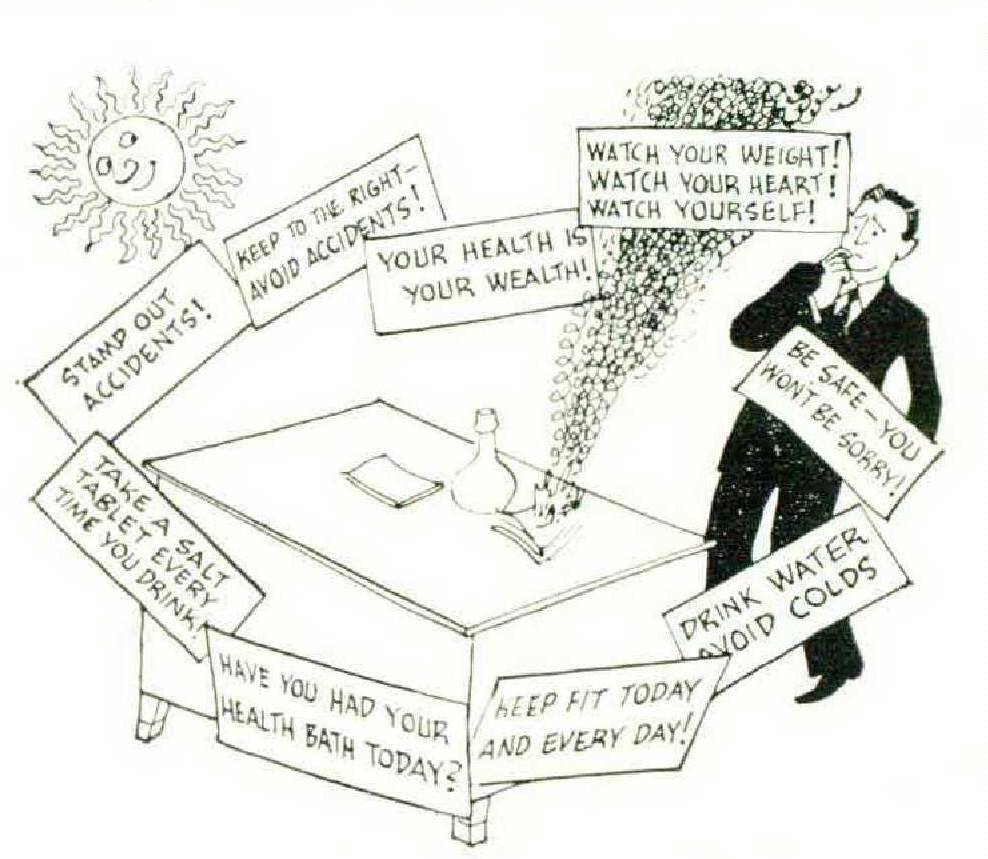
After the introduction was accomplished, I decided that I really needed a drink of water before reading any more office procedures. I recalled seeing, from a distance, a water cooler located in the corridor at the angle of the L, and I set off down the hall. I cannot say that I had begun to feel oppressed by my reading, but I can remember reflecting, as I walked toward the cooler, that the council certainly was fussing over me. Then, nearing the angle in the hall, I was astonished to see, painted on the floor, a yellow traffic line which evenly divided the passage and curved primly around the corner. Overhead, jutting out from the wall, was a printed sign which read:
KEEP TO THE RIGHT!
AVOID ACCIDENTS!
Resisting an impulse to signal, I turned left across traffic and pulled up to the water cooler. I reached for a paper cup — and stopped in mid-reach. Bolted to the cooler was a device which I decided must be a salt-tablet dispenser. From the dispenser dangled a sign reading:
AVOID EXCESSIVE PERSPIRATION AND THE ATTENDANT DANGER OF HEAT EXHAUSTION. TAKE A SALT TABLET EVERY TIME YOU TAKE A DRINK.
I had never before seen salt tablets, but by now I was in no condition to resist obviously competent authority, so I dutifully swallowed a tablet and washed it down with a long, thoughtful drink of water.
I returned to my desk and was pondering the many faces of paternalism when a tinkling noise at the door caused me to look up. A girl entered the library, pushing a chromium cart which carried an array of large jugs filled with water and ice cubes. She wheeled purposefully in my direction, and then I noticed that on my desk, and on every desk in the office, there was a globular, clear-glass water bottle. Inverted in the wide neck was a glass tumbler which served both as receptacle and stopper. While I watched in silent wonder the girl filled my carafe, replaced the tumbler, and moved on with her cart to the next desk. I quickly riffled through my papers and in a moment found a procedure only three weeks old which contained the expected injunction:
Water pitchers have been placed on all desks. They will be filled with fresh ice water twice a day. Drink plenty of water: avoid colds.
But the end was not yet. At that very moment, before I had recovered and while the freshly poured water still slowly swirled in the pitcher, my telephone jangled; it was my maiden phone call. I simply had to sound brisk and battle-ready, and I pulled myself together.
“Mr. Gwynn,” I said crisply.
A soft, female voice came to my ear. “Mr, Gwynn,” it purred, “it’s time for your bath.”
“ Time for my bath! MY BATH?” I am afraid that I shouted.
The voice became reassuring. “Oh, it’s a sun bath, sir. We have a violet-ray lamp in the Health Room, and we hope that every employee will take a two-minute sun bath twice a week.”
“Okay,”I said limply. Once again I looked at my bulletins. The sun lamp was listed, sure enough, not far below the diathermy machine. A footnote read: “A schedule of exposures is worked out to prevent confusion, and this schedule must be observed.”Battle-ready, I walked across the hall to the Health Room and stripped down to my shorts.
That was my first thirty minutes at the National Safety Council, and it was a prophetic half hour. I stuck to the job for four months, correcting unsafe practices, keeping to the right, ingesting sodium chloride, gulping water, and exposing my reluctant, darkening hide to the violet rays, but I was not comfortable. My body grew ever more sturdy, I guess, but my spirits drooped lower with each well-governed day. A reckoning was in order, and it came to pass about two months before I resigned.
For no apparent reason, we suffered a scries of fires. An industrial safety engineer returned to his office after lunch to find a pile of papers mysteriously aflame on his desk. A few days later the head of Home Safety sat down to work and found himself staring at a little heap of ashes and a smoldering blotter pad. There were two or three other unexplained small blazes, and with the honor of the council at stake, the staff members soon became popeyed with watchfulness.
Then, one sunny afternoon, a startled shriek came shrilling out of the Health Room. All the men in the office raced to the rescue with such speed that the scream still echoed as we surged into the room. The full-time nurse stood there transfixed, pointing at a spiral of smoke which rose gracefully from a small, charring spot on the wooden desk top. And, converging on that spot, sharply focused by their passage through her globular glass water pitcher, were the rays of the bright October sun!
The next morning my water carafe was gone. On my desk was a dignified notice stating that the water pitchers — all one hundred and twenty-five of them — had been sent out to be frosted.
They came back in a week or so, there were no more fires, and I faithfully drank from my now translucent carafe until I resigned at the end of December. But the atmosphere was not the same. There was a sad diminution of assurance in the safety engineers. They brooded.
Twenty-five years have passed since then, and I suppose that the council has long since regained its confident fervor. Not so with me. I still, once or twice a year, get to mooning about the philosophical question which was first posed for me by that incident.
I ask myself and the world: How safe can you get?