A Warm Hike
Born in 1915, S. YIZHAR has concentrated in his stories on life in Israel, in the kibbutz, and during the war of 1948-1949. He has published several volumes of short stories, including CHIRBET CHIZEH,a collection of powerful tales of the War of Independence, and SHISHAH SIPUREI KAYITZ (“Six Summer Stories”).
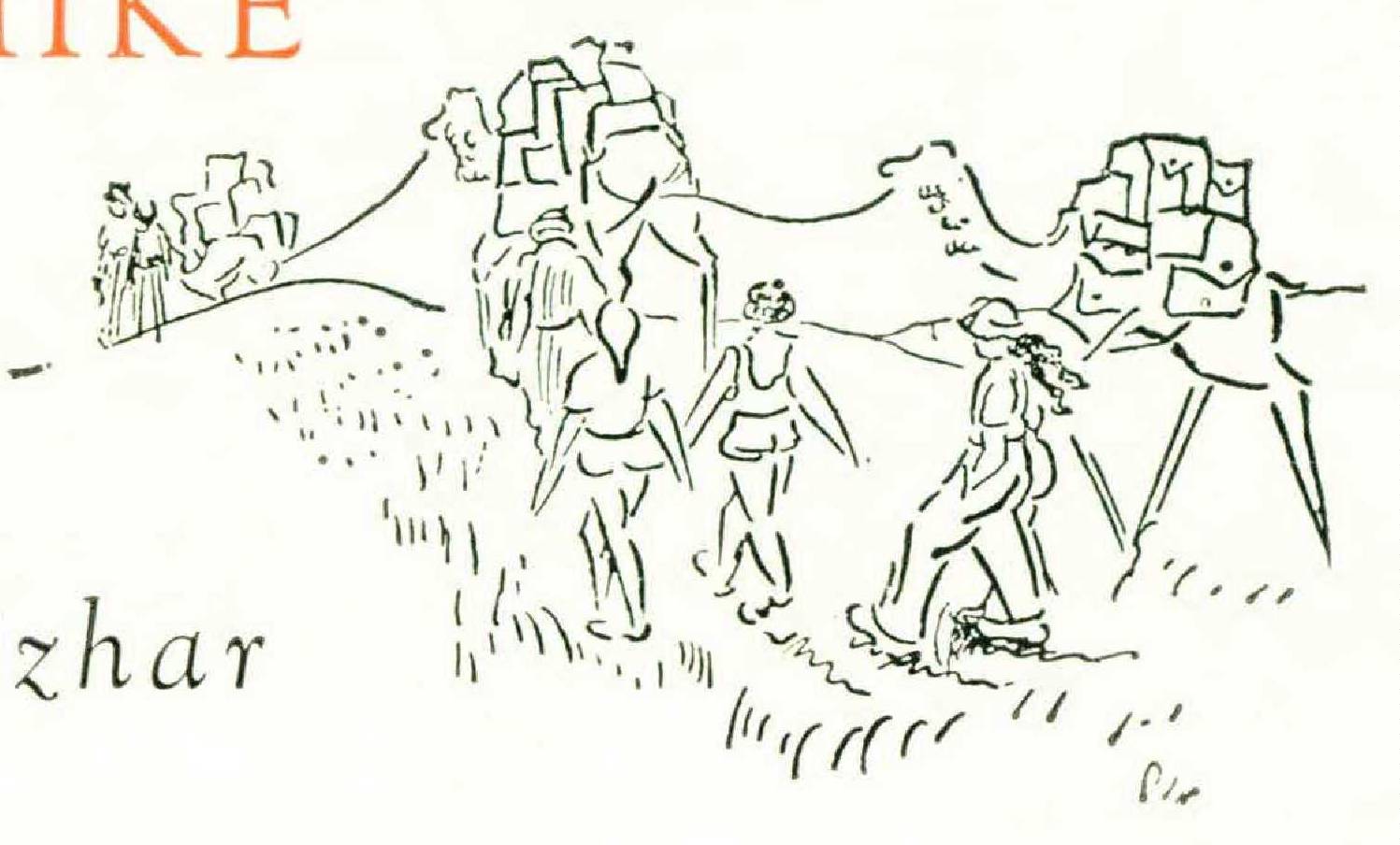
A Story by S. Yizhar
IT WAS on a warm day, the morning being rather humid, that the lot of us were walking it from Revivim to Gvulot in the southern Negeb. We hadn’t sung as yet, but we were quite prepared to do so, and we were still keeping an orderly Indian file, although we were already about to split up and scatter. And everyone was immensely pleased with the morning, the level plain, the clean, clear air.
Perhaps more pleased than anyone else was our guide. At dawn the watchman of the young settlement had gone out with him to the gate and, pointing into the pale, blue haze, had explained the course so simply and with such enjoyment in the telling that there was no room for the faintest particle of doubt. “There, you see,” the watchman had said, “that’s the road. The valley is Ka‘atMakbullah” — this was pronounced with a finished Bedouin accent, almost without effort, and with a nonchalant stroke of a sprouting mustache
-“and beyond that lie the sand dunes and Khalassa. That’s the border of the Azazma tribe and the beginning of the Tarrabin Bedouin. A little further on, you will enter the wadi, and it couldn’t be any simpler after that. Bir Khalassa, one” — this was counted with the bending of a finger — “Bir Abu Elyun, two; Bir Melka, three; Bir Seneh, four: that’s where you connect with Wadi Beersheba, and from there to Bir Shenek, five.” And he opened the five young, well-shaped fingers of his hand. “You have five biar — watering places. Then, as you leave the wadi, turn west, and you will soon strike Gvulot.” The watchman finished and, with a flourish, straightened his akal. “And, in any case,” he added, “you will have the camel drivers with you. They can be depended on implicitly, beyond doubt.” And he turned to the two Bedouins crouching by the cold embers of the fire, who smiled back broadly and cordially, showing white teeth and red gums.
They had been called the day before yesterday, and a fire had been lit in their honor, and coffee had been ground, and songs sung, and we had chatted to them in their language, all so that they would agree to let us have the camels for a pound a day. But they had merely crossed their legs under them and had sat around comfortably, feeling fine. They had bared their teeth in laughter, listened to the singing, drunk loudly of the coffee, and had answered us in their own manner, holding stubbornly to their own — two pounds. And we talked to them, bargained, promised, and hinted, and grew irritated, and once again compromised, until at midnight we had reached an agreement — two pounds. Then the watchman, very gratified, had said to our guide, “You’ve got to know how to handle these fellows; otherwise they take you in without mercy.” And he had gone off to bed contentedly, with the air of a man who knows how to get things done.
We marched on across the flat expanse. The camels advanced with a mincing stride, loaded down with knapsacks, water bottles, and blankets. (The driver had been promised that the load was no load and its weight was no weight and that it was a crime to weigh money against such a weightless load.) Only one of the Bedouins accompanied us, the fellow with the toothy smile, who rejoiced visibly whenever anyone started to talk to him (our meager Arabic was insufficient to do more than begin), and, clutching the tail of the last camel, he strolled along breezily. In short, it was really fine.
It wasn’t long before we came to the other side of the Ke‘ah, the canyon that cut across the plain, And, in spite of a few dry wild shrubs on the monotonous, rather dreary immensity of the landscape, we couldn’t help feeling that round and round there was no limit and no end to the expanse. We reached the soft sand dunes and shuffled through them till we came to the first watering place, Bir Khalassa, or Halutza. Now, there isn’t a map of the Negeb without Halutza marked on it, yet all of it is no more than a half-dozen stone huts with a round well in the middle, where some women were watering their animals. But our guide was very enthusiastic. He glanced into his little book and raised his head and looked around and showed us some large piles of stones. He explained that once, so many and so many years ago, there had been a large city here and that at least twenty thousand people had lived in it, and he became even more enthusiastic and asked us if such a Halutza couldn’t rise again. “What a question!” we answered, with a single voice. “And how!”
We drank some water of doubtful taste and character drawn in a leaky tin, and we sat for a moment in the doubtful shade of one of the dilapidated huts, and already somebody began to complain that the heat of the day was just beginning. Then the guide blew his whistle and we started on our way again. Our object now was to get to Wadi Halutza and connect up with Wadi Beersheba, the very same wadi whose source is in the Hebron Hills and which empties into the Gaza Brook and through which we would have to trudge from watering place to watering place.
Well, we walked some more across the sands, we climbed a little up and down the dunes, and the single file stretched out and bunched into sections, each section winding of its own accord, singing and conversing of its own accord, as though trying to ease the strain of this weird, flat landscape by surrounding itself with something of home by loud talking and singing. Suddenly we found ourselves descending to the bed of the great wadi. There, in the truly wide channel with its steep banks, the horizon became more restricted and the sky clear and warm and our shadows almost invisible.
Abu Elyun means “Father of the Pipe” — not just any pipe, but a real long-stemmed churchwarden, which requires much ceremony to light and gives off a terrible stench when smoked. We pushed on to the Father of the Pipe resolutely with vociferous shouts and ringing laughter until the very banks of the wadi were astonished when they resounded with our cries. At last we saw a few donkeys, sheep, and goats sticking out in the middle of the broad wadi. When we came up we found a small round well, the renowned Well of the Father of the Pipe.
A pail was slipped down, and we drew water. Our lips had barely touched the edge of the pail when a sevenfold thirst gripped s, and every one of us was prepared to swallow another pailful or two and to empty this well and leave it dry with nothing but its name and its hoary memories. Except that once again the whistle was heard, and once again we set out.
Meanwhile Yossy, Yoske, and Yosef took off their shoes and shuffled along barefoot in the sand. Not satisfied with that, they went and hung their shoes on the saddle of one of the camels. And Zippora, Dvora, and Drora, and other hot and sweating bearers of water bottles and knapsacks went and hooked their loads onto the camels too. After which a few smart alecks took off their shirts and, thinking that they would feel more comfortable, also tied them onto the camels. Our guide, of course, warned them that the sun and the sand would scorch them above and below, but they answered that the camels were alongside and there was nothing to fear.
SO FAR, so good. We kept going, and I don’t quite remember all that happened between Bir Abu Elyun and Bir Melka except that we emerged from the wadi and found ourselves among endless hills and countless dales of sand, and that somewhere among these hills and dales the three camels and the Bedouin disappeared.
“It’s nothing,” we said. “They will probably turn up at Bir Melka. Forward!"’ There’s no way of knowing what the guide thought to himself, but he, too, said that it was nothing to worry about and that we would no doubt see the camels on the next rise. And he hurried to climb the next hill, with all of us close behind him, only to see the bald crest of another hill in front of us and an empty depression in between. All around, the pink and yellow expanse stretched out in vacant loneliness.
Now, where was this Bir Melka? We had been following a seemingly endless path, up and down, twisting and turning, but there was still no descent to a wadi with its watering place. Sweat was pouring down our bodies, legs were beginning to falter, and the water bottles and the food — everything was on the camels. Not a living thing to be seen anywhere. Where were we to turn now?
Our guide changed color. He rushed up to the hilltop to spy out the land. We didn’t follow him, for we already knew that all you could see was the backside of the next hill, which, indeed, proved to be the case when we came there, except, of course, that then we saw our guide rushing across the valley and up to the top of the hill after that.
Finally, over the hill, shimmering in the haze, we made out two blots, half floating, half vanishing into thin air. When they became more distinct we saw that they were really camels and not just a trick the driver had played on us, and that two Bedouins were holding onto the camels’ tails and grinning heartily. Who were they? Nobody in particular. Just two wayfarers in the desert. Greetings, greetings, then more greetings. Whither and whence? Bir Melka? That’s right! Just behind you, in as long as it takes to smoke two cigarettes. The camels are yours? No, they aren’t. So what? So nothing, nothing at all! The Bedouins are in a hurry. There is an endless road ahead of them, and the sun is beating down above and doesn’t allow them just to stand around.
“Just a minute,” our guide bethought himself. “And what about Bir Seneh?”
“Bir Seneh?” they repeated, putting the cigarettes we had offered them behind their ears, among their tangled, shining locks, meantime apologizing profusely that, since it was the time of Ramadan, people like them could not smoke just now. “Bir Seneh? Right under your feet! About two smoked cigarettes away. A little turn to your right and even less to your left, and there you are. There are people there, there is water, there is shade — everything you want. So may God grant, and even more, so be it and so shall it be.”
The last scrap of greeting was wafted away on a breeze whose business was not to cool but to blow — on purpose — a fine spray of sand into our scorched, jaundiced faces.
WE CAME upon a castor tree with about a palm’s breadth of shade. Somehow we all managed to squeeze into that sparse shelter from the sun and tried to rest, breathe, and draw our parched tongues back into our mouths. And, as we swallowed the dry saliva in our burning throats, a general grumbling began. “So? Now what?” “Didn’t I say so before?” “What a hike!” To which, moaning and groaning, our guide added an explanation. “It’s Ramadan, the period when the Arab doesn’t eat during the day. That’s why we’ll probably find our Bedouin, poor fellow, at Bir Seneh. And if he isn’t there, he’s somewhere else, maybe lounging about in one of the tents of the tribe. There’s nothing to worry about; everything will turn out fine. And, incidentally, the scenery at Bir Seneh is something extraordinary. Two streams meet there — ” This vivid description of the scenery seemed to revive Dvora a little, and she asked, “How long will it take to get there?” Our guide, in reply, merely stretched out both his palms and said, “About — not much! We’ll walk, and we’ll make it soon enough.”
And our guide picked himself up, set his sunglasses on his nose, and said, “Well, this is the Negeb. What did you expect? Forward !”
Somehow we got up, and somehow we started to walk, but our spirits were pretty low. Then we saw Yossy and Yoske running like wild donkeys across the sands, the burned soles of their feet seeking in vain for something cool to step on, and they almost vanished from out of our sight. As for Zippora, her strength failed her utterly, and two boys had to walk along and support her and sing to her and joke, but no matter what they did, she just tottered and groaned, “Water!” and “Oh, my feet!” So they drew her along.
Have I mentioned that it was hot that day? The desert was immense. The hillocks of sand rolled one after the other like waves on the sea, and the path beckoned us into the blue. How we longed to sit down and rest. But where? Every inch of ground was on fire. We were possessed by a terrible appetite for the most impossible things. The fellow walking behind me kept repeating “Ice cream” over and over, in between other unmentionable ejaculations. And another kept saying: “Watermelon, watermelon, watermelon.”
It seemed as though we had done nothing but walk through an empty desert, climb a slight rise and go down on the other side, and then reach a second rise, and a third, and a fourth, and a fifth, and so on, endlessly, with always another hill in front of us and the sun blazing away all the time. We were sure that we would never get anywhere, and that we were doomed to walk on forever, and that there was no longer house or mother or family or anything but this hot, dry, and infinitely weary path with its strange and obstinate resolve, saying, “Keep going, keep going.” And we went, unthinking, unfeeling, sinking and sliding in the sand. And, at some indeterminable hour in the afternoon, we saw a tiny mud hut before us.
An old woman was sitting outside, and on seeing us she became so frightened that she scampered indoors and none of our entreaties could bring her out again. Then we saw a donkey in the distance and a small barefoot and half-naked boy plodding behind it down into a shallow valley where there was a well. And what do you think? That was really Bir Seneh! We neither saw nor heard nor knew anything after that; we just gulped and gulped. With my own eyes I witnessed how Drora drank seven huge cupfuls, and only at the seventh did she notice the water and that it was a little greenish and had a curious-looking worm in it. Upon which she pronounced that she wasn’t feeling so good and that she was about, to throw up. But she didn’t keep her promise, and wandered away with shaky knees. At the foot of the slope there were a few tamarisk trees, short and thin, with a skeleton shade, and we fell and lay still beneath them like fresh corpses.
SOME time later, I lifted my head and marveled at the wildness of the scenery. A branch of the wadi coming from Khalassa by way of Bir Elyun and Bir Melka met the tremendous wadi that leads from Hebron to Gaza through Beersheba, with a generous curve. The two were white, broad, cutting deep gashes in their crumbling, eroded banks, in which we could still see the traces of the furious rushing of flood waters. The angle formed by the two streams was pitted and gashed by the winter torrents, for which the river bed was too narrow, and they left behind a proud, dry, and savage white and yellow and brown watercourse.
Below us were the well and a huddle of sheep. In the thin shade of the tamarisk, I noticed Drora crying, with her head on Zippora’s lap, and Zippora weeping on Dvora’s shoulder, and the tears fell soundlessly to the ground. Our guide was peering at a map, and his face was grave. Yosef, Yossy, and Yoske were lying on their backs with their feet up in the air to restore the circulation. And those who had taken off their shirts to get a little sunburn were by now well broiled and roasted and tanned. There was silence for a while longer. A few even dozed. Then Zippora whimpered, “I won’t move from here.”
“What do you mean, ‘I won’t move’?” our guide asked.
“I won’t move from here,” Zippora repeated stubbornly.
Some water that was murky and green, and who knows what else, was brought. Our guide went down to the well to inquire about something and, returning, said that our camels were not around but that Bir Shenek wasn’t far away and that Gvulot wasn’t very far from Bir Shenek, and we ought to get started already. But Zippora and Dvora burst out crying, and it was clear that nothing could be done to soothe them.
Once more our guide went down, and this time he came back with a queer-looking bloke whose face was all mustache, a hairy brush to the right of his nose and another to the left. Our guide was trying to hire a donkey from him, and after a long discussion it became evident that Mustache didn’t even have a donkey; he had a camel. Then our guide started to haggle about the price in the traditional Sveessa manner of cunning and flattery, but, seeing that campfire and coffee and suchlike were wanting, and also because his tongue and his knowledge of Arabic seemed to stumble considerably, he had to succumb to Mustache’s insistence on his own price and his indignant protests that it was a great privilege to show the well-known hospitality in the desert and a small matter of money was — and so forth, and so forth.
Our spirits rose. We got up and made ready. But these hips and backs and legs were very heavy, like swollen sacks of flour, and we could not move them. We grunted and jerked this way and that to get “into gear,” as our guide so happily put it, and flopped down again.
“I refuse to ride on a camel,” Zippora called out. And someone said. “This camel will probably follow the others!” And Dvora just cried and cried and said nothing. Just then Mustache appeared with a droopy, bony, smelly, humped camel — with large yellow teeth, which it insisted on showing — at the end of a halter.
The camel shone yellow in the sunlight, and Mustache grunted to make him kneel, and old Hump grunted back, arguing the point obstinately. The Mustache gave him a crack across the back, and the Hump raised his head and closed his eyes and tugged at the halter and grunted and gurgled horribly. Finally he consented and kneeled and bared his yellow teeth, and Mustache did likewise and bared his yellow teeth and pointed to the Hump in invitation.
“Nu!" Our guide turned to Zippora and Dvora with honeyed accents. “Get up, and we’ll move off.”
Only after a thousand arguments and persuasions would Zippora consent to be lifted onto the Hump, where her face changed color several times. And then we took Dvora and swung her up beside Zippora. Her yells ascended to the heavens. “Take me down ! Oh, Ma-maa!”
At this moment, the mustached one gave a loud snort, and bony Hump gave another loud snort, and raising his rear end, the camel stretched forward two front hoofs. And the two girls screamed their heads off. At which we all burst out laughing and felt more cheerful, and we were able to get up and start on our way, singing and shouting. Once again we bent our steps to that long and dreary path which led to wherever it led and which didn’t encourage us to think of where it might lead.
So we laughed and trudged on until the laughter subsided and only the trudging remained, and the weariness, and the thirst, and the unmoving sun in the broad expanse of sky.
Fat Shimon didn’t stop grunting. He was hungry. “What’s it, my fault, if the Arabs have Ramadan?” he argued forcefully. Someone else wailed about his green blanket that he had lost with the camels. His mother had told him he would do so, he wept. She had predicted that he would lose the blanket. And the others chattered until their tongues were dry, and finally we came to the crossroads, and there in the middle of it, by a scrawny tamarisk, sat two Bedouins, smiling, with bared teeth and curious eyes. And immediately the hikers rushed up to them and fell down where they stood as if these two were their only hope.
“Wadi Shenek?” the older said, lighting a cigarette despite the famous Ramadan. “Why, it is nearer this way. Straight ahead! Dugri! Dugri!”
Then the mustached camel driver, who at the end of a halter led the humpbacked camel upon which was the Miracle of the Desert — Zippora and Dvora, a little pink and a little green, a little scared and a little cheerful — said, “No! We shall go to Wadi Shenek!” The younger of the two, he of the thick plaits and the glittering eyes, chimed in, “No, it is nearer from here!" “No, from here!” ejaculated the elder. Said the camel driver: “No, from here!” And so on, the younger, the elder, and the camel driver, until our guide, who all the time had been studying the map and making his inscrutable calculations, declared peremptorily, “This is how we’ll go!”
And that is how we went.
On and on we walked, stumbling, silent, bent, apathetic, our eyes glued to the ground and our lives obnoxious to us. Who wanted this hike anyway? What’s all this bluff about the Negeb? Who is going to live here? What do they want to do here? What is there to see or do in this empty wasteland? Sheer madness! A swindle! A delusion and a snare! We dragged one foot after another, slowly, mechanically. We crept up a mound and skidded down it. Until we came to a straight, flat plain, a gray, sad, and mournful level, unbroken by hills or mounds and ending only where the sky bent down to the earth.
IT WAS noticeable by now that once again the single file had become split up into several groups, The foremost consisted of the three barefoot ones, a couple of hungry ones, and two or three of the “Never say die” girls. The second dragged behind it, centered around and scattered about the camel; the third was just scattered: the fourth was far behind: and the fifth had the guide to raise their morale and to encourage them to keep going; and the sixth lagged, lagged behind; and the seventh, in so far as there was such a thing, tail-ended feebly somewhere in the vast open spaces of the Negeb.
I don’t know about the other groups, but I was with our guide, and I recall how I dragged myself on, worried about the group behind us and tired of seeing the group in front outdistancing us all the time. There was practically no rise and fall of the ground now; it was all one great table top. Once, rather suddenly, we passed a ditch, and someone gathered strength to say that this might be a sign of Jewish land. We looked about, but all we saw was the same endless flat desert. We plodded on. Then we sat down and we just could not get up. But we did get up, and found that we couldn’t walk. But we walked; we walked and fell, walked and fell. All at once, there was a shout from one of us that he could see something. We lifted our heads, and we, too, saw something. A tower! We sat down for a moment and struggled on a bit further. And then it became evident that the tower was far, far away. We were heartbroken, so we went on with broken hearts. Then we saw that the tower wasn’t a tower at all; it was a tree, a single, isolated tree standing all by itself in the world. Whereupon we sat down again and dared not utter a word, lest we break down and cry.
All around us, a flat, level plain, with grayish couch grass. In the distance, where the skies were low, was a haze. I thought to myself, “If they sent me to look for that seventh group that got lost, I wouldn’t go.” No, I shouted within myself, and cast out the thought. And then I thought again. “What if a cart or a motorcar came up and gave us a lift.” A flat, level plain. What distances there are here! God almighty! Suddenly a breeze from the sea came. From far, far away. And then there was another puff—how can I put it? — as if it brought a promise.
We heard the sound of a tractor. Over on the horizon, we made out a tiny tractor. We set our lips and marched on. When we came up to it, we found that it was an Arab tractor, and that those in the van had already drunk all the water, and that the horizon was still far, far away.
And still there was no sign of anything. Nothing, and silence. Arms, head, and legs were numb. Then our guide rose up before us and called out hoarsely, “Chevra! Kadima!” And he was so ridiculous, it’s a wonder we didn’t laugh out loud.
Nevertheless, we managed to smile a little, and on the strength of that smile we got to our feet and walked. I don’t remember who it was— I think it was myself, if I am not mistaken — who blurted out, “Why, look, there it is!” For there, right in front of us in the distance, clear against the sky, were a tower and perimeter’s stockade, just as in the pictures of the Keren Kayemet, and it was Gvulot.
We rested a little, rose, walked, sat, and walked. Drora, who was with us, began to weep silently, and someone else said, “Chevra, I’m going to lie down here. You go on, don’t worry, I just can’t walk another step.” And the guide said a word or two, his voice seeming to come from far, far away. But nothing mattered, we didn’t care.
We fell, got up, and tottered some more. And, at the very end, we really managed to walk a little. Someone even tried to sing, but he only ground his teeth and groaned. Step by step we arrived.
At last we came through a barbed-wire fence and passed by green fields with young trees and vines, and we smiled dreamily at the cultivated earth on both sides of us with a sort of stupid, contented smile, as though our hearts had found their refuge, knowing that we could fall here where we stood and all would be well. Dazedly, we walked the rest of the way, and suddenly we bumped into a wall and a group of people we seemed to recognize, sitting in its shadow, eating watermelons. The watermelons were red and dripping, and we dropped like leaden weights to take the proffered pieces.
After the first watermelon we said, “Ah,” and after the second we said, “Nu, Nu,” and after the third we opened our eyes, laughed somewhat idiotically, straightened our legs, and said, “What do you know?” And when, a little later, we looked around, we saw the clean, good faces of the settlers
-it seemed as though we had known them all our lives; and then we saw the broadly smiling face of our Bedouin with the camels that had disappeared. He told us that he had been waiting four hours already, and how silly of us that we didn’t follow in his tracks, and how funny it all was. I, for my part, felt like throwing the half-eaten watermelon at him, despite our neighborly relations, but decided to eat it instead.
Then we noticed that the sun was setting on the broad, distant horizon, and it was all red and brilliant and sprayed with gold dust. So, it was the end of a day, with the whole chevra at home, devouring watermelons and knowing at last that this was the Negeb. The real Negeb, mind you, and all in all — what do you think? — it’s not so bad, not so bad at all!
Translated by Yehuda Hanegbi.