Abstract
R. P. LISTER is an English free lance whose poetry and light articles appear frequently in the ATLANTIC.
Over a period of several months, not long ago, I was engaged in a series of abstract collages. These were made from bits of paper stuck all over plywood panels, and they achieved a certain local notoriety. Enthusiastic would-be purchasers flocked to see them from all parts of the realm, and one went so far as to inquire the price, but nothing ever came of it. Making collages, abstract or otherwise, is not really my line; I am a poet by trade, but a poet has to decorate his room somehow. By changing the decorations frequently he avoids mental stagnation, and by making them himself he avoids expense.
These collages, displayed about my room in their ever-changing glory, led to my receiving my first commission as a painter. They aroused the esteem of a London friend of mine, a Prussian nobleman who had recently established an employment agency in a suite of offices off the Portobello Road. He commissioned me to paint an abstract in oils, to be hung in his front office. As a guide to color, he gave me two small pieces of his office wallpaper and one of the bits that had been snipped off in fitting the dove-gray carpet.
“I want it to be completely nonrepresentational,” he told me. “It has to harmonize with the general color scheme and look like nothing at all.”
I said I should be happy to paint this abstract for him, on the rough side of a piece of hardboard. He proposed to buy it from me at cost price, which, it was tacitly assumed, I would blow up by a shilling or two to compensate me for my time and trouble. It was not a big commission, but it is something for an unknown abstract painter to receive a commission at all.
This financial aspect of the matter troubled my friend Bix, who is a real painter. He came to see me one day at five thirty, which is the correct time, since I lock myself in all day from nine to five and snarl at callers, and after six I am usually out. “I hear you’re doing an abstract for Paul,” he said.
This is one of the few drawbacks of living in Bayswater, which otherwise represents the concentrated essence of all that is highest in Western civilization. It is impossible to keep anything secret. Rumors run round the squares like bush fires, gathering momentum as they go.
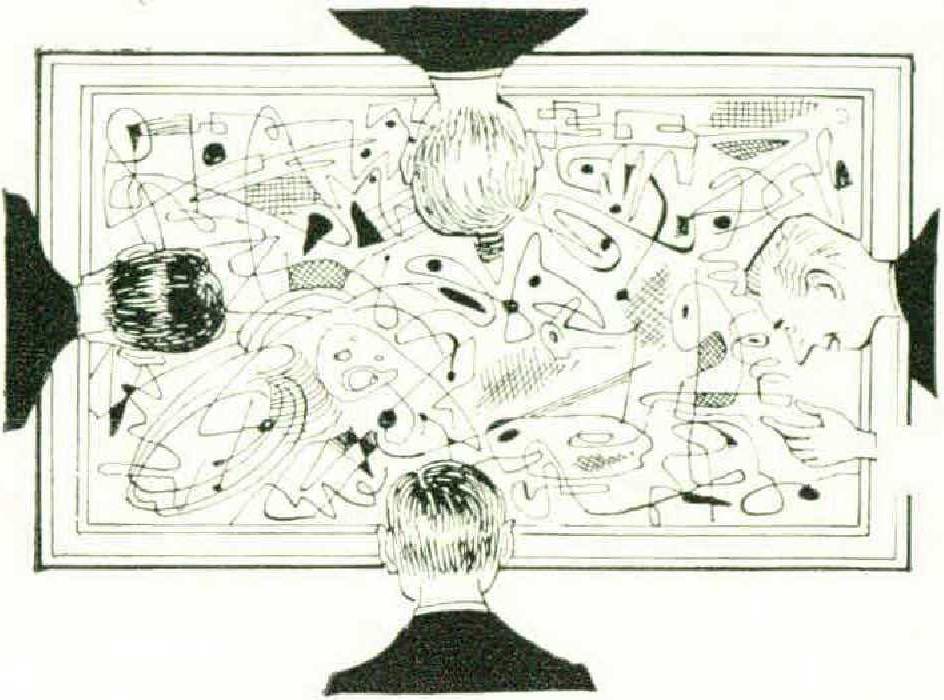
“That’s right,” I replied. “For his front office.”
“For nothing,” he accused me.
“Not at all,” I said. “He’s paying for the materials.”
“And how,” he demanded, “are painters going to make a living if London is full of poets who paint for nothing?” It was the old restrictive trade-union spirit, creeping like a blight across the Elysian fields of art. “Suppose I wrote poems and undercut all the poets?”
“Why not?” I retorted. “Write what you like, sell it for what you can get, and good luck to you. Everybody does it, all the time. It’s an open profession, and a hard one.”
So the argument went on, without coming to any conclusion, and finally I went back to his studio with him and borrowed a tube of Naples yellow, which I have a passion for but Bix hates.
A few weeks later I had finished my abstract and took it around to the office of Paul, the baron.
“There’s a lot of yellow in it,” he said.
“It needed a lot of yellow to give it vitality,” I said. “It’s rather expensive, but I knew you wanted the job done properly.”
“I thought you borrowed the yellow from Bix,” he said. Paul lives in Bayswater too.
“But I’ll have to pay him back. Mid-chrome instead of Naples, but it comes to the same thing.”
He said he liked my abstract, but he would like it better still if it were a little less yellow. So I took it away again and covered up some of the Naples yellow with cobalt. I thought this made a distinct improvement, and so did Paul when I took it back.
“That’s a lot better,” he said. “Is it the right way up?”
“Any way up,” I said.
He tried it tall way up instead of sideways, and then upside down.
“I don’t know that I altogether like the cat,” he said.
“What cat?”
He pointed out to me what might, to a fervent imagination, look like a pair of viridian eyes, set in the ghost of a cobalt cat face. “I can hardly see it even when you point it out,”I said. “Try it the other way up.”
He tried it the other way up.
“Now it looks like a cat upside down,” he said.
“You didn’t see a cat at all at first.”
“No,” he said. “But I can see one now.”
“Try it sideways,” I suggested. So he tried it sideways.
“Now I can see a cat sideways,” he said.
I took the picture away again, and the next weekend I tried to paint out the cat, which was rather difficult, as I was by no means certain where the cat was. “Do you have this difficulty with your patrons?” I asked Bix, who dropped in, knowing that I only snarl at callers on weekdays. “Invariably,” he said. “And the less they pay, the more trouble you have. If you’d charged Paul ten guineas, he’d have wanted a cat, to make sure he was getting his money’s worth.”
“Can you see a cat?” I asked him.
“No, but I can see a horse.”
“Well, whatever you do, don’t tell Paul about it,” I said.
As soon as the painting was dry, I took it around to Paul’s office again. He professed himself satisfied this time and paid me. Then came the question of framing this masterpiece, and after we had discussed what kind of frame he wanted I took it away again, calling at the woodshop on the way home for some beading.
When I took the framed painting back to Paul’s office, I found that he had a painting on the wall already. I recognized it as one I had seen in Bix’s studio.
“I hope you don’t mind,” Paul said. “Yours was very nice, but this was exactly what I wanted.”
“What did you pay him for it?”
“Ten guineas. He’s a profes sional, of course.”
“Of course,” I said.
“I’ll hang yours in the back office.” He took me in there. “ The only thing is, there’s a green carpet in here. I think it might do with a bit more red, to go with the green, don’t you think?”
“Why, yes,” I said. “A bit more red.” Then he invited me to a party on Saturday to smooth down any ruffled feelings. On the way out again through the front office, with my framed masterpiece under my arm, I took another look at Bix’s picture.
“I like it,” I said, “but I’m not altogether sure that I care for the horse.”
“What horse?”
But then compunction struck me. Paul’s check might not have gone through yet, and I did not want to take the bread out of a fellow artist’s mouth.
“Well, it’s not exactly a horse,” I said. “It’s more a kind of jaguar. And, in any case, it’s upside down.”