Accent on Living
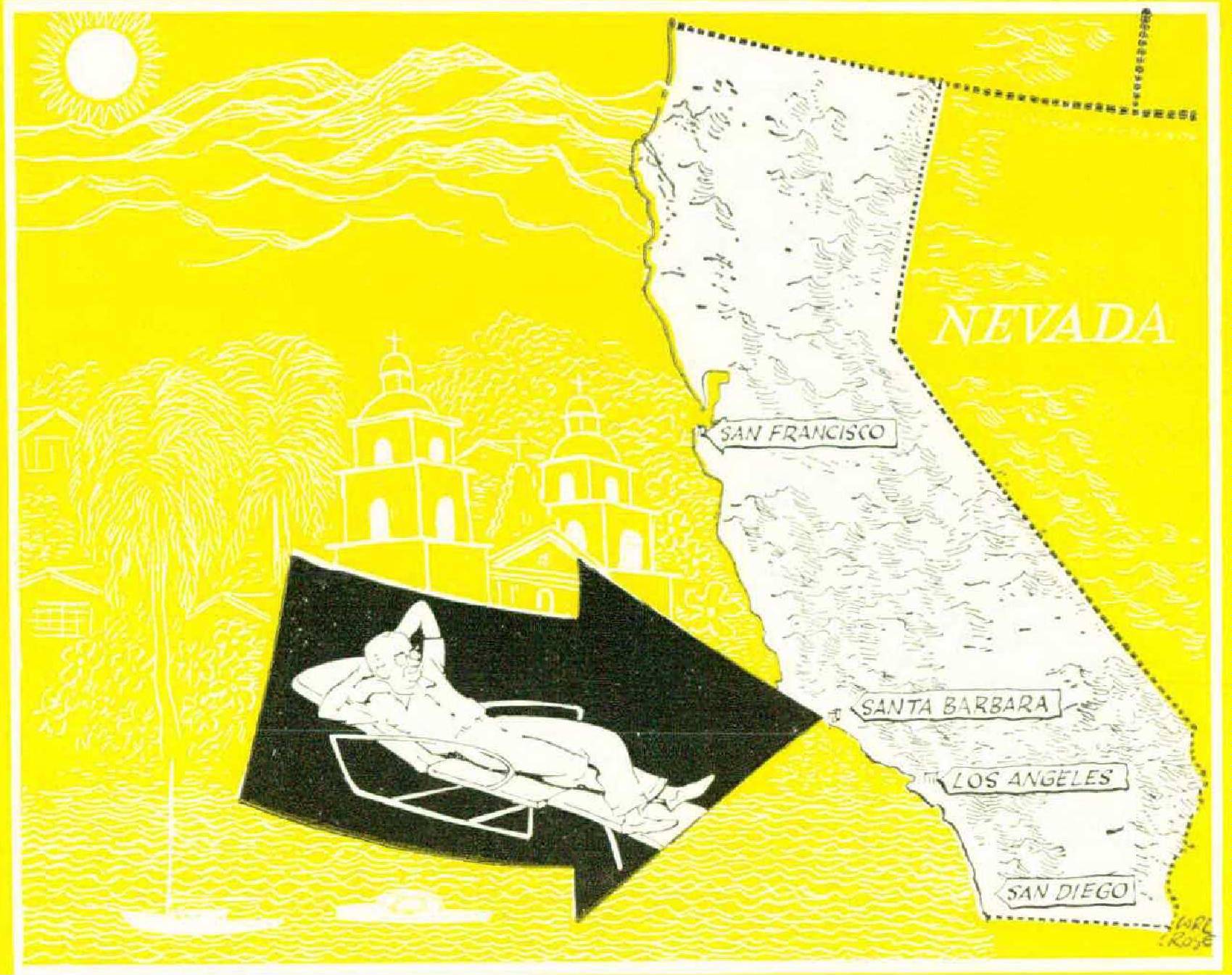
THE coast of southern California, however well remembered, is likely to prove startling to the city dweller from the East who returns after a long absence. He has followed from afar the zany aspects of the Hollywood region — the cults, the pet cemetery, marital quirks, smog, and the café brawls so esteemed by the press — and he has allowed himself to be reassured by these that he is much better situated a continent distant from them. Just as the New Englander tries to believe that the Florida winter is colder, if anything, than his own, so do Easterners in general seek to write off California as somewhat inferior to Jones Beach or the Poconos. The incomparable attractions of the Pacific scene are best ignored and are probably only braggadocio. And doesn’t too much fine weather become monotonous?
A few weeks on a coastal hilltop a hundred or so miles north of Los Angeles bring powerful reminders of what is missing elsewhere: the succession of blue, cloudless days; a temperature range of around 75 at noon to a low of about 55 at night; the certainty that it won’t rain; the hot sunshine, and in the shade, the cool drafts from the prevailing westerly sea breezes. “A strange event, light August rain, was reported at Port Arguello this morning,” the Santa Barbara News-Press — an excellent newspaper, by the way — informed its readers. The daily ocean temperature seemed to be fixed at 67 to 68, while the large fresh-water pool just off the beach stayed at 74. Somewhere in the world there may be a summer climate in more delicate balance between the pleasures of sun and shade, but it would be hard to say where.
The scene itself is equally unfamiliar to the Eastern eye: songbirds and a profusion of hummingbirds; flowers and flowering trees, vines, shrubs, creepers, all blooming apparently on some private schedule of their own without regard to the season; the vast, writhing limbs of the California oak, the rich greens of pines and juniper; citrus trees bright and heavy with fruit; tree ferns, cacti, palms; the turf everywhere looking as if all the householders were in a Perfect Lawns competition, or, in place of turf, terraces blooming with whole coverings of pale-pink geraniums. In a downtown residential street of Santa Barbara I saw two quail making a leisurely crossing, indifferent to the traffic.
If the visitor arrives by car, up the coast from Los Angeles, Santa Barbara appears as a seaside community, and this impression is enhanced by sweeping views of the Pacific as he ascends the ridge which rises abruptly behind the city to a height of about a thousand feet. But from the top of the ridge, in the opposite direction, is disclosed a reach of wild, rough country culminating in the steep barrier of the Santa Ynez Mountains, much higher and quite near, and there you have it: live on one side of the ridge for the ocean, or on the other for the mountains, or on its spine for both.
The residents of Santa Barbara seem pleased when the visitor speaks well of the weather, but they are so determined not to overstate that I could not quite tell, on the basis of August and September, what the rest of the year might be. “It’s chillier in the winter, and there’s more fog,” was offered as a complaint, or perhaps an apology, but one learned that, of course, these changes did not mean any interruption of the flowers or most of the greenery. The past three years have been very dry, so that a “rainy season” derived from an annual total of six or eight inches of rainfall would scarcely seem a wintry hardship to the Easterner. During my own recent sojourn the great weather choice was whether the hospitality should be indoors or out; no matter how this was decided, there was never a day when conditions outside were anything short of beguiling.
CHARLES W. MORTON