An Ambassadress in the Golden Age
One of our most distinguished living diplomats, WILLIAM PHILLIPS began his career in foreign service as a private secretary to Ambassador Joseph H. Choate in London in 1903. He returned to the Court of St. James’s again in October, 1909, as first secretary of the American Embassy, and it was then that he had the opportunity of serving under Ambassador and Mrs. Whitelaw Reid. Later Mr. Phillips was to be put to the test as assistant secretary of state, 1917 to 1920; as ambassador to Mussolini’s Italy, 1936 to 1941; and as the President’s representative in India, 1942. But here he is writing about a happy time.
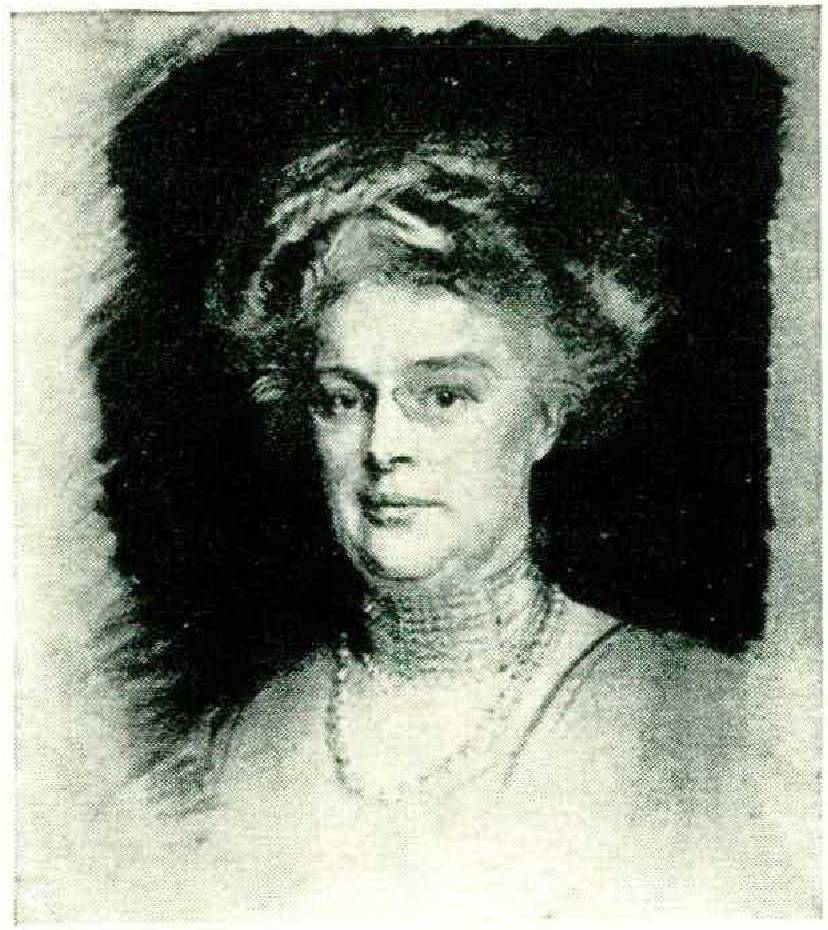
THE Golden Age in England ended with the sudden cataclysm of World War I. At the height of this spectacular era, from 1905 to 1912, the United States was represented in London by Ambassador Whitelaw Reid, a well-known New Yorker and the owner of the New York Tribune. Mrs. Whitelaw Reid, the subject of this essay, was the daughter of Ogden Mills of California, a man of immense wealth whose fortune was founded upon his widespread interests in the development of the West.
It happened that in 1909 I was appointed first secretary of our London embassy. Several years previously I had served in London as private secretary to Ambassador Joseph H. Choate, whom I greatly admired, and the friendships formed at that time were now to be happily renewed. After our marriage in England in 1910, my wife and I were launched into the brilliant circle in which the ambassador and Mrs. Reid played a prominent part, though it must be admitted we were both apprehensive as to our ability to undertake our responsibilities successfully.
My first connection with our embassy was as a bachelor fresh from the Harvard Law School. Life in the London of 1903 I had found gay and stimulating. Invitations to balls, large and small, were showered upon young attachés in foreign embassies. Most of such entertainments were given in private houses, which added a pleasant touch of intimacy, even though hosts and hostesses were unknown to me. Often I would attend two dances of an evening, returning to my lodgings by daylight. This was not an ideal way to begin a busy day at the office, but a brisk run around Green Park before breakfast, muffled in sweater and flannels, proved to be a good restorative. One made many passing friends, and in particular I remember Lord Dunsany, years later a wellknown writer and poet, who in spite of his reserve and apparent shyness enjoyed these festive occasions as much as I.
As a bachelor, I had expected to spend a lonely Christmas in London. But Lord and Lady Midleton, who lived in northern England, came to my rescue. I was met at the train on Christmas Eve and was driven in a closed brougham through a seemingly endless park to a huge mansion sheathed in total blackness. Not a light escaped from any one of the many windows. But, in response to my summons, the great doors opened and a solemn butler informed me that His Lordship and Her Ladyship were in the dining room and were expecting me. I was ushered into a vast banqueting room, where at either end of a long table sat my host and hostess in full dress. In spite of the solemnity of the scene, no welcome could have been warmer. They explained that it was the custom of the house from ancient times for the lord and master to drink this “horrid stuff,” as they called it, in formal state on every Christmas Eve, and thus they were performing their duty. After one sip, I agreed that this particular type of spiced ale aroused my sympathy without quenching my thirst!
WITH my altered status in the chancery and as a married man, my life in London changed. The work required close contacts with my chief, as well as with the foreign office, and it was necessary to become familiar with all of the embassy’s activities. My first weeks, therefore, were busy with calls upon foreign-office personnel, as well as upon those in other government departments concerned with American affairs; in diplomacy, first impressions count, and I tried my best to make friendly contacts with the officials with whom I had to cooperate. In spite of my inexperience, the cordiality with which I was received was reassuring.
Before settling in town, Caroline and I occupied a small villa in Seven Oaks, the gardens of which bordered on Knole Park. Here stood the vast spreading Tudor palace of the Sackville-Wests, with its 365 rooms, 52 staircases, and 7 courtyards. I remember the evening when Lady Sackville, its chatelaine, showed us the preparations for the annual Servants’ Ball which was to take place. Both sides of a lofty gallery were covered with wooden shelves extending from floor to ceiling, containing hundreds of silver and silver-gilt pieces of all shapes and sizes which had been taken out of the storage vaults for this occasion. Only for the annual Servants’ Ball was this fabulous display of family wealth and history shown, and as I glanced down the gallery, it seemed as though the very walls were silver-lined — a glimpse of England’s ancient splendor.
Our shabby and dismal embassy chancery was then maintained at 123 Victoria Street, where it had been for many years, but we had no cause to apologize for the famous Italian palace on Park Lane, known as Dorchester House (it has now given way to the opulent Dorchester Hotel), which was Ambassador Reid’s residence throughout his mission to the Court of St. James’s. This splendid building he rented at his own expense from the owner, Major Holford, and the only change in its exterior that I noted was the emblem of the United States with its spread eagle wings carved in stone, placed over the main entrance.
The interior was impressive with its three spacious drawing rooms and library, its large and small dining rooms, and its great art collection, some of it good, some mediocre. No other foreign embassy in London compared with Dorchester House; and though I, puritan-minded, was at first shocked by its overpowering magnificence, I knew that it was good propaganda for the United States, a country which the British public had begun to realize was important in world affairs.
Mr. Reid looked every inch an ambassador; he was a good speaker and was certainly a prominent and distinguished figure in London society. No one could possibly dislike him. I felt at once the rare qualities of Mrs. Reid, her vivid interests, her intelligence and wisdom, her generous instincts, outgoing personality, and quiet sense of humor. In stature she was short and rather squarish, yet her frank and honest opinions revealed her warm heart, and she had a natural friendliness which won people to her and which seemed to me rare in the London society of that day.
One Christmas Eve Mrs. Reid told me, hesitatingly, that she had just received a Christmas present from her father and asked if I would care to see it. “Yes,” I said, expecting one more jewel to be added to her large collection. Out of her bag she drew an envelope, and out of the envelope came a check for one million dollars. I gathered that this was no unusual gift from Ogden Mills to his daughter, but remained mystified as to why she showed it to me. However, when I came to realize the extent of her charities at home and abroad, that ninety-two retainers were required to maintain Dorchester House and the beautiful country estate known as Wrest Park, and that constant entertaining on a grand scale was the rule at both establishments, I could understand the purpose of that check.
Society was then at its most brilliant stage, with King Edward VII, Britain’s gay monarch, setting the pace. The great historic houses, the spreading mansions of the dukes of Devonshire and Sutherland, Lord Lansdown’s classic residence on Berkeley Square, and countless other notable family residences, all opened their doors for crowded evening receptions. Society in those days was closely associated with political and international affairs. The presence of leading British statesmen, of foreign ambassadors and ministers and representatives of Britain’s colonial empire, as well as the display by the ladies of family jewels, dazzling tiaras, and the latest fashions, gave to those assemblies such sparkle and color as will probably never be seen again. The “crushes,” as they were called, seemed to unite all of London’s official and unofficial life. At one evening reception at Devonshire House, the crowds were so dense and the reception rooms so numerous that my wife and I became separated. In spite of my frantic search for her, we each found our way home alone.
At the height of the season came Ascot Week and the opening day of the races, which the ambassador and Mrs. Reid and I attended as a diplomatic duty, for this day was regarded as a sort of royal function. The King and Queen and their guests arrived in state, driving down the course toward the royal enclosure in their open, shining landaus and entering their flower-decorated box, the focus of all eyes. All the men, including the diplomatic corps, who had the privilege of the royal enclosure wore top hats and tail coats. The scene, which resembled a fashionable garden party more than it did a race meeting, was to me just one more decorative, though exhausting, function. Yet Ascot reminds me of a more delightful occasion, when my wife and I spent a weekend as guests of Field Marshal Lord Roberts, the famous Boer War leader, and Lady Roberts, living near Ascot. Lord Roberts drove us to Windsor Castle for the evening service in St. George’s Chapel. As a Knight of the Garter, he was escorted to his seat in the choir under his banner, the other choir seats soon being occupied by the general public. We sat on either side of the field marshal and listened in rapture to the beauty of the boy choir, accompanied by the magnificent tones of the great organ. Many a time since, I have sat under the banners of the knights and let my thoughts wander back to that Sunday evening service beside the distinguished old soldier. Physically, Lord Roberts was a small man, but he was vigorous and mentally alert. Although well advanced in age, he had kept his health, he said, by continuing his daily program of rest. Even during his South African campaigns, he had always taken a half hour of relaxation following the midday meal, and this, he believed, accounted for his strong constitution.
At first we had difficulties in finding a suitable town house on a yearly lease. I located one that seemed to me ideal, but the owner, whom I had known previously and who was anxious to rent, advised me, as an old friend, not to take it. It was haunted, she said, and known to be haunted, so that the servant problem was too serious for a young wife to handle. Strange figures were seen frequently upon the stairs, and the door into the sitting room would open and close quietly as if someone had entered through it. I accepted her advice with gratitude. But we finally did find what we wanted, conveniently near Dorchester House.
Our life in London became so strenuous that I was soon looking for a small hide-out in the country where we could be assured of quiet weekends, and this I found near Beaconsfield, Buckinghamshire, in a very unpretentious little house called The Grange, of white stucco construction with several acres of fields and an attractive garden. We loved it at the first glance and spent many happy days there in seclusion and in motoring about the lovely countryside. It proved to be a lifesaver to both of us.
My father-in-law, J. Coleman Drayton of New York, paid us a London visit soon after we were settled, and in no uncertain terms he expressed his mind about my casually stocked cellar. Never, he told us, had he tasted in a gentleman’s house such inferior wines as I was serving. It was only too true, as I had casually laid in my supply at a grocer’s around the corner. The next morning I called upon Mr. Berry of Berry Brothers, St. James Street, probably the most famous wine dealers in London, and asked him if he knew a Mr. J. Coleman Drayton of New York. “Of course,” he replied. “He is one of my oldest customers.” And so, then and there, I told him of my predicament and asked for his help in providing me with a goodly supply of the wines my father-in-law preferred. Mr. Berry, thoroughly amused, carried out my request to perfection.
DORCHESTER HOUSE was the scene of many interesting gatherings, always superbly given under the watchful eyes of Mrs. Reid, and distinguished American visitors were always welcome. They came in a never-ending stream, then, as now, expecting some special attention from the embassy. My wife was able to be of help to the ambassadress, who I know enjoyed the heavy task of late-afternoon entertainment. London went into deep mourning at the time of King Edward’s death, and we prepared for the visit of Theodore Roosevelt, who had been appointed special representative of the United States for the funeral of the King. For several days he was the guest of Ambassador and Mrs. Reid, but much to his outspoken annoyance, every other special foreign representative to the funeral insisted on calling on him at Dorchester House, never allowing him a moment’s peace. However, for two or three days he stole away secretly with Sir Edward Grey, the foreign minister, to observe and study the wild birds of England. The press begged us for information as to the whereabouts of T. R., which we never, of course, revealed. On his return he was honored with the freedom of the City of London, and during his speech of acceptance before a distinguished gathering, to our embarrassment he criticized the British government for its policy of interfering in Egyptian affairs. Sir Edward Grey promptly let it be known that he had read and approved the speech before it was delivered, and all further criticism of Theodore Roosevelt vanished.
Mrs. Asquith, or Margot, as she was popularly known, wife of the Prime Minister, seemed to take a fancy to my wife and me, and we were occasionally invited to lunch at 10 Downing Street, where we met the Prime Minister and other members of the government. They were very informal occasions, for she was witty, caustic, and outspoken. She, too, had entertained Mr. Roosevelt in the course of his visit, and she showed me her guestbook and, turning to T. R.’s signature, told me that she had asked him to write a few lines of sentiment, to which he replied, “I never write sentiments in albums,” and instead had dashingly inscribed his name three times.
During my tenure as chargé d’affaires, I had occasions to call upon Sir Edward Grey at the foreign office. As I entered his office, he would be standing to receive me, and after a cordial handshake would motion to one of two large chairs placed in front of the fire. If he had requested my visit, without preliminary exchanges he would open the subject matter in carefully chosen words. If it was I who had sought the interview, he would ask me to proceed. But the moment the business in hand was finished, he would turn the conversation into informal and personal channels, and I would then have a glimpse of the man himself.
Of all the distinguished men I met in England, I admired Sir Edward the most. Later, at the end of World War I, when I was assistant secretary of state and he had come to Washington as ambassador, I saw him more informally. He was then Lord Grey of Fallodon. At that time he was suffering from serious eye trouble and was threatened with blindness. One day he asked me to lunch at the embassy and afterward to take a walk with him in the country. During the luncheon the heavens opened, and a steady downpour continued throughout the afternoon, but it never occurred to Grey to postpone our expedition. We were soon tramping across country over muddy fields where footing was uneven and difficult and where, because of his failing eyesight, he was in danger of a bad fall at any moment. But nothing daunted him. We paused beneath a tree and listened to the “music,” as he called it, of the rain, and he began to recite Wordsworth, verse after verse. Then, as we turned back, he told me that he had an appointment with his eye doctor, who would this day give a final verdict as to whether he was going blind. He must have known what the verdict would be, and this tramp in the rain may have been in preparation for it. Here was an example of courage and resignation which was a great lesson to me. The following day, when I learned the worst, my sympathy was heartfelt. Not long after he returned to England, complete blindness came upon him.
DURING our London experience, we were privileged to witness two historic ceremonies, replete with pomp and pageantry, in which the British have no equals: the coronation of George V and the investiture of the Prince of Wales.
The coronation of Elizabeth II made the world so familiar with the ancient pattern that it need not be recounted here, but the investiture of the Prince of Wales, following closely the coronation ceremonies of King George, took place at Carnarvon Castle, Wales. The long velvet greensward framed by the massive walls and towers of the castle was the setting for this picturesque midday ceremony. A Welsh choir was singing lustily as we took our seats close to the thrones. Their Majesties entered without ceremony, and then, from the far end of the enclosure, a brilliant procession moved forward toward the thrones. As I remember the scene, first came standard and pennant bearers, followed by officers and gentlemen of the Prince’s household, all in historic court dress. After a short interval appeared a boy dressed simply in a white shirt, knee breeches, and stockings, a small solitary figure, the center of all eyes. He was followed at a little distance by groups of retainers in quaint costumes. The Prince — for it was he — made his obeisance to the sovereigns; the King arose and proceeded to dress his son in his state robes, and finally crowned him with the circlet of the Prince of Wales. The moment had arrived for the Prince to face the great assemblage and to say a few words in Welsh and in English. For an instant, he seemed to have lost courage. Then he turned and spoke without hesitation. He afterward received an immense ovation while the Welsh choir sang with increasing vigor. The investiture was over. The procession returned as it had entered. The little Prince, although still a lonely and touching figure in the center, was now clothed in splendid robes of state and wore his royal circlet.
During the season there were always two or more evening courts at Buckingham Palace, when Their Majesties received the diplomatic corps and their wives, followed by a long procession of young British ladies about to be presented. The ambassadresses were asked to present only a limited number of their respective countrywomen, six Americans in our case. Counting on our good relations with the court officials, however, I could manage usually to procure one or two additional invitations. The task of filling our quota, not always an agreeable one, was left to me. Ordinarily our embassy received requests far exceeding the quota allotted to us. Mothers and their charming daughters, with letters of introduction from prominent Americans, including senators and congressmen, would arrive in London assuming that the embassy would arrange all that was necessary. Disappointments were many, and it was my unfortunate duty to have to soften hurt feelings, and sometimes indignation.
Mrs. Reid made the presentations. Our ladies followed her in line, curtsying low to Their Majesties, who would be standing before the thrones, smiling pleasantly. They were then shown seats in the vast Throne Room, from which they could watch the proceedings. The foreign ambassadors and their staffs followed and were escorted to seats near the thrones, while we small fry of the diplomatic corps were given standing room behind the crimson rope, facing the thrones. No sooner had the diplomatic corps passed than the King and Queen seated themselves, remaining seated until the last lady in the so-called general circle had made her curtsy.
DURING the season, gay window boxes overflowing with brilliant flowers adorned the fronts of so many houses that residential London appeared to be en fête. The City, however, center of business and financial affairs, maintained its crowded and gloomy splendor as though it belonged to another world. But on August 12, when the shooting season opened, there was an abrupt departure of the whole social world to the country and the moors. The diplomats then seemed to have London to themselves, for diplomacy has no seasons and no ending.
Entertaining at Wrest Park in the summer was largely confined to shooting parties, and some of the best shots in England were there. Guests for the weekend would arrive on Thursday afternoon. The following morning, after a leisurely breakfast, the gunners would be rounded up and driven to the place designated for the first of several pheasant drives. Usually each man brought his own valet to Wrest Park, who, in his altered capacity as the loader, cared for his master’s guns and changed guns for him during the drives. British shoots were scarcely gay affairs, for there was business involved in the marketing of the game, although not at Wrest Park. While Mrs. Reid did not shoot, she took a personal interest in the bag of each individual. She and the ladies of the party would appear for the luncheon, which, weather permitting, would be set out under the trees and served by liveried footmen. At the conclusion of the afternoon’s sport, everyone returned to the house to change for tea and bridge, changing again into formal attire for dinner at nine, when neighbors of distinction in the county were often invited. Sometimes the day ended with music and dancing. To all the details of these prolonged entertainments. Mrs. Reid gave her own personal attention.
I do not recollect that she often talked about the ambassador’s official responsibilities or mine as head of the chancery, although I know she was well informed. Mr. Reid undoubtedly discussed them with her, not only because of her genuine interest and intelligence but because it was customary for him to share his work with her. He leaned on her judgment continually, though they did not always agree, for her judgment on his speeches was said to be uncanny, and he never failed to consult her before their delivery.
Soon after my arrival in London, in those first days of knowing Mrs. Reid, I learned of a task she had undertaken on her own. In the North End of London, near Euston Station, there was a neglected and miserable section of the city seemingly overlooked by all charitable organizations. There was no place but the filthy streets for the ragged youngsters to play, and they were frequently in serious trouble. Mrs. Reid, having noted the sad conditions, lost no time. She acquired two buildings — one for boys, the other for girls — on either side of the principal street and turned them into centers for young people. She herself chose the matrons and instructors and equipped the buildings for useful and enjoyable activities of such interest that the sorely neglected youngsters began flocking to them. She had brought new and more wholesome life to this black spot of London’s direst poverty. Being curious to see the results of her labors, I spent an evening at both houses and was deeply impressed. The following morning I said as much to Mrs. Reid and added that the ambassador, too, must have been greatly interested in her undertaking. Shyly, she replied, “Oh, I didn’t tell Whitelaw what I was doing, because I was afraid he would laugh at me.”Moreover, she rarely spoke to anyone of this undertaking, and I doubt that many people ever knew of it.
Another day, my wife and I were lunching at Dorchester House to meet the Gaekwar of Baroda and his son and daughter, who were about to return to India, the young people having just completed their university education in England. Mrs. Reid mentioned that she was building a hospital in California in memory of her father. The Gaekwar became interested and asked if he could see the blueprints, and after luncheon they were brought to him. Starting with the ground floor and proceeding upward to the top floor, Mrs. Reid held the Gaekwar spellbound. Every room, every closet, every activity — in fact, every detail of this vast building — she explained with a knowledge that was astonishing. When she laid aside the prints, the Gaekwar asked if he might take them back to India to show his fellow princes what should be done in hospital construction. Mrs. Reid regretfully said she could not part with them, as she had to refer to them in her correspondence with her California architect. Then, after a pause, the Gaekwar said, “Mrs. Reid, if you will let me have them, I promise you that I will build in my state of Baroda a hospital as nearly approaching your memorial as is possible.” To this Mrs. Reid replied, “They are yours.” Years later, I discovered that the Gaekwar had kept his word and that a fine hospital stands in Baroda now, a living testimony to Mrs. Reid’s far-reaching influence.
There are other delightful aspects of Mrs. Reid, one of which I enjoy mentioning because it illustrates an unexpected trait in her character. Mrs. Reid lived for big accomplishments and devoted her time and energy to their fulfillment. The little things in life did not seem to disturb her, or she let others shoulder them for her. Fortunately, she had a loyal and highly competent secretary, Miss Helen Rogers, without whom Mrs. Reid would indeed have found her duties as ambassadress overpowering. Years later Miss Rogers married the Reid’s son, Ogden, and in time herself assumed the presidency of the New York Tribune and became a leading and gifted personality in the life of metropolitan New York.
On one occasion the ambrassadress asked me to lend her two pounds, because she was obliged to pay for something in cash, and immediately. She had no cash with her, her secretary had gone out, and I gladly lent her the money. Time passed, and there was no repayment, though Mrs. Reid frequently referred to it as something she must do. Repayment was clearly in her mind, but there was never any money in her purse. A few days later, I had to bring some matters to her attention and asked if I could call upon her at 9 A.M. the following morning on my way to the chancery. She received me in her upstairs apartment, and when I had concluded my business she said, “Now, you must not leave until I have paid my debt,” and thereupon she rang for her secretary, but without success, for it was too early. “Never mind,” said Mrs. Reid, “I will find my checkbook,” whereupon she proceeded to open every drawer and cupboard in the room, but to no avail. There was no sign of her English checkbook. “It must be,” she said, “in the secretary’s office,” and off she went, hot on the scent. She returned in a few minutes with the checkbook, waved it triumphantly at me, and sat down at her desk. A long silence followed. Finally, in a small, slightly ashamed voice, she said, “Billy, will you show me how to write this check in English pounds?” And so the debt was paid, but in so doing she revealed one of her qualities, her dependence on others for details. She was the general with a competent staff to do her bidding, managing somehow to keep free of all petty things and to devote herself and her fortune to doing good and helping others.
In England, as in America, she lived in regal splendor, but through it all there shone her strong and vibrant character, even though shyness and, at times, awkwardness never left her. She had had great opportunities thrust upon her and gave her energy and her life to their fulfillment.
When, in 1912, only two years before the outbreak of war, I finally left my post in London there was no general feeling of alarm, although concern over Germany’s military power was evidently deepening in government circles. During that year in London, the ambassador had been suffering recurrently from bronchitis. He was not of robust health, having had a long struggle with asthma, and Mrs. Reid watched over him anxiously. The end came suddenly in Dorchester House on December 15, 1912, with Mrs. Reid beside him. The King at once sent a personal message to President Taft and decided that a special service should be held in Westminster Abbey. This took place five days later and was an impressive and moving tribute to the Ambassador and Mrs. Reid’s years of devotion to the cause of British-American friendship. The body was then taken by special train to Portsmouth and brought to New York on the British cruiser Natal, which flew the American ensign during the entire trip. Mrs. Reid followed immediately on the Cunard liner Campania from Liverpool, arriving in New York in time to meet the British warship.
I shall always think of Mrs. Reid not only as a notable ambassadress during the Golden Era but also as a woman of generous and heartwarming human qualities.