Accent on Living
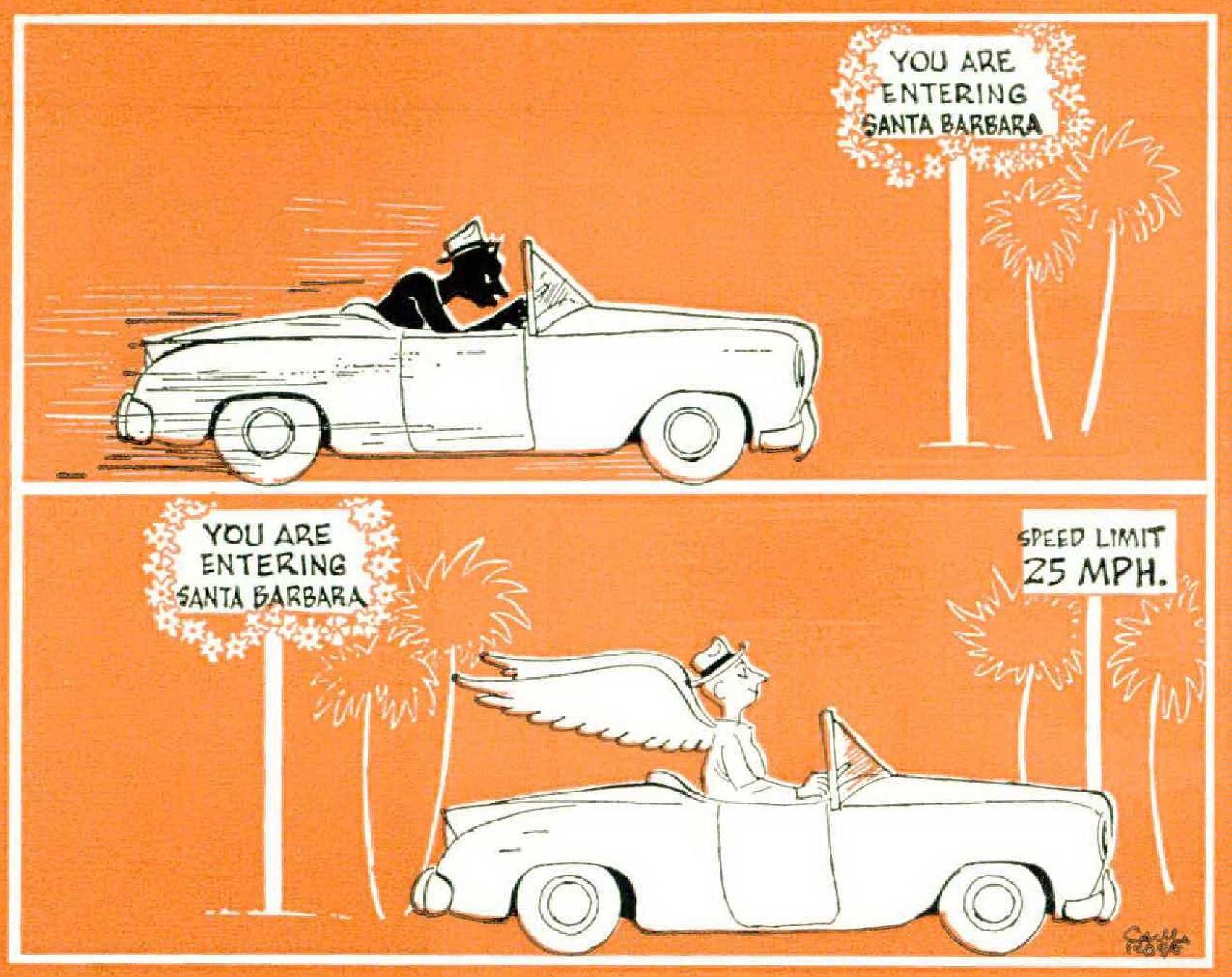
SANTA BARBARA is one of the few cities along the southern California coast that has not succumbed altogether to the automobile. The place is full of cars, and the traffic is heavy, but the controls are distinctly superior to the task at hand. In my month’s sojourn there (which I mentioned in the November Atlantic), I heard no automobile horn sounded. The driver in need of a horn, so it seemed, had got himself into an untenable position and was, therefore, inept, or else he was too inexperienced to realize the futility of horn tooting. Either way, he would be cutting a figure that other Santa Barbara drivers would regard with derision.
It was relaxing, also, to drive within a 25 mph speed limit where all other drivers were doing the same thing: outwitting or outjumping the rest of the world simply isn’t worth the trouble, under that circumstance. One got around quickly just the same, for there were no tie-ups and no built-in jams. At some of the uptown corners, incidentally, was an artfully contrived “dip,” a rolling bump of which a sign gave warning and which could not be crossed at more than 25 mph without bouncing the car’s occupants through the roof. Why the dip is not more widely used, especially near schools and in neighborhoods with many children, remains a mystery, for at safe speeds a dip is hardly noticeable.
The visitor from Boston or New York is astonished to find in the Santa Barbara shopping district that there are actually parking places at the curb. There are no meters, but there are fifteen-minute zones and one-hour zones, with the space for each car marked on the pavement, and it is considered a poor idea to park carelessly in disregard of the markings. The main reason for the availability of parking spaces is an energetic and constant patrol by police, who go whizzing about on three-wheeled motorcycles, putting time stamps on tires. I did not find out about the scale of penalties, but I got the impression that they would be troublesome.
The other great weapon against the parking problem is a provision in the city’s building code that every new commercial structure, large or small, must include, on its own land and of the street, a parking area. The number of cars to be accommodated is fixed by formula, according to the size and use of the building, and much of the city’s retail district is thus equipped: banks, restaurants, markets, office buildings, and such. The city forbids advertising billboards, and the banks bordering the freeway are blanketed with a luxuriant growth of ivy instead of bearing a crop of garish signs.
For the rest, a system of one-way streets, plainly marked lanes, and plenty of traffic lights and stop signs keeps the city’s traffic in order. At many intersections a full stop is required on both streets; at a place called Five Corners, five stop signs bring everything to a polite halt, with no hint of impatience or an impending battle for precedence.
The good sense and professionalism of the drivers are conspicuous. To wait, to look, and to wait some more if need be are ordinary procedure: a matter of self-preservation, immediate convenience, and not getting arrested. Such reasoning would seem strange in many Eastern cities, but it seems to work very well indeed where they really give it a try.
CHARLES W. MORTON