Around the World
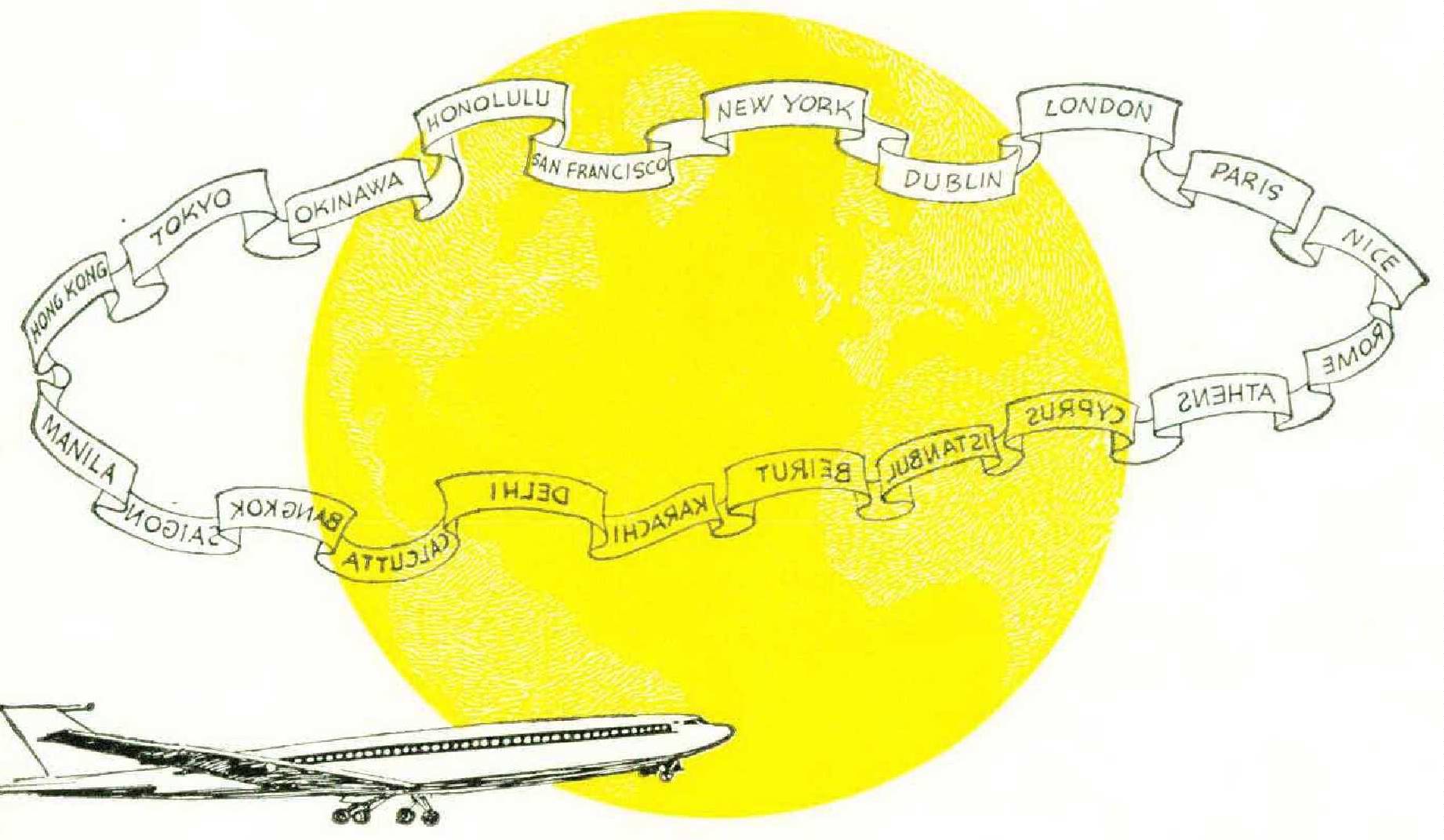
An imaginative clerk in a California travel agency created a substantial increase in business by pointing out to Europe-bound clients that for only $450 more than their roundtrip fare to Rome, they could fly home around the world. Jet planes, circling the globe in under seventytwo hours, have erased time and brought the last and greatest of the world’s travel areas, the formerly remote and unattainable Orient, within reach of the vacationer with four weeks’ time.
In 1959 some 10,000 Americans circled the globe by air in an average time of forty-two days; some 3000 others took twice as long to go by sea; a mere handful rode one third of the way by bus and train; and probably fewer than fifty followed an itinerary that included all six continents. For transportation, hotels, meals, and sightseeing, some spent $60 or more per day; others went around the world in comfort on a daily outlay of less than $10.
When vacation time is less than ninety days, air travel is almost compulsory. By new economy-class jet services, the basic global air fare runs approximately $1335, slightly less by propeller aircraft. As the only oneway trip available with a round-trip fare discount, such a flight is undeniably a good buy.
At this basic fare, the traveler may elect to fly eastbound to India by way of Iceland, Scandinavia, Moscow, and Tashkent in Central Asia; by an almost infinite variety of routes that ramble extravagantly all over Europe; or via the Azores, Portugal, Spain, North Africa, and Egypt. The last two routes converge to cross the Bible lands to India. Beyond Delhi, a further multiplicity of optional routings lead homeward across the Pacific by way of Thailand or Singapore, and the Philippines, Hong Kong, and Japan.
This vast choice of routings is made possible through the interchange facilities of the sixty-odd airlines comprising the International Air Transport Association. By mutual agreement, all leading international airlines charge identical fares, permit a free stopover at every city at which their planes make a scheduled call; and by routing passengers over the systems of member lines, all are able — with minor exceptions — to offer passengers an identical choice of round-the-world routings and stopovers.
Since airline tickets are good for one year, the traveler with ample leisure might plan a trip taking him to Shannon, Dublin, Glasgow, Manchester, London, Amsterdam, Brussels, Paris, Madrid, Barcelona, Nice, Rome, Athens, Istanbul, Ankara, Beirut, Cyprus, Cairo, Jerusalem, Amman, Damascus, Baghdad, Teheran, Kandahar, Karachi, Ahrnadabad, Bombay, Delhi, Benares, Patna, Calcutta, Rangoon, Bangkok, Siemreap (Angkor Wat), Pnompenh, Saigon, Manila, Hong Kong, Taipeh, Okinawa, Tokyo, Honolulu, and back home — a total of fortytwo cities in twenty-eight countries.
Such a trip might comfortably occupy an entire year. By making each stopover city his base for several days, the traveler could explore the surrounding region by local day-long motor coach excursions, which, in well-organized tourist areas, such as Europe and Japan, are available in season at an average cost of $4 per day. Slightly longer out-and-back excursions may involve a stay of one or two nights elsewhere. From Cairo, for instance, one can make an inexpensive three-day excursion by rail to Luxor and Aswan; a similar two-day car trip from Delhi to Agra and Jaipur; and from Tokyo one may roam Japan from end to end over one of the world’s finest railway networks. By staying at the more comfortable second-class hotels at an inclusive demi-pension rate and by sightseeing as far as possible by public bus, rail, or excursion coaches, a thrifty traveler might well expect to circle the globe in 300 days for a total daily expenditure of less than $15, air fare included.
By contrast, the thirty-day globe circler could briefly visit a maximum of only twelve cities at an overall cost exceeding $60 per day. Despite the advent of jets, the air traveler seeking the best compromise between money and time might still be advised to emulate the feat of Phileas Fogg and devote eighty days to his circuit around the earth. By doing so, he could comfortably visit a total of twenty cities for a daily outlay in the vicinity of $32 or, if he is an experienced traveler, for as little as $27.
When thinking in terms of a round-the-world flight, few travelers are aware that, with the exception of an optional stopover at Djakarta, the conventional itinerary does not cross the equator. Throughout the journey, temperature patterns closely follow our seasons at home. Climatically, the Middle and Far East are tolerable only from November until March 15, while northern Europe and Japan can be uncomfortably cold from December until March.
From this writer’s experience, the best months for round-the-world travel are from late October until mid-May. For a departure before the first of January, the best plan is to travel eastbound, taking in Europe in late fall, traversing the Bible lands and Far East during the cool season, and arriving in Japan in spring to coincide with cherry blossom time. For a departure after January 1, one should travel westbound, which means chilly weather in Japan but still ideal conditions in the Far and Middle East, and which brings one to Europe in spring. It is worth noting that most world voyageurs delay their departures for Christmas and New Year’s; hence, die traveler who leaves earlier experiences considerably less difficulty in obtaining hotel and airline (or steamship) space.
After one studies an airline tariff with the aid of a travel agent and decides on the cities to be visited, planning a successful round-theworld itinerary simply amounts to an intelligent apportionment of time to each place in relation to its interest. Most global tours devote almost 20 per cent of their time to Japan, to India, and to western Europe; fifteen per cent to the Middle East or Soviet Union; and the rest to such tourist favorites as Hong Kong, Angkor Wat, and Bangkok. For approximately $106 more than the basic fare, Australia may be included on a global Bight, and for roughly $1600, one may fly via a wide choice of stopovers in Europe, in either east or west Africa, and in southern Africa, Australia, and the South Pacific.
With an outline itinerary prepared, showing the number of days desired at each stopover, a travel agent will write up an exact schedule, make all flight reservations, provide information on which countries require visas (preferably obtained by mail before leaving), and supply addresses from which travel literature, guide booklets, and hotel listings may be secured. Upon request, he will also make reservations at the more expensive hotels. Alternatively, one may select recommended lower-cost hotels from guidebooks, write for reservations on a ten-cent air letter sheet, and invariably receive confirmation within fourteen days.
Eight times a year, a Dutch liner leaves Miami for an eighty-day voyage around the world. Calling first at Bermuda and England, the ship spends a week in Holland, then circumnavigates the globe by way of ports in Egypt, Aden, Ceylon, Australia, New Zealand, Tahiti or Peru, and Panama. These passenger ships, which fly the house flags of the Nederland or Royal Rotterdam Lloyd lines, maintain the proud traditions of immaculate Dutch shipkeeping and hearty bourgeois meals, yet fare for the full world cruise starts at a bargain level of $885 and ranges up to $1299 for the best tourist-class accommodations. As an alternative, by changing ships in Australia or the Far East one can make a three-stage world cruise with a choice of stopovers at way ports for approximately $900 to $1200 tourist class, depending on the route. This flexible means of travel is provided by a group of the world’s leading liner companies, which operate as a single system through an organization called Interchange Lines, much as do the airlines, through the International Air Transport Association.
Most round-the-world passenger liners carry from two to eight hundred passengers, divided between tourist and first class (a minority also carry cabin-class passengers, while several are exclusively one-class ships, whose offerings are slightly superior to the usual tourist-class accommodations). In passenger ships, each class has its own dining room, with the most elaborate meals served in first class. Although fares vary within each class, depending on size and location of cabin, all passengers enjoy the standard choice of menu, served in the dining room of their class. In freighters, there is but a single class, and fares vary only slightly, being a little higher for suites or special cabins, where they exist; all passengers eat in the officers’ dining saloon and have the same menu as the ship’s officers.
On more expensive liners, a ninety-day world cruise averages $3500; on freighters, $1450. Undeniably restful and invigorating, a sea cruise nevertheless suffers from the drawback that only one third of the voyage is spent in foreign ports, from which opportunities for sightseeing excursions are limited by the duration of the vessel’s stay.
The traveler who prefers the leisurely pace and intimacy with the countryside of surface transportation will discover a fund of information about these services in two readily obtainable guides: Cook’s Continental Timetable, available for $1.50 from Thomas Cook & Son, Berkeley Street, London, W. 1; and the Europabus Schedule, free from Europabus, 630 Fifth Avenue, New York City. Bus and railway timetables for other countries are generally available without charge from national tourist offices, whose addresses may be found in the New York or San Francisco telephone directories or obtained from travel agents.
With these timetables, one should have no difficulty in planning a trip around the world chiefly by overland transportation. After leaving Calais, France, by the SimplonOrient Express, for example, the traveler may cross Europe with a choice of stopovers at Paris, Lausanne, Milan, Venice, Zagreb, Belgrade, and Istanbul. From Turkey’s Asiatic shore the Taurus Express will bear him on to Ankara, Aleppo, Baghdad, and Basra. Timing his arrival at this port to coincide with the departure of the British India Line steamer for Karachi, he may again entrain at the Pakistani capital and continue to Lahore, Delhi, Benares, Patna, Calcutta, Madras, and Colombo in Ceylon. Second-class through fare from London to Colombo amounts to roughly $276. A side trip from Aleppo to Damascus, Beirut, and Jerusalem by train and jitney would add about $40.
By train from Victoria Station, one may proceed through Belgium’s art cities to Germany, Denmark, Sweden, and Norway, and from Oslo over the wildly scenic Flam Railway route to Bergen. The standard sixday Norwegian hord cruise then takes one to Hammerfest, from which comfortable post buses cross Finnish Lapland to connect with trains for Helsinki, Leningrad, and Moscow. The world traveler may then My on to Tashkent and Delhi and continue by train through India to Ceylon. An alternative route is to take a train to Berlin and change to another for Poznań, Warsaw, Smolensk, and Moscow; or for greater variety, to travel first to Nurnberg and go on by train to Karlsbad and Prague in Czechoslovakia, and to Katowice, Auschwitz — the infamous Nazi extermination camp — medieval Kraków, and Warsaw in Poland; thence to Smolensk and Moscow. By any route, one may then continue eastward from Colombo around the world by ship or plane.
The ambitious traveler desirous of seeing all six continents can begin by flying down the west coast of South America, with stopovers at all cities, to Buenos Aires, a trip costing only $220 if made by A PA Airlines. From Buenos Aires, a $255 voyage by Royal Interocean Line steamer would take him on to Rio de Janeiro and Cape Town, starting point for a fortnightly through connecting service by trains, buses, and river steamers that in forty-two days covers the entire distance from Cape Town through the heart of Africa to Cairo for approximately $500. By frequent steamer connections, he could then cross to Europe, tour the Continent, continue by a choice of routes to Colombo, take a ship to Australia, another to Japan, and return home across the Pacific.
For unorthodox travel of this sort, one should first obtain all available timetables and prepare a schedule allowing liberal time for making connections. A travel agent will then make reservations for each of the transportation companies he represents. For transportation by other concerns, one should write the respective national tourist office, inquire it reservations are necessary, and if so, where to make them. Outside peak tourist seasons, one can usually purchase bus and train tickets on the spot, and if time is not important, one may even join that fortunate class of carefree travelers who proceed at their own pace without advance reservations.