Nil Admirari
STEPHEN BARR is a free-lance writer who lives in Woodstock, New York. This is his second appearance in the ATLANTIC.
In the old days, people used to write d — n when they meant damn. The idea was to get the idea across, and, at the same time, get the credit for not actually writing it down. Like so many other things, this strategy has undergone improvement and thereby become an end in itself. Fowler tells us that the obvious is better than the obvious avoidance of it, but another savant, Isadora Duncan, said that it’s not work but the artistic gesture that counts. Anyway, the net result is the art of elision and shunning the vulgar.
The trouble with me is that so many things get shunned that 1 never realized were vulgar; and I have the uncomfortable feeling that I’m probably no more than an upper-lower-middlebrow. With the avant-garde, things have reached a dizzying height. I think they feel that everything is vulgar, and the best thing to do is avoid it. They subscribe to the rule of Least said, soonest mended. Keep your trap shut, and you won’t have anything to be sorry for.
The twelve-tone-scale composers have worked out a system whereby anything so commonplace as a tune is automatically stifled at birth, but John Cage has gone much further, because one of his piano pieces contains not one single note that is commonplace — in fact, it doesn’t contain any notes at all. If the audience coughs or shuffles its feet, that is the music. Or at least I am told that this, plus the alfresco noise of exterior crickets, is what Cage intends.
This being the case, I suppose one could go to one of his recitals, if that piece were on the program, and play a recording of something by Cole Porter on a portable victrola. Mr. Porter could then sue Mr. Cage for plagiarism, since, according to Mr. Cage’s expressed plan, Mr. Porter’s piece would be being played as by Mr. Cage. (This, of course, shows why logic isn’t any good when you come to the arts.)
The delicacy and restraint of this composition has a double force, since not only do we sit imagining the inept and cloddish strains that we have not heard, but we can go over in our mind the fact that he has chosen the piano as its noninstrument.
It is not not for the oboe, or not not for Borrah Minnevitch’s Rascals and their harmonicas, but it is not for the piano. Thus, the piano takes on a cast of inexpressible vulgarity, and I was unable to listen to one for several weeks after Cage’s recital without wincing.
The Cage technique is not to be confused with that of James Joyce. Joyce can skirt the edge of not quite saying dozens of things at the same time. In Finnegans Wake there are depths beneath depths of the incompletely stated, so that I have the impression of three dimensions of shunned banalities. But it makes me feel hemmed in and overprotected. With less inventive minds, the effect is one of status maneuvering; the radio and TV pitch has this quality, as well as the nice avoidance of giving offense.
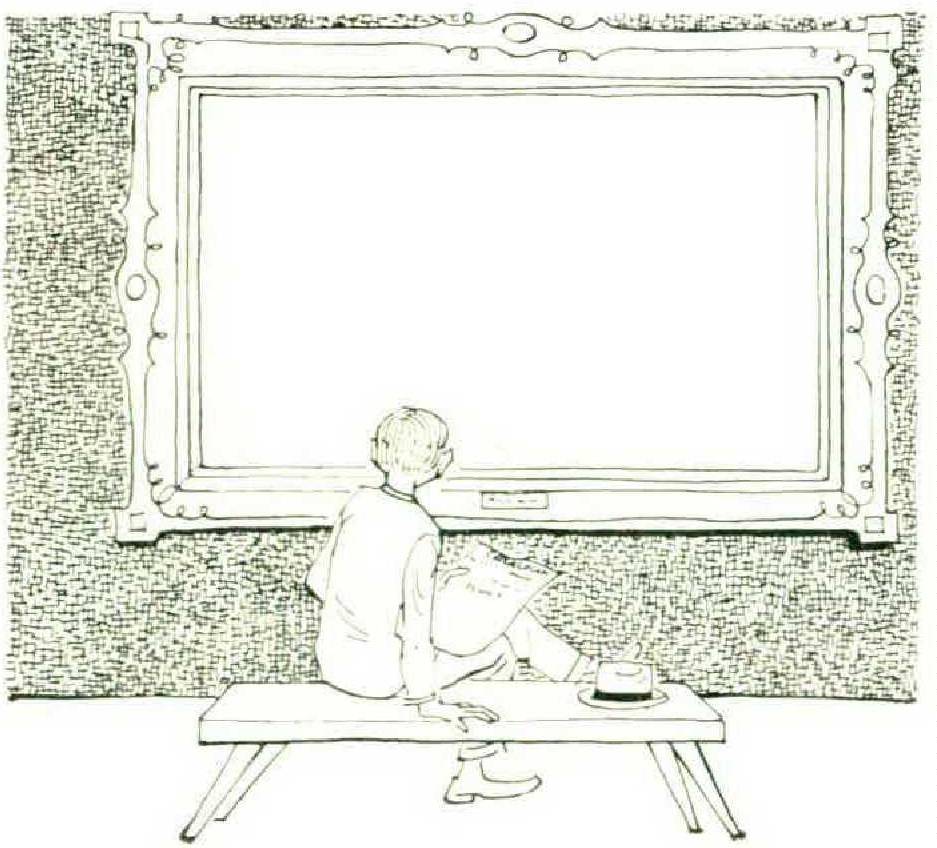
The under-understatement, or nulmethod, is useful in painting and is, I suppose, the end product of impressionism. A very advanced example is the painting called While on White in the Museum of Modern Art in New York, but someone has gone further still and exhibited —or inhibited — a blank canvas. I heard about this from a painter who said it was “by” So-and-so, but I wondered why I couldn’t claim it. After all. I hadn’t painted it, too.
Metonymy rules here: The container equals the thing contained; and I am the wrong container — I don’t paint. Or, rather, I don’t not-paint things.