The Other Home
FRANCES MCFADDENwas managing editor of HARPER’S BAZAAR for eleven years before World War II, and then went to London as an editor for the Office of War In formation, where she worked on magazines for the Continent before the liberation. She is now living and writing in Cambridge, Massachusetts.
WHEN they asked the children, “If you ever get lost, where will you tel! the policeman home is?”, the children chanted all together, “The Kenilworth.” Home was on the fifth floor, and you could tell their door from the others because of the horseshoe; their father had hung it over the door knocker, turned up to hold in the luck. But one day their mother came running to them, every inch of her smiling, and said she was taking all three of them home for Christmas. They wondered. It seemed then that there were two homes. The Kenilworth, with Tim, the doorman, and the darling little Peke who belonged to the strange lady from Six, and the strange boy from Three, who rode the elevator in his roller skates, and the strange children who looked out of the window of their nursery across the court — and another home! Long after the children had moved from the Kenilworth to a bigger apartment in another building, and then to one still bigger than that, there was always, in their blood and bones, way off somewhere in the dark places of memory, that other home.
They had new flannel petticoats, featherstitched in a hurry, for the journey, and new gray squirrel capes, and new bonnets with rosebuds under the brims. Their father was to follow later. He put them in the drawing room of the train, and said good-by, and be good, and say hello to — and was gone and lost forever. But they heard a sharp tap on the window and saw him again, waving and waving and waving until the train pulled out of the station.
They explored the drawing room. They loved the long mirror between the seat and the couch. They loved the paper bags they put their bonnets in. They loved the little washbowl that pulled out of the wall. They could stand on the footstool and dabble their lingers in the dribbles, but they mustn’t drink the train water because no one knew where it came from. The porter brought them tizzy water that prickled in the nose. They loved the porter. Their mother showed them how to slide the window shades up and down by pinching the clasp. The clasp had been invented by a boy who went to dancing school with their mother. He had made millions out of it, she told them, but he was a poor dancer.
They stood in the train corridor and looked out at the frozen river. Their mother knew every landmark, but the train went so fast, her stories had no beginnings and no endings.
“Now we’re coming to Sing Sing!” she said. “Poor things, shut up there at Christmas.”
They didn’t see the poor things shut up there.
“There’s West Point! There’s Flirtation Walk on the cliff! I suppose he married some army girl and is stuck at Fort Sill.”
They could not see Flirtation Walk, though she pointed it out to them.
“Now, soon we’ll leave the river and be turning west,” she said. And she leaned her head back on the white tidy and smiled a long, happy smile into the setting sun.
They went to the dining car and tucked the corners of the big white napkins into their guimpes and held up the menus and pretended to read their orders.
“I’ll have chocolate soda and brown Betty and hard sauce and charlotte russe,” said one.
“Maple syrup and popovers and sarsaparilla and cake,” said another.
“Birthday cake?” said Baby, and she rolled her eyes and smacked so loudly that the men at the next table laughed. The children could have died, because of Baby.
They went to bed, one up the ladder into the upper, two in the lower, their mother on the made-up couch. They swung their shoes in the hammocks beside the berths. Their mother pinned her gold watch to the couch back with her hatpin and put on a long silk wrapper and braided her hair and tied it up in a long gray veil. In case of accident, she told them.
In the morning, she reached across the children and put up the shade. She was so excited it went up crooked.
“Wake up!” she cried, so happy, so happy. “See! No more hills! Oh, the lovely prairies!”
And they crouched in the lower berth looking out at the flat fields covered with snow, at the farmhouses with their windmills and their poor little privies out there in the cold.
“I don’t see anything,” said Baby.
“Look!” they all shouted together, but not soon enough. They had to look backward to see the big baby painted on the barn. It had nothing on but its shirt.
“Fletcher’s Castoria,” said the mother. “It’s supposed to jog the liver, but I have more faith in castor oil.”
The train had come to a stop in the white wilderness. Now a cattle train rumbled slowly past, car after car after car, casting a pattern oi light and shade on the children’s faces.
“Six, seven, eight—” chanted the children, counting the cars. They could see the steers steaming in the cold. They were packed so tight their horns stuck through the red slats.
“Fifteen, sixteen, seventeen —” chanted the children. They could hear the mooing. The steers were climbing on top of each other, trying to get out. Even after the caboose had passed, they could not forget the terrible mooing.
“They were crying,” said Baby.
“Beef on the hoof,” said the mother. “Maybe some of Grandpa Winant’s on their way east.”
Long before the journey’s end, they were dressed and ready to get off. And their mother was hugging her handbag and reading the signs on the rooftops of the factories and mills and telling more stories with no beginnings or endings.
“Claussen Paint and Varnish. They gave me that cut-glass fruit bowl for a wedding present. The fat Claussen girl was called Dolly.”
Before the children could look for the fat Claussen girl, their mother had switched to some smoking chimneys.
“He had a pew just in front of ours at the Fourth, but Father said he’d never trust him around the corner. He once sold Father a cow that went dry.”
There was no more of that story either. They were pulling into the station.
The porter lifted the children down the steps, one by one. It was bitter cold. They straggled down the platform and past the great black panting engine lost in clouds of white steam. Faces came out of the steam suddenly, bending down over them, smiling — the aunts and the uncle and the great old man with the white beard. He lifted them up, one by one, and examined them. His beard brushed their faces. He held Baby right up to his nose.
“This one is a Winant,” he said.
The brougham was like a little house. The coachman’s name was Johansen. Johansen put the fur rug over their knees. He called their mother Miss Yulie. Plop, plop, plop went the horse’s hoofs.
It was so cold the children snuggled down under the robe. Their mother kept her face at the window.
“There’s Kranz’s candy store,” she called back to them. “I wonder if old Mr. Kranz is still alive. He made my wedding cake. Look! A new skyscraper where your great-grandfather’s grain elevator used to stand. Now, when we get to the bridge, you’ll smell the coffee roasting in the warehouse by the river.”
And when they got to the bridge she told them to smell, and, just as she had said, they smelled the coffee roasting.
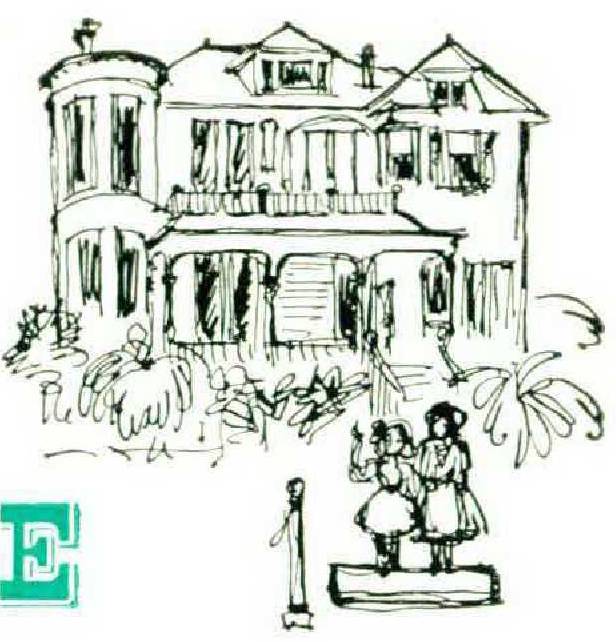
EVERYTHING was big in the other home — the long mirror inside the front door, and the chairs and tables, and the paper cutter shaped like a sword, and the Moorish Girl and the Wounded Deer in their great gold frames, and the bear that held the canes and umbrellas in his arms by the library door. Everything was dark. Even by day there was always a light in the front hall. Everyone wore black, even the old ladies in aprons — the Girls — and Emma, who got the children up and put them to bed. And everyone knew everyone else. “Why, Mr. Gumprecht, how good to see you again,” said their mother to the funny little man who came to wind the clocks.
Three aunts lived in the other home, the little aunt who was a great-aunt, Aunt Lydie, and the fat aunt, Aunt Ellie, and the beautiful young aunt, Tanta, who had breakfast in bed in a cap. But there was only one uncle. Uncle Gus, who was married to Aunt Ellie. The children loved Uncle Gus. He brought them jujubes to suck. He cranked up the victrola in the morning room, and when the music came out of the horn, he put on a straw hat and took a cane from the bear’s arms and did the cakewalk. They almost died laughing when he did the cakewalk.
“Turn that thing off, Gus,” called Great-aunt Lydie crossly from the center parlor. She was at her writing desk, writing letters to her brother who had the gold fever.
Every morning when the children came down to breakfast they found Grandpa Winant in the morning room by the window reading a newspaper. Sometimes he would put down the paper and call to them. “Come here, you little monkeys, and let me have a good look at you.” But they hung back, dawdling over their cereal. They were afraid of his white beard.
Every evening after supper they kept watching to see if he had come home from the office. “He’s there!” they whispered, tiptoeing to the library door. They could see him and his newspaper in the lamplight. But it was a long way through the darkness to the lamplight, and the bear guarded the entrance, his terrible glass eyes gleaming. They wrapped the red velvet portieres around them and peeked at Grandpa Winant, all alone in the lamplight. Grandma Winant was dead.
When everyone was busy the children played with the cards on the silver card tray under the hall mirror. They sorted out the little ones and the big ones and the cards with the corners turned down. Every day there were more cards. “Corners turned down mean Called in Person,” said their mother, as she hurried past them. “You mustn’t lose any of those; they all have to be returned.”
The children sat on the landing, where the light shone through the Knight and his lilies, and watched the hunters moving on the big clock and the little moon on the clock’s face that got bigger every day. “Ding Dang Dong Ding. Dong Ding Dang Dong,” sang the clock, out of the stillness.
UNCLE GUS took the children to the opera. He put a coin in the box attached to the seat ahead of them and took out opera glasses. When the lights went off and the stage was lit, Baby stood up on the pile of squirrel capes and told everyone what was going to happen next.
“Now they’re going to put die witch in the oven. Now they’re going to eat the gingerbread,” she said, out loud.
“I see you’ve got your hands full, Gus,” said a man leaning from behind. The children were ashamed of Baby.
When ihey got home. Aunt Lydie asked them who sang. They did not know.
“Our new mezzo. Quite an armful, but she can sing,” said Uncle Gus. “Gretel sang flat.”
The front parlor smelled of roses. There were callers in the front parlor, Cousin Cyrus and Cousin Bessie and Cousin Mattie Parker. The children hung on to the arms of their mother’s chair and observed the cousins.
“Where did they get that curly hair?” asked Cousin Bessie. “There was never any curl in our branch that I know of.”
“After all, they have a father,” said their mother.
“I think that second one is a throwback to the Harrisons,” remarked Cousin Cyrus. “There’s a look about the eyes that reminds me of Aunt Pansy Harrison.”
“God forbid!” exclaimed their mother.
“The Harrisons were connected but not related,” said Cousin Bessie. “They bury in Kalamazoo.”
They all agreed that Baby was pure Winant.
“But you can’t be sure till she gets her second teeth and the gap shows up,” said Uncle Gus, putting his head in the door.
The aunts pounced on him. “You don’t know anything about it, Gus,” said Great-aunt Lydie. “The gap between the front teeth is Parker. The fang incisors are Winant.”
They counted up all the relations who had the Parker gap or the Winant fangs. Uncle Gus went out laughing, with his hands over his ears.
Upstairs, in the big bedroom. Tanta was dressing for a party. She let the children play with all the silver pieces on her dressing table and smell all her bottles. She let them lift out all the trays from her candy box. No one wanted the chocolates with the nasty green foils. They had to go to the bottom to find those in silver wrappers.
“How would you like to be grown-up and get candy from a beau?”
She was smiling her naughty smile, so they knew she was teasing. “Well, when you are grownup, you’ll be awfully sorry if you don’t get any,” she said.
Would Tanta be allowed to go to the party? While the children ate supper, the aunts were quarreling. Great-aunt Lydie said she shouldn’t go because she was still in mourning. She had had attention, Aunt Lydie told their mother, and it had gone to her head. Aunt Ellie said she should go. The party was i’or the orphans, and the orphans were a family charity, and the family should be represented in the tableaux. Their mother said she could go if Uncle Gus took her and brought her home before the cotillion.
“I hope she won’t have to bring Gus home,” said Great-aunt Lydie crossly.
But Uncle Gus didn’t care. He had cranked up the victrola, and His Master’s Voice came singing out of the horn.
Thought she’d have a party
Don’t forget what the teacher taught
You’ll be sorry if you get caught —
“Turn that thing off, Gus,” said the great-aunt, but the children loved the Smarty song, they loved Uncle Gus. They were glad he was going to the party with Tanta. They waited up in their wrappers to see them go off. Uncle Gus looked splendid in his shiny top hat. Tanta’s great pink dress filled the front hall. Her hair was white; her cap edged with pearls. A black mask hid her eyes, but not her naughty smile. Her neck and arms were shining bare.
“Not much left to the imagination,” said Uncle Gus, getting into his overcoat.
“Nonsense,” said their mother crossly. “She’s a Watteau.”
“I don’t see how Ellie stands it,” Aunt Lydie said to their mother later in the bedroom. “He’s reverting to type. I can remember going to market at Henckle’s with Mother. Old Gus Henckle stood behind the chopping block and cut up the meat.”
“Gus has been very nice with my children, I’ll say that for him,” said their mother. “And Father says he’s the up-and-coming man at the Yards.”’
WHAT was wrong with Uncle Gus?
“He’s not a real uncle. He’s an uncle-in-law,” their mother told them. She was taking them to see the lake. The wind whirled around the corners of the houses and blew the new snow in their faces. Their mother didn’t mind the wind. She loved it. She made them climb up on the mountains of ice by the lake shore, dragging Baby behind them. But there was no lake. No boats calling to each other. Only frozen snow as lar as they could see, forever and ever and ever.
They went to the candy store and sat on gold chairs and had cocoa and whipped cream, the hot air blew up from a hole in the floor around their feet. On the walls were mirrors tied with gold bowknots and paintings of beautiful girls wading in streams.
An old man came from behind the candy counter and shook hands with their mother. “No boys to carry on the business? Too bad,” he said, but he gave them each a bag of sugar stars.
When everyone else was out, Aunt Lydie stopped writing letters to her brother who had the gold fever. She took off her glasses and spun them into a button on her dress and told the children about the piano in the front parlor that had come all the way across the Alleghenies, pulled by mules. When it was set in place, she told them, their great-grandmother sat down and played The Campbells Are Coming, Tra-la, Tra-la. The children didn’t want to hear the piano story.
“Tell about the baby.”
“Tell about the little muff.”
“Tell about the burning brands,” they begged her.
It was all the same story. “It was Sunday, ‘ Aunt Lydie began. “We were coming back from service at the Third Church. We stopped on the bridge and saw the light of a fire in the sky. ‘
The children knew what was coming next. The fire got bigger and bigger. The wind blew more and more. Grandpa put wet blankets on the roof to save the house, but the wind blew the blankets away. Uncle Daniel buried the silver in the sand behind the house. Then the waterworks went. There was no more water. Even the sidewalks were on fire. Grandma put a coat over her nightgown, and the nurse carried the baby, and they ran down to the beach. The burning brands were flying all around them. “My God, is that a baby? It will be killed,” cried a man on the beach (the children loved that part). At last a boat came along and took them all to the West Side, and they were saved. But they had no clothes. All Grandma had saved was her little ermine muff. And the baby was their mother, Aunt Lydie told them. And the silver pitcher that Uncle Daniel had buried in the sand was this pitcher. Aunt Lydie showed them the dent in it where Uncle Daniel had kicked it up after the fire was over.
The afternoon before Christmas, Aunt Ellie took the children to the orphanage, carrying baskets of presents. They were proud to be going to the orphanage with Aunt Ellie, just as Grandma had always done.
“I am going to orphans,” Baby informed the policeman at the corner.
They stood in the hall of the orphanage under the picture of Jesus and Suffer Little Children, waiting with their baskets. A bell rang, and the orphans came clattering down the stairs and swarmed around them. There were hundreds of them. They wore blue dresses, all alike, and black stockings and black button boots, and their hair was cut off like boys’. They stroked the squirrel capes and felt the roses under the bonnets and put their fingers up Baby’s curls and tried to pick Baby up in their arms. Baby kicked them, dropped her basket, and ran down the corridor, screaming.
“They’re not mine; they’re my sister’s,” said Aunt Ellie, following the orphanage lady to the door. “They live in the East. She’s brought them home for Christmas.”
And in the carriage she told the children: “You must be good at our Christmas tree. Now that your mother is back and the whole family is assembled, we are going to divide your grandmother’s things. They will be put in equal piles on the floor, and we will draw lots for them. That way it will be perfectly fair and there will be no arguments. We want this to be a very happy occasion.”
When they got home, the Christmas tree was set up in the front parlor. A new uncle was putting the last star on top — Uncle Tad, from the country — and a new aunt, Aunt Grace, was getting a boy out of his leather leggings. The children didn’t bother about the boy. They rushed out of their tights and bonnets and capes. They couldn’t wait to see the presents. They mustn’t touch them, their mother told them, they could only look at them. So they went around the piles on the floor, looking. There were necklaces and rings and bracelets and silver bags and lace shawls and feathers and a pair of pearly opera glasses and all sorts of queer little boxes. In one pile the children spotted the silver pitcher with the dent in it and the muff. They knew what those were. That was the muff, that was the pitcher saved from the burning brands.
The little boy, Taddie, was led around to all the aunts, carrying a bowl filled with slips of paper.
“Which are our presents?” asked the children when all the slips had been drawn.
But their mother wouldn’t let them play with the presents in their pile. She laid a bracelet safely in shining satin and snapped the box shut.
Baby picked up the ermine muff and stroked the little black tails.
“Put that down,” their mother said. “That isn’t ours. It went to Aunt Ellie. Now we must all pack up everything before Grandpa comes home. This will be a sad sight for him.”
“Aren’t moonstones bad luck?” asked Tanta, putting away the moonstones.
“Who got the pearl set that Mother wore to Lincoln’s inaugural?” asked Aunt Ellie, folding a lace shawl.
Aunt Grace was at a mirror trying a feather in her hair, placing it this way and that way, making silly faces at herself in the mirror. “When would I ever wear this thing?” she asked.
“It’s a very fine paradise,” said their mother crossly. “Father bought it for her in Paris.”
“Take it off, Grace,” said Uncle Tad. He was cross, too. Aunt Grace was not a real aunt.
Only the children knew that Uncle Gus had come home from the office early. Only they knew what he was doing in the pantry. They trouped behind him as he came hustling down the hall with a big glass bowl in his arms. He set it on a table in the center parlor.
“You all look about as cheerful as Moody and Sankey,” he said. “I’ve made some punch, and I advise you all to come in and partake.”
The Girls brought Christmas cookies and fruitcake from the pantry. Uncle Gus unhooked the glass cups from the edge of the bowl and scooped the punch with a ladle. Soon everyone was in the front parlor, glass in hand, back to the fire. They were talking all at once.
“Do you remember that time when —?” began Aunt Ellie.
“Has anyone ever heard from —?” began Aunt Lydie.
“What ever became of—?” began Uncle Tad.
Tanta was flashing the big green stone on her finger in the firelight.
Before long their mother was showing Uncle Tad a new dance. “Four steps forward, four steps back. Grapevine! No, clumsy, cross one foot over the other.” Their mother, in Uncle Tad’s arms, dancing! The children hid for shame behind a sofa.
“What did you put in this, Gus?” said Aunt Lydie, twirling her glass around and around.
“Dynamite. Trust Gus!” said Uncle Tad.
“Run into the pantry, children, and get your lemonade, and take Taddie with you,” said their mother.
But, instead, the children took Taddie to the center parlor. They stood up on chairs and unhooked the cups and dipped them into the punch. The punch was good. They showed Taddie how to scoop the punch up in his cup. They took Taddie to see the calling cards and the sword paper cutter and the victrola and the Moorish Girl and the Wounded Deer. They took all the umbrellas and canes away from the bear and crawled into the bear’s arms and felt his glass eyes and kissed his snout. They raced upstairs to the landing to look at the moon on the clock. They raced back to the punch bowl and dipped in their cups and scooped all that was left under the ice. They raced down the hall and slid on the bare floor all the way into the dining room. They had forgotten their disappointment about the presents.
“Smarty party,” sang Baby to Uncle Gus, chasing after him, tripping, and falling.
“Bully for you!” said Uncle Gus, ducking her gallantly with his tray full of glasses.
Everyone was happy now in the front parlor. Aunt Lydie was at the piano with her head thrown back, singing The Campbells Are Coming, Tra-la, Tra-la. In the pantry, Johansen and the Girls were drinking what was left of the punch from a pitcher. Everything was lovely, everything was light and bright and lovely in the dark house.
Only the children knew that Grandpa Winant had come home. He was in the library with the lamplight shining on his sad old white beard. Only the children knew where Baby was. She was on the sofa in the library with Grandpa. And afterward, when everyone was searching, only they knew where the muff had gone to, and they weren’t telling. It was with Baby on the sofa with Grandpa in the library.
They stood in the hall and watched Emma hooking up Taddie’s leather leggings with a buttonhook. He was almost asleep.
“Ding Dang Dong Ding. Dong Ding Dang Dong,” said the clock.
“Time you were all in bed,” said Emma, herding them upstairs. “You have to be up bright and early to meet your father on Christmas morning.”
The children were too boozy to wonder. They had forgotten all about their father.