Communism, Mongolian Brand
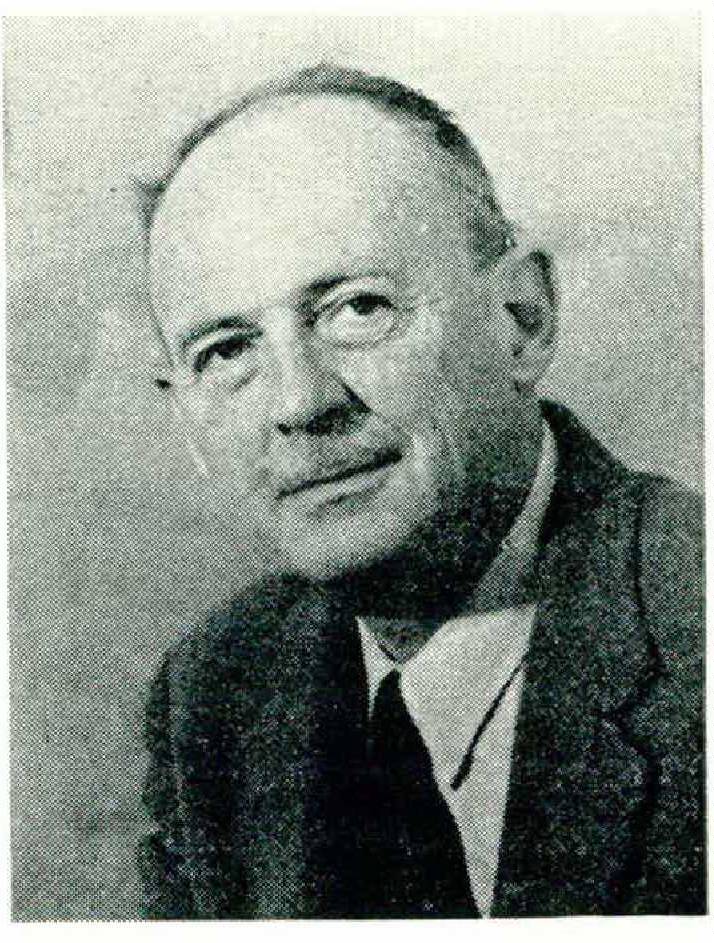
OWEN LATTIMORE is the only American who, when traveling in the vast frontier regions between China and Russia, front Manchuria to Central Asia, has the advantage of being able to speak Chinese and Russian as well as Mongol, He and his wife, Eleanor Holgate Lattimore, first reported on Mongolia and Turkistan in the ATLANTIC in the 1920s. Their visit to Mongolia in 1961 was made possible by grants from the Wenner-Gren Foundation for Anthropological Research and from the American Philosophical Society; and the book emerging from their trip, NOMADS AND COMMISSARS,will be published by the Oxford University Press.

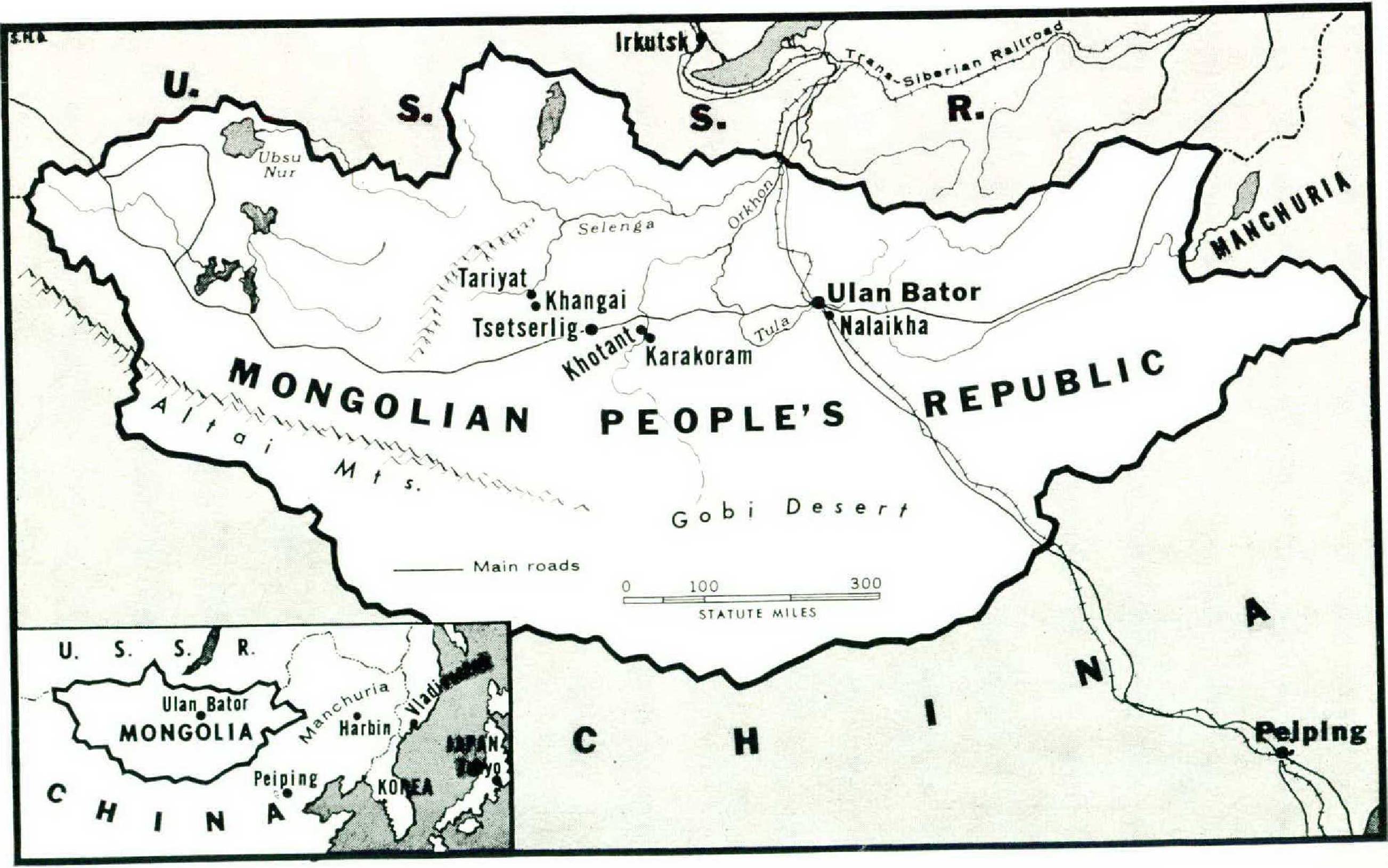
THE admission of the Mongolian People’s Republic to the United Nations in 1961 aroused sudden interest in a country which, though it had not itself sealed its frontiers or made itself a hermit land, had been neglected by the outside world for forty years. Mongolia’s membership in the United Nations has led to the asking of many questions. What are the relations between Mongolia and the Soviet Union and China, the only countries with which it has common frontiers? Is Mongolia a kind of disguised member republic of the Soviet Union? Or, on the other hand, are the Mongols a kind of Chinese? Is their language a dialect of Chinese? What is the difference between Outer Mongolia and Inner Mongolia?
For more than thirty years Mongol studies have been a major part of my activities as a teacher and writer. An unplanned encounter with some Mongol scholars at the 1960 International Congress of Orientalists, held that year in Moscow, led to an invitation from the Mongolian Academy of Sciences to visit Mongolia in 1961.
The Mongolian delegation to the Congress had invited us to a dinner at which, following the social custom in all Communist countries, the hosts got up at intervals between courses to make polite little speeches. From this it became clear that several of them knew English and had read some of my publications, not just casually but with a scholar’s attention. One thing interested me particularly. People like the Mongols, who frequently are called “primitive,” “uncivilized,” and so on, are often more irritated, in a personal way, by what is said about them in travel books than by political opinions with which they do not agree. In my book Mongol Journeys, published in 1941, I wrote about my experience of Mongol life. The dirt and the lice were there, as well as a lot of other things, but I was not looking down my nose or feeling superior; I was trying to recall the feeling of participation in a kind of life. So I was understandably pleased when two of our Mongol friends referred to this book as a trustworthy account of what Inner Mongolia was like in the 1930s. One of them added, “Your Mongols are real Mongols.”
Living in part of the vast area of historical migrations between Asia and Europe, the Mongols are physically a mixture of many stocks. They are a different people from the Chinese, and their language is as unrelated to Chinese as English is to Finnish. The Mongol language is related to the Tungus family, of which Manchu is a member; it is more distantly related to Korean; and the nature of its relationship to the Turkish family of languages is a matter of controversy among scholars.
Formerly a part of the Manchu Empire, like China itself, Mongolia became autonomous in 1911, when both Mongols and Chinese revolted against Manchu rule. Autonomy was a status regulated by negotiations among three countries — czarist Russia, the Republic of China, and Mongolia itself. China continued to claim sovereignty over Mongolia, however, until 1946‚ when Chiang Kai-shek agreed to a plebiscite in Mongolia, which was overwhelmingly in favor of complete independence and sovereignty.
Chiang Kai-shek accepted this verdict, and China, under Chiang, voted in favor of Mongolia’s first application for United Nations membership, later in 1946. This approval was withdrawn the very next year, however, because of a frontier dispute, and up to 1961, Chiang did his best to prevent Mongolia’s admission to the United Nations. This objection was not based on a claim to sovereignty. It is not true, as many newspaper stories might lead the unwary reader to believe, that Chiang maintains that Mongolia is a province or possession of the island of Taiwan.
”Outer” and “Inner” Mongolia are old administrative terms. The Manchus conquered Inner Mongolia first, beginning with campaigns in the late 1500s, and Outer Mongolia much later; the consequence was that the administrative structure of Inner Mongolia was linked more closely than that of Outer Mongolia to the system that the Manchus set up in China. The old Outer Mongolia is the Mongolian People’s Republic of today. The old Inner Mongolia has partly been absorbed by several Chinese provinces, and part of it has the status of an Inner Mongolian Autonomous Area, under Chinese sovereignty. Our government forbids Americans to visit Inner Mongolia because it is a part of Red China.
In 1936 I first described Mongolia as a “satellite” of the Soviet Union. Today Mongolia is the only Communist-ruled country which is completely surrounded by other Communist-ruled countries. Russia and China. In this respect it is different from Yugoslavia and Albania, and also from Hungary and Czechoslovakia. All four of these countries have at least one frontier with some country that is not in the Soviet bloc; but they are not all alike. Yugoslav policy is independent of Soviet policy, though often similar; Albanian policy is hostile to Soviet policy; Hungary and Czechoslovakia have somewhat different policies, but both are in line with Soviet policy. These differences are a reminder that Mongol policy needs to be studied in the light of Mongolian conditions. Mongolia should not simply be lumped together with other Communist-ruled countries.
In what is going on throughout the world today there is, of course, a competition to win men’s minds. Among the ways to reach men’s minds there are: logic, the reasoned argument for adventurous individual freedom against the dull conformity of the herd; sentiment, the family and the nation; and association, that of which we are proud because we received it from our ancestors, and which we aspire to hand on to our descendants. But there is another way, and that is through the material conditions under which men live. Are things bad or good? Does it look as though they are going to get worse or better than they were before? In either case, what can be done about it?
We Americans are prone to make a false distinction between pure and true spiritual values and gross material values. In fact, both enter into human life and are so tightly intertwined that they can never be neatly separated. Being well off has a lot to do with contented thinking. Being badly off may contribute either to discontented thinking or to resigned thinking. What makes the difference between action and passivity is often the feeling of a man, or a community, that things are likely to stay just about the same for an indefinitely long time, or will probably get so disastrously worse that there is not much use doing anything about it, or might get better if somebody does something about it. Here is where the material world in which we live joins with the theoretical world, with that which we abstract, by thought and emotion, from that which we know by experience.
Under conditions as they are today, abstractions tend to become slogans, commercial or political. A typical slogan of our own world, appealing to the consumer, would be: Milk Builds Better Bodies— Buy More Milk. A typical slogan of the Communist world, specifically Mongolia, appealing to the producer, would be: Milk Is Wealth — Raise the Yield per Cow.
Mongolia is a large country with a small population, but with vast natural resources. It is a block of territory geographically resembling North and South Dakota, Nebraska, Kansas, Montana, Wyoming, and Colorado, and almost as large. It is less desert and has more variety of climate and soil than is generally supposed. People who have not been to Mongolia, and most people who have read books about Mongolia, do not realize that it has rich forest resources and lake and river fisheries capable of large-scale profitable development. Its minerals include coal and iron in important quantities, and rarer metals, like tungsten. In the 1950s oil was struck in the south, and may prove out in really large figures.
Early experiments with agriculture are turning out well, though there is the risk that some of the methods of cultivation may start erosion and create dust-bowl conditions. Time will tell. It is a country in which it is possible to develop an advanced modern mixed economy: livestock, harming, fisheries, timber, mining, and a diversified industrial superstructure. The question is, How is this to be done?
A problem that is run into at every turn is lack of enough people. The Western stereotype of Asian countries is that they are overpopulated and plagued with unemployment and underemployment. They have some problems that can be tackled, as in China, by mobilizing manpower by the hundred thousand, using pick and shovel instead of earth-moving machinery to dig canals and build dams. In other cases, the introduction of machinery destroys handicraft employment, and thus creates problems of maladjustment at a time when the old economy is thrown out of gear and the new one is not yet in operation. If the machines are available, there are plenty of people who can be trained to use them. For this reason it is sometimes practical to buy relatively inefficient machinery, or even secondhand machinery, which does not give the maximum economy in manhours.
In Mongolia the problem is exactly the opposite. The machinery is needed, but it cannot be used without drawing on the already short supply of manpower. Therefore, for industry the best economy-efficiency ratio is obtained with the very latest machinery, using the minimum of manpower. The same thing applies to agriculture. There is no pressure whatever on the Mongols to make a change from herding to the ancient Asian peasant’s hoe agriculture. What is needed is the most modern mechanized agriculture.
WHAT the world most needs to know about Mongolia today is that it is an outstanding example of the successful economic development of one country by a planned program of aid from another country. Forty years ago the nation was poor, the economy primitive, the political system antiquated and inefficient, the society sluggish. Today the Mongols are, I believe, better fed and better clothed than any other people in Asia. Their housing is probably at least as good as the average of any other Asian people. The educational system is good and goes a long way toward providing equality of opportunity to all, according to individual talent. The distribution of this high standard of living is remarkably equal. There are no depressed areas, no depressed classes, and because of underpopulation, there is no unemployment.
All of this could not have been accomplished if the Mongols had not been a gifted people, able to respond to opportunity; but also it would have been impossible without Soviet aid. More recently, Mongolia has had aid and expert personnel from other countries of the Soviet bloc, and loans, gifts, and labor battalions from China; but the main program has always been Russian, and the overall results can be judged as an example of Soviet theory and practice in carrying out a program of aid and development.
This is of world importance. No form of international competition is more important than rivalry in programs of economic aid. The competition is open to all economic, social, and political systems. It is a kind of competition in which, if things go wrong, enormous amounts of money can be spent with very disappointing results. Internationa] competition in this field has developed mostly in the last ten years, and it is also in the last ten years that the Soviet program in Mongolia has been most active and has had the most successful results; but since the Russian experience in Mongolia is spread over forty years, the Mongols have had thirty years more in which to learn than other countries.
Mongolia is important for comparative study because under either capitalist or Communist auspices aid programs have some results that are comparable. Economic changes have a social impact, which in turn has political consequences. New social classes may be created, as in Mongolia, where there was previously no industrial labor class; or the existing balance of interests and classes may be affected, as in India, where the receipt of aid in economic and technological development from both the United States and the Soviet Union has sharpened the competition between the state capitalist sector and the private capitalist sector of the economy.
Another phenomenon, which has an interesting history in Mongolia, is closely associated with the shift in social balance and interacts with it. New machines and techniques, when first introduced, are mere additions. They are at the periphery of the economy, not yet within it, and the men who operate them are attached to the society but not yet integrated into it. A second phase opens as the complex of men. machines, and techniques begins to change the economy and society which were there before. Then comes the decisive phase. Either, as in Kuomintang China, the new additions fail to fuse with the old elements and there is a breakdown, leading to a totally new regrouping, or there is a fusion which goes beyond “old plus new,” a transformation which results in a new entity ready to make its way in the world.
A transformation of this kind seems to clear the way for very rapid acceleration. In Mongolia, making a very rough count by decades, it can be said that the 1920s were the decade of addition; the 1930s, the decade of modification; the 1940s, the decade in which transformation began; and the 1950s, the decade in which transformation became complete enough to open the way for acceleration.
It is difficult to measure acceleration in one country by the standard of speed in some other country. The newspapers frequently have stories about the rate of growth of the gross national product in the United States and other countries, which I am sure mean very little to the average reader. Perhaps mood and atmosphere — in themselves things that it is impossible to measure precisely — are the layman’s best guide to rapidity of change. In Mongolia, in 1961, my wife and I found an atmosphere of hope and a mood of confidence, which seemed to be justified by the ability of the Mongols to manage and direct new enterprises as well as to staff them with operating personnel. The stage of mere imitation seems to have been left behind. Experiment and change are going on all the time. The books we had read were already out of date, and my own description will be out of date in a year or two; but still it seems worthwhile to try to capture this point of time, because in post-war development programs all over the world so few outsiders have been present, in any country, at the moment of success.
WHEN we arrived in Mongolia in early July we were excited by its transformation in contrast with the stagnation, decay, and loss of hope we had experienced in Inner Mongolia in the 1930s. The contrast between the new and the old is, of course, particularly striking in Ulan Bator, which is without rival the urban and Industrial center of Mongolia today, as well as the bureaucratic center of national government. Its industrial growth is an unplanned consequence of the nearby Nalaikha coal mines, and may be matched when an iron and steel industry is developed in the west, under the 1961-1965 Five-Year Plan. At present, with 160,000 inhabitants, it claims about 18 percent of the total population of the country. This seemed to me to be rather lopsided for a still mainly pastoral country, but the city planners claim that the growth of Ulan Bator will be tapered off, and that with the growth of industry in other cities the proportion will not be lopsided.
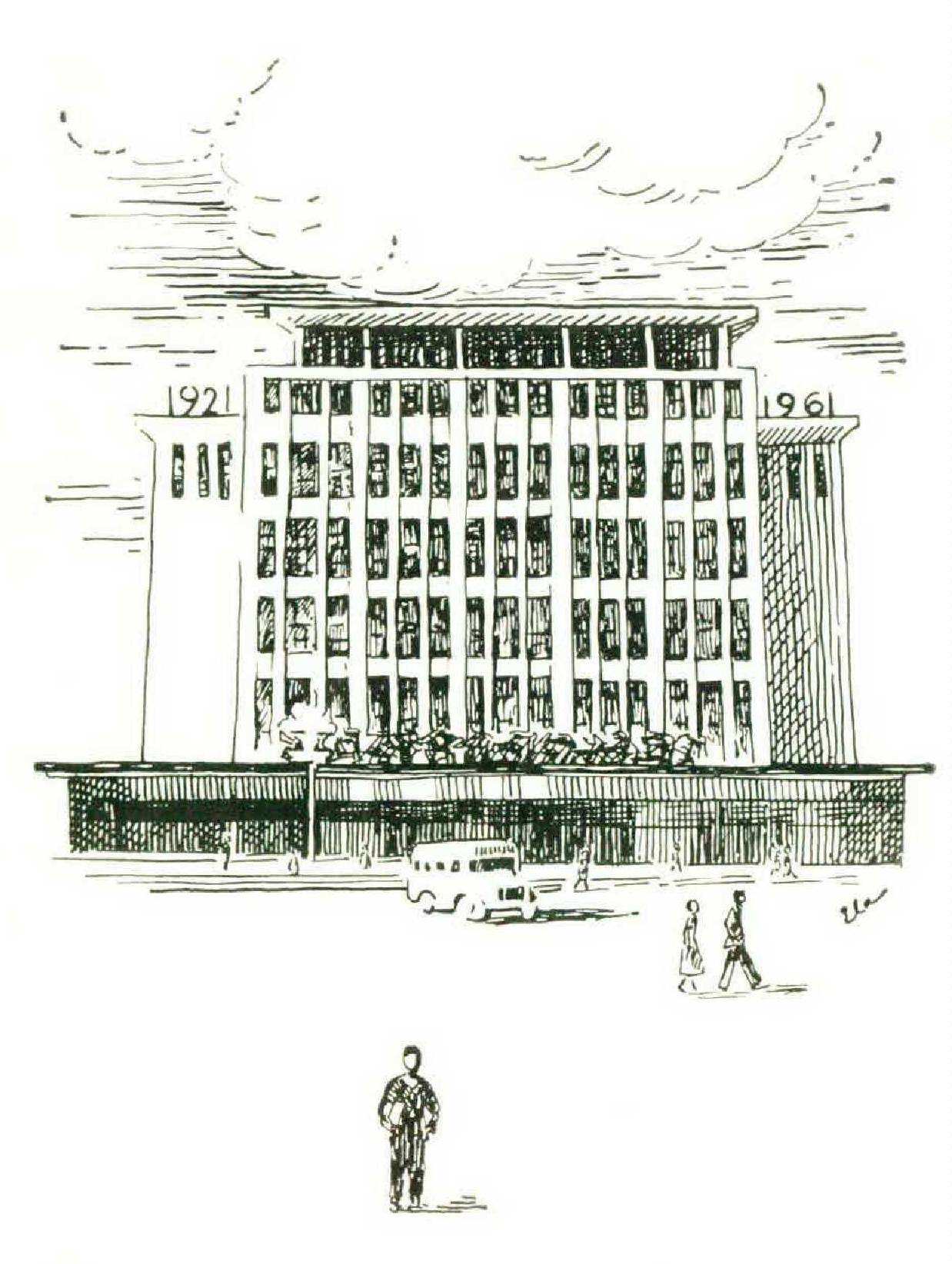
Rapid growth has made Ulan Bator a uniquely beautiful city. Stretched along the northern side of the Tula River, it will eventually be a city about twenty miles long and four or five miles wide, in a broad plain almost enclosed by forested mountains. Because the population has grown too fast for the builders to keep up, there are still many wooden-fenced rectangles in which people live in the old round white Mongol tents, which make a striking contrast with the modern buildings. Because the city is in an earthquake zone, few modern buildings are more than four stories in height.
For some reason Ulan Bator escaped the plague of atrocious “wedding cake” architecture which was inflicted on Moscow and also on Warsaw in the Stalin era. The prevailing architecture is square and simple. Many buildings are a dazzling white, but others are pastel-colored, which under the bright sunlight that prevails for most of the year gives the city, in spite of its northern latitude, a Mediterranean mellowness. The sharpest contrast between old and new is in the fact that, while many people are still living in tents, heat and hot water are piped underground to the modern buildings from a central heat, power, and lighting plant.
Perhaps the most startling modern spot in Ulan Bator, to old-timers like us. is the sophisticated new 200-room hotel to which we were taken by our friends from the Academy of Sciences, who met us at the railway station. It was built by the Chinese and decorated and furnished charmingly by the Czechs in the best kind of Danish-modern style and comfort.
Most of Mongolia’s small modern factories are on the outskirts of Ulan Bator, the large flour mill, a tannery, boot and shoe factory, large modern textile factory, glass factory, printing plant, prefabricated housing plant, and many others some built by the Soviet Union, some by China, and several by Czechoslovakia or East Germany, but by this time completely or almost completely staffed and run by the Mongols.
The total industrial output of Mongolia is still small, but growing rapidly, and the government plan is to double it by 1965. The following figures roughly sketch the picture of the 1950s. In 1952 there were 148 small industries with 13,500 workers and an output valued at 187 million tÖgrÖg. (The nominal exchange value of the tÖgrÖg is about five to one U.S. dollar.) The state owned 37 of these factories, and 111 were cooperatives. In 1960 there were 162 industrial establishments with 24,660 workers and an output valued at 567 million tÖgrÖg. Of these, 93 were state-owned and 69 were cooperatives.
This rapid growth would, of course, have been impossible without a great deal of aid from the Soviet Union, and in more recent years from China, Czechoslovakia, and other Soviet-bloc countries. Most of the Soviet aid to industry has been given since 1952, almost all of it in the form of low-interest loans and technical assistance.
Equally revolutionary is the growth of an urban and industrial class which is still so new that the girl tending a loom or serving you at the department-store counter, the coal miner, and the flour mill operator, even the scholar bent over a Chinese or Tibetan text, are people who, when visiting their relatives camped far out in the country, can milk a cow or yak, shear a sheep, and catch and saddle a horse. In all the new activities. Mongol nationalism asserts itself in two ways: it assumes that a Mongol can do anything that people do in other countries, be it atomic physics or coal mining; and it assumes that every new activity and occupation introduced into Mongolia must as soon as possible be carried on entirely by Mongols. Foreign advisers, experts, and instructors are needed, of course, at the beginning, but there must be no industry, trade, or profession identified with the permanent immigration into Mongolia of an alien minority.
From the beginning, high standards were set by Ulan Bator’s industrial workers, and today in the woolen-textile and boot and shoe factories of Ulan Bator, new labor is recruited only from boys and girls who have completed the ten-year school program (from age eight to eighteen). There could not be a sharper contrast between such a labor force and that of the early industrial revolution in England, czarist Russia, Japan, or preCommunist China, recruited from helpless people forced into the factories by economic failure in working on the land or in handicrafts unable to compete with the machine, It is not only that youngsters who have just completed ten years of school are ready for further training on the job and rapid promotion as the industry expands; the new industry is treated from the beginning as a social complex. With the job go rights to housing, medical care, paid vacations (which can be arranged as collective outings, if the worker does not prefer just to go home and visit his family, enjoying the camp life, drinking mare’s milk, and helping with the livestock), play schools and group care for children up to the age of eight, when regular school begins, and so on.
Clearly the intention is to create a factory labor force which from the beginning regards itself as an elite, loyal to an existing socialism that it regards as a benefit and a privilege, and not requiring to be evangelized to suffer privations for the sake of a future ideal socialism. One result of creating such a system out of what did not exist before is that there is no trace of that hatred of the machine which elsewhere accompanied the industrial revolution, when each time that a machine was introduced to do something that had previously been done by hand, people were thrown out of employment. (Our word “sabotage” comes from sabot, the wooden shoe which European workers used to damage machinery, either on the sly or when rioting.) For the Mongol, the machine is that without which a superior kind of job cannot be obtained. There is no fear of automation; the more automatic the machine, the better.
We visited the mechanized coal mines at Nalaikha and a number of factories, including the large new textile factory which has the latest English machinery and a high degree of automation, as well as hospitals, a tuberculosis sanatorium, a kindergarten, and a large day nursery. As far as a layman could tell, they were all up-to-date and well equipped. In going through a factory I can at least get a rough idea of whether labor conditions are good or not, because that was one of the things I got in the habit of noting when I was a young insurance agent in China many years ago; but my experience of pastoral life was much more intensive, and I do feel that I can tell a well-run herd or a competently handled caravan when I see one. After the many months I had traveled with camels in the old Mongolia in the twenties and thirties I was particularly eager to see something of the countryside and the way modern Mongolia was handling its livestock economy; so we were delighted when our historian friends at the Academy of Sciences arranged for us to make a twelveday trip west and northwest from Ulan Bator, traveling by jeep, to visit four livestock cooperatives.
IT IS difficult to find a single word to describe the organization of the livestock economy in Mongolia today. The Mongols have specific terms for “collective” and “cooperative,” but they have a third term, rendered by some writers as “collective” and by others as “cooperative,” to describe their present organization of the pastoral economy. It is negdel, which means simply “association.” As it is a simple word, easy to pronounce and remember,we might as well use it in English, just as we frequently use kolkhoz in speaking of Russian collectives. The Mongols say that their negdel have some of the features of a Soviet collective and a few of those of the Chinese commune, but are a “looser” organization and “not at as high a stage of development” as the Soviet collectives.
Of the four negdel we visited, the first was only 120 miles from Ulan Bator. It is used to receiving foreign visitors, because it is a stopover on the way to Tsetserleg, a provincial capital of about 10,000 inhabitants, and Karakoram, which is both the site of the medieval capital of Mongolia and the headquarters of one of the most important state farms. The other three were far beyond Tsetserleg, and we were told that we were the first foreigners to visit them.
The first of the three, Tariyat, is less than 400 miles from Ulan Bator, airline distance, but it seemed much farther than that because it took us three days of hard driving to get there. We were traveling in the rainy season, which in 1961 was unusually wet. For most of the way there were no made roads; tracks and meadows were flooded, and where there were no bridges it was difficult to ford the swollen streams. At one ford we barely made it by uncoupling the fan of our four-wheel-drive, Russian-model jeep so as not to splash water on the almost flooded engine. Also, beyond Tsetserleg we felt a long way off, because for long stretches we drove across empty country, seeing only occasionally a single felt tent or a lowpitched cloth traveler’s tent.
This was one of the legendary campaigning grounds of Genghis Khan, and our Mongol companions recalled stories about him and the valley — that of the Khanui — in which he had said that the girls were the most beautiful in all Mongolia. Crossing another river, the ChuluuL, or “Stony,” which is well named because it runs through a stone-walled canyon, we came to the Suman Gol and followed it up to where it flows out of Tsagaan Nuur, “White Lake,” which is ten or twelve miles long. A little beyond it is the headquarters of Tariyat negdel, or cooperative. This is up in yak country, at an altitude of about 6000 feet, with bold but not craggy hills, forested on their northerly slopes, rising another 2000 feet. It is too cold for any agriculture except hay and oats, which are harvested unripe for winter feed. Another eighteen miles away, across flooded meadows and up and over a couple of ridges, was the headquarters of Khangai. the second negdel that we visited. From there, swinging south and turning back east, we came back to Tsetserleg by a different route, and cast of Tsetserleg visited the cooperative of Khotant.
Each of these four negdel occupied a territoryaveraging about 900 square miles — equivalent to a square of 30 miles by 30 miles — and owned an average of 56,000 head of stock. We were told that there are negdel which own over 100,000 head. The difficulty of keeping up with statistics in Mongolia is shown by the fact that at the end of 1958 there were 727 negdel. By the end of 1959 these had been reduced, by merger, to 389 larger negdel, with an average membership of 475 families, owning an average of 43,000 livestock. By the time Premier Tsedenbal gave his State of the Nation speech in July, 1961, another round of mergers had reduced the number of negdel to 337, with an average membership of 525 families, owning an average of 62,600 head, representing 78.4 percent of all livestock. At the same time another kind of merger had begun, to make the territory of each negdel coextensive with that of the sum, an administrative unit corresponding to a county. The negdel management does not seem to have taken over completely the functions of the county government, but the trend is shown by the fact that each of the negdel we visited was always referred to by the territorial name of the sum with which it was identified, although each of them also had its own organizational name as a negdel, an example being “The Ray of Light.” Another one that I like is “The Happy Life.”
In the negdel we visited, about 25 percent of the stock was the private property of member families — higher than the national average of 22 percent. We were told that a family is allowed to own privately up to 75 head, with allowances made for old people and young children. Government officials, factory workers, and town dwellers are also allowed to own cattle, which are pastured for them by cooperatives in which they have relatives. At accounting time each member family is allowed to take its dividend either in livestock (up to the permitted maximum) or in cash.
In connection with collective farming, it is frequently said that people tend their own little plot of land more carefully than the common land of the collective, but this kind of thing is not possible in herding. If your family is assigned to a milking herd of cows or yaks, and you elect to own sheep as your private stock, your sheep are thrown in with one of the big herds (unless you choose to keep one or two close by, for slaughter), and may be pastured far away, by somebody else. I asked if privately owned stock carried the owner’s brand or earmark and was told, sometimes yes, sometimes no. At Khangai negdel all cattle were branded, but a nomad does not really need brands. Ask a man in charge of 800 to 1000 sheep to show you those belonging to so-and-so, and he will go right into the herd and cut them out for you, saying as he does so, “This is the two-year-old he put in this year; this is the four-year-old he put in last year,” and so on.
THE membership of each negdel that we visited was about the same. For one of them, my notes show a total of over 2000 people, about 600 of them children. Counting out children and old people, there was a working force of about 1000. About 100 were Party members. As one would expect‚ Party members are often the kind who get themselves elected to committees and administrative jobs; but it is also true that if a man is competent and respected, people elect him to important jobs. The Party woos such men and tries to get them to join up, but sometimes they are just not the joining kind.
The headquarters of a negdel is a little village of permanent buildings, but people of nomad origin do not yet have the villager’s idea of permanence. At one negdel I was told, “We used to have our headquarters over there, on the other side of the lake, and then we moved here. Now we think this isn’t really the best place, especially when the rain is heavy, like this year. So next year we’ll tear everything down and move to a place about fifteen miles from here.” The headquarters always has an administrative building, to which are attached guest rooms and a kitchen, so that in fact it becomes a kind of hotel, as a pattern of travel grows up within the network of negdel.
There is also a school. The standard aimed at is a full ten-year school, but many negdel are able to manage only a four-year or seven-year school. There may be a dormitory, or children may board with families living in the village. Many children ride to school from camps that are not too far away. Mongols think nothing of letting an eightyear-old child set off on a tenor fifteen-mile, ride by himself. Other parts of the permanent establishment are a Red Corner and a hospital. The Red Corner is the community center. It has a room large enough for meetings and for showing movies (which travel around the country), and at least a rudimentary library.
We stopped for an hour or two at a fifth negdel on our way back to Ulan Bator because we saw from the road a large new bus, a bright-blue decorated traveling tent, and twenty or so horses tethered outside one of the headquarters buildings. It turned out that the building was the negdel theater and the bus and tent belonged to a theatrical party on tour. At the end of the “big city” season in Ulan Bator, the state theater and opera break up into small parties which tour the countryside.
A folk play was in progress. The episode on stage at the moment (familiar to medieval Europe as well as to the old Mongolia) concerned a lascivious monk who was trying to make time with a poor but pretty girl who was no pushover. We stood for some time at an open window through which we could watch not only the play but the appreciative audience. The room was packed, mostly with older women and young children, because it was noontime, when the men and younger women would be busy elsewhere.
Negdel hospitals vary according to the prosperity and size of the negdel and its organizational skill in getting the authorities to assign a medical staff. A woman doctor told me that until recently the policy was to assign doctors to any part of the country, at random; now the theory is that if possible they ought to be stationed in the part of the country where they grew up and are familiar with conditions. One hospital that we visited had fifty beds and three doctors, graduates of the sixyear course of the Ulan Bator Medical School. This hospital was equipped for major operations under anesthetics. It also had two cars for visitingoutlying camps. More and more, such cars are equipped with two-way radios.
Some of the families at headquarters live in tents, some in two-room houses, part of which are built of brick, while others are log cabins. One of the aims under the new Five-Year Plan is that every family should own both a house and a round, roomy, comfortable, Mongol felt-covered tent. (Nowadays, most Mongol tents have an outer covering of white canvas. An inner covering of felt is essential for insulation, but the outer covering of canvas gets dirty less quickly than felt, sheds water better, and lasts longer, thus making it possible to export more wool.) Looking down a row of tents and houses, my wife and I saw a sign of the new Mongolia. A little way off there was a tethering rack for horses, but parked in front of every single tent or house there was either a bicycle or a motorcycle.
We asked a woman if we could step into her log cabin, and she hospitably invited us in. Making allowances for the square instead of round shape, everything inside was arranged just as in a tent, and none of the possessions—beds, low tables, and stools, chests for storage, and so on — were too big to be packed on an oxcart or a camel. At the back of a Mongol tent or room, where the family altar used to stand, you still sometimes see religious pictures or images, with candles or butterlamps in front of them, but you always see a collection of photographs of family and relatives, and past heroes or present political leaders of the republic.
We asked our hostess, when she came back with tea from the other room, which was the kitchen, how she liked living in a house, compared with a lent. She replied that she also had a tent, which she used in summer for storage. The house was nice and cool in summer, but in winter the tent was more snug and took less fuel to heat. So as soon as it got cold enough to freeze meat, the family hung its share of the autumn slaughter in the house and moved into the tent. The more modern Mongols are, the more likely they are to say that tuberculosis and respiratory diseases go with the tent life. I think they get this idea from the Russians and that it is wrong. A Mongol tent is easily kept warm in winter, easily ventilated, and not drafty if properly snugged down along the groundline. I have not lived in Outer Mongolia in winter, but in the old days in Inner Mongolia I often had a cold when living in houses, and never had one when living in tents.
IN DEVELOPING the negdel form of collective or cooperative, the Mongols have now had a lot of experience, ranging from the disastrous headlong approach of the Left Deviation, through the years of the persuasive policy of the New Turn, to the post-war years, in which they have been able to budget more money for special training courses for cooperative managers, accountants, and the like.
As late as 1947, 99 percent of the cattle were privately owned. There were about 100 cooperatives but only .2 percent of the cattle were owned by them, and the other .8 percent were owned by state farms and stations. By 1957, 75 percent were still in private hands, and 678 cooperatives owned 22 percent. It was only about 1958 or 1959 that the government moved back to a policy of compulsion, and the last holdout private-enterprise herdsmen were ordered to join cooperatives. When they did so, there was no question of compensation based on the number of livestock they owned; they just turned in their stock and joined.
By the time this happened, however, the private herdsmen were more than ready to join. The cooperatives were flourishing, and the people who had stayed out were “cattle-poor,” as we speak of a man being land-poor when he has a lot of land, has to pay taxes on it, but does not have the money capital to develop it properly. Most of those who had stayed out of the cooperatives were, naturally, rather well off; but this meant that they had to hire shepherds.
As cooperatives became more profitable, poor people wanted to join them instead of working for private owners — and here is the twist to this story. With Mongolia’s universal labor shortage, and the cooperatives’ now having plenty of cattle, the cooperative managers were more in need of new members than of additional cattle. Richer men were being turned away because they had too many livestock, of which the cooperative had more than enough, and too little manpower, of which the cooperative was short. Thus, when cooperatives were finally made fully compulsory, in many cases the law was just as much an order to the cooperatives to admit new families as it was an order to the holdout families to join.
It is quite clear that the Mongol planners are aiming to convert the livestock economy from a nomadic structure to something like a ranch structure, with most of the people sedentary most of the time. They will not be able to do this for a good many years, because of the same old story of labor shortage. Small numbers of people handle large herds. The larger the herd, the more frequently it has to be moved, because the more animals are concentrated, the more they trample the pasture, destroying the herbage. The present system is complicated, but still rather closely connected with the traditional system. Two to four big moves are made each year, depending on the type of country. This is as it was in the old days; but there is now more specialization and a much greater diversity of subsidiary activities. Since the camps through which the many activities of a negdel are dispersed are usually miles apart, there is a strong emphasis on individual initiative and willingness to take responsibility.
Specialization ramifies in many directions. First of all, there is the separation of the various kinds of animals, in order to place each kind on the pasture most suited to it. Sheep are herded the farthest away from other animals, and herds of sheep are usually much bigger — not less than 800 to 1000 — than other herds. They graze on a wide front, cropping the grass very short. Goats used to be herded along with sheep, but now seem to be herded separately. There is so much meat in Mongolia that most Mongols will not bother to eat goat — it is not as fat as mutton, and Mongols like fat. Goats are commercially important, however, for their underwool (cashmere) and for their skins. Sheep account for 52 percent of the total livestock, but I was rather surprised to find that goats account for as much as 25 percent.
A further degree of specialization is to separate mothers and their young from other animals. This is beneficial for all animals, and commercially important for dairying activities. Cows and yaks, which for some reason never seem to be separated statistically, make up only 8.3 percent of the livestock population, but that comes to nearly two million. There is now enough cow’s milk, so that few people continue to drink sheep’s milk, as they used to do in the old days: there is plenty of cheese, though mostly of Mongol kinds for which it would be difficult to find a foreign market; and there is an important export trade in butter, which goes to the Soviet Union.
A dairy herd is called a ferm — the Russian word, which in turn is borrowed from the French rather than from our word “farm.” One such ferm which my wife and I visited consisted of fifteen families milking two hundred cows, yaks, and hainag. or crossbreds. They made four kinds of cheese and delivered part of their milk to a butter central, which also collected from other ferms. A specialized camp of this kind engages in elaborate exchanges of its milk and cheese with other camps, all‚ of course, being within the same negdel organization. The butter central—also belonging to the negdel — had two churns, one worked by hand power and one run by a little gasoline engine, which had been presented to the negdel by the state as a reward for good quality and quantity of production. Language is often psychologically interesting, and I noticed that Mongols, when they speak of receiving an order from the government bureau, use a term which means “the place of control”; but when the manager of this butter central spoke of the engine presented by the government, he said, proudly, that it was “the gift of the nation” — using a word that also means “people,” and even, anciently, “tribe.”
Another kind of milking unit is the herd of mares, and this brings in another illustration of the psychology of language. For cows, you may use a foreign word like ferm, but for mares, nothing but the proud old traditional words will do. If you are asking your way to the herd of mares, you ask, “Where have they captured the mares?” Mongols believe that fermented mare’s milk, which is about as strong as beer, not only tastes better than anything else in the world (and I agree) but is practically an elixir of life. Russian doctors have taken over from the Mongols, and from the Kazaks and Kirghiz of central Asia, the belief that it is both a preventive and, in the convalescent stage, a curative for tuberculosis and for such modern industrial diseases as silicosis. The great coal mines at Nalaikha, which fuel the power plants and industries of Ulan Bator, have their own herd of 30,000 mares, and every miner is entitled to his ration.
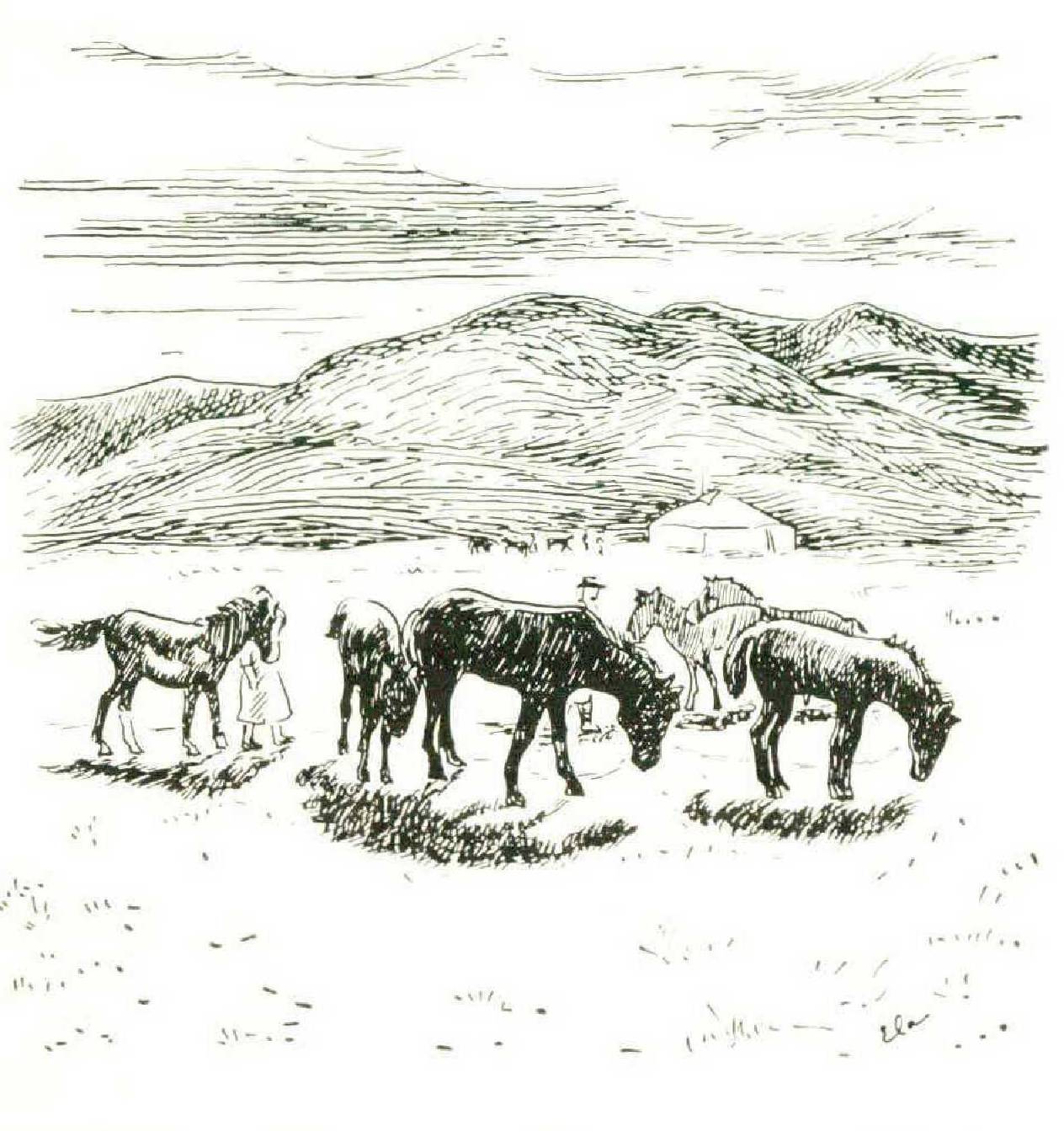
We visited a herd of 600 mares, a unit belonging to a negdel. The man in charge, heavy-shouldered, thick-bodied, short-legged, had concentrated in him, I thought, more of the old Mongolia than any other one man we met. He gave the impression of not particularly caring who ran Mongolia, as long as he was allowed to handle his herd the way it ought to be handled, and of thinking rather well of the present government, because it let him do just that. His mother, eighty-seven years old‚ belonged to the past and was not ashamed of it. She was a chavgants, a woman who after the change of life has shaved her head and is considered a “female lama” — that is to say, something like a nun, but still living in the family and tending the family altar.
In the old Mongolia the employment pattern was extremely uneven. Tens of thousands of monks sat idle in the monasteries, but at the same time children, since they did not go to school, were available for most of the routine work of herding. Untold working hours — mostly put in by women and children — were spent in trudging around the steppe to pick up dry cow and camel dung for fuel. When, in summer, riding through an empty landscape, you came across an enormous stack of dry cow dung, squared at the sides and plastered on top to keep out the rain, you knew that someone had prepared it for his winter camp. Cow dung is good fuel, but in the busy Mongolia of today nobody has the time to go out and gather it if wood or coal is available. An urban concentration like Ulan Bator, with its 160,000 people, would be impossible without its nearby coal mine; and in the cooperatives, going to the forest for fuel or building timber is an important job that somebody has to do. To be done efficiently, it has to be organized.
This and all other kinds of intermittent work, like shearing, driving herds to a slaughter point or export point, putting up a building, rough-andready road making, or bridge building, are done by a birigad, in which everybody will recognize the international word “brigade.” A birigad is a task force organized for a particular job and disbanded when the job is done. Even though the men who work on this job belong to the cooperative, they sign a contract for that particular job, and the “labor days” credited to each man go down in the accounts. Estimating the cost, checking over the work lists to see who can be spared for assignment to a particular birigad. and agreeing on the incentive bonus for above-standard work or completion of the contract ahead of time represent a concept of work and of the relation of the individual to the group and a complexity of organization quite unknown in the old Mongolia. This is a real part of the revolution which changes the character of a society.
ANOTHER part of the revolution is the complex of activities which gear the cooperatives into the national economy. All of these are traceable to Russian originals, but have peculiarities which derive from Mongolian conditions. First of all, in a vast country still short of the rail and truck transportation it will someday have, manpower and transportation cost must be conserved as much as possible in delivering the output of the cooperatives to the state trading agencies, woolwashing plant, textile mill, meat-packing plant, and so on. This is done in the following way. The cooperative organizes its own birigad for short-haul delivery to an intermediate point, the ‘“preparation” station — what we would call a processing station. Here wool, hair, manes, tails, hides, and furs are sorted, graded, given a preliminary or intermediate cleaning if needed, and turned over to the trucks of the state transportation agency for long-haul delivery.
Some small-scale haying is done by the cooperatives themselves with horse-drawn machines, but large-scale haying, plowing, and harvesting are done by contract with a special state agency, the MTS. or Machine and Tractor Stations. As in Russia, these stations developed out of a double need — the shortage of machines and the need, in an undermechanized country, to train men in skilled maintenance as well as in simply driving the machines. I might add that in my opinion pastoral nomads, though most people think they are more primitive than farmers, master the machine more quickly than peasants do. because they know that maintenance is all-important. Horsemanship is not just galloping across the country; it means knowing how to look alter the horse; and if you are going to move livestock on a long drive, knowing what to do with the lame animal is good — but it is better to see to it that the animals do not go lame.
In 1956 there were only 4 MTS, serving 15 negdel. By 1960 there were 36, serving 180 negdel, many of them bigger negdel because of the mergers that I mentioned previously. Serving fewer but bigger negdel greatly increases efficiency in the use of machinery. With the plowing of enormous additional tracts of virgin land, the importance of the MTS will be still further increased. In 1940 only 66,000 tons of hay were cut and the grain harvest was 14,900 tons, but by 1960 production figures were about 1,477,000 tons of hay and 256,000 of grain. In 1957 there were 199,000 acres of plowed land, which by 1960 had risen to 6,372,000 (a figure which the government plans to triple by 1965). The planned new plowing has already begun, with the receipt in the last two years of several thousand more tractors from the Soviet Union.
This tendency toward delegating special functions to special units is balanced by a tendency, within the negdel, to do more things for themselves. As they prosper and the number of trained mechanics in their membership increases, they invest in their own trucks, cars, and four-wheeldrive jeeps, liven within a negdel’s own domain, a short-haul truck releases men from the work of driving strings of oxcarts or leading caravans of camels.
Again following the Soviet example, the Mongols have state farms, on which the labor force is wage earners, not profit-sharing members. State farms are multiple-activity centers of experiment, innovation, and technical improvement. Instead of depending on the MTS, each farm has its own pool of machinery, and the farms engage in rainfall farming and irrigated farming, in which they experiment with food crops, and livestock breeding‚ in which they experiment with crossbreeding with imported stocks and the improvement of native stocks by selective breeding. It is obvious that the danger of running into heavy erosion and dust-bowl losses in plowed agriculture is to an important degree insured against by the operations of such farms, which are directly under the state and its scientific institutions and in a position to report promptly the development of an adverse trend.
In 1960 there were 35 state farms, with 480,000 acres under cultivation — 77 percent of the total cropland of Mongolia. In livestock they go in for quality more than quantity. They own no more than 475,000 head, as against the 17 million head in the cooperatives and 5.4 million head privately owned by negdel members and industrial workers and government employees. The importance of the work done on state farms is shown by the fact that they invariably rank ahead of the cooperatives in such things as rate of breeding increase, weight of wool per sheep, and so on. It was on a state farm, after years of experiment, that a new breed of sheep was stabilized, the Orkhon, which produces more meat and more and finer wool than any of the old Mongolian breeds. State farms are also responsible for introducing artificial insemination.
OUTWARDLY, in spite of new agriculture, industry. and urbanization, many of the characteristics of the old Mongol life seem unchanged. In reality the whole society has been transformed — even the old pastoral economy. Up to 1921, 8 percent of Mongol families belonged to the aristocracy and owned 43.5 percent of all livestock, with an average of 2370 head per family. The 92 percent of all families who were commoners owned an average of barely 50 head per family, and, of course, there were many families who had no stock at all. Today, in one cooperative of 2000 people owning 80,000 head of stock, the average holding would be 40 head — not per family but for every man, woman, and child. Government statistics for all cooperatives record an average of 52 head per member (everyone over age sixteen) plus 15 privately owned head per member. In addition, each family has a cash income for the work done in herding, on birigad jobs and other jobs, the various kinds of work being equated with each other by the elaborate Soviet-style labor-day form of accounting.
In the Mongolian countryside the transformation and acceleration are in some ways not so obvious as they are in Ulan Bator; but they are there, and not only in the physical, tangible prosperity of more and better food, better clothes, neater, solider tents and houses. They are also reflected in the people’s pride in their achievements, their pleasure in showing foreigners what they have, and in talk about better health, education, and recreation. A number of recent writers about China describe an atmosphere of grim, unremitting toil and effort. That is not the atmosphere in Mongolia. The Mongols act like people who are confident that they now have the knack and the knowledge to tackle any problem that may come along and so are entitled to take the afternoon off now and then to go for a picnic.
In such an atmosphere it is not surprising that the overwhelming majority of Mongols — not just members of the Party and the government — consider the relationship with Russia a huge success; they think that their country is on the right course; they like it the way it is; they think that the present is much better than the past: and there is a buoyant optimism about the future. As in America in the late nineteenth century, people think that life is going to get better and better.
It is also true, and underlines the importance of not using blanket terms that muffle differences more than they reveal similarities, that what l have just said about Mongolia could not, of course, be said about each and every country that is under a government controlled by a Communist party. One has only to start calling the roll of names alphabetically: Albania, Bulgaria, China —why go further? And who knows what distinctions the ordinary person in North Korea makes when he compares his country’s relationship to the Soviet Union and to China?
Mongolia, like any other country, also has its historical heritage. Even the uniformity of Marxist thinking and the command of a Communist party to regard all other Communist-ruled countries as “socialist brothers” cannot make history in a hurry. In Poland there is a deeply rooted folk tradition that “the Russians — and the Ukrainians, and the Byelorussians, and the Jews, and the Germans — are not our kind of people.” Old hatreds and suspicions of this kind are hard to eradicate. In Mongolia there is one old tradition that you can always get along with the Russians, and another old tradition that the Chinese are enigmatic and somehow menacing, that you either have to knuckle under to them or stand them off. Relations between Mongolia and China are good. Mongols speak enthusiastically about the fact that having a Communist China on their southern frontier makes it no longer necessary to keep up a big army. They are cordial about the Chinese labor battalions which do so much of the building and road making in Mongolia. They would, I am sure, be distressed if they found themselves in an “Albanian” situation between Russia, on one side, and China, on the other. But the fact remains that man-to-man relations between Mongols and Russians are easy, while friendship between Mongols and Chinese is something that has to be worked at.
The Mongols know a lot about the Chinese — much more than we do. They have been in sideby-side contact with them for many centuries. On my last day in Mongolia we drove past a Chinese construction job. My companion, a scholar, began talking with the driver about the Chinese. The driver was just as much at home in that subject as the intellectual was. They agreed that the Chinese are the wonder people of the world. They can do the most brutal heavy labor, the finest handicraft, the most delicate art. Anything they do is planned and methodical; they have thought it out first. And they stick together.
In recent centuries the Mongols have felt more affinity for the Russians, specifically the Siberian forester-farmer-herdsman Russians, than for Chinese merchants and peasants. This does not mean that today they think of the Soviet Union and Communist China in either-or terms. I have seen it suggested that the Mongols might want to go along more closely with China than with Russia because the Chinese are Asians and the Russians are not. This is an illusion.
The Mongols do not particularly consider themselves Asians, and never did. There is absolutely no evidence, from the days when they were conquerors, that the Mongols thought of themselves as conquering or uniting Asia. They just defeated everybody they came across, and that included Russians, Poles, Hungarians. As far as Asia meant anything to them in the past, it meant the lands of the peasant cultivators, and the Mongols were not peasants. They were horsemen, herdsmen, nüütel uls — people on the move.
With an independent history of their own, I believe that the Mongols today do not want to have to choose between the Soviet Union and Communist China. Why should they want to compete antagonistically with one side against the other side? Of course, they repeat the usual slogans of a competition with capitalism, in which capitalism will be defeated, but what they really want is friendly relations and trade, even with the capitalist countries, as long as it is understood that they are interested in new friends in addition to old friends, not instead of old friends, and are not looking for a chance to break away from their Soviet alliance.
As things now stand, they are closer allies of the Russians than of the Chinese, and have been for a long time, What they want most, l am sure, is continuing cordial relations with both their giant neighbors, combined with a nationalism at home whose ambition it is to fill Mongolia with a rapidly growing Mongol population and to raise the materia! and intellectual level of that population to a proud place in the world culture.
As for the rest of the world, there is more eager curiosity about America than about any other country. Many Mongols talked to me and my wife about the possibility of diplomatic relations with the United States, and cultural and economic relations too, and always enthusiastically. They are convinced that they can learn a lot from us, not only in science, technology, and industry, but also in their own special historical occupations, livestock breeding and range management.
The Mongols have been lucky so far in the adjustment the Russians and the Chinese have made between ideology and great-power interests. Russians and Mongols know as well as the Chinese themselves how decisive the victory of the Chinese Communists was. They know that in spite of present difficulties and setbacks, nothing can now stop the Chinese from becoming one of the greatest nations of the world — a leading nation in thought, invention, discovery, as well as power.
For the time being, it would seem that the Soviet Union and China, tacitly acknowledging their grave conflicts of interest elsewhere, have agreed that things would only be made worse by rivalry in Mongolia. Whatever happens, increased communications with each other are an imperative need for both the Soviet Union and China, and it is better to have those communications run through a rapidly developing Mongolia than across a backward waste. There is so much to be done in development economics that the aid program of the two countries in Mongolia can be made complementary instead of competitive.
MONGOLIA has more than 6000 students in higher institutions, and it is claimed that in ratio to total population this establishes a standard higher than that of West Germany, not to mention a number of other countries less industrialized than West Germany—Italy, Japan, Turkey, Pakistan, and Iran. Doubtless this is true, but Communists, like others, like to present statistics in the manner most favorable to themselves. This high general average does not mean that Mongolia comes anywhere near being in the same class as West Germany in discovery, invention, and advanced research; but it does mean that intellectual life in Mongolia is exciting, diverse, and vigorous. The Mongol intellectual is a man who is confident that there is nothing in the world of the mind that he cannot tackle, and invariably, in my experience, the very highly specialized man has interests beyond his special subject that range far and wide.
It is common to plunge into the description of such phenomena of rapid development with picturesque journalistic phrases about the descendants of Genghis Khan’s savage warriors now flying jet planes. This is altogether wrong and misleading because it exaggerates the barbarousness and ignorance of the Mongol past. Mongol revolutionaries have themselves contributed to this distortion because it was fashionable at one time to decry and denigrate the whole past in order to make the revolutionary present look brighter and the future more promising.
The truth is that Genghis Khan himself, though he never learned to read and write, not only respected men of brains and knowledge but knew how to use them. From the moment their conquests brought them into contact with the cultures of China and Iran, and, more distantly, the cultures of India and the Arabs, the Mongols began to develop what can fairly be called an intelligentsia, partly within the ruling class and partly in the service of the ruling class; and Kublai Khan, grandson of Genghis, was probably as well educated and cultured as any European sovereign of his time.
More than a hundred years ago, in the introduction to his Mongol-Russian-French Dictionary, the great Kowalewski, a political exile from the Russian-ruled part of Poland who later became thoroughly Russianized, paid tribute to Mongol scholarship. He noted that the original stock of the Mongol language is the vocabulary of herdsmen and hunters. With the introduction of Buddhism and the translation into Mongol of Tibetan and Sanskrit texts, “nomadic expressions had to be adapted to abstract ideas.” The priestly translators, he says, “conscientiously fulfilled their task, rarely borrowing foreign words and making every effort to provide expressions of their own when they could do so without altering the text.”
Another intellectual influence came in with the translation of some of the Chinese Confucian classics, and also — even in the first half of the nineteenth century — Western ideas had begun to have some influence through the translation of Christian texts and proselytizing literature and of scientific knowledge “current among the Asian peoples in contact with Europe.” There were, it should be added, Mongols who wrote, and wrote well, in Tibetan, Chinese, and Manchu as well as in Mongol, and by the end of the century there was an increasing flow of knowledge of all kinds from Russia.
Mongol, having made the transition centuries ago from a folk language to a language adapted to any kind of sophisticated use, has a seasoned vitality and beauty. The Mongols love it as the French love their language, and they are jealous of it and like to hear it well spoken. It has a rich heritage of epic poetry, folk poetry, folklore, and proverbs, and a varied repertory of styles — the archaic, the ceremonial, the sentimental, the militant, the elevated discourse, the earthy and pungent, the exact and tightly argued.
Like all languages under twentieth-century conditions, it is borrowing a great many new words. It is my impression that more words are borrowed from the international vocabulary of Greek and Latin derivation than from any one language, like Russian or Chinese. Not infrequently a word is borrowed for a time and then dropped. Years ago Mongols in Outer Mongolia used to say “aeroplan,” while those in Inner Mongolia used the Chinese word “fei-chi” now most people use a Mongol word meaning simply “the thing that flies.”
Changes in language are only part of what is happening in the world of the mind in Mongolia, My wife and I have been in Poland and Czechoslovakia and also in the Soviet Union, and, of course, we have heard Marxism discussed in many countries in Europe as well as in our own country, but Mongolia was our first experience of a battlefield which Marx has conquered without a battle.
Marx. Engels, and Lenin were all born into the middle class. They hammered out their beliefs and their principles of action only after they had decided what was wrong in that which was accepted as right in the families into which they were born, Marxism, or Marx-Leninism, came out of debate, and the debate is still going on.
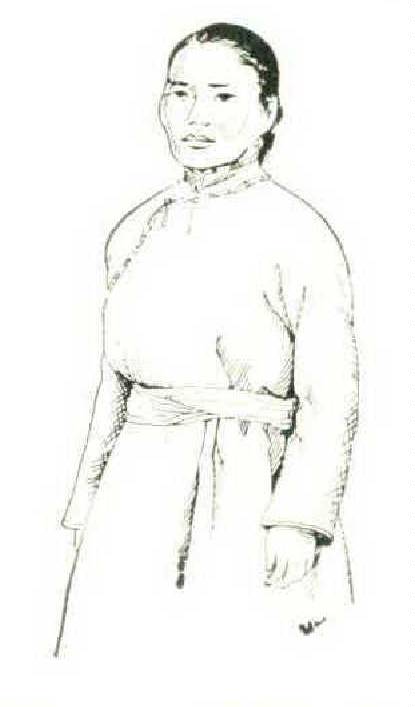
In Mongolia there is no debate. I have referred before to the fact that there was no Mongol middle class, only an alien Chinese middle class (at a low stage of “bourgeois” efficiency), which was disliked and driven out and which nobody would want to see come back. To try to debate whether a ruling class of feudal princes and Living Buddhas could industrialize, mechanize, and modernize their society better than a socialist government could would be ridiculous.
To debate whether a Mongol middle class could have been created and, if created, could have done better than the People’s Revolutionary Party and the present government is to argue at a disadvantage, because the Mongols have had no contact with a progressive middle class or an efficient capitalism. The middle class of czarist Russia was of poor quality, and in any case, the best representatives of the middle class and the bourgeois intelligentsia in Siberia were the political exiles, who were all anti-czarist, even those who were not Bolsheviks. The Chinese ruling class and middle class of warlords, landlords, and merchants were even less attractive.
Nor does the Lama Buddhist religion offer an alternative revelation to the Mongol intellectual or the Mongol who has a warm feeling for his fellowman. In the United States we have a community of several hundred families of Kalmuk Mongols, adherents of this religion. In their old homeland in Russia, near Stalingrad (now Volgograd), the religion was dying out fast. When these refugees settled in America as displaced persons, the religion revived, because it became the symbol and vehicle of community loyalty and mutual help during the difficult period when individuals and families were adjusting to a new language, new kinds of employment, and new living conditions. It remains to be seen whether, in the American environment, the religion can perpetuate itself by recruiting a new generation of young lamas.
In Mongolia, the religion has no such appeal. In the nineteenth century it did not go through the searching debates about, and sometimes difficult adjustment to, the new discoveries and theories of science that shook the Christian churches but that, once the adjustments had been made, left them better fitted to survive in the twentieth century. It is therefore burdened with dogmas which are of antiquarian interest but not compatible with scientific thinking. It shut itself off even more tightly from the intellectuals by its insistence on the Tibetan language. The great translations into Mongol of the evangelizing period were forgotten, and a shabby standard was tolerated under which a few scholars really mastered the Tibetan texts, but hordes of lamas, using the Tibetan alphabet phonetically, were only able to gabble the prayers without understanding them.
When laymen attended a service in a temple or monastery, they came to be awed and to bask in some kind of divine or magical emanation from the ritual, sometimes enhanced by the presence of a Living Buddha. There was no such thing as a sermon delivered in the common language, exhorting people to good conduct or charity. The religion taught that for a man to make himself poor, at the expense of his family as well as himself, by giving all to the church was good. It did not teach that the church had any obligations toward the society in the way of charity, of secular education. of care for the sick, the aged, or the orphaned. Indeed, it could not teach any such thing, for these activities were of this world, and it was a basic doctrine that religion is not oi this world but stands against it, holding up the ideal of Nirvana, the ultimate escape from the Material into Extinction.
One of the most important weaknesses of the old religion was that, unlike Christian religions which oppose Marxism, it was not closely associated with the family. It was, in fact, hostile to the family. The best way to teach a boy religion was to take him away from his parents and put him in a monastery. The church regarded sex as sinful. Marriage is a regularization of sex relations. Therefore, the church only tolerated marriage from a distance and did not sanction it with a religious ceremony. Some lamas even believed that homosexuality was less sinful than sex relations between man and woman, because it did not lead to procreation and thus to the perpetuation oi sin.
IN THE wider reaches oi intellectual hie — history, sociology, literature, art, music I have the impression that lack of competition from other systems of ideas leads to a good deal of rather naïve Marxism. I hope the many friends I made in Mongolia will not think that I intend this in any slighting or patronizing way, because the truth is that I find it rather refreshing. For example, Marxism emphasizes the mode of production and class conflict. The Mongol scholar says, “Why, of course. Our mode of production was pastoral, that of the Chinese was agricultural. No wonder we were different. And as for class conflict, let us look for it in the career of Genghis Khan and for differences in class structure before and after Genghis.” Without reading, seeing, and hearing a lot more I should hesitate to speak as an authority on novels, short stories, poetry, painting, the theater and opera and cinema, but my impression is that the Mongols have suffered less from the banalities of socialist realism than the Russians have. If I am right, then I suspect that the reason may be that the dull and boring qualities of socialist realism can lie ascribed in part to a propaganda pressure to convince Russians that all kinds of things formerly done or believed in or accepted as right in a bourgeois way within a bourgeois society ought to be made over in a socialist way within a socialist society. But not only had the Mongols never had a bourgeois society; they had never had some of the things that exist in both a bourgeois society and a socialist society.
The Mongols had had religious sculpture but no decorative sculpture for homes or monumental sculpture for public places; they had had religious painting but no representational or abstract painting. They had had folk music, court music, and religious music but no orchestral music, and no instrument as complicated as a piano or organ. They had neither opera nor ballet. They had had religious pageants but no theater. They had had wonderful epic poetry and folk poetry, but no lyric or romantic poetry. They had no novels or short stories — though one Mongol in Inner Mongolia had written a famous novel in the Chinese manner which exists in both a Chinese and a Mongol version.
Socialist realism, therefore, though imitated, seems to me to have been subordinated to a Mongol renaissance, an extraordinary outburst of creativeness and intellectual vigor. For the Mongols the real problem often was not whether a thing should be done in the bourgeois way or the socialist way but whether it could be done by Mongols at all. The mastering of new techniques and genres — leaping instead of evolving into the twentieth-century intellectual world — had for the Mongols the excitement of creative effort, even when it was imitative. Translation was one of the intellectual ferments, and it would be absurd to think that only propagandists material was translated. In any case, that which has a propagandists tendentiousness related to a particular phase wears off, while the great intellectual stimuli have not only initial impact but enduring influence.
Both Pushkin and Shakespeare have been translated and staged. A photograph of one of Mongolia’s leading operatic stars in the role of Otello was prominently hung in public places in the summer of 1961. And D. Natsagdorj, one of the translators of Pushkin — himself sometimes called “the Mongol Pushkin,” both because of the beauty of his poetry and his versatility — also translated Edgar Allen Poe’s The Gold Bug. If you are an American, you may well ask, why Poe? And if Poe, why The Gold Bug? The answer is, I think, that the Mongols were, and still are, exploring in all directions.
Several Europeans who were in Ulan Bator in 1961 wondered whether the present enthusiasm for Russian ballet, opera, and music might not contribute to a subordination of the Mongol culture to the Russian culture. In fact the cultural adaptation is rather complicated. In all these arts, the Russians themselves have been influenced by Oriental and especially central Asian cultures; this is one of the reasons why Russia is different from the West in its ballet, opera, and music. The Mongols know this and find it intellectually stimulating. For them, the mastering of these techniques goes beyond simple adaptation to Russian culture; it is rather their own readaptation of that which others had previously adapted.
In the same way, it has long been known that the special Chinese theatrical form called Peking opera was very strongly influenced by the Mongols during their period of rule in China in the thirteenth and fourteenth centuries. But just what were the influences, and to what extent were they blended, perhaps, with Persian and other nonChinese influences? Mongol scholars today are attempting to show that a very difficult research problem can be handled by a Mongol student of Chinese history and culture as well as, or better than by a Chinese student of Mongol history and culture. Mongols scorn the idea that their culture is so inferior that it always was and still must be a taker and never a giver.
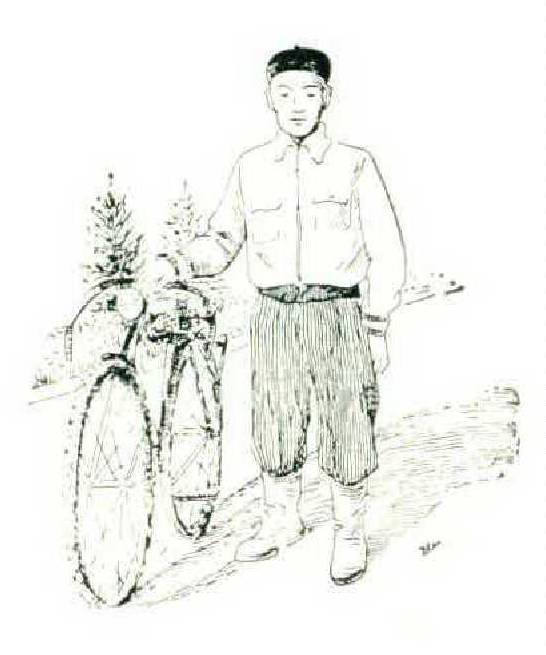
At Tsetserlcg, on our way west from Ulan Bator, my wife and I saw a film the title of which can be freely translated as “Horseback Is All Right.” It opens with two young men, good-natured rivals. One revels in the old life and the old ways. He can ride the wildest horse, is clever with the Mongol pole-lasso - a skilled horseman. The other has a motorcycle and is the partisan of everything new.
Enter the girl, very pretty. She is driving the ambulance which the negdel has just acquired. At once the rivalry between the two young men reaches, to put it dialectically, a “higher plane.” They go into a frenzy of competition, each one showing off his prowess in his own line. Anyone who has seen a few old Soviet films knows the answer. The machine triumphs. The inadequacies of the old, backward way of life are shown up. But wait.
The girl is driving her ambulance across country — not too fast, because there is no road, only cattle trails. Horseback Is All Right gallops beside her, showing off, and proving that a machine is not that much better than a horse. Now he is ahead, now alongside, now behind. His horse steps into a hole and falls, breaking its neck. The girl stops and offers him a lift home. Disconsolate but proud (he loved that horse), he refuses the lift and trudges home, saddle on shoulder.
The next day, without a horse, he has to go out herding yaks. He rides a yak. People jeer at him. But then the girl, out driving her ambulance again, stalls at the ford of a small stream. Wheels spin. Car can’t make it. Mr. Motorcycle comes along. That’s simple. He hitches a towrope, to tow the car out — no good. Car and motorcycle together can’t make it. It is the turn of Horseback Is All Right. He hitches up a couple of yaks and triumphantly pulls the ambulance out.
There are more sequences of ups and downs, including some to prepare the audience for the new morality by showing that the affections of Motorcycle are not as stable as those of Horseback Is All Right. Motorcycle will fall for any girl, if she’s in some new kind of job. Horseback Is All Right is a bit dumb, but he’s a dependable type.
Then the grand climax. Blizzard — sensationally photographed. The cattle stampede, running before the storm. If they aren’t turned, they’ll scatter, and losses will be disastrous. Engine roars. Motorcycle dashes off, depending on speed. Snowdrift. That’s the end of that. Horseback Is All Right, slower but riding with courage and skiII, knows his cattle. Don’t frighten them, but turn them, turn them. He rounds them up. Situation saved.
My memory is a bit blurred here; I was having such a good time laughing. But I think that Motorcycle has to be rescued and that both Horseback Is All Right and the girl have a hand in it. Anyhow, Motorcycle is no longer deus ex machina, but machina is still in it, as the ambulance — and the one who gets the girl is Horseback.
Moral: Don’t get mixed up over this controversy about whether the old is better than the new, or the new better than the old. We need both. Marry them to each other.
A wonderful country, Mongolia, and the Mongols are wonderful people.
The illustrations have been drawn by Mr. Lattimore’s sister, Eleanor Lattimore Andrews, who is the author and illustrator of forty-two books for children, published under her maiden name, Eleanor Frances Lattimore.