Noah and His Flood
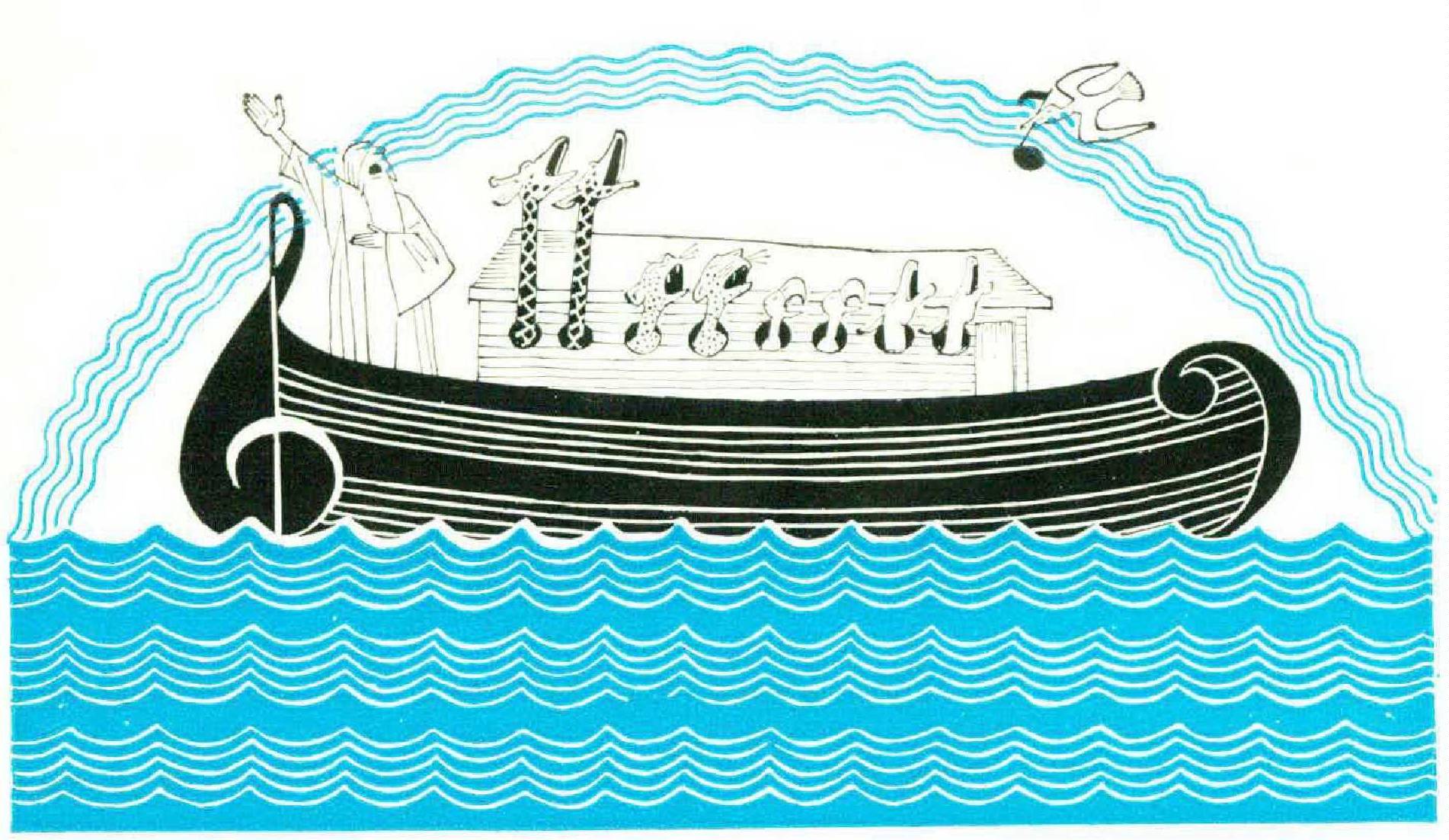
More than any other Old Testament patriarch, Noah seems to exert a fascination for modern composers. The skipper of the Ark has always led a flourishing musical existence in Negro spirituals and other unsophisticated songs, as attested by such numbers as “Didn’t It Rain, “Old Ark’s a-Moverin’,” and “Ol’ Man Noah Knew a Thing or Two.”But nowadays he has been discovered by the likes of Igor Stravinsky and Benjamin Britten, who have been impelled to explore the musical and even the philosophical depths of the ancient legend of the Flood.
Stravinsky selected the Noah story for one of the most widely heralded and thoroughly publicized compositions of his life — the dance drama which was commissioned by the Columbia Broadcasting System earlier this year as a kind of public celebration of his eightieth birthday. The resultant television production, which stretched a twenty-three-minute work into a sixty-minute show bv means of various interpolations, commercial and otherwise, was not generally accounted to be either a broadcasting, balletic, or musical triumph. The critic of the New York Times remarked the next day that the program “was enough to retard the progress of the arts in this country by a great deal,”and even the composer’s warmest admirers were somewhat embarrassed by The Flood’s manner of presentation.
Stravinsky’s work, shorn of its shampoo commercials, its pretentious preliminaries, and its masked dancers, has now been released in recorded form (Columbia MS-6357, stereo: ML-5757, monaural). Almost simultaneously another contemporary setting of the Noah story has made its first appearance on records — Benjamin Britten’s Noye’s Fludde (London OS-25331, stereo; 5697, monaural). Both share a common textual origin, not only in the Book of Genesis, but in the medieval miracle plays about the Deluge which were presented — appropriately enough, by the Watermen’s Guild — in Chester and other towns in Britain during the fifteenth century.
Considering that they deal with the same subject, Britten’s and Stravinsky’s musical versions of the story of Noah and the Ark are about as far apart as two musical works can be, further apart even than the idioms and techniques that separate the two composers. Stravinsky s Flood was commissioned for television; Britten’s Fludde was designed to be presented in church. Stravinsky’s is couched in modern tones and textures, and written for performers who can cope with advanced musical styles; Britten’s has its roots in the hymnal and basically is intended to be performed by children.
Behind the surface simplicity and seeming artlessness of the Britten work lie a dramatic vigor and musical freshness that seem, at least to this listener, to catch the spirit and surge of the Old Testament tale far more tellingly than Stravinsky’s complexities and sophistication. The Britten score was written in 1957 for performances at Orford Church in Suffolk during the Aldeburgh Festival. It was recorded during a performance in that church, with not only the children and adults of the cast but the congregation itself participating. And it conveys, in addition to the reverence and wonder that underlie the biblical tale, the ebullience, innocence, and sheer fun that were elements of the medieval miracle play upon which the libretto is based.
Noye’s Fludde is scored for two orchestras, one made up of adults, the other of children. The first consists of string quintet, recorder, percussion, organ, and piano duet; the latter of strings, recorders, bugles, percussion, and handbells. The lusty sounds of the children’s bugles and bells lend a bucolic atmosphere to the scene, so that one can well imagine the drama of Noah and the Ark being played out in the English countryside.
Adults and children also share the singing parts. Noah is played by the strong-voiced bass Owen Brannigan; Mrs. Noah by the mezzo Sheila Rex; and the Voice of God, a spoken part, is majestically intoned by Trevor Anthony. Nearly all the rest is left to the children, who impersonate Noah’s sons and their wives, and also make up a completely charmingchorus of animals.
Equally effective is the participation of the congregation of Orford Church, which, in the reputed manner of Bach’s congregations at Leipzig, is called upon to partake in the musical drama, rather than watch it passively. The work begins with the congregation singing the hymn “Lord Jesus, Think on Me” as Noah himself passes through the church on his way to the stage, where the Ark is about to be built. As the tale proceeds, the chorus of animals enters singing “Kyrie eleison”; Mrs. Noah riotously resists boarding the Ark, preferring to remain with her bibulous women friends, her “gossippes”; the Flood comes and passes; the animals file out, this time chanting “Alleluia!"; and the work closes with a final hymn of thanksgiving, sung by all within the church.
But the most thrilling — and that is the only word for it — moment of all comes when, in the midst of the Deluge, with all aboard the Ark praying for deliverance, the massed voices of the congregation break in with the hymn “Eternal Father, Strong to Save" — “O hear us when we cry to thee For those in peril on the sea" — and the waters, as if in answer, miraculously subside.
Considering the special nature of its surroundings, Noye’s Fludde very likely may turn out to be a festival rather than a repertory piece. But it has eloquence, charm, and humor; and it catches the mood and emotion of the Flood story, even though all those bugles do seem a bit boyscoutish at times.
Noye’s Fludde, moreover, makes for a richly satisfying recording, with the words coming through clearly, the sense of motion caught admirably in stereo, and the exaltation and fervor of the participants pervading all. A well-printed brochure is supplied, enabling the listener to follow the text to perfection and even, if he is so moved, to add one more voice to the soaring hymns that help preserve Noah and his charges from the “restless wave” and “foaming deep.”
It seems highly unlikely, on the other hand, that anyone, now or at any discernible future date, is going to be joining in a chorus from Stravinsky’s Flood. To be sure, the eighty-year-old composer had no thought of writing a community sing. His work was conceived as a dance drama, with choreography by George Balanchine. The Flood is written mostly in the terse, compact, fragmented style typical of his recent compositions. That is the way Stravinsky is writing music nowadays, and for those who do not like it there is plenty of other music, including more Stravinsky.
7he Flood certainly makes a far stronger impression on records than it did on television. But despite its moments of grandeur (as when God speaks not through one voice but through two, performing in unison) and its graphic touches (as when the Ark is being put together both percussively and charmingly), Stravinsky’s score seems rather rarefied and arid, which is certainly the last thing that Flood music should be. It also seems to have little to do with Noah, either the Intrepid mariner or the biblical patriarch, and its relation to the medieval miracle versions of the story are textual far more than musical.
The Flood is performed by John Reardon and Robert Oliver, jointly depicting the Voice of God; Sebastian Cabot as Noah; Elsa Lanchester as Noah’s Wife; Richard Robinson as Satan; Paul Tripp as the Caller; and the Columbia Symphony Orchestra and Chorus, with both Stravinsky himself and Robert Craft listed as conductors.
The other side of the record contains another Stravinsky work of religious origins — one of his most serene, sensitive, and direct compositions, the Mass for ten wind instruments and mixed chorus, written in 1948. This is music in an authentic Stravinsky idiom, yet with a purity of line and transparency of texture that makes it beautiful to hear, and a religious sentiment that is as unmistakable as it is uninsistent. It is the second side of this record that gives it its luster.
With both Stravinsky and Britten finding grist for their musical mills in the old mystery and miracle plays, it seems appropriate that some of these ancient dramas are beginning to make their own way on records. True, the procession has not been exactly overwhelming. But one label, The Spoken Word, Inc., which addresses itself primarily to the educational market, though it by no means despises the commercial, has issued a whopping four-album, nineteen-disc collection of LPs devoted to a comprehensive survey of the English drama before Shakespeare (Spoken Word A-11, 12, 13, and 14, monaural only).
Among the works included is none other than Noah’s Flood, in a version put together from the Chester, New - castle, Wakefield, and Hegge miracle plays, which turns out to have plenty of gusto and life in its original spoken form. The entire set of albums, entitled “The first Stage, is a recording of an extended series of broadcasts given over the British Broadcasting Corporation’s Third Programme. The narrator, authoritative if a hit professorial, is John Barton, and the large east of actors is thoroughly professional. Explanatory textual data are, unfortunately, completely lacking; the recording is simply thrown at the listener, with breaks in the continuity occurring not only between sides, but even between albums.
In addition to Noah’s Flood, the contents include a range of works from early Nativity plays to Thomas Kyd’s blood-spatiered 7he Spanish Tragedy, which in this vivid presentation takes on an almost Shakespearean intensity. Also in the collection are two uproarious sixteenth-century farces, Ralph Roister Doister and Gammer Gurton’s Needle, the latter with all its bawdy passages, and with its refrain beloved of graduate students of English:
Both foot and hand, go cold;
But, belly, God send thee good ale enough,
Whether it be new or old.
Now, there’s material for Stravinsky or Britten to start working on.
Record Reviews
Barber: Adagio for Strings, Opus 11 BarTók: Roumanian Folk Dances Britten; Simple Symphony, Opus 4 Respighi: Ancient Dances and Airs lor the Lute, Suite III
I Musici; Philips 900001 (stereo) and 500001
These four string compositions may not represent modern music at its most typical, but they do constitute four presentable and enjoyable pieces whose lack of “importance” may be compensated for by their sheer listenability. Barber’s Adagio, with its lovely melody and clean lines, is almost a classic of modern romanticism; and Britten’s Simple Symphony, with its movements alliteratively entitled “Boisterous Bouree,” “Playful Pizzicato,” Sentimental Saraband,” and “Frolicsome Finale,” is quietly
elegant fun. The twelve expert musicians called I Musici play these pieces with suavity and skill. The Bartók and Respighi works also fall lightly on the ears, although those ancient lute dances do go on and on.
Castelnuovo-Tedesco: Five Pieces from “Phatero and I”
Frescobaldi: Passaeagli, Corrente Sor: Study No. 3, Study No. 17 Debussy: La Fille aux Cheveux de Lin; and others
Andres Segovia, guitar; Decca DL710054 (stereo) and 10054 With the world’s greatest guitarist in excellent form and some delightful new music making its debut, it may seem the height of contrariness to express disappointment in this record. It nevertheless represents an opportunity lost. Mario Castelnuovo-Tedesco has written a set of evocative and atmospheric guitar pieces illustrating scenes and episodes from Platero and I by Nobel Prize winner Juan Ramón Jiménez; and while we are given some of the musical portraits, we get none of the narration that is supposed to go with them. Since Jiménez’s little tales of the gentle donkey Platero are so captivating, it seems a pity that no effort was made to present words as well as music, whether in the original Spanish or in English translation. Castelnuovo-Tedesco’s music, too, is of such aptness and flavor that one wishes more than five of the original twenty-eight pieces had been included. Platero was entitled to meander over two faces of a record without being crowded off Side Two by such interlopers as Frescobaldi, Sor, and Debussy.
Debussy: Petite Suite
Satie: Trois morceaux en forme de poire Chabrier: Trois raises romantiques Fauré: Dolly
Robert and Gaby Casedesus, pianists: Columbia MS-6523 (stereo) and AIL5723
Charm and good spirits abound in this collection of French music for piano, four hands. Each piece is an expression of youthfulness, whether exuberant, as in Fauré’s Dolly (a work for children); dashing, as in Chabrier’s Valses; prickly, as in Erik Satie’s “pear-shaped” pieces; or pictorial, as in Debussy’s Petite Suite, which is usually heard in Busser’s orchestration. The style in the stereo epoch is for four-hand piano works to be recorded on two keyboards, thus injecting exaggerated sound separation. Judging from the wellblended, natural tones heard here, the Casadesuses have played this music the composers’ way rather than the engineers’.
Gilbert and Sullivan: The Gondoliers Bnrnand and Sullivan: Cox and Box
Isidore Godfrey conducting New Symphony Orchestra of London and D’Oyly Carte Opera Company, with Mary Sansom, Jennifer Toye, John Reed, Kenneth Sandforth, Joseph Riordan, Donald Adams, and others; London OSA-1323 (stereo) and A-4351: three records After a period of apparent decline, at least on records, the D’Oyly Carte Company seems to have regained its old punch and panache, as attested by a glittering performance of The Gondoliers, possibly the most musical of all the Gilbert and Sullivan works. Since the current scries of recordings includes spoken dialogue as well as sung passages, one is enabled to savor more satisfy - ingly than ever the Venetian adventures revolving about the Duke of Plaza-Toro, that noble Spaniard who led his regiment from behind — he found it less exciting. Cox and Box is Sullivan without Gilbert, the libretto being by F. C. Burnand, his first collaborator on comic operas. Although it was eclipsed by the later masterpieces, in the theater it still makes a cheerful curtain raiser, and on records an amiable albumcloser.
Courting and Biddle Songs
Jean Ritchie and Oscar Brand, folk singers; Washington WLP-706 Two folk singers are sometimes twice as good as one, and the vivacious and stylish singing of Jean Ritchie and Oscar Brand is further enhanced by their choice of some fresh and engaging material. “Riddle Songs” are songs that pose questions such as “How can there be a cherry without a stone?” or “Who killed cock robin?” “Courting Songs” are, well, courting songs. The fifteen songs on this record, whichever heading they fall under, are tasteful and tuneful, and well seasoned with wit. Among other things one learns that the old nursery song “What are little boys made of?” has additional verses to cover the ages of man. For example: “What are old women made of? Moans and groans and achin’ bones; that’s what old women are made of.” Mr. Brand, incidentally, plays a lively guitar, and Miss Ritchie a gentle dulcimer, while a third party named Dave Sears weighs in with a driving banjo.