The Buggy on the Roof
“The children who come to my door will remember All Hallows’ Eve as a night when they sold their right to rebellion for some sugar in expensive wrappings.”
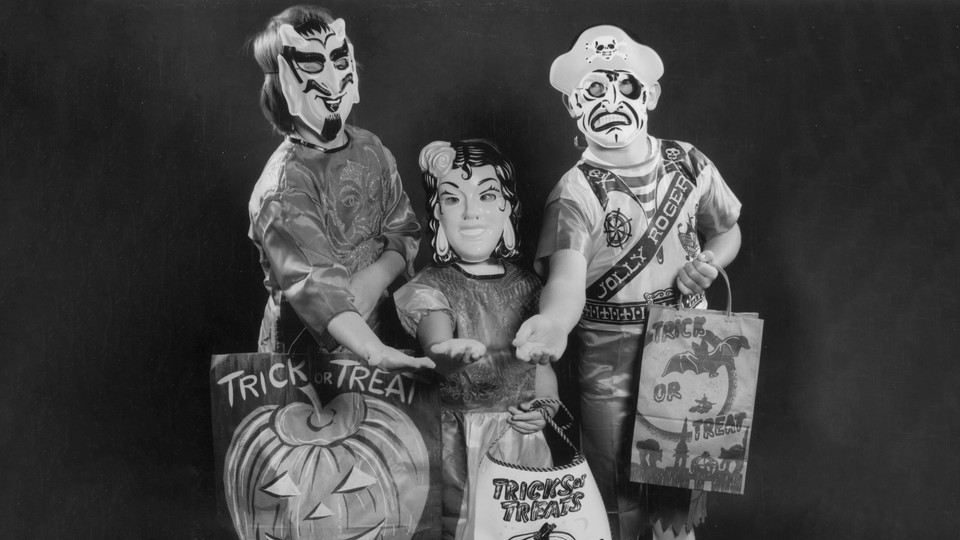
IN 1935, the year of ray memorable Halloween, nobody in Cleveland, North Dakota, had ever heard of trick-or-treating, that apologetic form of annoying neighbors, subsidizing candymakers, ruining teeth, upsetting stomachs, and cheating red-blooded human sprites. The contrast between what I did as a child and what my neighbors’ children do now makes me embarrassed for them as they shuffle about in the brisk night under my porch light, dressed in the costumes of television cartoon characters, begging treats and also begging pennies for some admirable charity. (It would seem that every modern childish pleasure must have its “constructive aspects.”) For my part, I would much rather participate in Halloween, now that age relegates me to the side of Authority, by doing my best to scare the daylights out of somebody I can catch tricking me—the way I was scared by a drunken old man with the biggest shotgun in the world.
The children who come to my door will remember All Hallows’ Eve as a night when they sold their right to rebellion for some sugar in expensive wrappings. I think they ought to remember it instead as a night when they worked off a good deal of normal human anarchy before it could do them or the rest of the world too much damage—the way I did as a third-grade anarchist.

That year, perhaps because I felt I was outgrowing the talk of my classmates in our three-grade primary room, I had taken to eavesdropping on the conversations of my ciders. For at least three weeks before Halloween I would hear the big boys in the eighth grade talking at recess about how they were going to “fix old Englehart and old Merry.” Mr. Englehart was the strong-armed principal of our twelve-grade school, and Mr. Merry, as dour a Scotsman as ever bore the name, was the vice principal and teacher of the seventh and eighth grades. Gloria Merry, his daughter, was my best friend in the third grade, and nobody could have been more impatient to see what was going to happen to her father than she was. Since I lived on a farm some distance from town, she invited me to spend the night with her, and my mother innocently consented to my celebrating Halloween “with my little friends.”
Gloria’s brother Walter was two years older than we, and he formed a tenuous link between us and the big boys. He knew, for instance, that a group of them planned to meet down at the abandoned livery stable around seven o’clock, and thither we went as soon as we could escape the supper table. The sun had set more than two hours before, and it was very dark and very cold. It was too early for the great harvest moon, which rose conveniently late that night. We startled the plotters when they discovered us skulking at the heavy, splintered doors, but they allowed us to come into the stable. One of them advanced upon us ferociously, his face eerie in the glow of the flashlight he held, and said, “You know what’ll happen to you little kids if you get caught? They’ll put you in jail. And if they put you in jail and torture you till you tattle on us — well, you just better stay there, that’s all. Because if they let you out after you tattle on us, we’ll just kill you, see? So just don’t get caught, that’s all.”
I am a little nostalgic now, in this big world, for his conviction that in a town of less than three hundred souls there would be no ideas about the identities of the persons who had rigged buckets of water to fall at the touch of a hidden trigger, who had rocked privies off their foundations or switched the signs from the pool hall and the Community Methodist Church.
The boys had spread out around them the homely tools of mischief— the long wires, nails, hammers, pliers, string, flashlights, paraffin saved from the tops of their mothers’ jelly jars, knives for cutting a clothesline or carving out insults to the grown-up world, and tin cans filled with rocks for making a farewell noise after the damage was done.
OPPORTUNITIES sat waiting and vulnerable in the night. Even the two or three families who had indoor toilets had privies too, in deference to selfconscious guests. There were the town pumps, which would wear their handles high in the air the next morning — creatures built literally in the manner of Joyce Kilmer’s trees, each with a disjointed arm languishing above a dried-out, rasping leather throat, pressed against the earth’s nonflowing breast. The buckets of priming water would be overturned, and the parents who first came to use the pumps, having forgotten what morning it was, would have to trek back home to get the last quart of water from the pail by the sink. And there were the windows, some of which would still show wax the next spring. For we did use wax, not soap, and I would rather look back on the two or three good wax jobs I have done than on any number of store windows painted innocuously with tempera under the patronizing eye of a “cooperating merchant.”
We stowed away the equipment and flitted off into the blackness. There were no streetlights, and the only sounds we heard were those of our careful feet on the wooden sidewalks. Except for the pool hall and the service station out on the highway, all commerce ceased at six o’clock, and the boys knew that all the downtown businessmen would be at home finishing their suppers. By the time we had fixed up the restaurant, the dry-goods store, the blacksmith’s shop, my great-uncle’s hardware store, the post office, and the old car in front of it, the night was far enough advanced so that we could undertake more ambitious projects with minimum risk. We headed across the tracks to the Merrys’ house.
The boys made Gloria and me stay at the barn door when they went inside. We could hear the sounds of creaking floorboards and of iron-rimmed wheels rolling over straw. Out they came with the Merrys’ tattered buggy. They pulled a few fistfuls of wiry stuffing from the leather seats and tossed it at us. They had already propped a couple of stolen planks from the ground to the roof of a lean-to shed adjoining the barn, and now they boosted the buggy up the planks, ran it up the long steep barn roof, and set it astride the high ridgepole. In silent hysterics they clambered backward down the roof, slid off the planks, and shouldered them for use on old Mr. Englehart’s barn.
But Englehart, being better paid than Merry, had a sturdy lock between us and the buggy in his barn. And his privy had, of all things, a new cement foundation. We had to content ourselves with waxing his basement windows and stretching a wire at shin height between his kitchen door and his prudently reinforced toilet.
As we headed for the scattering of houses along U.S. Route 10, we saw that the dim yellow bulb was still burning above the two rusty pumps of Gerry Schlosser’s Super Service Station. Reasoning that where there was light there might be action, two of the boys slithered into the ditches on either side of the highway, telling the rest of us to stay back and keep quiet. We did not have long to wait. Old Gus Koch came weaving down the pavement, seeking more beer and fresh company now that the pool hall had closed. He shambled into the wire they were holding, staggered, recovered himself with the lucky oscillations of the drunk, and began screaming oaths into the empty night.
Schlosser ran out of his station, and Gus fastened on his arm. “By God, Gerry! Can’t nobody do nothing about them kids!”
“I’ll shoot the goddamn brisshes off their goddamn buttsh!” cried Schlosser. He ducked into his two-by-four office and came out with a shotgun. He waved it around in the light of his little yellow bulb, but he did not leave the station. He had no idea of where we might be, in all that great blackness of prairie, nor of how many more wires might be stretched out in the darkness.
We were safe, but the boys could not let the challenge pass. We waited until the two old men had squeezed themselves back into the tiny office, and then we headed for the privy fifty feet behind the station. Every year it was a little shakier. This year it offered scant resistance. It whined and groaned as the boys rocked it back and forth, and suddenly its one vital prop fractured with a terrible noise.
Schlosser rushed out with his shotgun just as the privy slumped down across its own ditch.
The boys vanished, Gloria’s brother along with them, and we were left running so far behind them that we had the nightmare feeling of not moving at all. The gun exploded in our direction— once, twice. Then again, when we thought surely we were safe—crash, CRASH !
Those shots were the loudest sounds I have ever heard in my life, and they seem to have driven from my memory any recollection of how we got together again with Gloria’s brother, or what we told her angry parents we had been doing.
I do, however, remember perfectly the wonderful satisfaction I felt when I saw pompous Mr. Merry’s shabby buggy silhouetted on top of his barn in the cold morning light of All Saints’ Day.
The buggy stayed there for at least a week, till Mr. Merry could round up enough friends to help him get it down again, and for all those days the force of Mr. Merry’s personality was quite neutralized by the craven attitude of his buggy, tensely clamping the ridgepole of his barn between its thin-spoked wheels, shuddering with acrophobia in the November gales.