A Tale of Happiness and Unhappiness
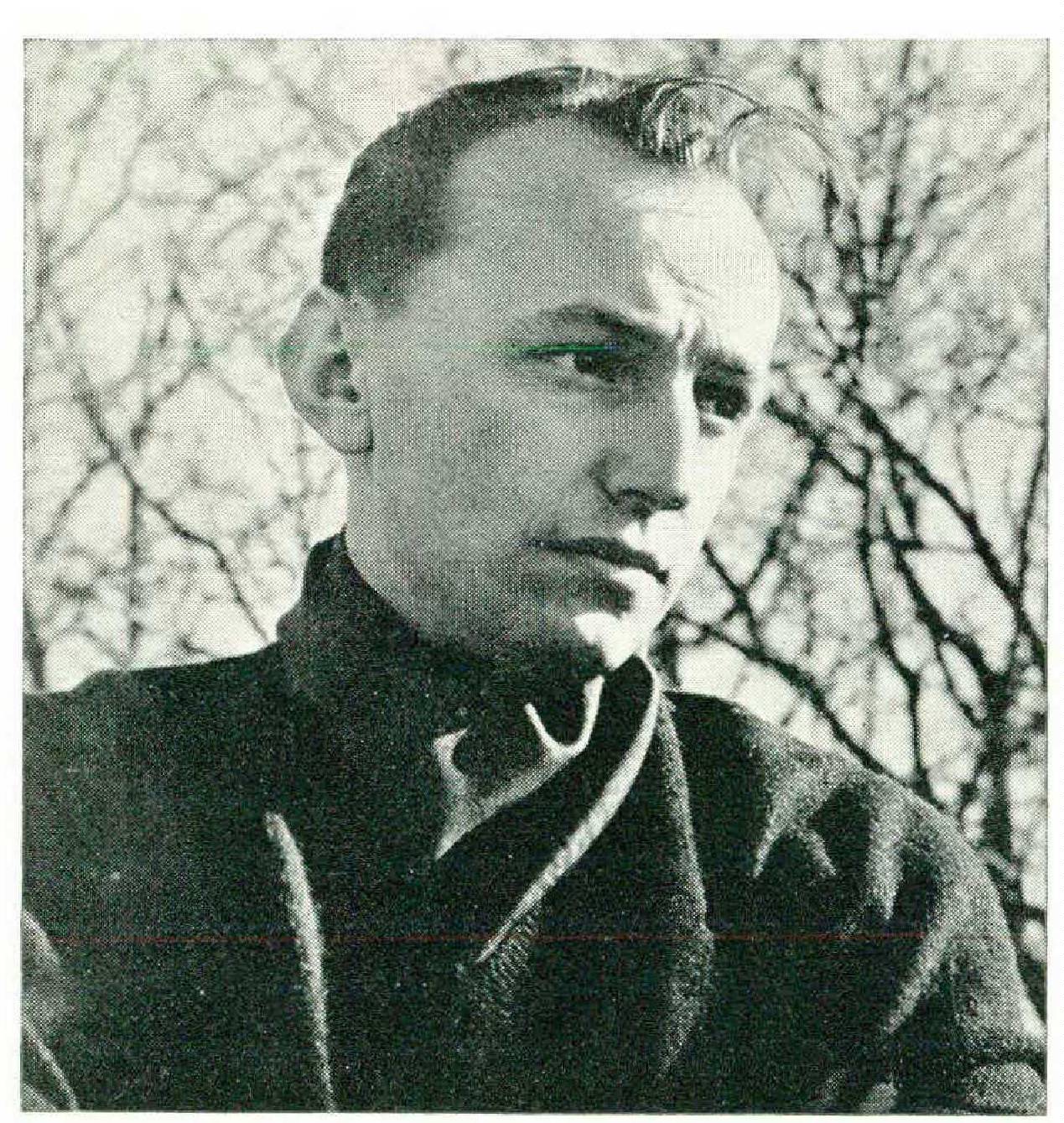
A student of Kafka and a lover of symbols, MIODRAG BULATOVIĆis a Montenegrin whose formal education did not begin until he was fourteen and who is today the most widely discussed young novelist in Yugoslavia. His latest novel, THE RED COCK FLIES TO HEAVEN,has appeared in eighteen foreign edit ions, and the American edition teas published this autumn by Bernard Geis Associates.
BY MIODRAG BULATOVIĆ
I’M NOT such a fool, I thought, as to go on sitting at the same table with these types. They’re none of them fit to wipe my boots. Look at that one in the corner, scowling and ugly with a big nose. And that one over by the door, and the one beside him. To be with them means being the same as them. And I want to be above them.
I gave my lunch to a stunted little baker. Then I grabbed the bundle concealed under my mattress and locked myself in the bathroom. There I was sure of nobody seeing me admiring my tie.
My God, I thought, aren’t I lucky to have a tie, a long silken tie with tiny white circles on it. No one, I reflected, had ever possessed such a tie. I recalled how, when I was a youngster, I had a neighbor who was like the man by the door or the one beside him, and he, too, had had a tie that was perhaps comparable with mine. But the neighbor died, and I went to his funeral.
I wasn’t the only one to be attracted by my tie. The girl next door opened her eyes as wide as if it had been a pile of sovereigns. “My, what a wonderful tie you’ve got, boy.”
And a neighbor was impressed by it too. “It’s worth a packet,” he said.
“More than that,” another neighbor exclaimed.
“You don’t often see such things,” a third said in amazement.
“It’s better than any of those that come from abroad,” my friends assured me.
“Someone will murder you for it. You’d better not go about unarmed.”
That’s what they said. One of them liked it so much he asked me to lend it to him for an evening, to impress a girl friend with it. People used to stop on the street, purposely, not just to look in the shop windows, but, as I say, they’d stop on purpose and sigh, and the women who’d never previously paid me any attention began to fuss over me. “You look wonderful in that tie, wonderful.”
“What’s it to you,” I’d ask, “if I look wonderful?”
“You know, that tie suits you marvelously,” they’d say.
“Let it! That’s my business. It’s me it suits, not you,” I’d say.
And I concluded that these women on the streets and the people who paused to look at me as I passed and the friends who assured me my tie was superior to anything from abroad were preparing and planning to get it from me. So I kept away from them all.
Unlike the ties in the shop windows, my lie had a history. My grandfather had charged my father to guard it as a rarity, and my father had said to me on his deathbed, “Whatever else you sell, son, don’t ever sell this, for if once you let it go. you’ll be unhappy. You’ll be finished, and our family will die out.”
At least, I thought, I’m being a good son and grandson for liking it so much. I’ve even brought it with me to the hospital, where one’s not supposed to have such things.
The orderly’s rough voice sounded in the corridor. The door closed on a storm of laughter. I’m used to people admiring me, and I need them to admire me here too, I thought. I’ll let these types see my tie. Then perhaps they’ll understand who they’re dealing with, and they’ll stop jeering at me. They won’t dare be rude to me.
I went into the room. They all spread their arms in amazement, as if they were greeting a dearest friend, as though they were about to embrace me.
A young boy came up to me. “What a smashing tie!” he said.
A man with mustaches jumped off his bed and looked at me piercingly. “Where’d you get it?” he asked.
“It’s better than Pa’s,” the boy said, popping in between us.
“I had it from my grandfather — that is to say, my father did.”
One after another, patients got up till they were all on their feet, those on the beds and under the beds, those who were holding onto the window bars and laughing insanely as well as the ones who had been gazing through the windowpanes. “Oooo,” they all exclaimed.
Now they’ll start behaving better, I thought. They’ll stop laughing at me. I saw their shaved heads crowding around me, and all those heads and eyes wanted to see my tie with its white circles.
THERE was one other patient I saw on a bed in the corner, sitting there in frozen immobility with his face between his hands. He avoided everybody, especially me. He had good reason for keeping away from me, since I’d struck him several times, but none of us could fathom why he swore at his wife and daughter when they visited him every Thursday and Sunday afternoon from two till four. I’d never once seen him smile. I don’t suppose any of the others had either.
Why doesn’t he get up to admire me too? I wondered. He should be made to, just as my friends made all the neighbors. He should be forced to sigh, spread his arms in amazement.
We all saw it. He got up, looked around him, rubbed his hand over his cheeks and the bald patch on his crown, and came toward us. We were all struck dumb. Someone stifled a boyish, bubbling laugh with his fist. It was a strange laugh, exactly like the neighing of a horse. I saw; he was looking penetratingly at me.
“What’s he clenching his fists for?” asked the boy.
I grew afraid. I wanted to shout, but his face expanded in a slithery smile. Smiling like that, I thought, he must seem not just ugly but revolting to the others too.
He caught sight of the tie and fastened onto it with the gaze of a drunkard. He giggled and brought his face close to my fists.
“What’s he smelling them for?” the boy asked.
We all saw and heard.
“Young man, where did you get such a wonderful tie from?”
I told him.
“You’re lying!” he snapped.
“I’m not. I got it from my grandfather — that is, my father.”
“You stole it. Why not confess?”
I began to explain how I came to inherit it. Staring at the tie, so that all of them could see, he began to laugh and shout. It was like the reaction of a drowning person who sees a rescuer approaching.
“The old judge is better,” said the boy in the corridor.
Some were glad to see the judge laughing, others were indifferent. I couldn’t have cared less.
“Will you give me that tie?” the judge asked in a whisper.
“No!”
“But why not, I ask you?”
“Because it’s a keepsake. I’ll buy you another tie.”
“But I want that one.”
“Well, you won’t get it.”
“And what if it happens to be mine?”
“That can’t be,” I flared at him, hiding the lie, “it just mustn’t be!”
But the judge put his hand on my chest. “Give it to me, please,” his fat face whined.
“What’s so special about my tie? What do you want it for?”
“Better not ask. I’ll go mad if I don’t have it!”
“You won’t,” I began in terror. “I’ll write my mother, and she’ll buy you another. If you like, I’ll tell her to bring a whole lot. But what is it you like so much about ties?”
“I’ll kill myself if you don’t give it to me,” he wept. “I’ll kill myself, this very day.”
I went over to my bed to escape him, and when he followed, I went over to the door. Then I clung to the bars at the window.
“Every night I dream about that tie, and —”
It’s strange about my tie, I thought, it really is. Ids extraordinary how these people want to part me from it, quite extraordinary. And I felt more attached to it than ever.
“And why don’t you dream about some other tie?” I asked.
“Only that one. I’m always dreaming of it.”
“Since when?” I asked.
“For years.”
“You saw it for the first time today. How could you have dreamed of it before?” I asked.
“I don’t know myself,” he said, “but—” A tear hung from his eyelid. “For God’s sake, give it to me!”
A strange feeling took hold of me. I nearly burst into tears. “Listen,” I said, “will you please leave both me and my tie alone? Ask me for anything else, but not that. Do you want money? Clothes? A woman? Whatever it is you want, I’ll get it for you, for I’m almost all-powerful, only don’t ask me for my tie.”
“If you give it to me,” he said, “all my suffering will be over.”
Yes, I thought, and I’d go mad, stark, staring, raving mad. They’d put me in an asylum, and I’d die there. I’d be destroyed, suffocated.
“Oh, give it to him,” the man with the mustaches said.
“He’s not mad enough to give away anything as valuable as that!”
“Give it to him. Look how he’s crying on the floor.”
“Drive a bit faster, friend,” said the little baker. “We’re late.”
“Give it to him,” said the mustached man.
“If you give it to him, he’ll get better.”
“He’ll be happy — everything will be happy — oh, so happy — it will be terrible — oh, it will be so terrible and so happy!”
I must be firm, I thought, they’re still not treating me as they should. They’re still being insolent.
“I won’t give him my tie, not if he drops dead this very minute! Do you understand?”
“You’re a lousy skinflint,” said he of the mustaches.
“What’s our altitude?” asked the baker.
“Oh, how happy he’ll be. Oh, how happy he’ll be! Oh, how terrible! He’ll give it to him, and he’ll laugh. Oh, how happy everything will be!”
The orderly came in. I dived under the bed. I saw the judge was frowning and covering his face with his fingers. It would be a long time, I thought, before he smiled again. The orderly gave him a shake, but the judge did not move. That evening he whispered to me, “I’ve been all over the world, but I’ve never seen a tie like that one.”
THE next morning he whispered again, “Are you sure you won’t give it to me? Are you sure you’re not just joking with me?”
“I’m not.”
“The tie’s fated to be mine,” the judge said dramatically.
“It’s not,” I said.
Then, we all saw it, the judge grabbed a broom from the corner and raised it above his head like a general waving his saber.
“You scum! You rabble! You don’t know who you’re dealing with! I’ll hang the whole lot of you!”
“The old judge is having another attack,” said the boy in the corridor.
Several shaved heads came up to us.
I saw beads of sweat standing out on the judge’s forehead, and there was foam on his lips. Scowling, he turned to me. “Young man, you’re causing me pain. I’m going to flay you like a goat.” He swung the broom. Somebody’s back came between us.
“The tie must be mine. It’s fated. Fated! Do you understand, you little milksop? If you don’t, you must be mad. Mad as a coot. You ought to be locked up. You’re mad!”
“It’s not fated,” I barked from behind whosever back it was.
“My dear lad,” he wept for the hundredth time, “give it to me. I’ve dreamed of it. I dreamed about it last night. I’ll die if I don’t have it.”
I began to avoid him, but he stuck to me. If I went into the room, he followed. If I went out into the corridor, he came too. I had to scheme for a whole hour so as to conceal the tie, for he was constantly by my side. One night I leaped up out of a sound sleep; the judge was kneeling beside my bed.
I looked alternately at him and at the moon, caught in the window bars. The moon was bald and drunk, and the judge was crying. “I’ll pay you handsomely if you give it to me. I will, really. I’m rich, very rich.”
I turned the pillow and covered my head with the blanket. He went on weeping, standing in the dark at the head of my bed.
“I’ll write my wife and tell her to sell everything we’ve got so I can buy it from you,” he murmured.
In the bed, I shivered like a trapped hare.
“How much do you want for it? Come on, how much?”
Silence and the throbbing of my heart under my nightshirt.
“I’ll give you anything you ask.”
Some of the patients giggled. The boyish laugh bubbled once more. One of them called out how happy everything would be and how terrible.
“I can’t go on living,” the judge moaned. “Look where it’s brought me. Either give it to me or kill me. Save me from all this.”
I think he must have gone away after I fell asleep. Two days later, at lunchtime, the orderly’s rough voice inquired, “Where’s the judge?”
“He’s not here.”
“He was here a while ago,” somebody said.
Hah, I thought, so he’s stolen my tie and run away. Probably gone home, or perhaps he’s run off abroad, to America.
“Well, look for him,” the orderly commanded.
The package under the mattress was gone. I screamed after the crowd of them, “My tie’s gone! It’s not here!”
I searched through all the rooms, without success. I looked in the bathroom; it was not there.
“Here he is!” somebody cried from the other end of the corridor. “Here he is, the old bastard !”
I flew. I pushed my way through the crowd and looked; the soles of the judge’s feet showed yellow, not more than a foot from the floor.
“And with your tie too!”
They covered him with a blanket. When the doctor came running down from the first floor, we all fled to our rooms.
“Where’d he get this tie?”
“I don’t know, Doctor.”
“It belongs to the chap in the judge’s room,” somebody said.
They didn’t come to look for me, nor did anyone say anything.
We dashed into the corridor. There, wrapped in a sheet, lay the judge. Beside him stood his wife. The little girl was crying too. And I wondered why they should weep when he was so ugly. I was crying too, not for the judge, but for my tie, which peeped out from the orderly’s pocket.
“What’s our altitude?” asked the baker.
The woman turned.
“What’s our altitude, madam?” the baker asked.
“Oh, how happy, how happy, how terrible!”
I searched for my tie in vain, as one searches for happiness. At last I discovered it in the dispensary.
“Where’s that tie gone to again?”
“Well, where did you leave it yesterday?”
“I don’t know, Doctor.”
“That chap in the judge’s room hasn’t stolen it?” “Perhaps he has, Doctor.” They couldn’t find it on me.
My mother was pleased I had recovered, and I was glad to be able once more to spend hours alone with my tie. My mother noticed my love of ties and bought me a whole dozen for my birthday, but I threw them all in the stove.
Every time of happiness is of short duration. One morning, as I was getting ready to go out into the town to keep a date with a girl who’d fallen in love with me, I suddenly shivered. There in the mirror I saw the judge hanging. His face was no longer fleshy, but small and blue like a cabbage heart. And I was tying my tie not on my neck but on his. I ran to the window, and the tie fell onto the pavement. A crowd gathered around it. The police appeared. A boy in a short coat grabbed the tie and ran. At once I remembered my father’s and my grandfather’s words and broke into a cold sweat. I ran out onto the street.
The umbrellas overtook one another. Flakes of snow whirled, light as goose down, above my head and covered the tracks of a trolley bus.
“Has anyone seen a boy with my tie?”
“You don’t mean to say it’s your tie, man?” somebody asked.
“Yes, it’s mine. It was left me by my grandfather — that is, my father. My father said I’d be unhappy if I ever lost it, and my grandfather said —”
“We’re looking for the boy too,” they said.
I ran on ahead and asked other passersby.
“We’re looking for him too.”
“He’s sure to get away,” I said.
The umbrellas dashed off.
“He won’t. The army will surround the town.”
“Excuse me. Has anyone seen a boy with my tie?”
The snowflakes fell dumbly and sadly.
I wept.
Translated by E. D. Goy.