Puerto Rico: A Farm in the Hills
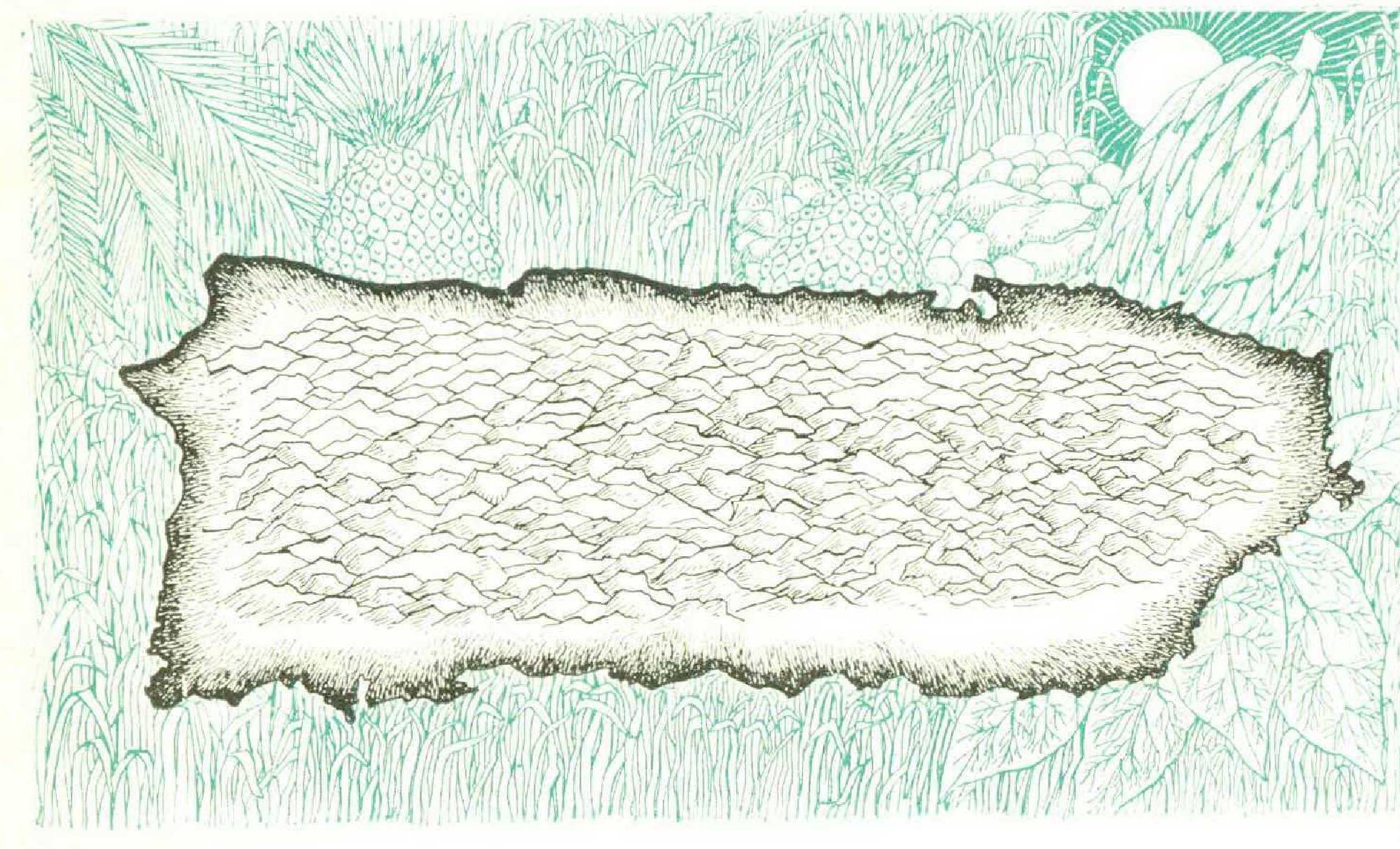
Up from the surrounding sea and narrow belt of coastal plain, in at the heart of the land, Puerto Rico is a country of hills. But not like those old hills of the eastern United States, rubbed and softly rounded humps separated by broad valleys. Here, in their extravagant irregularity, the hillocks and hills and miniature mountains and real mountains resemble nothing so much as waves of a sea blown violently together. It is the sheer abundance and variety of them that are astounding. There are hills lying in wrinkled massive humps, and hills with gentle slopes that take the shape of perfect cones. There are steep treeless hummocks and crags shaggy with tangled vegetation. There are mountains in miniature as rugged as real mountains, with jagged pinnacles and with the ridges and ravines of peaks ten times their size. And also, where these little mountains occur strung out, there are tiny sierras two or three thousand feet high.
But the landscape is compact. Nearly all these hills can be found right under the eye from a single lookout, jumbled without discernible logic or progression. Flocking and pressing on one another, ridge after ridge, there are only hills and more hills, the last of them a blue profile cut out of cardboard and hung against the sky. Finally, the hills are what take over the imagination, dispelling the first sense of being encircled by water. After that Puerto Rico is no longer a hilly island but a whole little country of hills.
It was two years ago that we came to live on a farm in the high center of Puerto Rico, in the green rain-washed eastern hills. At one time the whole area had been solidly planted in tobacco, a fact still to be read in the face of the steep slopes: their treelessness and essential barrenness and the characteristic lozenge-patterned scars of old drainage troughs, where cattle now find meager grazing. Tobacco gave way partly to sugarcane, as cane land is now giving way to beef and dairy pastures. Yet tobacco still centers hereabouts. Tall rickety drying sheds thatched with palm leaves or covered with burlap sacking or sheets of corrugated iron dot the countryside and through the winter are as active as hives with families sewing the green leaves into strands. Seven days a week, in small trucks and jeeps and on horses, the men come down to town with their bulky rolls of dried leaf, depositing them in cavernous wooden warehouses that smell pungent, pepperminty. There shabby women, garishly outfitted in bright skirts worn with knee-length trousers, work and worry over the wrinkled bunches of leaves, stack them into mounds like fortresses, and ultimately pack them in bulk for export. And in several of the surrounding towns new cigar factories, long low masonry structures with clipped lawns and with a force of neat uniformed young women to operate the machines, have been springing up. But the farm we lived on produced mainly citrus fruits and sugarcane and also small amounts of pineapples, flowers, vegetables, and only on occasion a patch of tobacco.
The farm was set on a level piece of land, such a rarity in the hills that it was known as a vega, a plain, though in this case it was less than a hundred acres in size, a tiny bottom of a bowl, rimmed by the ubiquitous hills. At the edges of the flatland, where the ground dropped steeply down to creek beds on two sides and a lake on a third, the farm workers lived in shacks in various stages of decay that had been placed roughly on the perimeter of the citrus plantings, supposedly to function as watchtowers, for chinas are a coveted fruit among Puerto Ricans. There the workers had patches of a seemingly endless variety of tubers — yautía, sweet potatoes, yuca, malanga, name — and some of them also had tiny coffee and banana or plantain groves. They all kept chickens, which roamed the whole farm freely, and most had pigs either penned up or on very short ropes that allowed them to root among the bananas at the back of bare yards. Along the creeks rose-apple trees grew wild and thick, and marvelous bullfinches whistled in the black shade and nibbled at the perfumed fruit with the taste of a mass of rose petals. The incredible todies, small plump birds leaf-green with bright red throats, darted out of the clay banks, catching insects in their long bills among the lime trees.
We walked about, we watched, we tried hard to get through those terrible first weeks of unfamiliarity. Our house was located in an orange grove. Nights the air was redolent with the heavy odor of blossoming fruit trees; from the lake came a chorus of frogs, resounding like jackhammers; and periodically flights of insects invaded the unscreened house, beating around the lighted lamps and shedding black wings over the floor in a rainfall. Mornings the sun rose fast and hot, burning off the mist in the front yard. On distant rooftops a light wind held aloft the little flags of the various political parties that everyone was then flying, and the towering plumes of bamboo planted as windbreaks beyond the grove waved and nodded. Through the fall and winter, swarms of boys, each wearing an incongruous military cap, shirt, or jacket (at first we thought they were all veterans of the conscription, but afterward discovered a surplus clothing store in town known simply by its only product, “Efectos Militares”), went through the trees singing their refrains of “Le-oh-le-oh-le-oh-la!” and tossing the ripe fruit down to older men, who whisked it off on their heads in sacks to be washed, sorted, and packed for market.
Here began our explorations of the first of Puerto Rico’s pleasures, its landscape. We made occasional twoand three-day trips to get a feeling for the whole country and its remarkable variety: down out of the hills to the parched Caribbean coast and tepid sea; into the arid southwest, where there are zebu and cactus, saltworks and turkey buzzards; up into the lonely coffee country in the high western mountains; and to the breathless eastern rain forests of giant ferns and mists, where clouds break in the treetops. There were also the numerous afternoon trips by guagua — the local buses, jammed with schoolchildren, which hurtle along narrow roads and around sharp curves rattling from hubs to roof— to each of the nearby towns. But in the main we determined to concentrate locally, to examine intensively the countryside where we lived.
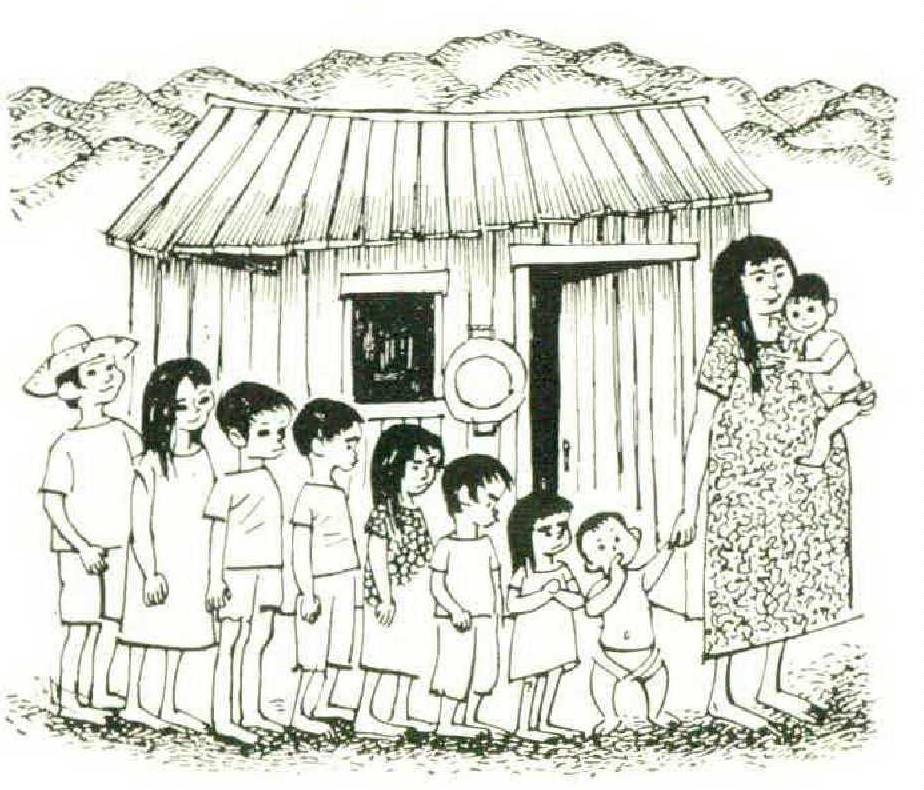
So we walked. In the beginning we took to each of the six or eight paved roads that radiated from town, going as far as our legs would carry us, and once the whole way to another town. Hedgerows of hibiscus, aisles of pink-and-white cassia, or avenues of overarching orange-red flamboyants lined the way. One tree or another was always in bloom, sometimes several together. Among the fields and gullies there were flaming African tulip trees, or robles with their masses of pink flowers very much like petunias, or the bucare, which puts out in naked branches a profusion of clawlike blossoms the color of pumpkins. The highways all led into the hills, for our town was also down on the floor of the bowl, and we marched past swept dooryards where women, usually pregnant and with dirty half-naked children clutching their skirts, washed clothes outdoors in tubs. Those yards, what a fusing of romance and reality: leaning, unpainted shacks with rusted or buckled iron roofs amid rivulets of sour-smelling drain water, discarded bottles, rotting tin cans, blazes of scarlet poinsettia, cascades of purple or coppery bougainvillaea, and dozens of leafy plants potted in used lard cans. “Buenas.” “Adiós.” We exchanged short greetings and smiles.
Later, from our porch, we would choose particular hills we had looked on for weeks and then go out and climb to their tops. No place was inaccessible. Where pavement ends, cane roads and horse paths and foot paths begin; everywhere they crisscross the countryside, ribbons and threads of flowerpot red that caracole up the slopes and wind along the ridges. Always a hot, steep ascent. Then, from bald windswept summits, resting perhaps under the thin stain of shade of a solitary soughing Australian pine, the surprise and joy of the view, of looking out over the quilt of cultivated landscape, sometimes to what we already knew, sometimes to what lay beyond. Even face to face, everything in Puerto Rico —people, houses, animals— is miniature. Now, as we looked down from the hills on the vega farm, on our town or other towns, to oxen plowing fifty-degree slopes for tobacco, or streams of men loading cane onto trucks, and glimpsed down the planted valleys to distant roads outlined brightly in a tracery of flowering trees and the far sugar mill spouting black smoke above an even carpet of green, it was Lilliputian, a god’s-eye view! And the vegetation itself, the skin of vivid green covering the hundreds of hills, proved a score or more different greens: yellow greens of bamboos and emerald of grazing land; dusty blue-green cane fields, gray-green plantings of tobacco or bananas, and the shiny blackish green of shaded coffee groves; and the nondescript, ever-changing greens of tiny woodlands, thick with vines and scrub, growing untended in steep ravines or like tufts of beards high on summits and upper slopes. There, all at once, was the face of Puerto Rico.
For other moods we had the lake. Formed some fifteen or twenty years earlier by damming a small river near its confluence with two creeks, it was a very long and narrow expanse of water that bordered the farm and looked like a bending river. Beachless, with rose apples and bamboo clumps leaning out in a wall over the water’s edge, the lake was always a place for solitude. Dozens of smaller creeks and brooks which once fed the former river were now flooded, and these made countless fingers and coves that shot off the lake every few hundred yards in long blind alleys.
It was down these secluded fingers that we pointed our borrowed boat, rowing without a sound. Some of the corridors were choked by water hyacinths, and as we drew near, gallinules hidden in the lavender blooms barked like seals, splitting the air. Then silence. Up on the wooded banks, deeper into the monte, a breeze that left the water below unruffled displayed the undersides of leaves in the taller trees. As in the plumage of mountain hummingbirds, colors flashed — sudden silvers, rusts, and reds — where there had been only greens before. Touching the muddy shore and finding a way through dense thickets, we entered one of those tiny bits of tropical forest that abounded in the gullies along the lake. Overhead was a tight canopy of branches and vines with the sky barely showing anywhere. Under the tallest trees grew others and under them still shorter ones, straight saplings with large silvery leaves that formed umbrella tops. Ropy, hairy aerial roots streamed like rain from the green roof, and except for the chittering of invisible birds high above, there was a beautiful quiet. No wind penetrated, nor did the air stir. It was cool, with the dank earth cold. Slightly below, between the trees, all that showed of the lake was a patch of flat green water. The enclosed isolation was complete.
In time the landscape began to tell other things too, to reveal more than its beauties. Throughout the hills in December the sun created an unforgettable dazzle like a snowfield as it set each evening on the silvery lavender blanket of flowering sugarcane. But in the bright hot days from February to the end of May or June these same fields became the site of the brutal labors of the thousands of men who cut and loaded the cane crop. On the vega farm some dozen or so of them, beginning in the semilight before sunrise, hacked away at the green wall of ripe cane, swinging their machetes and leaving behind a helter-skelter double wake of discarded leafy tops and yellowish stalks already oozing sticky juice. Loaders followed, arranging the stalks into bundles and lifting the fiftyand sixty-pound loads onto their padded heads, then climbed steep narrow ramps hooked to the slatted sideboards of the big trucks they were filling. Bent over the whole day, first drenched with dew and then soaked with sweat, working steadily heedless of sudden squalls or burning sun, they went eight monotonous hours, stroking Connecticut machetes with Portuguese files, whack, whacking at the cane, raking the leaf aside with the knife’s blade, slicing the long stalk in two and tossing the pieces in a heap, advancing and swinging again, whacking. It paid them under four dollars a day. For the men who loaded — raising the bundles to their heads with grimaces of exertion and climbing the treacherous incline slowly, their feet muddy, their trousers turned black and gummy by the souring sap — the work proved heavier, and because of this they were rewarded a dime more a day. Still, everyone managed to laugh and chatter and sing between silences; no one complained or ever skulked.
We often went into the cane fields to look on this numbing spectacle and sit and talk with the men during the noon lull, when they ate. In their wonderful hill dialect, full of elisions and clipped endings, sliding intonations and diminutives, they spoke of their families, eight, ten, sixteen, even twenty-six children, and of sons-in-law in Brooklyn textile plants; some, dropping Spanish to exercise a few words of barely intelligible English, told of migrant work picking celery in Pennsylvania or strawberries in New Jersey. With a machete one man scraped tiny cane hairs off the back of his hand. The hand on the blade was covered with ulcerous sores caused by the penetration of the minute hairs; he had the festerings treated with a white salve. Arthritic hands and knees were common to a number of the men; poor teeth and missing teeth commoner, even among the youngest.
Out of stacked pails of enamelware and Hong Kong aluminum lettered in Chinese around the rim, everybody every day lunched on oily rice-and-beans. Some had bits of codfish mixed in, or rarely a chunk of meat, but in other pails even the beans were sparse and few. The last rice grains scraped up, the second dish got uncovered — several boiled plantains — and held in the fingers or speared on forks, this plain gray food was, according to appetites, nibbled or devoured in three bites. (Supper would be an exact repeat.) But there is a sound like no other in the world that unpalatable food makes in the mouth of a man, a sticking sound neither dry nor wet. And on those grassy banks by the cane field where these men ate, in the cool shade of a stand of tall bamboo that creaked and swayed, among the flowers and birds and good air and sun, that sound was always audible.
After water and shared half pints of cold coffee, they talked of change, of early days when the farm was planted in pineapples and there was no lake, and of the value of land in small plots and big estates. For the vega farm was being sold that year, and none of those men who lived around the property in falling shacks were certain of their future. They knew that flat land, especially when close to town, held greater prospects not farmed but divided into plots for fancy concrete houses they could never buy. And so they were left wondering and waiting.
Months later, when finally the farm was sold, we went to live in a rented room in the town. It was a small, typical hill town with narrow streets, a number of which ended dead in cane fields two blocks off the plaza. The blocks rarely contained more than seven houses, and except for a few buildings around the plaza, they were mostly tiny one-story places. The back streets had been laid out in a time before the need for order or the dream of pavement, so that when modern straight streets and curbing arrived, one house found itself with seven feet of sidewalk, the next with two, and the third with six inches. The town’s largest structures were the church and the movie house; the firehouse had one truck. Our room was in a house a block and a half, exactly four buildings, from a corner of the plaza.
Formerly, our visits to the town several times weekly were minor events. In the humid heat the place throbbed with life. There were always the extremes of indolence and industry, of men idling and boys busy pushing carts on roller-skate wheels that carried water cans and sacks of groceries. Horses were tied up on sidewalks and sows dragged along the streets on ropes. From the direction of the farm, the town came to sight all at once, and that sudden whole view — a discordant heap of rusted wrinkled iron roofs and brightly colored walls contrasting sharply with the vivid green hills in a ring beyond the rooftops — seemed fraught both with happy, comic exaggeration and with promise. Caribbean music from a bar jukebox, so loud it made the walls appear to bulge, became not just a caricature but a powerful accent. And the lone coconut palm raising its head high above the roofs out of a maze of backyards, a breeze visibly flowing through the fronds and keeping them in constant motion like seaweed, worked a spell. Something of this tropical color and tempo was transferred to us, and though it would have been impossible to love such a town, we did feel an affection for it.
But living there turned out to be a thing quite different. The town’s distinctions proved egregious, and more and more frequently we took to the roads leading into the hills, escaping to the country. In a leaning shack across the street from our room lived a big family with many small children. Out of their window came bath water and coffee grounds and mouth rinsings. The mother of the brood swept and swept in a losing battle and each morning came onto the sidewalk, where she squatted and peeled huge hands of plantains. Once she fought with a lazy barber in the house behind, coming into the street to present her side and enlist support, and finally, receiving an audience’s approval, went off for a policeman with several of her smallest children tagging behind. These intimacies, without as much as learning names, were soon tiring. The town was neither scrupulously clean nor really dirty, but it was hot, noisy, and crowded. Most towns and cities are anyway, but Puerto Rican hill towns contain every one of man’s faults unrelieved by a single feature of his achievements: there is not one remarkable church edifice, significant monument, charming garden, or good public square to be found in any of them. Instead, every new construction only serves to accentuate the rawness and unfinished quality of things. Earth is moved aside and left like an open sore; afterward, a huge red scar remains. Fresh cement poured as a pavement will crack badly before the year is out. It is all makeshift and temporary.
In good part, it was the ceaseless, daylong cacophony that finally drove us out: hammers on iron roofs, uneuphonious church bells, deafening carts on wheels of used ball bearings or roller skates, crying children, shrieking mothers, squealing pigs, blaring jukeboxes, high radios, insidious sound trucks, and automobiles without mufflers. And the sad thing was that little of this was essentially Puerto Rican; most of the racket was produced by the junk pumped into the country from the civilization, so-called, up north.
In town, caught in the coming and going of a flood of people, it seemed a good time to put a number of our observations of them together. What were the Puerto Ricans like who lived in the hill country? Mainly, they were gregarious and submissive.
Puerto Rican gregariousness is so complete that families flock to the edge of the highway, their stream of life, to build houses just two steps back from the road and one step from each other, leaving the best sites and whole areas of back country vacant. Even in the fields, we saw that workers distinctly preferred working in groups, the more the better, rather than alone — and not because they thought they could shirk in a crowd. Hill people are such hard workers (limited seriously in their achievements because they know only two worthless tools, the hoe and the machete) that even the man among them who dislikes working works hard when at last a job overtakes him. But gregariousness probably also accounts for two other Puerto Rican qualities, the easy friendliness (and informality) and the extreme generosity. In homes we were not asked if we wanted coffee, we were promptly served a cup. Other times, when we asked, “Is this shovel yours?” the answer was invariably, “Yes, and yours.” And they meant it. Rustic politeness we encountered on every hand, and once country shyness was broken down, the way we were accepted was warming.
History accounts for Puerto Rican submissiveness: nearly live centuries of foreign domination. It is significant that in a country whose inhabitants have been American citizens for over forty years, never once in the hills did we hear anyone speak of himself as an American. This is partly because they do not want to be Americans, but equally because they could never feel themselves Americans. Every American is called Mister; and always, too readily, too willingly, is his word carried out. How many countless times were we deferred to with, “Whatever you say. Mister,” This submissiveness tends to give a first impression of childlikeness, but nothing in Puerto Rico is that simple or pure. Submissiveness called gentleness or childlikeness is a nicely exploitable quality; but as we observed it daily in its subtlest forms — in the pathetic uncertainty with which a man meets you face to face along a stretch of road — it was a parasite that robbed the spirit and forced men to pass through life cruelly deprived of having lived it.
For us, after six or eight weeks of town life, it was back to the country, and this time further out. Again in a citrus grove, among shrubby orange trees and tangerines; again the lake, high above the shore where it forms a little bay; and all around, the endless Puerto Rican hills, always different and always the same as they turn through their regular changes — of seasons, of crops, of weather. That is what they offer at last, their ageless harmony.