The Fiesta of Pamplona
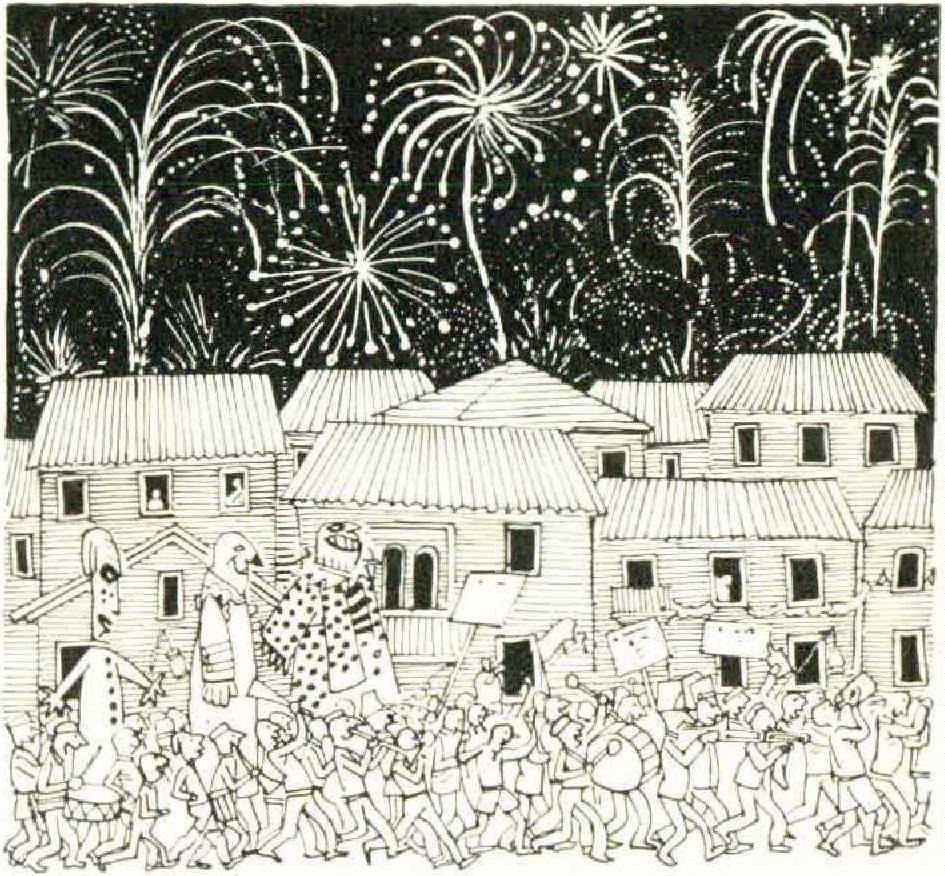
A rocket pulls a thin gray thread of smoke into the clear mountain sky and explodes with a flash. Guitar strings by the dozens begin to vibrate. Hundreds of throats, moistened by hundreds of skillfully directed streams of red wine, open in song. The clashing of cymbals is nearly submerged by the rapid booming of bass drums, which can scarcely be heard over the shouts; and from assorted directions the thin call of Basque pipes stabs through the din. Around a corner a file of giant figures, each three times as tall as a man and with a man inside propelling it, marches into view. And from the doorways of bars, apartment buildings, barbershops, cafés rush the young men of Pamplona, many dressed in the traditional white with red trimmings, to leap and turn in their mountain dance. So Pamplona embarks on its annual fiesta.
On the seventh day of July, thousands of visitors from the United States and the countries of Western Europe swarm into this northern Spanish city for the celebration that is one of the most rugged the Continent has to offer. When they stagger out of town a week later, they will have survived an experience that combines some of the features of a guerrilla battle, a jazz festival, and a Legion convention.
As one local publication puts it, there is “no minute of repose, among musics, reveilles, and above all the encierro.” This last is the attraction that gives Pamplona’s annual fiesta its unique flavor, the daily running of the bulls through the streets. It is quite likely the only important event to take place in the early morning that Spaniards have ever devised. To see, or take part in, the encierro, the visitor must arise from his bed well before six o’clock. Encouraging him to do so are the musics and the reveilles, groups of young men, embracing wine bottles and guitars, who roam the streets in the dark hours of the mornings, shouting cheery songs about the necessity of departing from bed with a jump, and pounding on drums.
For fifty-one weeks of the year, Pamplona, the capital of Navarra, goes about its business with a reasonable amount of restraint and decorum. However, at the time of the New Year, to judge from the words of a tune that never loses its hold on the eighty-five thousand inhabitants, a certain restlessness sets in. The lyric goes: “First of January, second of February, third of March, fourth of April, fifth of May, sixth of June, seventh of July, San Fermín!” By the time July arrives, Pamplona, steaming with repressed excitement, is ready to explode in a flare of fireworks, rope-soled sandals flashing in the kicks and turns of Navarra dances, cascades of wine, and a prolonged clamor exceedingly rich in decibel content.
It is the saint named Fermín, the patron of Pamplona, who is honored by the fiesta, which the inhabitants call the sanfermines. Although the martyred saint seems to have spent most of his working years in France, the return of his remains to Pamplona has been celebrated relentlessly for centuries by his fellow townsmen, and the present generation has lost none of the old-time energy and enthusiasm. From before dawn until well after midnight, large sections of the population take to the streets. They use the streets for eating, dancing, and singing. They dare bulls to kill them in the streets, doze in café chairs in the streets, and stroll amiably through the streets, flirting, carrying balloons, and making sounds on noisemakers. Embarked on a marathon of wine consumption from bottles, glasses, and leather bags, they grow friendlier with every gulp.
Unlike some other well-known festivals, the fiesta of San Fermín is an affair of, by, and for the people, and the absence of balls and parties organized by clubs and other private groups ensures the visitor from any country that he can, if he wishes, be quickly swept into the main current of the celebration. While he is relaxing in a café chair on the curb, eating potato chips or drinking beer, sooner or later a group of young men will suddenly appear in the street, leaping and twirling in a dance. If the tourist is a male physically able to stand the exertion, there is nothing to stop him from joining the dancers; if he does, they will almost surely smile a welcome. If, when wandering with the crowds in the streets, the visitor should direct his gaze to one of the goatskin botas the men carry on cords over their shoulders, the chances are that the carrier will instantly offer a drink. On all sides there are reminders that if the stranger surrenders to the urge to buy a bota of his own, sensible procedure is to have it filled with white wine, not red, until after considerable practice in the trick of pouring the wine down one’s throat with the bota’s nozzle a good two inches from the lips. The gaiety of the Pamplona scene at fiesta time is enhanced by the great purple stains on the shirts of the foreigners who have been practicing with red wine.
Although the daily bullfight is the main item on each day’s program, other fiesta attractions would fill a list formidable in length. The determined celebrant, before probable collapse, can cheer jai alai players, groan with wrestlers, inhale sawdust at a circus, gasp at competing weight lifters, and buy a mule at the horse fair in the field near the winding River Arga, just outside part of the old city wall.
Still, the festival does revolve around bulls; the talk from the day’s first sleepy grunting to the night’s last murmur is about bulls; and, as the first-time visitor is almost certain to discover within minutes of arrival, every day at least six bulls will be killed, butchered, sold to the public, and consumed in the form of steaks, chops, and stews.
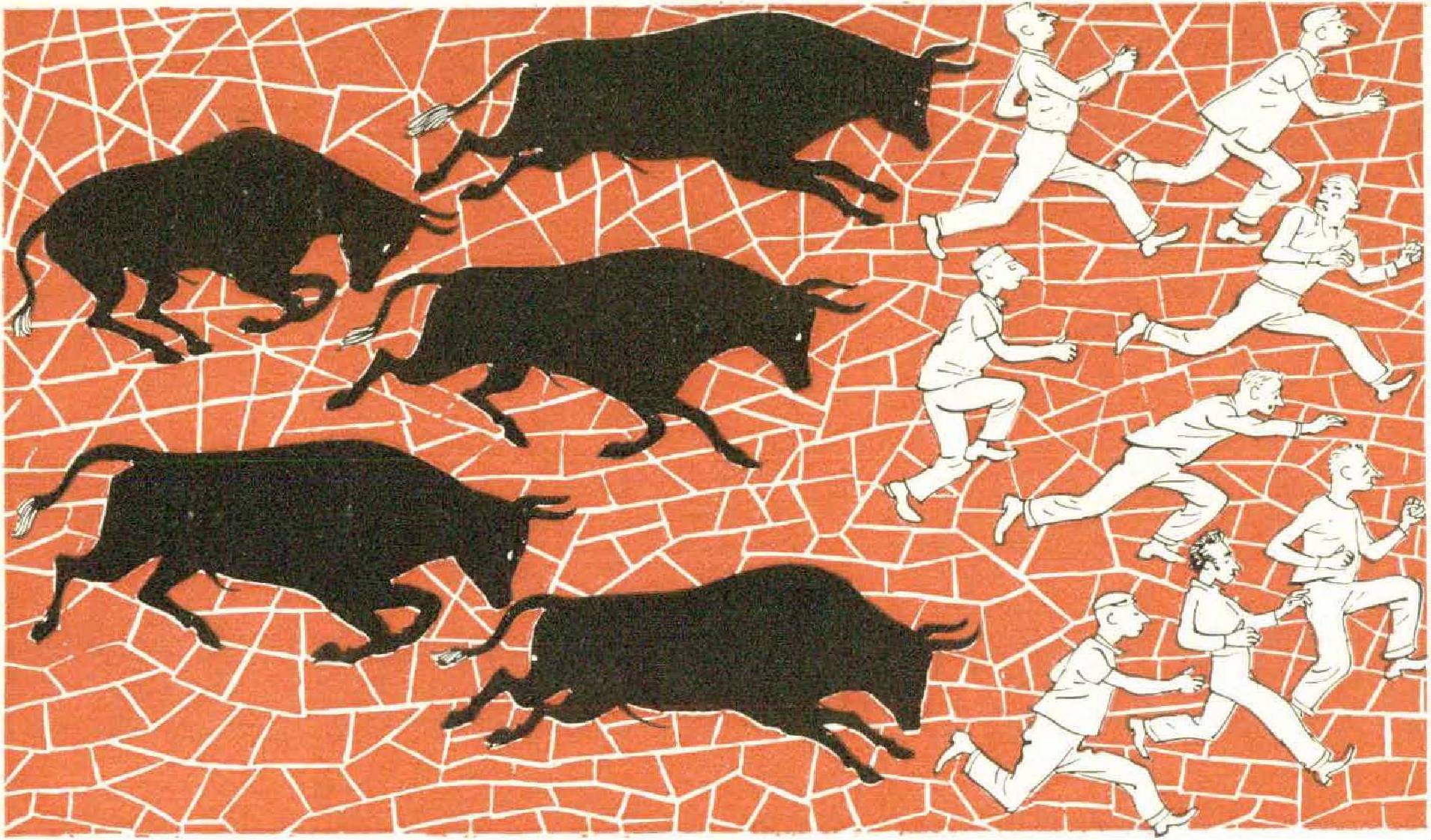
Visitors who may not wish to attend the afternoon bullfights can, nevertheless, get a good look at these handsome animals in motion by watching the run through the streets every morning. In most of Spain’s cities, the bulls are brought by truck to the corral behind the ring several days before they are to be fought. The local Pamplona custom is to let the bulls get to the ring under their own power along a half-mile course from the edge of town.
As they have done for at least three hundred years, Pamplona’s brave young men run ahead of the bulls. At least, they begin ahead, assembling near the baroque facade of the eighteenth-century city hall to await the starting signal, the first stroke of the bell in the thirteenth-century church of San Saturnino. Since a half-ton bull can cover the distance at a clip considerably faster than a four-minute mile, the animals pass many of the human runners on the way. And the spectator who is not satisfied by the flash of hooves and horns glimpsed for an instant over a wooden street barrier would do best to watch the encierro from the ring. Most mornings, a ticket there costs less than twenty cents.
In recent years, foreigners have joined the native runners in increasing numbers and have become the target for some but not all the complaints that the encierros are not what they were in the good old days. Last year, after a number of accidents, often serious, handbills appeared in the streets signed by “the young men of Pamplona,” reminding all who read them of what would seem to be the obvious truth: that one should not try to run a footrace with a wild bull without knowing something of the techniques of the competition.
After a week of arising shortly after five in the morning to be sure of getting a good place to see the encierro, the tourist is likely to feel nearly as shaky as if he had been run over by a bull. Every morning, after the bulls are safely in the corral, most of Pamplona, before popping into bed for a quick nap, streams to the big central square, the Plaza del Castillo, to breakfast at one of the many cafés that border it. Kutz Cafe, the largest and best known, also offers, in addition to the usual drinks, a brief menu of light dishes, like omelettes or cold cuts, that make an acceptable evening meal after a tiring day.
The best restaurant in Pamplona is a fine one, and expensive by Spanish standards, the Hostel of the Noble King, popularly called the Seven Sisters in tribute to its efficient owners and managers. There, if the diner is lucky enough to get a table at the peak hour of three in the afternoon, he can lunch on excellent versions of Spanish-style cold tomato soup; paella, rice yellowed with saffron and cooked with chicken and shellfish; and ajoarriero, a regional concoction of dried codfish and olive oil to which, for best results, there should be added meat of the langosta, the big clawless lobster of the warm seas.
The appetite may have been sharpened by activities like a midday visit to the bullring to watch husky Basques at their sport of wood chopping, in which the competitors stand on thick logs, gripping the curved surface with shoeless feet covered by thick wool socks; or a visit to the little open lot where the garlic farmers display their crop, the grayish-white bulbs strung into garlands hanging on the walls of their huts. About a dollar will buy a garland of at least fifty bulbs; the whole string can be carried away around the neck like a gigantic necklace. If this is not the best garlic in the world, then the best must be ambrosia indeed; but alas, the law forbids returning travelers to bring it into the United States.
Between diversions, because it is hard to get to bed early in Pamplona (the nightly concert on the bandstand in the square generally lasts until one thirty in the morning), and because it is customary to get out so early, almost everyone feels the need of stealing away for a nap as often as possible. At the sanfermines, as a sleep-starved visitor once said, more people go to bed more often for perfectly innocent purposes than anywhere else on the globe. The beds they fall into are not likely to be excessively comfortable, because Pamplona contains only three hotels large enough to be recognizable as such by most travelers and no one below the rank of ambassador or matador’s assistant is likely to attain a room in one of them. By the summer of 1962, the authorities hope to have ready a new hotel of two hundred rooms. But, as usual, the vast majority of liesta visitors will move into private homes. Depending on whether such a luxury as occasional hot water for bathing or shaving is essential to one’s happiness, lodging should cost from two to five dollars a person for a night.
In any case, for nappers at any hour, earplugs are recommended to dull, if not obliterate, the nearly constant toot of horn and bang of drum, the almost continual accompaniment to anything else that is happening at any time. As the clubs of men and boys move through the streets, they hop and wheel in their jota, their arms upraised, their fingers often prevented from snapping the rhythm by handfuls of wine bottles, bread rolls encasing slices of ham, rolled newspapers, and cigarettes. They lose the red handkerchiefs from their necks; their floppy straw hats grow tattered; their white shirts and trousers turn gray with dust; but still they dance, from the parading of the statue of the saint that opens the festivities to the night the party ends. At the final hour, they are still dancing, singing now in mock despair, “Ay! Poor me!”, for the fiesta is done. At the end of the chorus, the stricken dancers fall to the street and are still. Then, after a few moments of silence and immobility, the music crashes out anew; the dancers spring to their feet; and off they go, leaping, their vigor unimpaired.
These young men are the real owners of the fiesta of San Fermín, and if they regret the inevitable commercialization of their fiesta and resent the hordes of tourists, they hide their feelings. The strap around the shoulder is as likely now to support a camera as a bota, and the sun that shines on the matador’s suit of lights also glints on the television and motion-picture lenses that peer from a dozen angles. In the crowd that nightly braves the sometimes erratic fireworks in the plaza, French girls in trousers stroll beside American boys wearing baseball caps, and the Germans are there, too, and the English and the Norwegians and the Dutch. The jets that whisk in a day half a town’s population halfway around the globe to once isolated centers of folklore have not spared Pamplona.
Yet there is a spirit of San Fermín too hardy to succumb to sightseers. “This,” as one visitor recently summed it up, “is the last innocent fiesta in the world.” When the rocket explodes and the pipes begin their shrill call, it is impossible to doubt that the dancing young men would not alter their fiesta by as much as one snap of the fingers if every jet were grounded and every incoming bus stalled. By the time the last pipe has fallen silent and the last group of dancers has finally forsaken the streets for bed, the visitor who has traveled to Pamplona for his vacation will be planning a vacation to recuperate before planning the following year’s vacation as one of the loyal band which returns to the big party for San Fermín.