You Can't Pet a Chicken
Born in 1912 in Oakland,California,SIDNEY PETERSON has had an unorthodox career. Among other things, he has been a draftsman for a naval architect, founder of a film company m Seattle, a television director and writer, and a writer of cartoon scenarios for United Productions of America and Walt Disney. His UPA scripts include THE INVISIBLE MOUSTACHE OF RAOUL DUFY and THE MERRY-GO-ROUND IN THE JUNGLE. The latter is regarded by people in the industry as a masterpiece. He is the author of A FLY IN THE PIGMENT, published in 1961 by Angel Island Publications.
SIDNEY PETERSON
IN A recent California divorce case a woman took the stand to testify that Yogi Bear had come between her and her husband, whose passion for the animated ursine hero was having a disastrous effect upon their three children, all of tender years. The judge thought she was talking about Yogi Berra. Ten years earlier she might have been. Times, however, change. Ballplayers are still culture heroes, but so are the bears and bunnies of the small and wide screens, and with the advantage, as it were, of having no seasons. Among young adults — which is to say, people over twelve who still go to the movies — Bugs Bunny is at least as popular as Willie Mays.
Does this contemporary bunny worship mean a return to the adoration of Manibozho, once so fashionable, or of Osiris Unnefer? I think not. What has happened, I am convinced, is that further inroads have been made into the steadily diminishing child world, and we are experiencing a vigorous revival of that kiddy cult which William Empson, in his classic study of the pastoral form in literature, Some Versions of Pastoral, has so cleverly identified as a version of pastoral.
Is the Yogi then really a shepherd in a bear’s skin? Or is he, perhaps, one of D. B. Wyndham Lewis’ irresponsible “revolutionary simpletons,” disguised as a disguised shepherd? In that shadowy world in which such questions have their being, few things are certain. One is that baseball has not yet been identified as a pastoral pursuit. Another is that one must distinguish between the child and the cult, which is no more concerned with the real child than Vergil, say, was concerned with real shepherds. This puts the child in a somewhat peculiar position, since, in effect, it denies his reality. It also gives him a somewhat special relationship to the bestiary of the animated cartoon, a mock world which we enjoy, as so many have so often declared, precisely because it is not real.
Not all unreality is pastoral, and not all cartoons are engendered by the kiddy cult. Nevertheless, certain cultish elements seem to be so basic to the medium that their presence is practically inevitable. The talking animal convention and the one about changes in relative size, both devices once familiar to a reading public in Gulliver’s Travels and in the two Alices, constitute a resource that is not only inevitable but indispensable. Some time ago, for example, one of the networks proposed to a producer the production of an animated version of the radio show called Amos 'n' Andy. When the producer raised a question about the financial wisdom of releasing such a show in a still segregated world, considering the greater impact of seeing as opposed to mere hearing, the network replied that it had already considered that problem and proposed to deal with it by substituting small talking animals or Southerners for Negroes. For all I know to the contrary, the vice president in charge of such matters for that particular network is an avid reader of Uncle Remus and a serious student of the arcadian tradition of the Old South, concerned with extending the hospitality of the small talking animal convention to Southerners in general, but I doubt it. It is not necessary to read in order to know such things. Even vice presidents are ex-children, and as Empson points out, children instinctively feel at home with such conventions.
Erwin Panofsky makes a more important point in relation to the cartoon when, in his essay on Poussin and the Elegiac Tradition, he reminds us that “Arcady was the domain of Pan . . . and its inhabitants were famous for their musical accomplishments as well as . . . their utter ignorance and low standards of living.” He quotes Butler’s description of the original pastoral types as being:
Whom nothing in the world could bring
To civil life but fiddleing.
Anyone who has ever watched an animated cartoon with the sound off will understand the importance of this fundamental arcadian ingredient, a component representing the so-called “hard” primitivism of the pastoral tradition, as opposed to the so-called “soft” tradition. Students of such things will recall that Spike Jones came out of an animation studio sound department. Thus the hard primitivism of the studio is linked to the even harder and more primitive pastorality of Tin Pan Alley.
It is hardly necessary, of course, to point to such specific links to establish the spread of primitivism in the modern world. And not all of it is pastoral. The kiddy cult is merely a part of that larger whole we have been cultivating for so long and, for the most part, so enthusiastically, although not occasionally without qualms. Curiously, it is a part that was not mentioned by Joseph Wood Krutch when he recently confessed his queasiness in an essay on The Infatuation With the Primitive. It is still customary in critical circles to associate children with savages, criminals, and the insane as important contributors to the cult of contemporary primitivism in all the areas in which it flourishes, including art and politics. At the same time, it is unquestionably easier to relate Hitler to Australopithecus africanus than to mere childishness. The kiddy cult is still dominated in large part by certain obsolescent conceptions, which are important to remember if we wish to understand how hard and soft primitivism coexist in the mock child-world of the animated cartoon as a version of pastoral.
Just as the Roman poets modified the harshness of the earlier Greek conceptions of life among the shepherds, the author of Émile almost put a stop to the kind of thinking that had found a satiric expression in Swift’s Modest Proposal. After Rousseau, it was almost impossible to think, or at least speak, of eating children except in a metaphorical sense, as an outburst of voracious affection. And what Rousseau did not accomplish with his diabetic doctrine of congenital virtue, Wordsworth did with his mawkish apotheosis.
Child labor was something else again. The Victorians were nothing if not ambivalent in their admiration of the infant. Devout in their conviction that childhood was a Golden Age, a sort of ontogenetic recapitulation of legendary phylogeny, they still kept faith with the bitter spirit of the Modest Proposal, banishing it from the nursery but preserving it in the mine, the factory, and the workhouse.
AGAINST this historical background of hard and soft child cult, corresponding to hard and soft primitivism, in the history of the animated cartoon we have early and late Disney. Up to a certain point in time, the creations of the Burbank Mouse Factory were as harsh, vigorous, and vulgar as the America of Mrs. Trollope, who would have been as shocked by early Disney as she was by early Cincinnati; and for similar reasons, including the unholy prevalence of spittoons. The primitive arcadian character of animated spitting was clearly shown by its deep tie with “fiddleing” or other sound effects. It had little in common with such soft cult expectoration as occurred, for example, in the famous balcony sequence in Maedchen in Uniform.
The time was 1934. Weakened by depression, the studios were as putty in the hands of organized Legionnaires representing not only the forces of virtue versus vice and vulgarity but that soft primitivism which had already found an outlet in what Professor Max Lerner, in his panoptic survey of the American scene called America as a Civilization, has defined as a “child panic . . . marking a phase in American social and class history,” distinguished in literature by the creation of “a pastel, two-dimensional world in which only cute and trivial things happened.” Disney celebrated the occasion by putting panties on a cow. It was his final protest against the forces of light.
The tide was irresistible. It was the heyday of the kiddy. Quiz kids had the status of bank presidents. Shirley Temple was the miniature queen of live action. The hard approach was as dead as Cock Robin. Slapstick was out. The most famous of all clowns was on his way to becoming apolitical commentator. Across the nation, carried by radio, the sedative voice of a great paternal President was heard, and abroad the fitful gleams of book fires illuminated the Chaplin mask of a homicidal madman intent upon altering the image of a great people into the likeness of an adolescent psychopath.
What no one quite realized at the time was that Dick and Jane and the Hitler Jugend were two sides of the same coin. The diabolical principle was clear enough when it wore a brown shirt. It was less clear behind the cheerful grimace of a cult-engendered rodent. The clue to the connection, of course, was the lack of a dimension in that pastel world of the cute and the trivial. “The devil,” Malraux reminds us in The Voices of Silence, “always paints in two dimensions.”
Perhaps it was our democratic disbelief in the existence of the diabolical that deceived us. At any rate, a soft approach became the imperative of the whole entertainment business on the cultist front.
On the Disney lot, the cardinal commandment naturally took the form of an observation about one of the simpler forms of life: You can’t pet a chicken. The allegiance to small, cuddly, furry objects was complete. It even achieved the stature of a natural law in a live series devoted to nature. Bears, we were reminded, are really teddy bears at heart; teddy bears with claws and teeth. It is a rule of pastoral, as formulated by Empson, that “you can say everything about complex people by a complete consideration of simple people.” If the simple people are animals or children, so much the better. The important thing is to keep it all simple. And soft — sweet, small, cuddly, and furry.
Also, it is part of the petting scheme of things that there must be symbols for petters as well as for the petted. A cow is such a symbol. When the question once arose in the Mouse Factory, as it did, about doing a film on anthrax, the response was immediate: “Walt doesn’t like sick cows.” There are no sick cows in Arcady. At least, not in the vicinity of Dopey Drive.
It is nice, in retrospect, to know that all through the period of intense dedication to soft kiddy pastoral and real child denial in the world of the animated cartoon, things were not quite as they seemed. Certain hard humorous elements remained as unfilterable characteristics of the medium itself. Vocables like “Eeeek,” “Crunch,” and “Bam” were not easily assimilated into the vocabulary of sweetness and light. “Hurt gags” abounded. In the end, in a “new Saturnian age of lead,” the animation industry became the last stronghold, on the entertainment front, of the comic spirit of early child cult, of that hard primitivism with which, as Mr. Krutch points out, we are still infatuated.
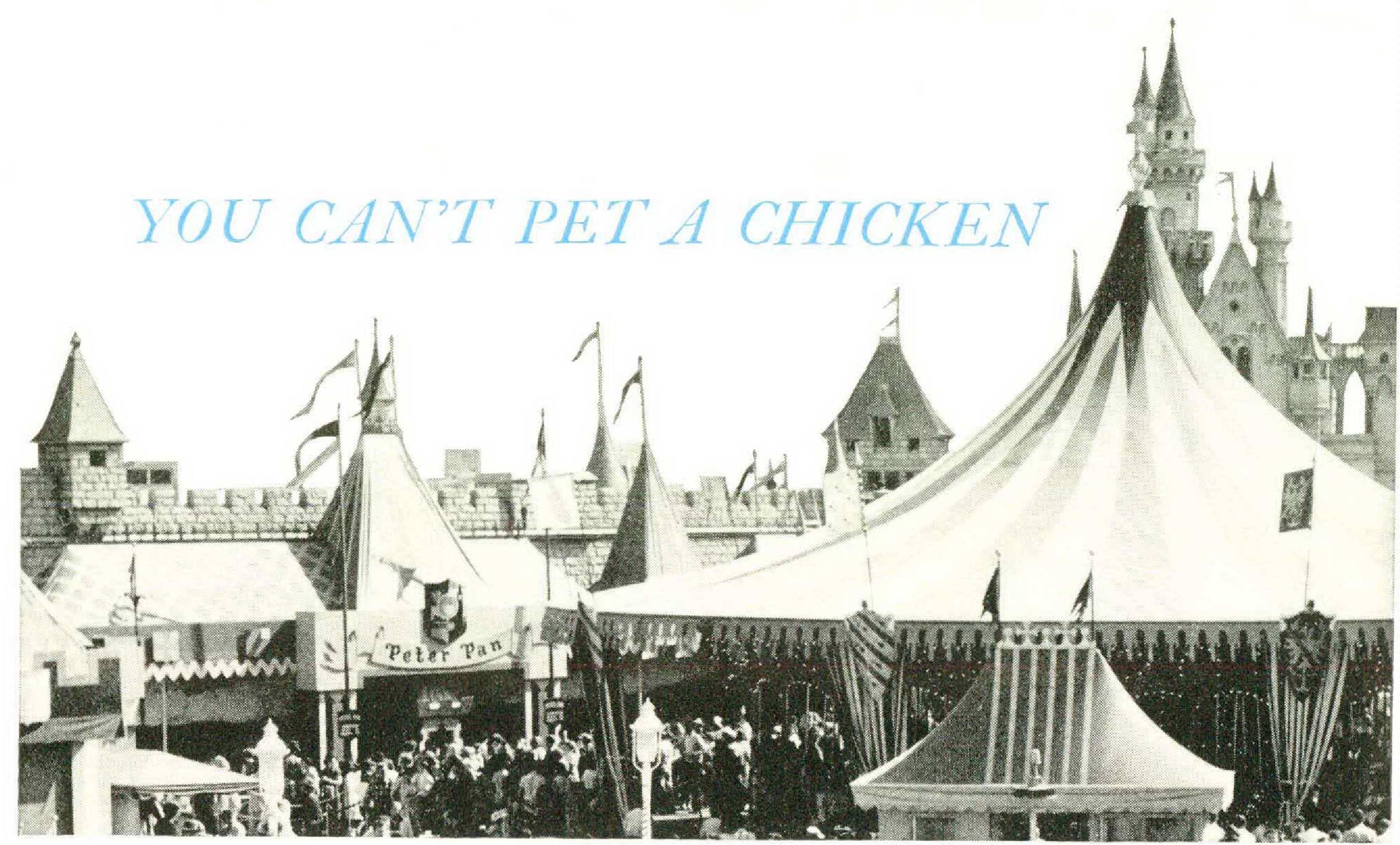
Not everyone, of course, capitulated to the inevitability of change. Disney, for one, having failed to turn real moppets into unreal little mice, sought a refuge in live action by creating a threedimensional small-scale masterpiece of the soft genre, a monument in keeping with the aesthetic requirements of a region in which the yellow section of the phone book lists Art Schools just ahead of Artistic Needlework and Artificial Breasts — Disneyland.
It is impossible to exaggerate the importance in the pastoral scheme of things of that one hundred and sixty acres of pure unabashed dedication to child cult and the dream of a Golden Age that goes back to the day before yesterday. Naturally, children are fascinated by it. They have been conditioned. The small ones are scared out of their wits by some of the rides, and the older ones enjoy the dances. For the ex-children for whom it was all really intended, it is a nostalgic vision of a past that never was, in a make-believe present as tranquilizing as snakeroot, with a tomorrow as improbable as the mind of man can make it. Vergil would have loved it. My own feeling is that the whole thing should have been laid out in circles.
So Bullwinkle has become the darling of adolescents who once sat patiently before their television sets, joining in paeans of praise for the little rodent whose fame, at its peak, had rivaled that of Chaplin. Bullwinkle is not a mouse but a moose. Millions of Greek peasants, Congo democrats, and newly touchable Indians have never heard of him, any more than they have heard of the squirrel, Rocky, or of Dudley Doright of the Royal Canadian Mounted Police. In all fairness, one must remember that Troy was founded by mice thousands of years before Canada was more than a gleam in the eye of a wandering paranoid Kwakiutl, and just as there was more in Homer than Homer knew, so there was more in Mickey than Walt knew. Nevertheless, it would be hard to improve on Dudley as a straight man for a generation of teen-age American comics dedicated to new forms of disbelief.
WE STAND, it seems, on the threshold of one world, if all goes well; one world, one sex, one audience, and — it is only reasonable to suppose — one age; probably about fourteen, if the entertainment business has its way. The movie houses are full — to the extent that they are ever full anymore — of fourteen-year-olds. The overwhelming majority of people who attend movies are between ten and nineteen. Most of them are there for the candy counter and each other. And here a curious situation has developed, which reveals the real nature of the influence of the very young on their entertainment. In order to stay in business for the weekend popcorn trade, upon which they are economically dependent, the exhibitors get by during the week with low-rental foreign films, which attract adults, mostly young ones. Thus, thanks to the voracity of the kiddies, the age level of the audience is being slowly raised.
It may even, in time, be raised by as much as six months. The question then arises: at what point is the impubic expected to join the great homogenized mass theoretically fixed at the 14.5year level? The line will have to be drawn somewhere. Where? The producers of The Alvin Show suggest that it be drawn at twelve. Eighty percent of the population of America under twelve knows Alvin. That makes twenty-two million viewers every week, altogether too many to leave out of the homogenized audience if it is to become — as there is every reason for supposing it will become — truly homogenized.
To suppose that there can be separate entertainment for a somewhat smaller group of very young children is to ignore both the existence of and the nature of the child cult, both hard and soft. It is to ignore the lessons of history, both literary and economic. The popcorn trade is simply insufficient to keep things going for very long. Nor is there enough of a child market for consumer goods below a certain age level to interest television sponsors. Cereals are a good example. “The G on the package stands for grownups,” is the kind of thing one begins to hear.
The old cartoon formula called for appealing to everyone from eight to eighty. But that was before the concept of homogenization had come to haunt us. Surely, now, we can do better than that. Five is a good round figure, referring, as it does, to Dr. Watson’s first-five-years plan and the end of preschooling. Before five a child may be said to be busy completing his own destiny and should probably be left alone as much as possible, or, at least, not exposed to the influence of mass media geared to the supposed interests of fourteen-yearolds.
In any event, if the past and present are any indication, neither the five-year-olds nor the fourteen-year-olds are going to have much to say about what they are going to get. They will get Yogi Bear, or some equivalent, and if they don’t like it, frankly, I don’t know what they can do, save possibly follow the sage injunction of Dudley Doright’s commanding officer to, “well, stand there, Dudley, and don’t just do something!”