Island Teacher
CHARLES C. O’CONNELL was born in and lives in the city of Cork, He tells us, “Though writing is what I want to do most, my wife and three children are interested in eating regularly; as a consequence, I hold down the position of general works manager in one of Ireland’s largest hosiery and textile factories.”
A Story by Charles C. O’Connell
I WELL remember the day Miss McCrary came to the island. I was just twelve years old at the time, and I was down at the quay with my father when she arrived from the mainland. Davy O’Toole and Paddy Cronin had rowed her over across the sound in their curragh, and they could have picked a better day, for the wind was pulling at us strongly and the sea was rough. Even within our little harbor the featherweight craft bobbed up and down on the swell as if it floated in oil, and the woman sat on the stern thwart, two pale hands gripping the gunwales and her face gray-green. Her belongings were strewn at her feet as though they had fallen from her hands — a small sack tied at the neck, a large suitcase, and a handbag, black as her somber attire. She looked very ill, yet she sat straight as an oar, showing us just her deathly profile, while the wind whipped her short hair around her head. She resembled a great black bird in the back of the boat, and she showed neither apprehension nor interest as the men delicately maneuvered the boat to the quay. The tide was nearly full, and my father had no difficulty in helping the woman ashore or collecting her luggage as Davy handed it out to him. Then he spoke to the boatmen about the weather and the times, and listened to the tidbits of news from the mainland, giving Miss McCrary time to recover her composure.
When she was out of the boat and on the dry land the semblance of a bird still clung to her, only now I felt that I could qualify my impression with the word “ugly.” The other side of her face was visible for the first time, and in all my days I had never seen a thing so strange as that great red mark which reached from her neck to her forehead and from her ear across to her nose. It was like a great angry scald that had never healed. Still, young as I was, I was greatly impressed by the way she held her head. It was erect and defiant, and I couldn’t understand why she didn’t want to hide the terrible mark from us. Another thing I noticed about her then was her hands. She held one, fingers spread, at the neck of her black coat, and the other was at her side, and I saw they were white as marble, with slender, ringless lingers.
She looked at none of us as my father spoke to the boatmen but stared out over the gray wrinkled sea toward the mainland that sat like a thundercloud four miles to the east. Nor did she move until Davy and Paddy had pushed the curragh away from the quay and were bow on for the open sea. Then she stooped to collect her luggage, but my father forestalled her. “I’ll carry these for you, ma’am.”
Without a murmur, she let him collect her sack and the suitcase, but she hugged her black handbag to her bosom as though it were a child.
“The women have the house fixed up for you,” my father told her. swinging the sack on his shoulder and picking up the suitcase by the handle. “I hope you’ll be happy here.”
She said nothing to this either. The green pallor was still on her face, and it struck me that she was afraid as well as sick, but whether it was of my father or of the island I couldn’t tell. I remember thinking that if she was afraid of my father she was being very foolish, for though he was big and strong and king of this island, nobody was afraid of him or had reason to be. So, because I couldn’t understand what was making her afraid, I mentally counted it yet another oddity in a very odd person indeed.
Though there was room in the width of the quay for the three of us to walk abreast. Miss McCrary kept behind my father, walking straight and firm with her head still held proudly and her strange hair blowing willy-nilly in the wind.
FROM the quay the way to the cliff top is a steep snaking road that doubles back on itself here and there to ease the gradient. It is a stiff climb for any man, but our lady from the mainland climbed it with a straight back and a sure step.
My father rested his burden on the rough road ten or twelve paces from the top of the eighty-foot cliff and drew the back of his hand across his forehead. I had never seen him do this before, and I guessed he was only giving the woman an opportunity to rest.
“It is no easy climb,” he said, and I could see the perspiration on his forehead, but that might have been due to the fact that he was wearing a coat over his jersey out of respect for Miss McCrary.
“It is not,” was all the woman said, flatly. She glanced below then at the sea surging on the rocks, and I thought she shuddered. Then she looked up quickly and held her gaze stiffly averted. I could see that my father was puzzled by her attitude because his forehead was puckered as he stooped to pick up her bags again.
Then, before he could move. Miss McCrary was sick; violently and helplessly sick over the side of the low wall that separated us from the sheer drop to a tangle of rocks and sea spume below. She kept her back to us, and as her shoulders heaved I felt inclined to be sick myself. Even after she stopped retching she still bent over the wall, afraid to move. My father was looking away to the scatter of islands that sat on the sea to the north of us, looking at them as though he had never seen them before, while with all the merciless curiosity of youth, I had eyes only for Miss McCrary. She stood there for so long that I thought she must have fainted and that somehow the wall was propping her upright; and then she began to cry, so suddenly that it was infinitely more startling than when she was sick. She cried in little hard gasps which shook her shoulders terribly. I had often seen women cry before, but I had never seen anybody cry like this. I felt sure that it must hurt her deep inside that slender body, and yet I don’t remember feeling any sympathy, nothing, in fact, but a deep curiosity, as if this person was not human at all but a tall, marked, ugly creature that Davy and Paddy had caught in the sea. My father didn’t stir but continued to stare away to the north, as though he was wondering how in the world the northern islands ever got where they were and why he had never noticed them before, but I saw that the muscles on his jaws jumped and spread, and that was usually a sign that he was in pain.
Finally the woman stopped crying and turned toward us. She held a handkerchief over her mouth and nose so that only her eyes were visible, and they startled me because they were soft and dark and lovely under her unusual thatch, and somehow I was pleased to discover yet another thing I liked about this woman besides her hands.
My father looked at her with a slight sympathetic smile on his face. “Are you all right now?”
She nodded her head and said lowly: “I feel so ashamed.”
“There is no need,” he assured her. “Crossing the sound in a curragh on such a day is not the most comfortable way to come to Innislaum, but unfortunately it is the only way. Most people are sick unless they arc used to it.”
Miss McCrary didn’t speak, and then my father said in a voice he always used when I was sick: “There is nobody here who would harm you.” And this started the woman crying again, but quieter this time—just tears and silence.
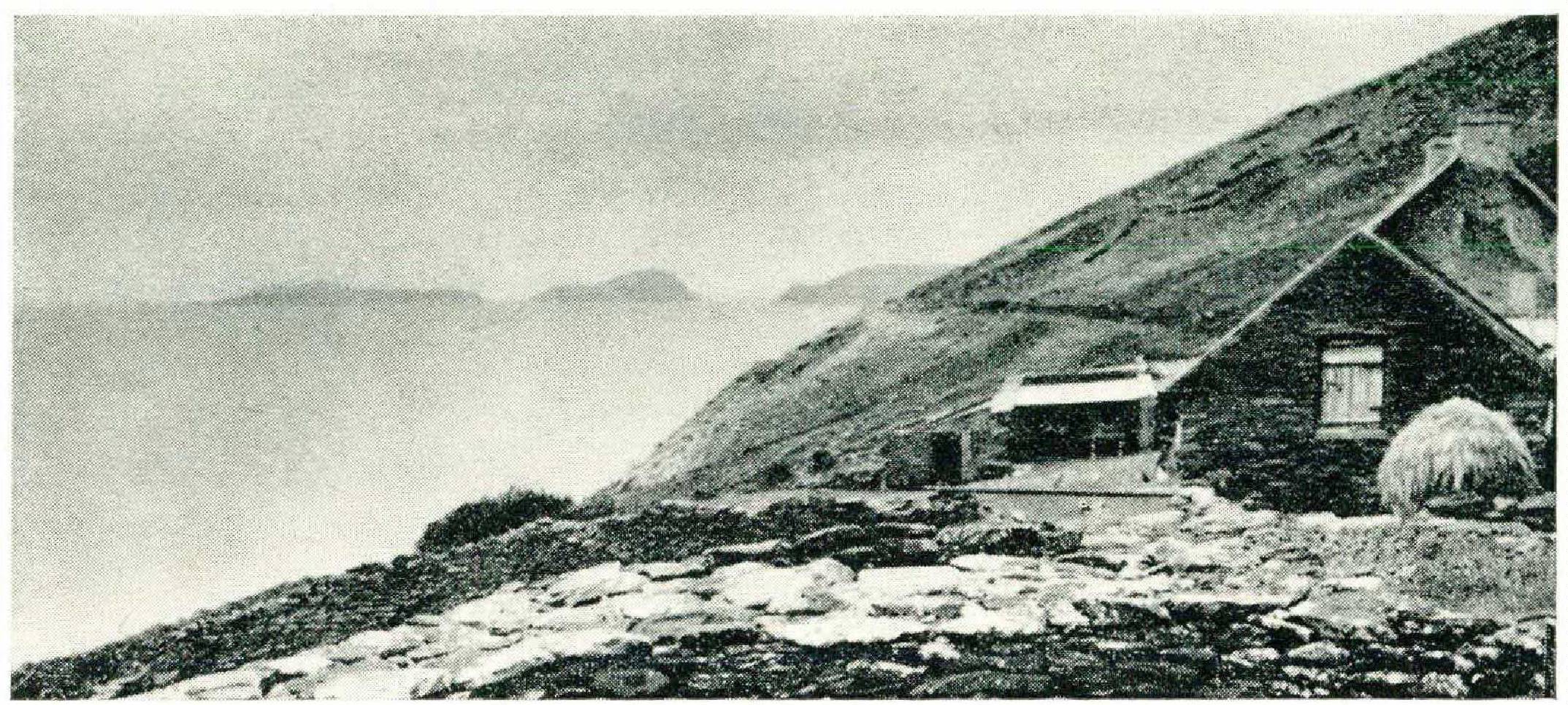
From the top of the quay road we turned south to the two dozen houses that made up our village. They all looked across the sound toward the mainland, and the ground humped itself behind them. One of the houses, a cottage small even by our standards, stood a little apart from the rest. It had two feet of thatch, two windows and a door in front, two more windows behind, and you could trace the bends of the chimney flue by the deep-brown stain showing through the limewash on the gable. There was a fenced piece of ground in front of it, and a deep trench cut behind to collect the drainage from the hill. A wisp ol smoke was coming from the chimney as we came down the quay road.
We stopped at this house, and my father laid down the case and the sack and gave the woman a key.
“There are fresh eggs and bread in the cupboard,” he said, “and potatoes in a wicker basket and more in a pit at the back. You will find turf and slivers of bog oak near the fire, and there is bacon in the safe outside the back door.”He nodded his head to the nearest cottage. “Mrs. Goughian lives below you, and she will be pleased to help you settle in. If there is anything else you need, let her know and she will tell me. I would rest now if I were you. Tomorrow will be time enough to talk about the school.
She thanked him and then went inside the cottage, closing the door soltly, and my father and I walked down the road toward our own home at the other end of the village.
“Isn’t she very funny, Dad? I said as we moved on.
He was deep in thought, and 1 could see by the lines on his forehead that he was worried. My question did not appear to make him any happier.
“What’s funny about her?”
“She looks funny,” I said, embarrassed, “all dressed in black like that and with that red patch on her face.”
I can still remember his shocked expression. Then he said: “Maybe with your braces over your jersey like that and your bare Feet and your mop of wild hair you looked very funny to her. At least her face was clean, which is more than can be said for yours at this moment.”
And I could say nothing at all to that.
THE coming of Miss McCrary to the island changed all our lives, at least the lives of the fifteen of us who were compelled to attend school. Our ages ranged from live to twelve at that time, and though we had teachers before, we surely never had anyone like this strange woman. She divided the fifteen of us into four classes and located each section in a different corner in the felt-roofed shed that served as a schoolhouse, so that all the pupils, though physically together within one room, were, in an academic sense, years apart. She contrived thereafter to handle four graded curriculums at the same time, and yet keep everybody busy.
Indeed, we were busy with Miss McCrary! Busier than we had ever been before, and somehow much more alive to what we were doing, because for all her strange appearance, she had the gift of wrapping a tedious and difficult subject with the tinsel of interest. She pushed out the four walls of the schoolhouse and introduced us to a world we never knew before. For the first time we realized the vastness of the universe and made a smacking acquaintance with the histories of people we never even knew existed. And in the end we became used to her.
Though she was always a little formidable, a little remote and mysterious, in an incredibly short time she no longer seemed ugly to me. We sometimes forgot she looked different to other people, and it seemed that she had been on the island since time began. One thing I particularly liked about her was that she had no favorites, nor did she make any distinction one way or the other in dealing with her pupils. I was very glad of this because I felt that she could have made life very hard for me since I had seen her being sick and crying on the first day she arrived. On the other hand, the fact that I had witnessed this particular moment of weakness placed our relationship on a different plane from that of the others — a lower plane, where it seemed to me she must always be shamefaced and bitter, and I self-conscious and secretive.
From the start she had the respect of the islanders — a special sort of respect that was ordinarily reserved for the clergy. Though she never mixed too freely with the people, they treated her with great courtesy, and I noticed, too, that most of the pupils arrived with oiled quiffs and clean hands and faces, even after the break for lunch.
The greatest change of all was wrought in my father. I know now that lie must have been in his middle thirties when Miss McCrary came to us, but to me he seemed as old as the world, as wise as Solomon, and as remotely austere as a star in the farthest reaches of the sky. He had been born on the mainland and had come to the island only because his wife — my mother — would live nowhere else. He was better educated than the island people and as adept as they at living of! the sea and the land. I do not know when he came to be acknowledged as the leader of Innislaum, but so he became, and I believe it was his knowledge of the islanders’ need ol him that held him here when his wife died bringing me into the world. Perhaps his remoteness dated from that tragic day, or maybe he was always a quiet man with his thoughts hidden deeply. It was he who was responsible lor the harbor, the schoolhouse, the road up to the hill, and, in conjunction with the parish priest on the mainland, the long string of teachers who came to teach school and left again because of the wind and the rain and the sea and the loneliness.
He was therefore responsible for Miss McCrary’s coming, and she stayed largely because all the things that drove the others from us attracted her.
My father seemed happier after Miss McCrary’s coming. Because of his position it was to him that she turned to have the various alterations made in the schoolhouse. Under her direction he and a fair share of our male population converted the drafty shed into a relatively snug building.
An old stove transported from the mainland and duly installed was a source of great comfort to us. Patches of felt which had drifted from the roof were renewed, and the wild lank grass around the building was given a semblance of cultivation by the pupils. There were other things, like maps and charts, which my father had to procure and bring from the hinterland, as well as copybooks and slates and chalk and other academic knickknacks. He seemed to enjoy doing all these chores and contrived at the same time to get his own work done, and in the process he changed. He was friendlier with me, for instance, and more considerate about my appearance. I suddenly found myself possessing new clothes and boots, which I preferred not to wear, and I had to scrub more frequently. But for all these inconveniences, he made up for it with a new comradeship, and he told me many things about his early life. He also told me something about my mother, and their life together, and he spoke of her as one speaks of a saint. One day on the high cliff while we were looking across the sound toward the mainland he told me what killed her.
“It was the sound took her from us, as it has taken many a mother and father before her. For us that stretch of water is a barrier to a decent way of life.”
Because I was puzzled I asked him if he liked living on the island.
“That’s a good question,” he said. “There is a fascination about this place. The sound of the sea on the rocks, and the wind and the wild life put a spell upon you. Off the island you’re a man alone, a stranger in a foreign land. And the mainland is foreign only because the people are foreign. It is not the island — it is the people make the island a good place to live. Sometimes I think that if all those people who live here formed a community somewhere safe they would be as happy as they are here, and life would be less hard. But they would change, I feel. Here only the winds and the rain and the sea beat against them, but on the mainland the keener winds of avarice and greed might destroy their happiness. Still, at least the young ones would be born and the mothers wouldn’t die and education would make a real man of a child.”
I DID not understand the significance of all he said then, and he never spoke of it again, but I had occasion to recall his conversation when Sarah Casey died. That happened about a year after Miss McCrary came to the island.
By this time our schoolteacher had shown us another facet of her capabilities. She proved to be an accomplished nurse, and people began to come to her with minor ailments. She was in attendance on Sarah Casey for a long time, but I did not know that Mrs. Casey was seriously ill until one day a doctor arrived from the mainland. A young doctor he was, better dressed than the country folks and half afraid of the wild people he encountered on the island. He spent a long time in the Casey home, and my father and Mr. Casey stood outside and waited. I waited also with the two Casey children, standing a little apart, and although I didn’t understand fully what was going on, I knew that some sort of crisis had arrived in the life of the Casey family. At last the doctor came out, spoke for a little while to the men, and afterward my father rowed him over to the mainland in the curragh.
I remember that day distinctly and the frightening feeling I experienced as my father’s boat appeared and disappeared as it rode the swell. I was afraid for my father, and I could not say why, for he had often crossed in worse weather. While I was trying to sort out my feelings I was conscious of Miss McCrary standing beside me, and she too was staring after the boat, the good side of her face turned toward me, white as polished marble and as lovely.
“Your father will be ail right,” she said.
And so he was, but Sarah Casey died before they could get her to the mainland the next day.
Two days afterward, she was buried on the mainland like the rest of the island’s dead, and with the exception of the very old and the very young our entire community went across for the funeral. Miss McCrary did not go across, but she came to the quay to watch us go. I was in my father’s curragh, and I noticed how he watched her as he pulled away from the island, and his expression was as soft as a child’s.
On the mainland we stood in a group and watched Sarah Casey interred while the rain fell noiselessly on the lank grass. Somehow the miserable sadness of the ceremony escaped me. Even when the lumps of sodden earth began to fall on the coffin the reality of the community’s loss did not possess me, although I knew from the tear-stained faces of the women and the grim expressions of the men that here was cause for great sorrow. And I didn’t leel it.
Afterward the men and women met in a tight group outside the churchyard and my father spoke to them, but I and the younger people were given money to spend on sweets in the village. I did not know what the meeting was about, but I was surprised to see that for once the women were included in it.
That proved the first of many meetings, some held in the schoolhouse on the island and others held in my father’s home.
The house in which my father and myself lived was at the extreme end of the village on Innislaurn, and though a little more elevated than the others, it was nevertheless of the same traditional structure. It was thatched and divided widthwise to separate my parent’s bedroom from where we ate and cooked. The partition did not go up all the way to the peaked rafters but ended at the floor of the loft. It was up in this loft I slept, and a ladder with broad steps went up to it. For safety a long knotted rope hung down from the rafters which I could grasp halfway up, and this made it possible to descend without the risk of overbalancing. I had my own little bed up there beneath the thatch, and the heat of the kitchen reached up to me, and also the conversation that went on below if my father had visitors. Many times I dropped off to sleep to the drone of intent conversation.
If there was a crisis building up in our lives I was at first only vaguely aware of it. We young people of the island were ever excluded from the important affairs ot our elders, and we had little idea of the ponderous problems with which they grappled. But I was thirteen at this time and approaching manhood by island standards, and for once I became curious and uneasy about these meetings, as if already some of the dust of responsibility was beginning to settle on my maturing shoulders.
One stormy night Miss McCrary came alone to our house. I had been asleep in the loft before she came, but the storm must have wakened me, and I lay in bed listening to the wind in the thatch. After a long while, as I hovered in the twilight of wakefulness, the wind dropped suddenly, and out of the lull came the low voice of Miss McCrary. “What you ask is impossible.”
“Why?” I heard my father say. “It’s impossible only because you make it so.”
“We must consider the boy,” said the woman.
“I am considering him. It’s partly because ol him that I’m asking you to marry me. He has never known a mother.”
Miss McCrary’s voice was gentle but firm. “We must consider him in relation to yourself and not me. Now he has all your heart, he would resent having to share it.”
“He’s only sharing it now,” said my father lowly, “and no matter what you decide it will always be like that.”
In the darkness of the loft I squirmed with uneasiness as I realized that they were talking about me.
“My dear,” said Miss McCrary, and I wondered dully why she should address my father like that. “If I married you, it is natural that he would resent me even more than he does now, and I could not bear his eyes on me, tracing out this hideous thing on my face. All my life I have fled from eyes like his. Why do you think I came to the island?”
The wind came again and blotted out the rest of her words, and the rain drummed explosively on the corrugated roof of the shed in the back, drowning all sound from downstairs. Some minutes afterward, while the wind collected itself for a fresh onslaught, I heard the door close and the latch click into place, and I knew that Miss McCrary was gone.
THE years seemed to rush on me after that night. I became mature and grave while this sudden problem twisted and squirmed in my heart. Somehow the possibility that my father would want to marry again had never occurred to me, but the fact that such was his wish did not disturb me. Indeed, I felt that since I saw so much of Miss McCrary in the schoolhouse, it would be no great wonder to see her around my own home. The unfortunate thing about the whole business was that I could not tell my father how I felt withouthetraying the fact that I had overheard himself and Miss McCrary discussing me.
Consequently I felt guilty before them and was rarely at ease in their company. Neither was I at ease at school. My eyes were permanently averted in case the teacher might think I saw in the mark on her face a thing of terrible wonder. And so, unwittingly, I strengthened the barrier between herself and my father and drew myself away from both of them.
One day in the following month my father told me of the things that came from the meetings. We were down on the quay, and he was puttingnew slats in the lobster pots. He had asked me along to help him, but so far he had given me nothing to do. After a while he said: “We are going to leave the island in about nine months, Son.”
I looked up at the sheer face of rock above us which was shutting out the sunlight. “Where are we going, Dad?”
“Not far. Only over to the mainland.”
“Forever?”
“Yes.”
I said nothing to that because I was busy trying to grasp the significance of it.
“We won’t be lonely, avick,” he explained, “because all the islanders are coming with us. We’ll have fine new houses, and we are going to leave this place to the petrels and the puffins.”
I was vastly relieved then, principally because under these circumstances there would be no good-byes. “It’s great news, surely, Father,” I said. “We won’t miss the island.”
He shrugged his shoulders. “We’ll get used to the mainland.”
So we spent our last winter on Innislaum, and it needed only the severity of this particular season to shatter any doubts that a few might have had as to the wisdom of coming off the island. During the whole month of January we were cut off completely, and it seemed that we would never know a fine day again. It was as though the hungry sea had knowledge of our imminent departure and was trying to take us to its green bosom before we escaped. During the winter storms it was easy to see in the mottled fingers of spray that reached up to us from the rocks the gnarled, grasping hand of the sea itself.
The spring came slowly, and with it all the intense preparations for the transfer. By April the families began to move over one by one until there remained only ourselves and the Casey family — and Miss McCrary. She appeared more remote than ever as the island emptied itself of people, and I wondered if she would continue to teach us on the mainland. Some of the speculation regarding her future movements was resolved on the eve of our departure, and this is how it was:
My father and I had packed most of our effects into boxes, leaving only the essentials to see us through the night and give us a hot meal in the morning. There were still some books and fishing tackle around the floor waiting to be stowed away when the latch lifted and Miss McCrary came in.
She wore a black lace shawl over her shoulders, and her short hair was tousled. My father, who was on his knees fastening the lid of one of the cases, came slowly to his feet.
She glanced around at our work, and her hands clasped and unclasped themselves nervously.
“You’re all packed.” she said.
“Except for these,” said my father, indicating the gear that lay on the floor. “We’ll need the blankets and beds tonight and a few other things, but we’ll be ready by noon tomorrow.”
“Noon tomorrow,” she repeated to herself.
My father touched a case with his toe. “Casey should be ready by then, too, and I suppose you’ll be ready yourself?”
She walked over to the fire and stared down at the glowing peat. “I have little to pack.” she said lowly, “and there is time enough to pack it because I won’t be going over with you tomorrow.”
Nobody spoke for a long time after that, and in the silence my father stopped and, picking up a poker, pierced the middle of the fire and added more peat to it. Then he straightened. “You can’t stay on the island alone,” he said, quietly.
“But I must,” insisted Miss McCrary, “even if only for one night. I am not going out on the mainland under the gaze of a hundred people. You can have a boat take me off the next day when things will be quieter — early in the morning, so that 1 can catch the train to Dunfoy.”
My father nodded his head slowly. “So you are going away?”
She stared into the fire. “There is no need for me. There is a fine school on the mainland and a very competent teacher.”
“I see,” said my father. “Funny, isn’t it? I never thought of you going away.”
They looked at each other in the lamplight, and I could see the torture in their eyes. Then Miss McCrary went away, but long after I went to bed my father sat before the fire with his own thoughts.
We were ready at noon of the following day, and the big launch was waiting for us. Miss McCrary was at the quay to see the last of us, and she looked pale and forlorn against the background of the deserted island. The Caseys and my father went aboard, and he had one last word for the woman. “I don’t like this at all, but I will have the boat over to you early tomorrow.”
“I’ll be all right,” she said quietly. “I will keep my thanks for all you have done for me until tomorrow.”
I was standing beside her on the quay, and my father looked at me a little impatiently. “Aren’t you going to get in?”
I looked at him steadily, my heart pounding on the plan I had formulated during the night. “I think it would be best if I stay with Miss McCrary until tomorrow, Dad,” I said. “She’ll be safe that way.”
I saw my father’s eyes widen and brighten, and then his gaze shifted swiftly to Miss McCrary, and suddenly he was laughing. “I think that’s a grand idea, Son,” he said as the woman’s hand fell on my shoulder.
“I’ll be quite safe now,” she said, making me feel ten feet tall.
“I know you will,” said my father joyously. “Everything will be all right now.”