Recordings of the Spoken Word
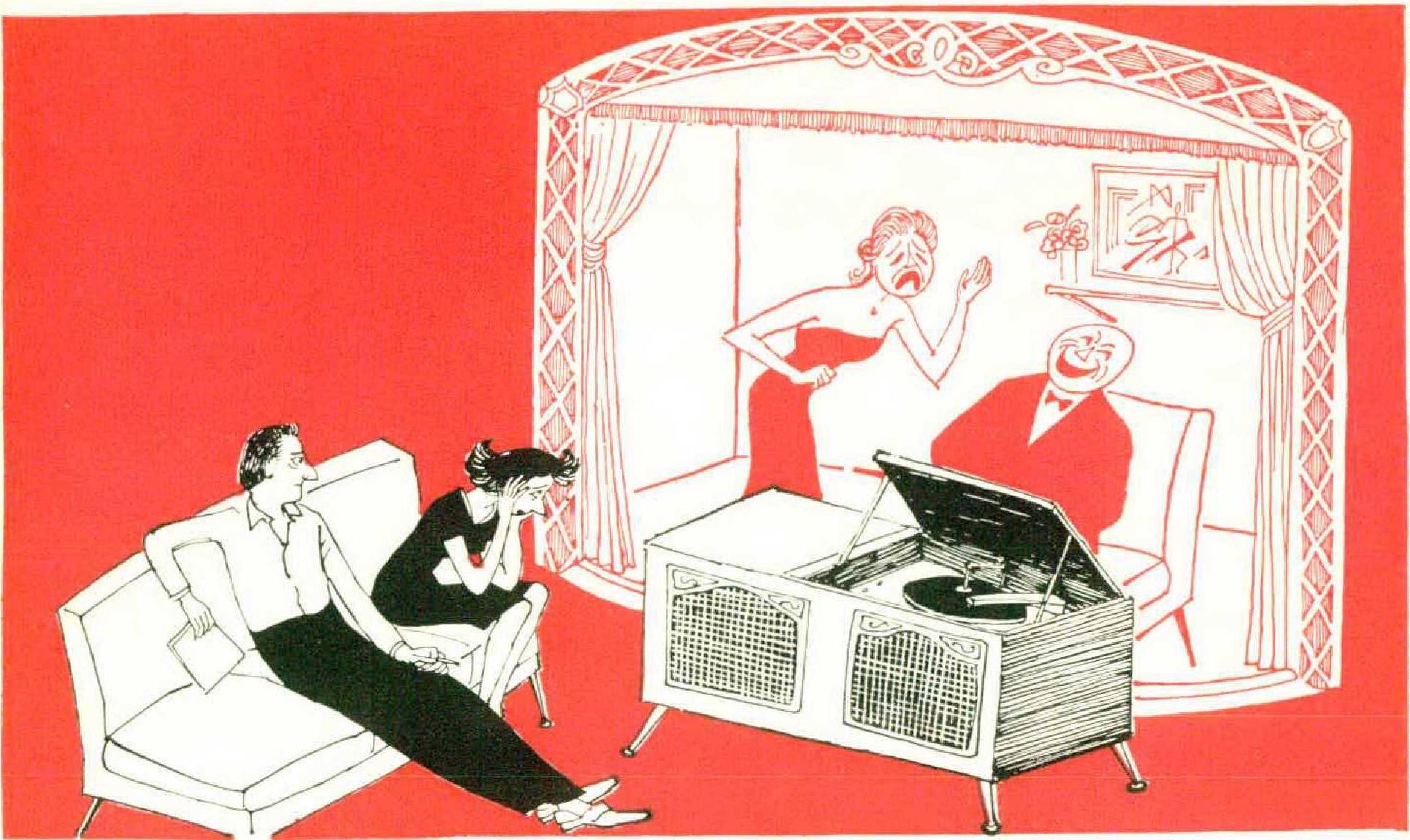
The first sounds ever heard on a phonograph were neither sung nor played, but spoken. “Mary had a little lamb,” Thomas A. Edison shouted into his primitive cylindrical recording machine, which promptly played the words back. A good many millions of words have flowed under the needle since that clay in 1877 when the inventor, listening to the sound of his own voice, confessed: “I never was so taken aback in my life.” Spoken records, particularly of drama and poetry, occupy a solid ten pages of the Schwann catalogue, and several companies manage to thrive exclusively on them.
Hitherto, most recording projects devoted to the theater have been concerned principally with classical plays. Shakespeare on records has lost its novelty, though not its impact; Molière, Goethe, and Lope de Vega may be listened to in their own languages; early dramas, including Everyman and Gammer Gurton’s Needle, have been rescued from college textbooks and brought vividly to life in spoken-word releases. Much remains unrevived and unrecorded, of course, but the words and thoughts of playwrights of the past flourish today on a scale and by a method undreamed of a few decades ago.
The modern theater is represented far less fully. Broadway musical shows are recorded automatically and indiscriminately; mindful of the commercial success of Mv Fair Lady, some companies hopefully take on recording rights to forthcoming shows sight unseen and sound unheard. But there has been no corresponding stampede to enregister Broadway’s dramatic plays. A number of substantial and serious dramas have been recorded, such as Dylan Thomas’ Under Milk Wood, Samuel Beckett’s Waiting for Godot and Krapp’s Last Tape, T. S. Eliot’s Murder in the Cathedral, Archibald MacLeish’s J.B., Brendan Behan’s The Quare Fella, and others. But few, if any, of these qualify as commercial theater, or typify the fare offered by most theatrical box offices today.
Now Columbia Records has undertaken to add a new dimension, and possibly a new direction, to spoken-word recording, with the release of Edward Albee’s Who’s Afraid of Virginia Woolf?, the most controversial drama of the 1962— 1963 season, and with the longrange project of recording nothing less than the complete plays of Eugene O’Neill.
No one, Columbia least of all, expects Who’s Afraid of Virginia Woolf? to approach My Fair Lady or South Pacific in sales volume. Still, Goddard Lieberson, Columbia’s imaginative and adventurous president, feels it will pull customers into record shops just as it does into theaters. To aid the process, he has specially priced the four-record set at $17 for stereo (DOS-687) and at $15 for monaural (DOL-287) — approximately as much, he calculates, as the cost of two good orchestra seats.
“There is a great record market in schools and colleges,” Lieberson says, “and we expect to do well there. Actually, you can’t record just any play — it has to be a play that you can shut your eyes to and still receive satisfaction. We certainly think Who’s Afraid of Virginia Woolf? is such a play.”
Who’s Afraid of Virginia Woolf? runs a solid three hours in the recording, but it amply sustains the listener’s interest and involves his emotions. Its opening words set a pace and tone that continue almost unbroken through the play — a drunken woman comes home from a party and exclaims. “Jesus H. Christ!” (One wonders what Edison would have thought of that for an opener!) Undoubtedly much of the engrossing quality of the play stems from the excellence of Uta Hagen, Arthur Hill, Melinda Dillon, and George Grizzard — the entire cast of this four-character drama. They depict vividly a pair of college faculty couples come together for a postparty nightcap that quickly finds them baring their disappointments, frustrations, and conflicts to one another, sometimes deliberately, more often inadvertently. It is the battle of the sexes fought out in words and ideas, and it is no less brutal or savage for being waged with intellectual rather than physical weapons. Who’s Afraid of Virginia Woolf? on records, as in the theater, is by turns comic and nasty, credible and exaggerated, vulgar and poetic, and it remains an absorbing experience right to its bitter end. In fact, the only question it raises as a recording is how many times a listener may wish to subject himself to its searing exposure of four human souls. In any event, it’s the ideal album to put on in case a college professor and his wife drop in for a nightcap on their way home from a faculty party.
Columbia is inaugurating its Eugene O’Neill cycle with satisfaction on its own part and skepticism from rivals. The doubters in the industry point to the sheer size of the project. O’ Neill wrote more than forty plays, and even if four were recorded yearly — a rather high rate — the task would take ten years. Besides, grandiose record projects have a way of going astray: back in 1956 Epic Records, a Columbia affiliate, announced a plan to record the complete works of Mozart to commemorate the two-hundredth anniversary of his birth. At its current rate of production the project may still be under way when the three-hundredth rolls around.
Nevertheless, Columbia has already completed Strange Interlude and is making plans for others in the series, which will be directed by José Quintero. Says Mr. Lieberson: “It certainly is our intention to record the complete works of O’Neill. He is the most important American dramatist and one who really has to be done in America. But there’s an audience for him abroad too; everybody has heard of The Emperor Jones, The Hairy Ape, The Iceman Cometh, and the others. We’re applying all the modern benefits of sound and stereo, such as using lapel mikes to indicate the ‘interior voices’ — the asides — in Strange Interlude. We think interest in recorded modern drama is growing, and that it is beginning to reach beyond the urban centers which are the only ones that have the chance to see live stage performances.”
Columbia has also recorded a curious show called Brecht on Brecht, a spoken and sung anthology of the plays, poems, and lyrics of the late Bertolt Brecht, assembled by George Tabori and presented by a cast including Dane Clark, Anne Jackson, Viveca Lindfors, George Voskovec, Michael Wager, and Lotte Lenya (02S-203. stereo; 02L-278, monaural: two records).
Brecht is currently undergoing a revival of interest in America, and Brecht on Brecht sets forth the work of his probing, skeptical, and sometimes cynical mind in his own artfully chosen words. Indeed, his actual voice is among those heard on the recording, speaking in response to the questions of a congressional investigating committee that deemed it necessary to inquire into his possible Communist affiliations. Brecht, as Lotte Lenya once pointed out, was essentially a poet who felt keenly the absence of his native tongue during his exile from Hitler’s Germany. But in Brecht on Brecht his ideas come through pointedly in translated form, although the use of excerpts and extracts sometimes robs them of continuity and a sense of climax. The most powerful moments are provided by several sets of Brechtian lyrics with music by the late Kurt Weill. It is in such numbers as “The Solomon Song,” set to a liltingly insolent tune and sung with sophisticated artlessness by Weill’s widow, Lotte Lenya. that Brecht’s genius seems to flash at its ironic brightest.
A new company called Calliope Records, with headquarters at 53 Pinckney Street in Boston, has entered the spoken-word field with four releases devoted to American novelists and short-story writers reading from their own works. Calliope’s records themselves are almost as intriguing as their contents, for they are junior-sized discs, revolving at 33 1/3 rpm but measuring only seven inches across and offering a maximum playing time of eighteen minutes. They are priced at $1.95.
The seven-inch LP record has won something of a place in Europe, but it has never established itself in the United States, although Columbia experimented with it briefly some fifteen years ago. Calliope regards its diminutive records as “the companion to the quality paperback book,”and believes that eighteen minutes’ reading time is sufficient to present a self-sustaining excerpt from a longer work and to display an author’s interpretive insights into his own books.
The four writers represented in Calliope’s first releases are James Baldwin with Giovanni’s Room (CAL11), William Styron with Lie Down in Darkness (CAL-12), Bernard Malamud with “The Mourners,” a story from The Magic Barrel (CAL-13). and Philip Roth with Letting Go (GAL-14). All four authors are adept and assured in their reading, bringing illumination and sharpness to the characters and situations they describe. Roth and Malamud in particular have not only a talent for writing dialogue but a knack for acting it out — foreign accents not excepted.
Naturally, there is a vast difference between the scenes and situations represented by the four records — Mr. Baldwin’s almost clinical report on the homosexual awakening of a young boy after a day at the beach; Mr. Styron’s touching account of a deformed and retarded girl’s discovery of human affection in the person of a compassionate workman; Mr. Malamud’s symbolical description of a senseless and unnecessary eviction in an East Side New York tenement; and Mr. Roth’s graphic dialogue between two lonely and conniving old men in a shabby rooming house.
For all their variation in subject and style, the four records share a certain grim and lugubrious approach to the lives they describe. Even their humor, such as Mr. Roth’s description of the two rooming-house schnorrers, Levy and Korngold. devising schemes to extract a few dollars from someone, is more sardonic than comical. In fact, listening to the woe. pathos, and wretchedness embodied in these four literary recordings, one is tempted to observe that Calliope Records could very easily have been labeled Calamity Records. However, the next batch of authors promised for early release by this new and venturesome company includes James Jones, John Knowles, John Updike, Archibald MacLeish. Howard Fast. C. Northcote Parkinson. Peter Ustinov, and Alastair Reid. One or two of these names, at least, suggest that some of Calliope’s future sounds may be a bit more cheerful.
Record Reviews
Bach: Concerto in D Minor for Violin, Oboe, and Strings
Vivaldi: Concerto in B Minor, Opus 3, No. 10, for Four Violins and Orchestra Handel: Concertos for Oboe and Orchestra Nos. 1 in B-flat, 2 in B-flat, and 3 in G Minor
Yehudi Menuhin directing Bath Festival Chamber Orchestra. with Robert Masters, Eli Goren, Sydney Humphreys, and Yehudi Menuhin, violinists, and Leon Goossens, oboist; Angel S-36103 (stereo) and 36103
Musical experts have long held the opinion that Bach’s Concerto in D Minor for Two Harpsichords and Strings (BWV-1060) was composed originally for violin and oboe, and that this version was subsequently lost. Yehudi Menuhin and Leon Goossens make the scholars look good by playing it in a conjectural violin-oboe arrangement that has the sound and sheen of the authentic article. The result is a lively and convincing presentation of a familiar work in a new guise. Vivaldi’s fourviolin concerto, one of the most likable pieces in the collection known as “L’Estro Armonico,” gets a lusty performance from a quartet of fiddlers headed by Mr. Menuhin; and the engaging Handel works are set forth by Mr. Goossens with skill and enthusiasm.
Beethoven: The Complete Piano Concertos
Artur Schnabel, pianist, with London Symphony Orchestra and Philharmania Orchestra conducted by Sir Malcolm Sargent, Issay Dobrowen, and Alceo Galliera; Angel COLH 1/5: five records {monaural only)
Artur Schnabel, who died in 1951 secure in his reputation as a musician among pianists and the foremost Beethoven interpreter of his time, made the first of these recordings (the Concerto No. 1 in C) in 1932 and the other four in 1946 and 1947. Some Schnabel devotees may prefer his recordings of the Concertos Nos. 4 and 5 in the 1930s with Frederick Stock and the Chicago Symphony. But this is a testament of what can only be described as musical nobility, worthy to stand with the previous thirteen-record release (by RCA Victor) of the thirty-two piano sonatas. The sound of the concerto records is somewhat disappointing. Many other 1946 and 1947 releases had greater depth and liveliness than these.
Lortzing: “Zar und Zimmermann”; “Der Waffenschmied" (highlights)
Peter Ronnefeld conducting Vienna Volksoper Orchestra and Stale Opera Chorus, with Hilde Gueden, soprano: Eberhard Wdchter, baritone: Oskar Cgerwenka, bass: and Waldemar Kmentt, tenor; London OS-25768 (stereo) and 5768 Surveys of operatic audience preferences in Germany invariably reflect a strong popular taste for the works of Albert Lortzing (1801—1851), especially for his “Zar und Zrimmermann” (“Czar and Carpenter”), a narrative of Peter the Great’s sojourn in Holland during his study of foreign shipbuilding methods. Lortzing’s music, engaging, skillful, and cut into neat patterns, most of the time sounds like watered-down Mozart or Rossini. Listening to it in these cheerfully sung performances — excerpts from a second opera, “Der Waffenschmied” (“The Armorer”) are also included — one understands why these pleasant tunes have made Lortzing so popular in his native land, and also why their lack of any particular substance or originality has left them totally unplayed elsewhere.
The Art of the Prima Ballerina
Richard Bonynge conducting London Symphony Orchestra; London CSA-2213 (stereo) and CM A-7213: two records
There is no lack of ballet records in the catalogue, but this album attempts to introduce two novel elements — the historical approach and the use of thoroughly balletic tempos. In other words, this is a dancer’s recording far more than a composer’s. It succeeds admirably, too, for Richard Bonynge’s tempos, which often seem flaccid and laggard when he is conducting accompaniments for his wife, Joan Sutherland, have the right quality of relaxation and elasticity for such pleasant diversions as Adam’s Giselle, Donizetti’s La Favorita ballet music, and several Tchaikovsky excerpts. Even more attractive than these are the selections from seldom-heard works by Drigo and Lovenskjold and especially by Leon Minkus, a Viennaborn Pole who was ballet composer for the Russian Imperial Court in the second half of the nineteenth century and who knew how to turn out scores that were not only danceable but highly agreeable to the listener sitting one out.
The Ballad of Robin Hood
Read and sung by Anthony Qiiayle; Caedmon TC-1177
This might be described as a superior children’s record, were it not that the phrase is too limiting. Actually, it’s a superior record by any standards, recounting the tale of Robin Hood in story and song. Anthony Quayle is renowned as an actor, but here he demonstrates that he is a pleasantly accomplished singer, too. swinging effortlessly between sung and recited ballads of Robin, with lute accompaniment by Desmond Dupré. Nearly all of Sherwood Forest’s lusty and leafy occupants are here — Little John, Maid Marian, Friar Tuck, Allan-a-Dale, and even the treacherous nun of Kirklees, who bled poor Robin to death. Whether he is impersonating a dashing outlaw or a pompous bishop, in song or in story, Mr. Quayle is a constant delight.
Emily Dickinson’s Letters: A Reminiscence by Thomas Wentworth Higginson from the Atlantic Monthly, October, 1891
Read by Samuel Charters; Folkways FL-9753 (monaural)
Thomas Wentworth Higginson was a New England literary figure with whom Emily Dickinson corresponded for many years, sometimes enclosing poems for his examination. He lent her encouragement and sympathy, although he was unable to help her achieve publication during her lifetime. In 1891, a year after her first book of verse was printed posthumously, with an introduction by him, Higginson wrote an article for the Atlantic Monthly, recounting his correspondence with the poet. Emily Dickinson’s letters, like her poetry, were filled with unexpected turns of language and fresh, spontaneous thought, and Higginson’s article set them in a sympathetic and sensitive framework. As read aloud by Mr. Charters, the letters, poems, and the article itself blend into a credible word portrait not only of the strange poet, but of her family background and literary epoch. The printed text of the article is provided, along with a critical introduction by Mr. Charters.
Songs of the Auvergne, Volume 2
Netania Davrath, soprano, with an orchestra conducted by Pierre de la Roche; Vanguard VSD-2132 (stereo) and VRS9120
Few sets of folk tunes are as distinctive or as haunting as the “Songs of the Auvergne,” first recorded, in the beautiful and simple arrangements of Joseph Canteloube, by Madeleine Grey in the 1930s. In the modern era Netania Davrath, whose voice has the freshness of a clear mountain stream, has succeeded Miss Grey as their matchless interpreter. This is her second volume; most of the more familiar songs were included in the first. But there are a few fine ones left, such as “L’Antouéno,” a cheerful pastoral tune which opens the record. To discover the “Songs of the Auvergne” is a musical thrill, and the discovery should properly begin with Volume 1. For those who have already done so, Volume 2 provides a logical progression and a sustained pleasure.