Water for the Village
Take a man. Possibly he lives not far from you. He is a resident of a fair-sized suburb, thirty minutes by car from his office. He owns a home and cares for it well. He has a rolling lawn, bright green, with no weeds or crabgrass to mar its delicate, thin blades. He waters it faithfully, and has acquired a barrage of hoses and sprinklers over the years.
Sometimes, during an especially dry summer, his township restricts him to a few hours each day when he may soak down the grass. Not enough time, really. A sprinkler, partly shielded by bushes, is spotted by patrolmen in a cruiser, and they caution him about it. Dry patches appear in the green and deface it. The man is indignant. Chances are the roots are dead. He will have to turn those patches over and reseed them if he does not want a lot of weeds on his hands.
The ban is short-lived. Before long it is lifted, and once more the man may use water as lavishly as he likes. Perhaps it would be hard for him to imagine, if he stopped a moment to wonder, people living their entire lives in the shadow of a permanent water shortage. I speak of the Greeks who inhabit the islands scattered over the surface of the Aegean Sea.
These islands are formed of volcanic rock and are barren, with a topsoil fit only for the hardiest plant life — wild herbs, greens and caper bushes, tall grass, barley, and tree crops.
Some smaller islands, which have no fresh water, depend entirely on rainwater. In the summer people there drink the rainwater which they collected the December before. Other islands, like Hydra, supplement the meager ration nature doles out with shipments of fresh water from the mainland, which is hosed from the boat into cisterns ashore. Certain more fortunate islands have enough springs and wells to keep the inhabitants supplied.
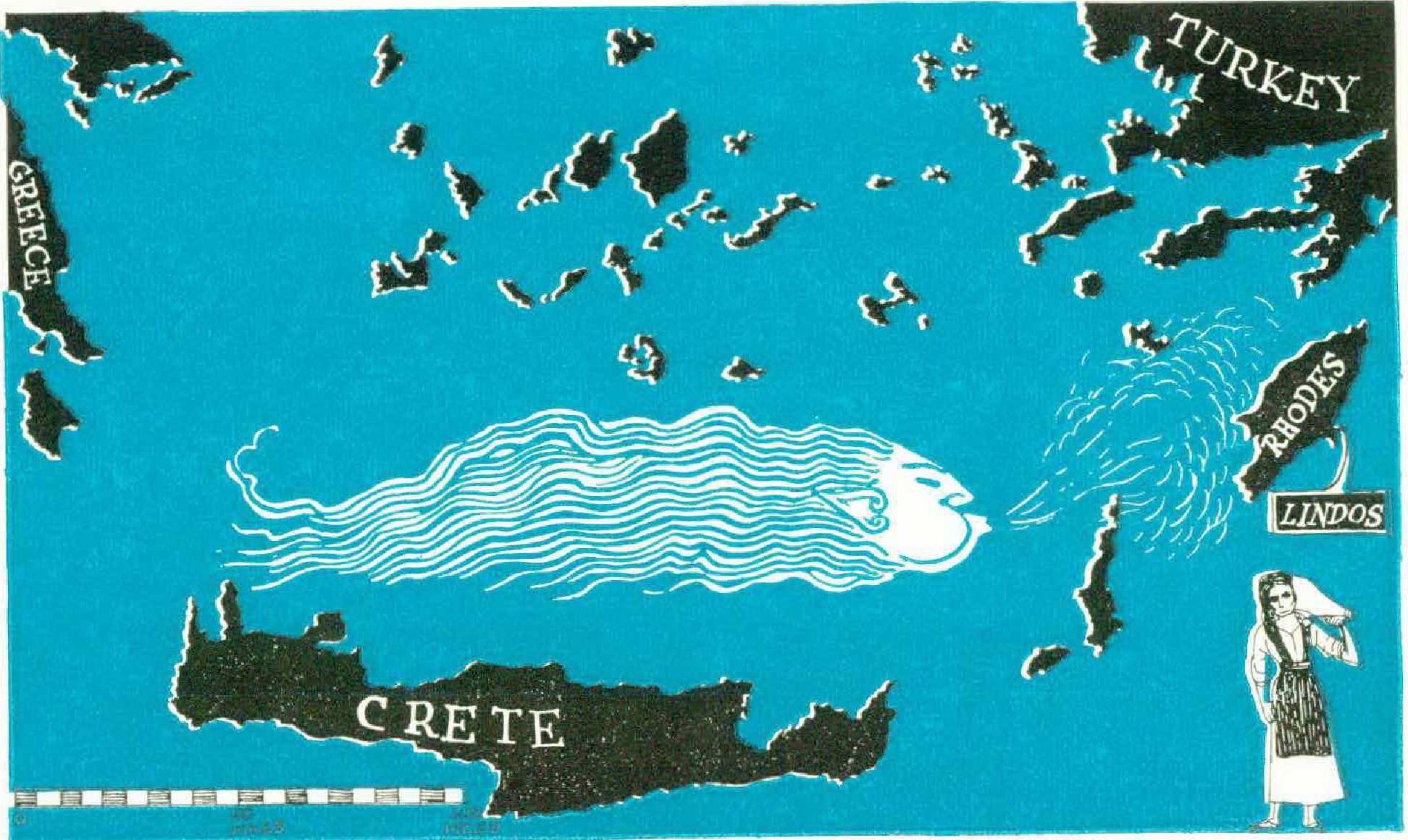
I lived on one of these for a year, on Rhodes (the largest island in the Dodecanese group, which runs south from Izmir off the Turkish coast), in the small village of Lindos.
On the road out to Lindos you pass a waterfall whose thin strip cascades over a clifif, not just in the rainy season but all year round, an unheard-of thing which even the Rhodians marvel at. And the road takes you through the green groves of orange and lemon orchards. But just the same, unless you see the land under the mantle of green that camouflages it briefly during the rainy season, you will quickly realize that water is not to be had here in abundance.
The pinch is strongly felt in Lindos. Nature is partly to blame for this, but underdevelopment is responsible as well. A large spring flows on the far side of a low mountain which could give Lindos a surplus of water if pipes were laid. But right now things stand as they have for centuries; life continues on a primitive level.
Lindos is a village of winding streets and whitewashed stone houses with mud roofs, some of which date back to the fifteenth century, when crusading Knights of St. John occupied the village. Lindos is dominated by an acropolis, built high on a promontory of solid rock, which separates the village from the sea. It has only one source of water, a spring located in the village square. The spring undoubtedly determined the location of Lindos. It was operating long before the birth of Christ, and it has never been known to dry up. In 600 B.C. the Lindians constructed a waterworks which provided outlets for the water at different points through the village. Although it is the oldest of its kind still to function, extensive repair work has reduced its efficiency over the years.
Only the main outlet in the square has been unaffected. Water flows there in a steady stream from the caves in the hill behind, refreshingly cool in summer. Air vents on the plateau above provide access to the caves in case anything happens to block the flow of water from inside. Men who repair wells and springs can be lowered by rope into the dampness below and, by the light of a hurricane lantern, set right whatever has gone wrong. The water will continue to collect, dripping from stalactites which hang from the roofs and walls of the caves, and to pour out of the marble trough in the square.
But none of it is piped to the individual houses. All water to be used for drinking or cooking must be brought either by hand or by donkey from the spring. This is quite a chore and a tremendous nuisance, and one good reason why the people of Lindos are very careful not to let water be wasted.
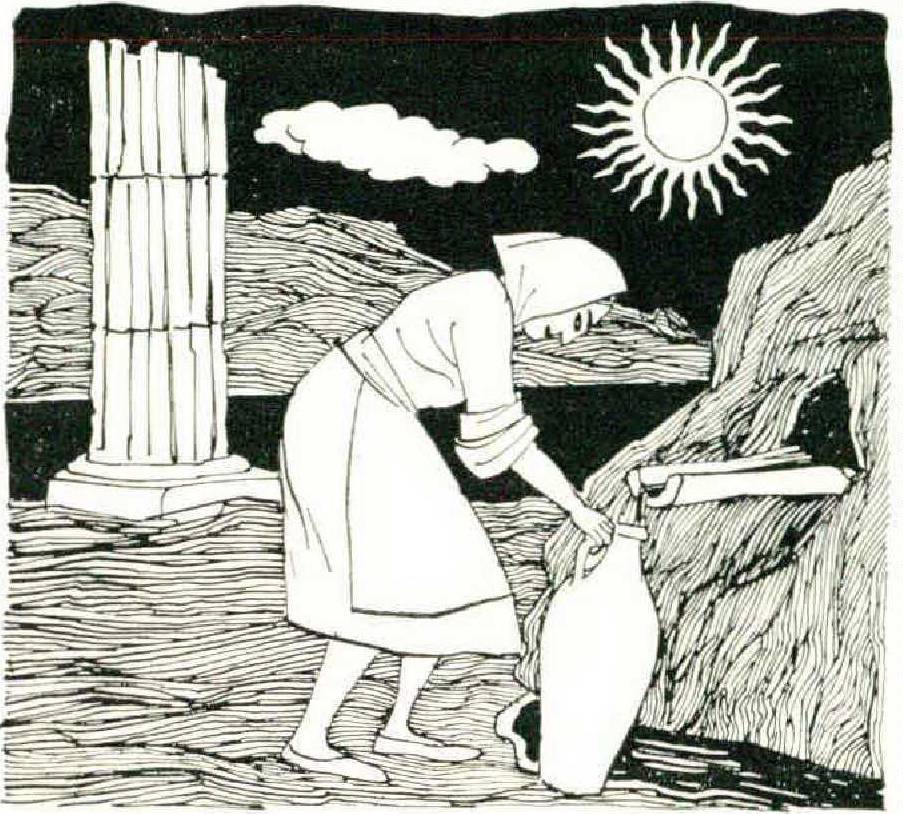
Transporting the water is by tradition the women’s task. They carry it in light-brown jugs made of baked clay, called stamnas. These vary in size and hold anything from a quart to six gallons. Women prefer to bring a lot of water with every trip. They have been transporting these heavy burdens since they grew strong enough to lift them, and now think nothing of it. When the stamna is full, they simply plug its neck with a small sea sponge and set it horizontally on one shoulder with a bit of cloth or a napkin to take the edge off the weight, gripping the handle to keep it steady as they walk. Only the slight forward bend of their posture suggests the number of pounds they are carrying.
A donkey, which can have twenty gallons lifted onto its back and not bat an eye, finds the work easier. People who have flowers or lemon trees to water get the additional amount they need from the waterman, who goes back and forth from the spring all day, prodding his donkey along with a switch. Each load, which totals roughly twenty gallons, costs the customer twelve or fifteen cents, depending on the distance from the square to his house. The waterman’s tins are rustproof and are tightly plugged with pieces of wood wrapped in canvas, so the water he sells can be used for drinking.
Taking into consideration the day-to-day difficulty of getting water into the homes, one can see why water becomes almost a luxury item. Economy is the keynote, and here are some of the ways water is saved, some of the ways in which water has a direct and formative influence on the lives of these people.
To begin with, they collect rainwater. Nobody in Lindos would dream of drinking it, as people do on drier islands, but everyone washes with it, takes baths in it, launders his clothes in it, and even washes the floors with it. It is collected in barrels or cisterns as it runs off the roofs in the rainy season. Since most of the roofs are spread with earth for coolness on scorching summer days, the water comes out muddy, but a bucket or two of whitewash pretty well clears it up. Rainwater is, of course, softer than springwater, and detergents work more effectively in it.
Strange as it may seem, the floors themselves economize on water. They are a Lindos original and until recently did not exist anywhere but on the island. Now a Lindos-type floor decorates the United Nations building in New York, I have been told, but the pebbles to make it had to be brought over from Greece. These can be found in great numbers on the beaches of Rhodes, worn smooth by the continuous motion of the waves. Their oval shapes appear perfect to the naked eye. They come in many colors; gray predominates. but many are an ivory white, fewer are jet black, and there is also a rusty red that is hard to find. The white and black pebbles, and perhaps a few reds if the stones are for a courtyard, are used to make the floors. The pebbles are set upright in a mixture of lime and concrete, forming a black design on a white ground, depicting motifs from the sea, or the pointed form of a cypress tree, or a branch. Now and then you come on a design that is completely abstract.
The practical value of these floors is that, with occasional sweeping, they need washing only twice a year. Dust and dirt disappear in between the pebbles. The floors are washed during fall cleaning and once again when the house is made immaculate for Easter. The floor is sluiced down, sprinkled with soap powder, and swept with a broom from one end to the other. Then it is doused again, and all the suds and water and dirt are swept out the door. The pebbles are left with a glistening finish.
Washing is perhaps the greatest single source of depletion of the water supply, but Lindians have devised a number of ways, in addition to collecting rainwater, to cope with the problem. The multicolored wool blankets and rag rugs which people weave in their homes during cold winter days are taken to the sea for washing, where they are pounded and scrubbed against the smooth rocks along the shore.
The strong Aegean sun is brought into play as a cleanser. Washed dishes are given a light rinse and then left standing for the sun to dry them and rid them of bacteria. A neat row of silverware leaning against the trunk of a tree is not an unusual sight. Clothes and sheets are hung out after washing to be bleached clean. Sometimes more is expected of the sun than of soap and water, but because of its intensity there, it seldom lets a woman down.
Insects are dealt with in the same way. In the summer you may open a box of cookies and find it swarming with ants, even though it has been carefully packaged and sealed. They seem to get into everything — meat, fish, butter, and cheese. Nothing seems safe. Your first impulse is to throw the food as far away as possible — unless you are a frugal Lindos housewife. This is something the women would never do, for they do not consider ants dangerous germ carriers. Perhaps they cannot afford to. In any case, they have an effortless way of getting rid of them, which has nothing to do with washing. The item is put out in the sun for a few minutes. The ants take flight in all directions, and soon it is free of them. They are gone before a slab of butter has time to melt.
Lindians believe that too much water is a bad thing, and when they are thirsty they hold their natural impulse in check and take a very small amount. This is no challenge in the winter, but a short walk in the summer sun can make your throat so parched you need several quarts to quench your thirst. But they are right. A lot of water drunk that way hits you hard, in the stomach. When you want a glassful, a sip is better. If you are a mealtime guest of a Lindos family, no water is touched until the dinner is over. Then everyone has a glass. Once you are used to the idea, you find that you are eating much more than usual and do not miss drinking with the meal. (Perhaps this accounts for the fact that most Lindos women are on the heavy side.) But once you begin sipping wine or beer, tea or coffee, you find you are drinking a lot and eating little.
An indirect saving is involved in the kind of crops most people grow, which, by and large, require no watering at all. Almost every family owns a vineyard which supplies it with grapes throughout the summer. The vines grow in sand, usually near the coastline, and despite the large percentage of water every grape contains, the vineyards require no irrigation to flourish. Most of the vineyards are located in Pefkes, a farm settlement about an hour’s ride from Lindos, which many of the villagers move to in the summer but which is left deserted in the winter, when the crops have been harvested. There the vines are flanked by orchards of fig and almond trees, which yield well without being given a drop of water. Olive trees are the same, and it is a rare family that does not own enough of them to provide oil for cooking. People also grow a low-grade grain to feed their animals, one which they give no care whatever until threshing time.
Only professional farmers handle crops which need constant watering. These men have invested in motors to pump well water into their fields, enabling them to grow tomatoes, eggplants, summer squash, peppers, and melons. With a little luck they stand to gain a sizable profit. Pefkes has only one real farmer, a lanky, sly, aging man who spent his youth in Algeria. One day he explained how money can be made in his business. It is all a matter of timing; you must have a good crop early in the season, when the product is in great demand. The profit is made when the price is highest. The more you sell the better. Then you can rest easy, when tomatoes are going for a cent a pound. But if you plant early and hit it right, a good crop of tomatoes can bring in thousands of dollars in two weeks. Chances are, however, that one of the many unpredictable windstorms will wipe you out before you even get started, and you will have to do your planting all over again in order to break a little better than even. The jackpot is an enticing target, but not an easy one.
Like most Aegean islanders, the Lindians are water connoisseurs. The water of every well in Pefkes has been tasted and judged for freshness, sweetness, and coolness. The quality is said to vary greatly from one well to the next. The mayor, who owns a large house, installed a metal windmill so that all could come and get water at his well. But the villagers say his water tastes like medicine, and his only takers are those who have no other source in Pefkes.
Fishermen know of secret spots along the shore, some hidden in almost unreachable places, where freshwater springs come from underground and flow into the sea. Many are indistinguishable from the saltwater pools that surround them, and it is a marvel that they were ever discovered. Some villages are famous for having good water. The cold water that flows from the spring of one mountain village is almost a legend. It is said to be so icy, even in midsummer, that it can make a watermelon burst apart. And for those not fortunate enough to live by that mountain spring, a special variety of water jug is imported from the island of Kalymnos during the summer months. Made of a very porous clay, these jugs will not only keep water cold but, if left in a breeze, will actually make lukewarm water refreshingly cool.
It is not certain that life will go on this way much longer in Lindos. The village must combat a steady decrease in population. In this century the number of inhabitants has dropped by the thousands. Lindos is losing the best of its men to the urban centers of Greece, as the country moves through the implementation stages of industrialization.
in the nineteenth Century Lindos had some commercial prominence, but this was lost when its sea captains refused to equip their ships with motors so they could compete in a new age of sea transport. Now the only ships in the harbor are the pleasure yachts which come in summer. Lindos has great appeal for the tourist, thanks to its ancient acropolis, which many viewers prefer to the more famous acropolis in Athens; and tourism is, at the moment, its one hope of economic rejuvenation.
But to take advantage of Greece’s fast-growing tourist trade, Lindos must become modern and streamlined. It needs hotels, electricity twenty-four hours a day, and running water. Not so long ago the sea captains held out and the commerce of the village went under. Now the village as a whole finds itself in a similar position, but it may not be the one to decide. In all probability, the government in Athens will make the decision — in favor of tourism and rapid development.