The Bronze-Age Ship: An Adventure in Underwater Archaeology
At the age of thirteen, PETER THROCKMORTONcould read and write Sumerian cuneiform, and since then he has been involved in adventures in every part of the globe. As much as any other single person, he is responsible for helping to bring scientific precision to the raising of sunken ships. The adventure which follows has been drawn from Mr. Throckmorton’s forthcoming book, THE LOST SHIPS, to be published soon under the AtlanticLittle, Brown imprint.
I SAW my first sunken ship at the bottom of Honolulu Harbor. She was a wooden minesweeper which had been abandoned to sink slowly when the shipworms weakened her planking. The water was dirty, and I could not see far. I was using the cable that held the marker buoy to the wreck as a descending line. It was overgrown with glutinous, unsavory globs of green seaweed, under which grew razor-sharp mussels. I was afraid.
I reached the mast and worked my way carefully past tangled rigging. The ship, still invisible, made itself felt as a dark presence looming below. The bridge came into sight. The pilothouse windows gaped like eyeholes in a skull, the darkness behind them concealing unimaginable terrors. Avoiding the bridge, I worked my way down the little ship’s side. She was canted over to starboard; I found the overhang ominous. Her bronze screws gleamed above the black slime of the bottom, which was littered with rotting cardboard and rusty beer cans.
I swam up to the main deck. The messroom door hung agape. Although the interior was dark, a dim rectangle of light showed that the door which led to the deck on the other side of the ship was open. My companion saw me hesitating and swam coolly past me, through the door, and out the other side. I pulled myself together and followed him. There was nothing inside but a rusty coffee urn.
But I had been caught by something harder to kill than any of the fabled beasts that storytellers put in sunken ships, stronger even than the giant groupers which inhabit wrecks in some tropical waters. That minesweeper crystallized the interest in shipwrecks which I had always had, and my interest in seamen, ships, and voyages.
The sea was the only fixed thing in my childhood, for my parents were divorced when I was very small, and I divided my time between them and the boarding schools and summer camps where I was sent from the time I was seven. To this day I cannot clearly say where I am from, except that every peregrination ended in New York, where I was born, and that I feel strongly that I am not from Chicago, where my father settled because of his job with a manufacturing company. Perhaps the prospect of another summer mucking manure on my father’s “farm” was what drove me to run away to sea before I finished school.
The Navy rejected me because of weak eyes. I hoboed my way across America, worked around a dozen seaports on barges and fishing boats. I shipped out in a tanker, signed off six months later in Honolulu, and went to work in a junkyard.
The war was over, and the armed services began selling surplus material by the ton. A typical “lot” might contain two trucks, ten thousand gas masks, and a heap of boxes of engine parts identified only by illegible code numbers. The trick lay in bidding no more than the real value of what you knew you could sell. The profit was in the unmarked boxes. One lot contained tons of heavy diving gear, which lay in a corner of the warehouse for months until it was purchased by a drunken ex-Navy diver named Charley, who was setting up in business on his own. He promised to teach me to dive.
I went to work for the diver, and he kept his promise, but then he went broke and I was left high and dry. Charley swore that he was my father and signed the papers for my enlistment into the Army Transportation Corps, which eventually put me to work in a Yokohama shipyard.
I was crazy about diving, but Army regulations forbade us to dive. I made friends with the shipyard divers. We dry-docked ships several times a month. Adjusting keelblocks after the ship was in the dock usually took place the night before the dock was pumped out, when there were seldom any officers around. Writing fifteen years later, I find it hard to remember why it was fun diving in a Jap helmet diving rig a foot too short for me, in the wintertime, in total darkness.
But Yokohama was a wonderful place to be if you liked ships. During the day I worked on big ships. At night and on weekends I worked on or sailed my own small boat. I got myself transferred to a fireboat which was based on an island in the bay between Tokyo and Yokohama, and spent the long watches studying so that I could go to college when I was released from the service.
I was fascinated by the Japanese, especially by the sea people of Tokyo Bay. A friendly anthropologist took me on as temporary assistant in his archaeological investigations of the Japanese neolithic period. I had not enough background to do very useful work, but the experience made me determined to study.
In due course I was paid off in Honolulu, after four years in the Army, and enrolled at the University of Hawaii. It was the year the aqualung came on the market. Those who dive for the first time with the aqualung can never know what the device meant to those of us who underwent our diving apprenticeship in helmet diving gear. As it was designed to do by Captain Cousteau, the aqualung frees man in the sea. A device which simplifies diving to the essentials, it allows the diver to breathe, by means of a regulator, compressed air from bottles strapped to his back. The standard Navy diving suit is, of course, an admirable device, more suitable for some kinds of work than the aqualung. But it is much more expensive, and the diver requires a boat above him and skillful attention from a minimum of two tenders before its use is safe.
I was twenty-five when I was accepted as a candidate for a higher degree in ethnology at the Museum of Man in Paris. My GI Bill ran out there a year later. I lumped cabbages every night until I found a job as assistant to a documentary-film maker, and took up free-lance photography at the same time. It was a wild and wonderful existence, and one day I just stopped going to school.
I WORKED my way across the Old World, doing my bit to satisfy the greedy public’s desire for photographs of royal weddings, revolutions, murders, accidents, and the adventures and amours of film stars. I saw some spectacular sights. I was still boat-crazy, but there was no future for me at sea, unless I earned enough to afford a small sailing boat. I planned dozens of nautical assignments and proposed them to editors, who inevitably found work for me inland.
In Istanbul in the spring of 1958, I found myself alone and at loose ends after a winter of steady employment. First I heard that a beautiful bronze bust of Demeter had been found near a place called Bodrum in southern Turkey. Then I was told about a Turkish diver-photographer who lived in Izmir, the main port of Aegean Turkey. His name was Mustafa Kapkin, and he was glad to see me.
Mustafa was a slight man, black-haired and olive-skinned, with liquid brown eyes. He was full of funny stories and charming turns of speech in English, which he spoke badly, and in German, which he spoke well. He had flown fighters in the Turkish Air Force, and his mannerisms were still those of a fighter pilot. Unlike most Turks, he was gay. This perhaps was because his family came to Izmir from Crete as refugees of the Balkan wars in 1912. He always spoke Greek with his mother, because she had never learned to speak Turkish well. It was not until I came to Greece that I understood that he was neither Turkish nor Greek, but Cretan. In short, he was a sea person, of the basic stock of the Aegean sea people.
Mustafa was prospering as a commercial photographer, and his work had taken him all over Aegean Turkey. Like me, he was fascinated by sponge divers, wrecks, and the sea. It was getting hot in Izmir, and springtime was never very busy anyhow. We decided to go to Bodrum.
Since it was impossible then to import diving equipment into Turkey because of currency restrictions, we collected some gear which had been copied from commercially manufactured equipment. We intended to meet some sponge divers and to attempt to find out exactly where the Demeter had come from. It might, we thought, make a good article. We didn’t really care. I was happy to be out of Asia, following the dream of clear water that possessed me. Mustafa was glad to escape for a while from the heat of Izmir and the daily round of his work. Like Xenophon — the literary gentleman of Athens who accepted a friend’s invitation to come along on an interesting adventure and a few months later found himself leading ten thousand men across Asia — I didn’t know what I was getting into.
THE tales Mustafa and I had heard seemed so promising that I was eager to go on. Our inquiries about the bronze Demeter had been inconclusive, but it did not matter. There were many other wrecks.
I knew that with one exception no sponge divers had ever voluntarily shown things to outsiders. The exception had been spectacular. In 1901, a captain from Syme named Demetrios Kondos found the wreck of a ship loaded with statues, probably looted about 80 B.C. during the Roman occupation of Greece. Antikythera, where Kondos had found his famous wreck, was over two hundred miles from the Carian coast. Still, the discovery of the Demeter might mean that the same kind of thing existed here.
Captain Kondos had reported his discovery. Other discoverers had not. Another treasure ship was found by Greek sponge divers at Mahdia, in the Bay of Tunis, in 1907. They tried to sell the bronzes they found but were discovered by the alert director of the Department of Antiquities in Tunis, who made them tell him the location. An American philanthropist put up the money to raise some of the material, and the art works found fill several galleries in the Bardo museum.
In 1926 some Greek trawlermen found a colossal bronze statue off Cape Artemision and tried to sell it. They too were noticed by alert authorities. The bronze, which was nearly broken up by the fishermen when they got into trouble, stands in the Athens museum today. One of the finest surviving fifth-century bronzes, it is a larger-than-life statue of Poseidon.
One of the glories of the Louvre is a bronze Apollo of the fifth century B.C., brought up by a trawler from the channel between Piombino and Elba in 1832.
By the time that I arrived in Bodrum in 1958, there had been a long series of underwater “excavations.” Most had been stigmatized by accidents. All were characterized by confusion of purpose. The salvagers had found wood, sheathing, and unidentified bits of ship material, but no one had ever published an accurate drawing made underwater. Even photographs of a hull in place were rare. Archaeologists on land perform technical miracles of the highest order. The Viking ship found at Sutton Hoo in England in the 1930s was excavated so carefully that detailed plans of the hull of the ship could be made, although the wood had completely perished. I wondered why the sea diggers, when confronted with actual wood in good condition, had not even produced sketch plans or accurate measurements.
The answer lay, perhaps, in the nature of the underwater medium. Anyone who dived automatically became an “expert.” The archaeologists understood very little about working underwater and left the actual labor to the “experts,” who committed archaeological atrocities right and left. Divers tend to be adventurous types, not given to sympathy with the archaeologists’ interest in broken pots.
If, as I now suspected, the Turkish Aegean were a treasure-house of ancient wrecks, and we should be able to record them, it might someday, somehow, be possible to get the money and equipment and personnel necessary to do an underwater job that would prove to the world that underwater archaeology was a practical proposition, and to convince people that ships and their cargoes could be as interesting as inscriptions and statues.
One of Mustafa Kapkin’s best friends in Izmir was director of the museum there. We spent an evening with him, talking about the possibilities of underwater archaeology. Hakki Gultekin was a dedicated and idealistic archaeologist who agreed that it was important to find out what we could while we had the chance. I am sure that he was not convinced that the hull of a ship could be preserved in mud after thousands of years. However, the evidence that something was there stood in his museum, in the form of the fourth-century bronze bust that had come from Bodrum.
Our project worked itself out over the table in Mustafa’s garden. Mustafa and I would go back to Bodrum. We would try to find out all we could about the ancient wrecks known to the sponge divers. Hakki Bey, as museum director, would take charge of the project under the auspices of the Izmir Diving Club.
In Mustafa I had an invaluable partner and ally. At thirty-seven he was one of the best photographers in Turkey, and the first Turk to make underwater photographs. His Cretan background had given him a love for the sea and an affection for the coast people, which they respected.
Both Mustafa and I believed that Captain Kemal, the most successful sponge captain in Bodrum, could take us to wreck sites. But it was impossible to accompany him and dive unless we had a highpressure air compressor for filling aqualung bottles, and decent equipment was unobtainable in Turkey for any price. Hakki Bey, Mustafa, and I shook hands on our project, and next morning I started off on my search for gear.
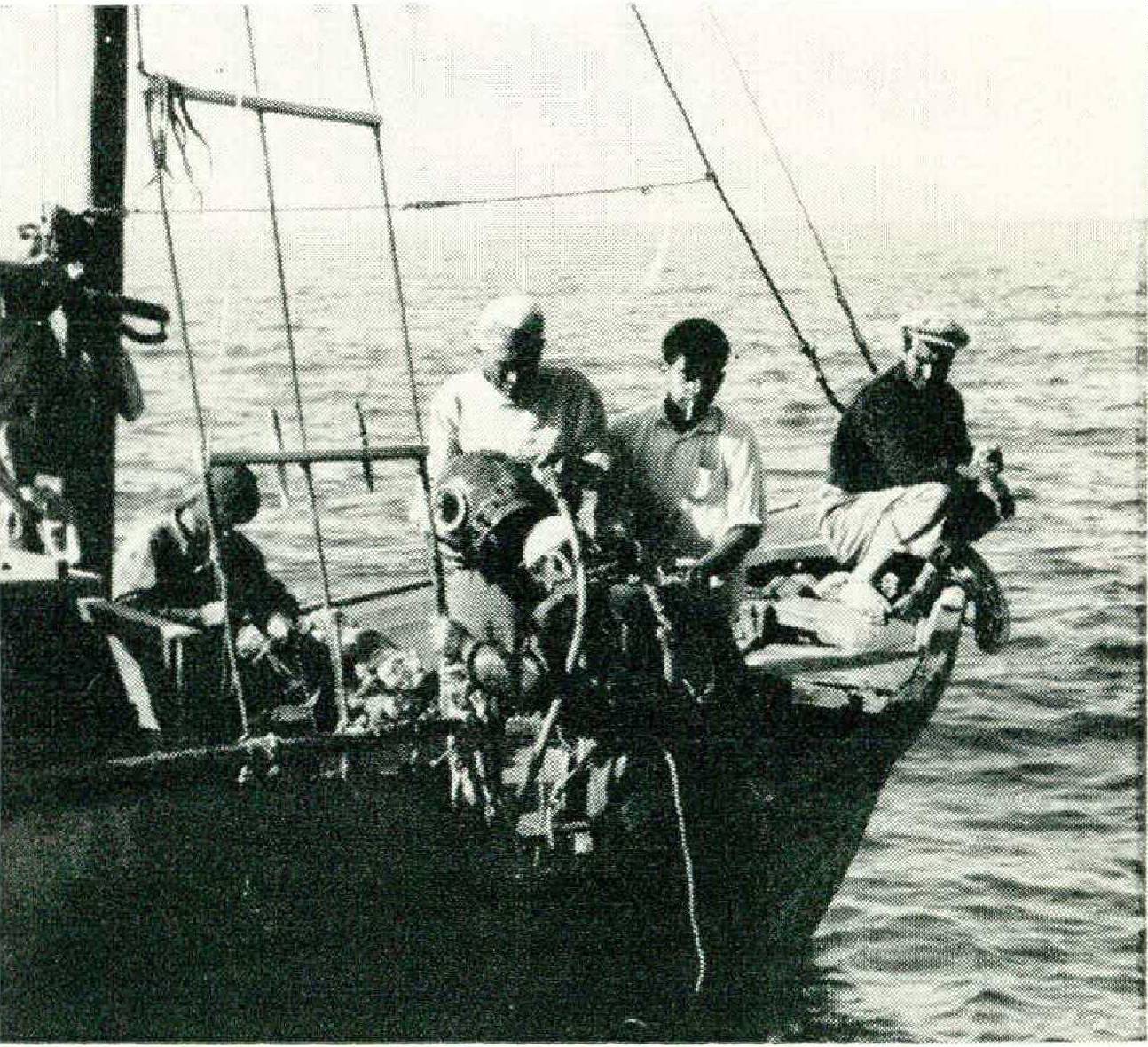
MANDALINCHE was the first sponge boat that I had ever been aboard. Thirty-six feet long, she was double-ended and sloop-rigged. The hull was lovely, rather like the famous Colin Archer Norwegian fishing boats, but not so deep in the water. The type is called trechenderi in Greece, tirandel in Turkey. Kemal’s boat was an aktarma, a variation of the design which had been developed in Kalymnos, the center of sponge diving in Greece, just across the channel from the Bodrum Peninsula. An aktarma is very maneuverable, a quality necessary to a boat which never anchors while working, and which must keep up with the diver’s movements on the bottom.
Most of the deck space was taken up by an open hatch, filled by an old Siebe Gorman German diving compressor. The bottom of the hold was filled with beach-pebble ballast. Lashed to the mast was a Roman amphora which served as the ship’s water tank, its tapered bottom jammed into the gravel. I asked Captain Kemal where it had come from.
“We just pull them up from the bottom,” he said. “They last longer than new ones.”
The crew’s quarters, called the rancha by Kiasim, had just enough room for the three bunks that slept Kiasim, Captain Kemal, and the top diver. One moved about on hands and knees in a tangle of gear and slipped sideways into bed. (I was to find out that it was a rancha indeed: the crevices of Mandalinche’s fo’c’sle were home range to the biggest and meanest fleas in Turkey.) The rest of the crew slept on deck; it was hard to see where they found room. The starboard side was completely taken up by several hundred feet of diving hose coiled neatly with the helmet in the middle.
The glass ports of the helmet were held in place by what seemed to be ordinary putty, and the grillwork that should protect the glass had been removed. In action, it leaked a continual stream of small bubbles from places where it had been broken and badly soldered. I found out, a long time later, that that helmet had come from Kalymnos in the 1920s. Divers had died in it. The diving suit, which was hung up to dry on the forestay, was ragged and full of patches. Red rubber showed in the places where the outer canvas was worn away.
Abaft the hose and helmet was the fuel tank, an oil drum with a copper pipe leading from its bottom to the engine. Behind it was the “galley,” half an oil drum set upright with a layer of sand in the bottom. Brushwood, fuel for this stove, was piled four feet high over the fuel tank. The port side was taken up by two more fifty-gallon oil drums, extra fuel for the engine. They were marked with a swastika and “Kriegsmarine,” and had washed ashore near Captain Kemal’s farm in 1943. The ship’s standing rigging was improvised from what appeared to have been telephone-pole stays. The boat had not been painted for a long time, but was clean and neat.
Mandalinche’s normal complement was six for shallow-water work, and up to fourteen for deep diving. I could not imagine what life would be like aboard that cluttered boat with six on board, let alone fourteen.
During the months that followed we found hundreds of underwater sites. A few were on sand or mud which had preserved bits of ship timbers, but most were scattered heaps of badly broken pottery concreted to the rock. It was easy to find material but impossible to cope with the incredible quantities of broken pottery that we had no space to store and no time to draw. It was hard to decide, with so little time, whether two or three broken amphoras of identical type indicated a shipwreck or were just odd jars heaved into the water after a party or as an offering to Poseidon from some captain whistling up a wind. We tried to select what might be meaningful and ignored the rest.
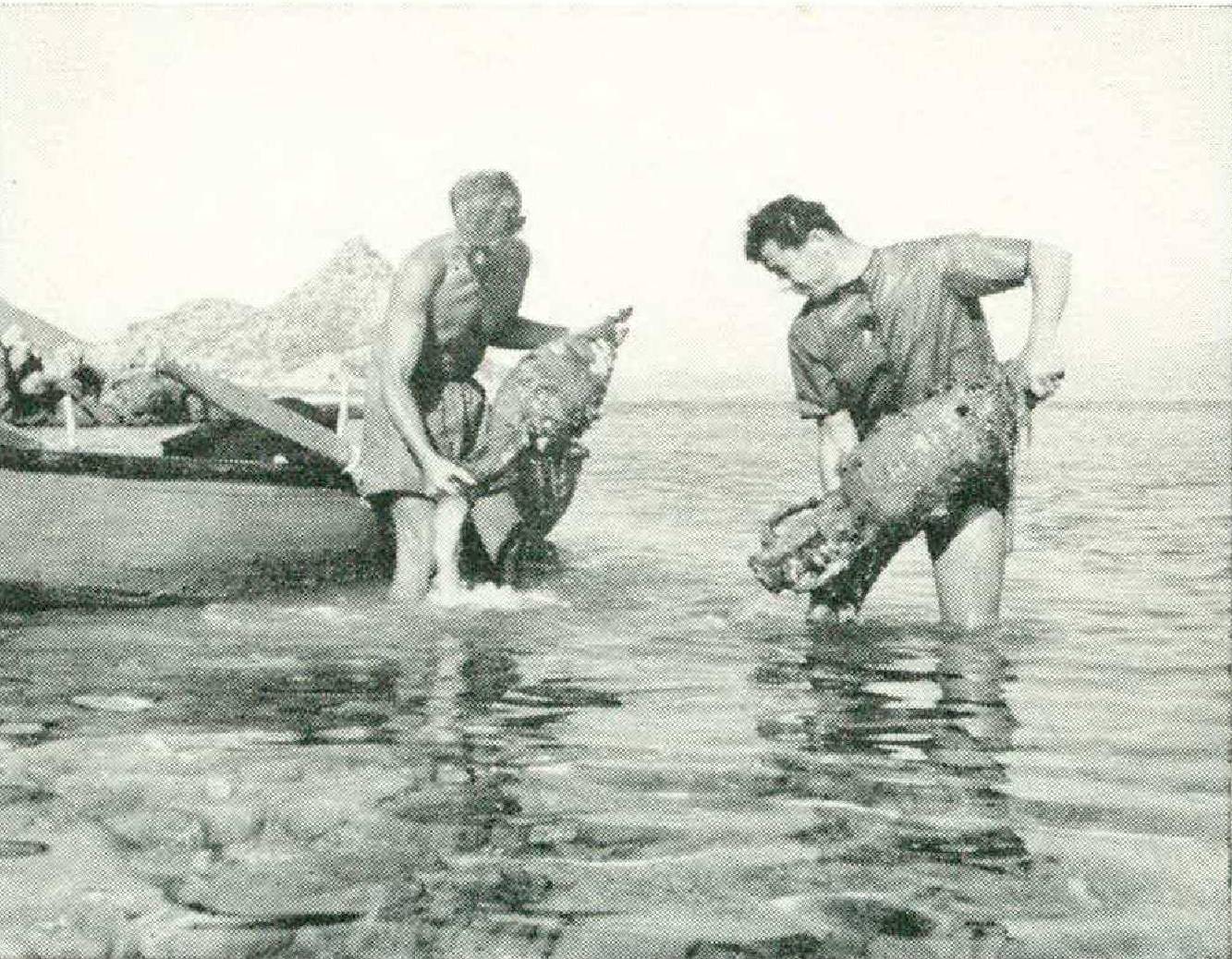
Our commonest finds were amphoras, and the types we found made an interesting commentary on the ancient commerce of that part of the coast. Only one out of ten jars was older than the time of Alexander the Great. The trade boom which appears to have occurred after the Romans stopped piracy and promoted trade was reflected in the high percentage of amphoras we found of the first century B.C. to the second century A.D. Jars from the period when the Roman Empire fell apart in the third, fourth, and fifth centuries were rare, but anaphoras of the booming early years of the Byzantine Empire formed the largest group of all. We had neither the time nor the knowledge nor the funds to raise and draw the thousands of jars necessary for valid historical conclusions, but our skimming of the surface gave an idea of the possibilities of such a survey.
For all the wrecks we had found, we had not yet seen anything that could make the archaeologists take notice. There were dozens of known wrecks of amphora carriers in the Mediterranean. No one was going to get excited about a few dozen more in Turkey.
We “found” the wreck we hoped for the night that Uncle Mehmet, an old captain from Istanbul, with whom Kemal had worked years before on a salvage job in the Bosporus, passed through Bodrum. Although they were now social equals, Kemal treated the old man with great respect. He was a master diver, he had been forty when Kemal was twenty, and he knew more than all of us combined.
The conversation turned to dynamite. We had all worked with it, and all began asking the old man what he would have done under this or that circumstance. We had a long discussion on the art of removing bronze propellers from wrecks that you have no right to salvage, how to dynamite a wreck so as to get at her copper boiler tubes, and how to cut up a wreck for scrap. I was fairly dazed by the time Kemal got around to what he had probably intended to ask the old captain in the first place.
“How would one go about dynamiting a mass of stuff grown flat onto the bottom, so that you could not get under it to break it loose?” he asked. He went on to say that the ingots were bronze, flat, and badly corroded. I did not pay much attention. He was probably talking about a cargo of mill ingot that went down in the nineteenth century.
It was very late when we staggered off to bed. I woke before dawn, with a dry mouth and a headache. I lay waiting for first light, when “the black thread can be distinguished from the white,” and the muezzin’s call would ring through the village to remind the people that prayer was better than sleep. I thought about our talk of the evening before, of dynamite and amatol and plastic, and the yellow metals that wait, intact forever, in the ruins of steel ships that rot away around them. I remembered how I once searched for and found the wreck of a steel ship in Hawaii. The hull had disappeared completely in seventy years, leaving only bits of the heaviest parts of the engines. When we raised the bronze propeller and hammered off the coral, the metal shone like new.
Like new.
But Kemal had said that the ingots were rotten. Rotten? Bronze ingots under the sea? But even bronze from Roman ships was often in pretty good shape. And where had I seen flat metal ingots before?
I got up, pulled on my blue jeans and shirt, and went to my packing box “library.” There was a book there about tne Minoans, and in it was a reproduction of a painting at Thebes in the tomb of Rekme-Re, an Egyptian official who had died in the second millennium before Christ. It showed men with kilts and odd hair styles, naked from the waist up, bringing bulls’ heads and jars and things that looked like giant, flat dog biscuits to pile in a heap, while a disinterested Egyptian official looked on.
The book said that these men were “the men of Keftiu and the isles of the sea” mentioned by the Egyptians and that the dog biscuits were copper ingots.
“Old rotten metal”; “men of Keftiu and the isles of the sea”; “Minos expelled the Carians from the Islands. ...” These phrases stayed with me all day. That evening Mustafa and I ran into Uncle Mehmet. Did he remember the ingots that Kemal had told us about? Yes, indeed. Mehmet had been the diver who had first found the “bronze” under the sea. I asked if they had taken anything from the site.
“Bronze knives and a hatchet of bronze, not strong, because I took a piece of it home and it broke when the children played with it. There was a copper box too, full of black stuff.”
The bronze wreck stayed in my mind all summer. I knew that Mehmet and Kemal had found something important. If there were bronze knives in the wreck, it had to be very old, before 1000 b.c. In all the reports I had read of the wrecks that had been found to date, not one mentioned bronze knives.
I dreamed of all the ships lost in that romantic sea, of Mycenean galleys, triremes, navi onerari, dromons, cutters, ketches, saykes, vomvarthas, brigs, barks, trechendiris, the fast kerkuroi of Rhodes of Alexander’s time, whose name lives in the humble fishing boats of the islands; line of battleships; crumbling destroyers from World War II, their guns still trained upward toward the aircraft which sank them; submarines, their sleek hulls and beautiful complicated machinery dissolving into original elements; great cargo ships, hatches blown upward and davits out, with giant groupers inhabiting holds where stevedores sweated. All of them lost, some in gales, others smashed on reefs through bad luck, foolishness, too much advice, lack of judgment, excess of caution, barratry, or bad construction. Others had been torpedoed, bombed, rammed, burned, and sailed under. They were all there, waiting, some for me, some for the ones who would come after, and two hundred miles to the south, at Gelidonya, the Cape of Swallows, the bronze wreck waited too.
I ARRIVED in New York in the middle of a snowstorm the day before Christmas, 1959. For two years I had corresponded with John Huston, founder and secretary of the Council of Underwater Archaeology. He had written to Dr. Rodney Young of the University of Pennsylvania museum, whose interest had first been aroused by verification of the age of several bronze tools from the Gelidonya wreck.
After Christmas, at the Archaeological Congress in New York, I told my story to Dr. Young and to Dr. Machteld Mellink of Bryn Mawr, pleading urgency with as much vehemence as possible. The Bodrum divers would never allow a known salvage job, with its two tons of scrap metal, to lie unmolested. Delay meant that the wreck would be destroyed, like three other Bronze Age shipwrecks dynamited by the sponge divers in the last fifty years. They listened patiently to my anxious babble about “dozens of ancient wrecks,” then introduced me to a young man who had been sitting quietly at one corner of the table.
“Work all this into some kind of program and come to see us next week,” said Dr. Young, and left me with George Bass, who was then a research assistant at the university museum.
George’s first question was characteristic. “Do you think I’ll have trouble learning to dive?”
“Not unless there’s something wrong with you,” I answered.
He grinned. “There better not be.”
He had a decent face, very open, a high-pitched Southern drawl, and curiously innocent mannerisms. He was the kind of man to whom a bank manager would lend money. We went up to my loft on Thirty-first Street with a bottle of bourbon, and talked until dawn. We found that we had both been in the Far East in the Army, George as a lieutenant running a radio detachment on the 38th parallel, and I as a sergeant running small ships. We had both been fascinated with archaeology since childhood, but George had taken the straight path and had seven years of study behind him. He felt that the Cape Gelidonya wreck might be material for a doctoral dissertation. He had worked on excavations for several seasons and was full of ideas. He had no patience with compromise in his approach to the methodical reconstruction of history.
Compared with George I was an amateur. I knew much more than he did about the practical aspects of the expedition because my experience had been practical. I still had a strong desire to be an archaeologist, with or without the academic right to do so. The one thing that we were never to disagree about, the thing which made our relationship an unusual one, was that our feelings about archaeology were the same.
George was engaged to a beautiful Southern girl named Ann. She came and brewed coffee for us while we thrashed out our working program, which Dr. Young approved at the end of the week. The university museum granted us an immediate $10,000. This sum was about half what we needed for a minimum budget. With four months to go until we would have to leave for Turkey, we set to work to raise funds and borrow equipment.
Some of the people we talked to were supercilious, and others were insulting. Underwater archaeology was something for the men’s magazines. One magazine editor pointed to a photograph of a beautiful girl whose charms were very little altered by air tanks strapped on her back. Another regretted not supporting us, but told us to be sure to come back if we ever found a treasure ship. I suggested that a ship of the time of the Trojan wars was more interesting than treasure. But it was difficult to explain that we meant to use diving only as a tool of archaeology. We meant to work underwater, not just salvage things for archaeologists to study on land. Few people understood. We were a bunch of skin divers off on a summer adventure and nothing more.
We were in fact attempting something that had not been done before, an archaeological excavation conducted underwater according to land standards. Our most revolutionary idea was to draw a plan underwater, for much of the meaning of the cargo of the wreck at Gelidonya would be learned through studying the context in which objects were found.
Unlike most earlier attempts at underwater excavation, we were not supported by a navy or by a government, but by a small group of people who eventually formed a kind of committee. Harry Starr, director of the Littauer Foundation, promised us cash if his board approved, and his intelligent questions clarified ideas which helped us raise other funds. Walter Feinberg of the Boston Sea Rovers, one of the pioneer East Coast divers, introduced us to manufacturers and thus made large discounts on equipment possible for us. Nixon Griffis, now president of the American branch of CMAS, and James Dugan, Captain Jacques-Yves Cousteau’s literary associate, formed an advisory board which kept us out of trouble in the early days of organizing the expedition.
By March the expedition was in shape: George Bass, director; Miss Joan Taylor, assistant to George in charge of preservation of objects and pottery; myself, technical adviser and acting assistant director; Frederic Dumas, chief diver; Honor Frost, architect; Captain Kemal Arras, running the boats; Herb Greer, photographer; and Claude Duthuit, diver and assistant to Dumas. Every person on the original crew was along because of a specific skill. The only members of the crew who had not worked on a land excavation were Greer, Dumas, Duthuit, and Captain Kemal. and both Dumas and Duthuit had worked on underwater excavations. Peter Dorrell, photographer, and Terry Ball, draftsman, who were to join us in July, both had had a lot of experience on land digs.
George married Ann a few weeks before we sailed for Europe. She was to meet us in Turkey in a month or two, when she had finished college. The day before George left Philadelphia, one of his colleagues remarked that he envied George the nice honeymoon he was going to have, lazing on the beach, swimming and sunbathing.
THE two small ships, loaded deep, headed for the cape and the five islands which rose from the sea a mile from it, where the wreck lay. Captain Kemal knew a beach which he thought would be a good campsite. It was a deep indentation opposite a small island called Su Ada, which Beaufort says was the Grambousa of Strabo and the Dionesia of Scylax and Pliny. A mysterious spring of freshwater rushes from it, although it is separated from the mainland by a half mile of salt water a hundred and seventy feet deep.
The cliffs rose sheer from the narrow patch of beach, which was in most places less than fifty feet wide. We found two springs under the cliffs, where generations of voyagers had dug temporary basins in the sand to catch the freshwater which seeped from the rock. The deep bay, protected from all sides except the south, would shelter us until fall when, said Kemal, “the south wind will throw the waves up to there.” He pointed halfway up the high cliff.
As we stood talking on the deserted beach, a stone, perhaps loosened by some small animal, came tumbling a hundred and fifty feet from the clifftop and fell with a clatter on the pebble beach near us. “It’s a rotten place,” said Kemal, “but the others are worse.”
When we had unloaded the boats and camp building was well begun, we went out to the cape in Mandalinche. Captain Kemal held her over the spot under the jagged cliff where the wreck lay, and Dumas and I jumped over. I hung, adjusting my gear, under the boat. The water was clear, and the bottom was visible. My heart leaped when I saw the outline of the great boulder which marked one end of the wreck site. When we bottomed on the sandy patch in front of it, I saw the mark left on the rock by an ingot which we had prized up the year before. There was another nearby, in a place which I did not remember working in. Had the wreck been robbed?
We swam around, spotting green stains on the beach rock which marked hidden pieces of corroding metal. I searched for the place where I remembered a stone bowl. It was gone. In places where I remembered ingots from the year before, there was nothing. There were still ingots in the place which we were later to christen the “platform,” but a stack of ingots which Mustafa had drawn in on the plan was gone. My air ran out. I pulled the reserve.
We hung the standard five minutes on the decompression stop and surfaced feeling anxious. What if my estimate that there was at least a ton of metal were wrong? What if, as some of our detractors had suggested, these were only a few ingots dropped overboard by an overladen ship struggling to clear a passage between the islands? How would we explain this to the university and to our other sponsors? I felt better the next day when we found that many of the places which I had thought rock were really heaps of copper and bronze objects covered by sea growth.
During those first weeks of June we set the pattern which would guide our lives for the months to come. The problems of decompression from dives of ninety feet limited our safe-diving time to sixtyeight minutes per day per diver — one dive of forty minutes in the morning, a second of twenty-eight in the afternoon, with six minutes of decompression for each dive.
Our first task was to define the outline of the wreck. Claude Duthuit and I made the first of many photographic mosaics of the wreck site, and Honor Frost laid out a first rough plan on the drawing board.
We slaved to build the camp. Nazif, our cook, and Dumas drilled the rock where water seeped from the cliff, and everyone labored to build the catch basin. Copper and bronze from the wreck would have to be soaked for months, perhaps even years, before they could be dried out in the open air. Frederic Dumas found that he shared with Uncle Mehmet a passion for stone work, especially dam building. By the end of the second day, with Dumas in charge and Mehmet as assistant, a gang of “slaves” including George and Hakki Bey had dug out a pool behind the dam constructed by the water experts.
Dumas, in his spare time, built himself a “castle” at one end of the beach, with stone benches, a walk, and a veranda. Herb Greer set up his darkroom in a cleft in the rock. The generator that we had scrounged from the dump heap ran perfectly from sundown till long after midnight, when Herb finished developing the day’s photographs.
We acquired a theme song. A magazine brought from Istanbul had an account of the booming success of a popular song that was sweeping America and which had sold literally millions of records. Its title: “Itsy bitsy teeny weeny yellow polka dot bikini.” It was a great day when we heard it sung for the first time over the radio, and its effect when sung in chorus by Frederic Dumas, Uncle Mehmet, and Herb Greer was indescribable.
The rotten tents salvaged from the junkyard sprouted in clusters along the crescent of the beach. Nazif’s cook shack was at one end, and the main spring and central camp in the middle, with the biggest tent attached by pitons to the cliff at its rear, and the front guy ropes lashed to boulders in the sea. Here we lived, worked, and slept. Toward the other end of the beach we set up the compressors and the generator so that their noise would not drive everyone mad. “Dumas Castle” rose on the heights at one side of the bay, beyond the generator shack, which was an ancient parachute stretched out like some medieval knight’s pavilion. We slept on mattresses from Izmir, since the budget wouldn’t allow cots.
If the bowl of cliffs surrounding the bay assured us of secure anchorage for our small ships and kept us from being blown as far as Cyprus by the Melteme, they also caught the heat. The beach faced the rising sun, so that a few minutes after sunrise it was so hot that it was an effort to move. The ireshwater-bred mosquitoes plagued us. The beach was not sand, but small stones the size of a man’s fist or smaller. By ten o’clock in the morning they were too hot for even the Turkish sponge fishermen to walk on with bare feet.
In the early morning we drank tea, discussed the day’s work, and loaded ourselves aboard Lutfi Gelil for the hour’s run to the wreck site. By the second week we knew approximately what we were dealing with. The entire area of the wreck was about fifty feet by twenty. One side was delineated by the “cliffs,” the bottom of the slope down which the ship had slid thirty-two centuries before, after striking the rock above. At the southern end of the wreck area was a great boulder. To the north the sandy bottom ran forty or fifty feet to a heap of rocks which was part of the cliff as it curved. In the middle of the wreck area was the “platform,” a rocky shelf covered with ingots.
The shot line, down which we descended every day to the wreck, was attached to the cliff near the platform. If we hung on this line, twenty feet off the bottom, nothing seemed like a ship or any part of one. As we descended, bits of ingot became visible.
Kemal had borrowed two anchors from a friend who had found them in the sea a few years before. They should have been in a museum, and would have been, anywhere but Bodrum. Of forged iron, they were over eight feet long, four-pronged, with a very large ring at the end for attaching the great hemp cable of some seventeenthor eighteenthcentury galley. They were the largest grapnel anchors that I had ever seen.
Kemal hitched them to an old kangawa wire, dropped them over, and attached an oil drum for a mooring buoy. Then, in order to be securely moored, we had simply to pick up the buoy to which the descending line was also attached, take a turn with the wire around the bow cleats, run our stern line to the rock where the Bronze Age ship had struck, and lead the descending line to the diving ladder.
ON THE bottom, the wreck site soon began to look like a conventional archaeological excavation, with meter poles scattered everywhere and numbered plastic tags marking all visible objects. We plotted and photographed, with George forbidding us to raise anything until he was certain that the objects were drawn in place on the plan. Our familiarity with the area increased every day, and as we began to chip away at the rock that covered everything, we discovered more and more material in places that we had first thought were only rock. As we began to raise objects, we discovered interesting things about the concretion, and about the process of dissolution of the bronze itself in the sea. In some places the concretions had grown five to ten inches over the rock. We found that it was possible to free objects with hammer and chisel without breaking them. But if the concretion was allowed to dry, it became harder to free from the objects it covered.
Most of the bronze had retained its shape, but some was soft as cheese when wet and when it dried became as brittle as plaster. It was green-gray straight through. The good yellow metal was gone, dissolved into the water around it by electrolysis between bronze and copper, and between copper and tin. There were different rates of corrosion in different areas of the wreck. Was this because of variations in the alloys of the metal, or because of different rates of electrolysis in different parts of the wreck? The wreck was a fascinating problem from the chemist’s point of view, but the answers to these specific problems will never be known, because Turkish law forbids export of any of the material, even small samples for chemical analysis, and we had been unable to find a chemist to analyze materials on the spot.
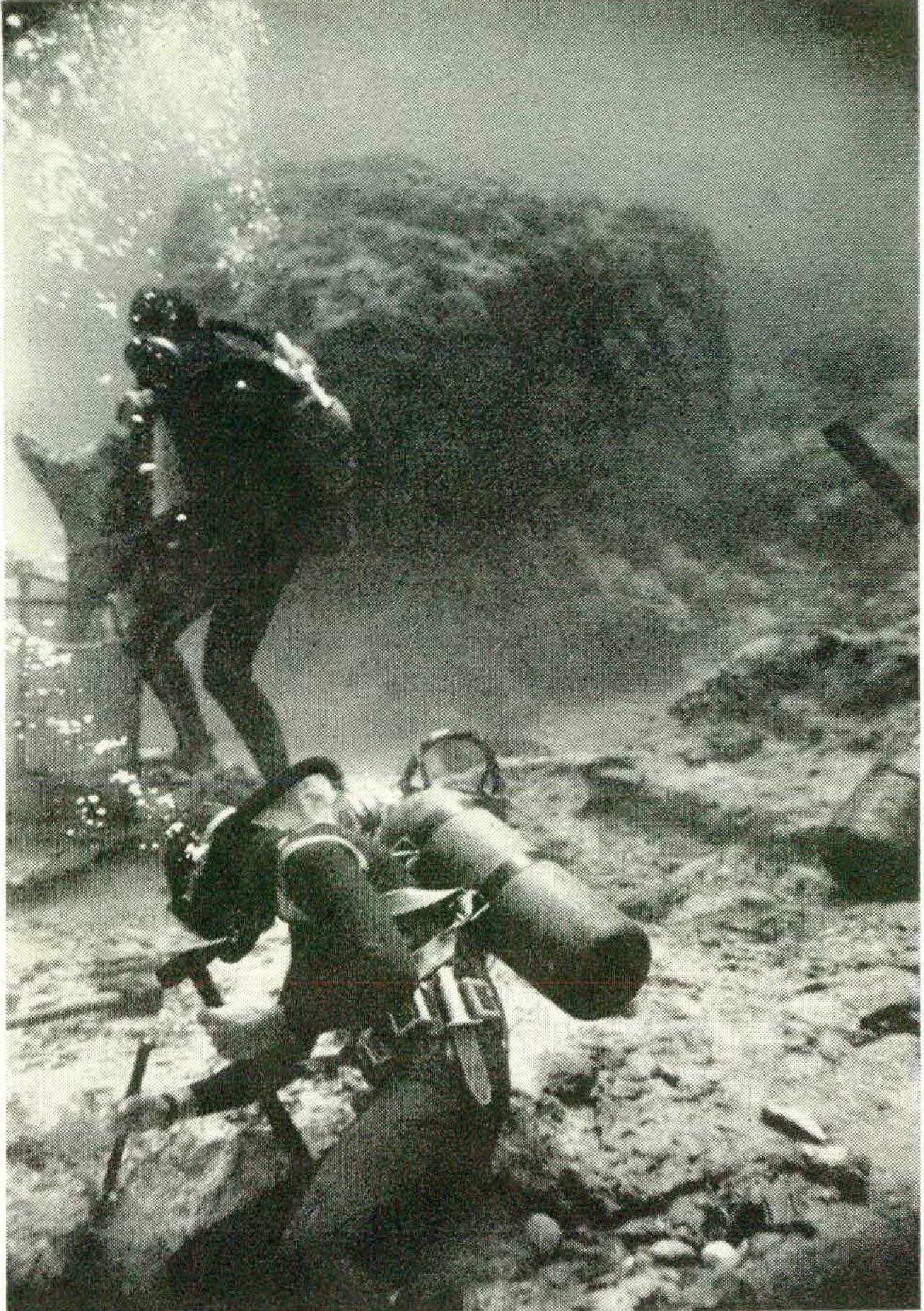
The year before, I had hoped that we would find that there was some wonderful new chemical process to clean the overgrown bronze pieces. But the experts whom Miss Taylor had asked all agreed that the best way in the circumstances was the most delicate possible version of the old hit-it-witha-hammer technique. Only if permission could be obtained to export the material so that it could be treated in laboratories abroad would magic methods of cleaning be possible. Reduced to primitive cleaning methods, we spent our evenings with hammer and chisel, chipping limestone from the objects which had come up that day.
The current ran nearly every day, flattening the surface of the channel into a smooth river which betrayed the force of its flow only where the sea met the rock and in the eddies which whirled around our buoys. It changed direction, sometimes in an hour or less, and some days it ran faster than others. Captain Beaufort had also remarked the current: “We found it one day almost three miles an hour, and the next, without any assignable cause for such a change, not half that quantity.” He concluded that it would form an interesting subject for future investigation.
We confined ourselves to trying to find out how to work in it without getting into trouble. It was not bad once we actually arrived on the bottom, but getting down and up was sometimes difficult. A diver jumped over the side, careful to be near the shot rope that led to the wreck, because it was impossible on most days to swim in open water against the force of the current. Once on the line, we went down, hand over hand, our bodies flapping like flags. On the bottom we were protected by the basin in which the wreck lay, and in most areas of the wreck the current was slight.
We became blasé about the current. Not so the helmet divers. Kemal had come to Gelidonya with Mandalinche and his divers, prepared to work with us on the bottom when the current allowed. Although the current ran hard at least half the time, there were days when there was little or none.
We were cutting out ingots from the solid rock when Kiasim and I decided to try working together. He would swing the heavy sledge while I held the chisel. During the dive the current increased, pulling his diving hose into a great curve. Surfacing, he lost his grip on the shot line and was swept away. We spotted him at the limit of the length of the hose, a hundred yards downstream from the boat. The boys pulled with a will to drag the helpless figure aboard. As he came alongside we heard a strange sound from inside the helmet, like the struggle of a lobster as he is dropped into boiling water. It was Kiasim, swearing.
When they twisted his helmet off, Kemal chided him gently for trying to go to Finike without leave. Kiasim, incoherent with rage, made the cliffs ring with his curses. For the rest of the summer we could always get a rise out of Kiasim by asking if he wanted to go to Finike, and “going to Finike” became our standard term for getting caught in the current.
THE hot days went on. We plotted and raised a continual succession of similar material, parts of ingots, broken bronze tools, and ballast stones. Our great hope was the heap of objects which formed the platform. For days we had discussed what should be done to it. Finally, Dumas proposed that we break it off all in one piece after plotting its position. But how? Dumas remembered the hydraulic auto jack in the jeep back in Finike. We sent Mandalinche to get it, and Claude and Dumas went to work to chisel a hole underneath the lump so that it could be inserted.
George at first opposed the idea of the jack. Dumas and I argued that if we could raise big sections and put them together on the shore in exactly the way they had lain on the bottom, we would be able to reconstruct how the ingots had fallen when the ship sank. This would save a great deal of time, as the most time-consuming part of our whole job was triangulating ingots in place. Dumas and I labored under our experience, which had taught us that the prime problem was how to work fast without wasting diving time. George did not agree. His view of archaeology transcended anything we could say or do. Dumas’s and my combined experience of diving came to at least thirty years, about the span of George Bass’s lifetime. We argued on the basis of experience, of what we chose to call knowledge. George infuriated us by violating the rules of efficient diving work on the bottom. When he came to a problem or question of whether the plan was correct, whether the material had been recorded in place thoroughly enough to permit its raising, George always stopped to check. He was capable of holding up the entire job for days, while he used up his diving time in mulling over how best to raise a small object. He was, of course, absolutely right. If we were attempting a correct archaeological excavation underwater, then it was just that, and not a diving job in the ordinary sense of the term.
The jack idea was our first big compromise. It was good underwater practice, and we hoped it would also turn out to be good archaeology. Claude and Dumas dived and chipped under the northwest corner of the platform. By the end of the week they had a hole big enough to take the jack. Claude and I dived with it, got it under the mass, braced it with wooden blocks, and pumped. The jack tightened, but went no farther.
We surfaced, furious. When I got the jack apart, I discovered that salt water had leaked into it. We topped it up once again with oil and handed it to Dumas. He dived alone, looking determined. In thirty-five minutes he reported the lump loose and ready for lifting.
Captain Kemal eased Lutfi Gelil over the wreck. Dumas dived again to shackle the lifting wire onto the lashings. Jumhur hove down on the stick that controlled the primitive winch’s drive belt. The mast groaned as the weight came on it. The whole structure of the ship creaked, and she heeled far over. The wire, stiff with strain, was bar-tight. Kemal shouted. All the men hove in unison on the big drive wheel of the winch. There was a jerk as the lump broke free.
For a moment it dragged on the bottom, and George gasped. It came free and the engine took the strain. The lump rose steadily. Everybody yelled when it broke the surface, swaying, green, mysterious, alongside Lutfi Gelil. Kemal ordered everybody away from the straining gear. He yelled and bent to the drive wheel. The mass swung inboard clear of the bulwark. We laid it on the tire that had been set on the deck for it to rest on.
What had seemed rock on the bottom was in reality cargo: broken bronze tools, bits of ingots, half and whole ingots, held together by limestone sea growth. Guided by Dumas, who had a fine eye for possible Weak points, we became lump-raising experts, able to spot instantly the places where pressure could be safely applied and where the underlying rock would break to fit the jack. We never broke an object in raising it, because the corroding metal had formed a cushioning layer of green mush between any object and the rock that had formed over it. No one had ever seen anything like it. I began calling it glurkus. For lack of a better word, George called it glurkus too. We had learned discussions about banded glurkus, the stuff formed by alternating layers of corrosion product and white sea growth, and bronze glurkus, the stuff formed by bronze, not nearly so soft as copper glurkus, the mushy bright green stuff that usually surrounded the ingots. The camp echoed with the clink of hammers as enthusiastic workers used hammers and chisels on the lumps, knocking off layers of sea growth that were often a handspan thick.
One day a heap of ingots on the platform split in the middle, revealing ropes and part of a basket lying between two of the ingots. Claude Duthuit and Herb Greer dived to lash the basket lump to the winch cable, which was then hove in till the lump hung above the bottom and stopped off so that the delicate material could be wrapped in a protecting sheet before being raised. Lutfi Gelil’s old engine chose that moment to stop with a wheeze, leaving the precious lump hanging ten feet off the bottom with the divers hovering, waiting to follow it to the surface. Nazif cursed Jumhur. I cursed Nazif, George looked ominous, and Frederic Dumas looked disgusted. Jumhur leaped into the hold and cranked the engine while Nazif worked the feed valve. It wouldn’t start. We turned the big winch flywheel by hand until the lump was up, everyone who could fit in the cramped space straining to do his part. Captain Kemal jumping and cheering us on.
The lump broke surface, and with it came Claude and Herb, both furious. It seemed that Claude had had trouble in wrapping the lump with the sheet. Herb, torn between his desire to help and his photographer’s instinct, had hung ten feet away, taking photographs, while Claude had pleaded with him in dumb show to come and help. George calmed them down, and when they were coherent they reported that where the lump had lain they thought they had seen planks.
This was confirmed the next day. There were bits of planking, and shadows of organic matter that showed where planking had rotted away. We had found, at last, part of the ship. George telegraphed the university museum: TONS CARGO HULL MAYBE SAILS PRESERVED SEVERAL YEARS JOB.
The pond began to fill up with cargo. There were plowshares, picks, hoes, axes, adzes, mirrors, chisels, knives, ax adzes, a spade, a spit, something that we puzzled over until we decided it was a pruning hook, what might be broken-up bronze tripods, and unidentifiable bronze scrap, besides dozens of the typical copper ingots and ingot fragments. One of the most exciting things we found on the platform was a lump of whitish, very badly corroded metal, which was analyzed by Rasim at his factory in Izmir and found to be tin. As it was tin ore, it must have come from nearby.
All this material seemed evidence that our ship might have been owned or chartered by a smith working his way up the coast with a cargo of copper and the tin for smelting it into bronze. Perhaps he gave new tools for old, making his profit from the weight of the metal when he made a new ax or adze or hoe in return for two or three old ones. The basket had contained broken tools, and was what remained of the baskets full of broken tools that had been our smith’s raw materials.
We were proud of the “junk man” theory. One night I explained it to Kemal. He lit a cigarette, took a long drag, and said, “Peter, this thing of yours about collecting a lot of useless junk doesn’t bother me too much. After all, we are good friends.”
He fixed me with that hard look he used when making a point in argument. “But collecting junk that’s three thousand years old —” He sputtered. “That’s — that’s — ridiculous!”
The last week in June began with jubilation over the lumps, and ended in exhaustion and despair. The bad period began when Herb’s regulator flooded, and he had to free-escape, abandoning on the bottom our revolutionary new camera case, the one especially built for us by GERS to take our Polaroid camera. A minute or two after he surfaced, choking spectacularly, we realized that the case was still on the bottom. It took several minutes more before we remembered that the case was almost perfectly balanced, neither positive nor negative in buoyancy. The sun was warm and pleasant, and I was cold after diving. There was no other diver on the boat. One of the men ninety feet below would surely spot it. No one did.
We spent the next two diving days searching for it, all of us knowing that a search was hopeless, for if it had been slightly positive we should have spotted it on the surface. If negative, it must have gone to several hundred feet and been crushed by the pressure soon after drifting off the wreck site. We were determined to find the thing anyhow, against all logic. Kemal and his divers searched also, frightening me by staying down far over proper decompression times.
On the last dive of the search, Dumas surfaced with a sea turtle clutched in his arms. He had surprised it sleeping on the bottom. When we arrived in camp we drilled its shell near the tail, and attached it to a nylon line while we discussed what to do with it. The debate raged while the turtle swam to the end of the line and paddled seaward, apparently not noticing that it wasn’t going anywhere. The camp immediately divided into two parties, the school of “eat the thing, we’re hungry,” and the opposition, led by Miss Taylor and supported by Herb and Honor, who said, “Let it go, poor dear, it’s so cute.”
Dinner was rice and beans, as usual. We had had no meat for a week. Didi led off for our side with the story of a delicious turtle eaten somewhere in the Indian Ocean. I followed with a description of turtle steaks fried in butter in Honolulu. Our side lost a point when Miss Taylor forced us to admit that neither of us, personally, had ever butchered a turtle. George, bemused and neutral, sat listening to both sides. Claude Duthuit remained neutral. After dinner we carried the argument to Kemal. He confessed that he had never eaten a turtle, but was willing to take a chance. Uncle Mehmet supported our side.
“It’s wonderful meat, good with raki.” He looked around sinfully. “Like pork.”
“Wonderful shish kebab,” added Diver Mustafa.
Nazif, the captain-cook, settled it. “Everyone knows it’s the worst kind of bad luck to kill a sea turtle.” Jumhur nodded sagely. “Anyway,” Nazif added, “I don’t cook it.”
George reluctantly said that he supposed we had better let it go. When we went to release it the next afternoon, it was still swimming in place. Dumas and I watched it swim away. My belly growled.
“Have a cigarette,” said Dumas.
“Sublimate,” said George, lighting it.
That night the big high-pressure compressor broke down. It had been giving trouble for weeks. Kemal and I had spent nearly every evening fixing small things, such as popped high-pressure fittings. It had been getting worse of late, refusing to come up to the requisite 1800 or 2000 pounds per square inch needed for the aqualung bottles, and emitting an ugly, untraceable clatter as it ran.
Kemal and I were still working, woolly-headed with exhaustion at three in the morning, when George, who had not slept, came to give us cigarettes and ask how we were doing. Everything depended on that compressor. Without it we had no expedition. All we had left was the tiny portable compressor that I had used for two years, which had never been very good and was now a wreck, and which took two hours to fill one small tank.
Our trouble was that the whole expedition was built on a very shaky platform of improvised, broken-down, or inadequate machinery, which only ran at the cost of backbreaking labor by the semiskilled mechanics in the crew, especially Kemal and me. Although we were both able to fix and rig anything in the camp, we simply didn’t know what a master mechanic should know, and spent hours tinkering at jobs that a real mechanic might have done in as many minutes.
Now we were as tired as the machinery. The week before, I had strained something, and now I groaned around like an old man. Kemal did not make me feel better when he remarked that half his friends ruptured themselves at thirty. What scared me was the weakening of my body with the approach of middle age. I had led an active life. Now I realized that there were things that I could not do because I was too old. I had always thought weak guts were a joke. Now I had to ask younger men to help.
George had found a mechanic in Antalya the week before when he had had trouble with the jeep. He gave everyone a day off while we went to Antalya in Mandalinche to ask his help. The trip took fifteen hours instead of six because the engine kept breaking down.
Ibrahim, the mechanic, began with the compressor. One of his boys pulled the starting rope. It failed to start. The starved boy handed him a screwdriver, with which he made a tiny adjustment. It started and ran perfectly.
We went to lunch. Has any poet sung of the delights of lunch to a diver on his free day? We ate three kinds of meat, and Kemal told me about Ibrahim, how he had been apprenticed at twelve, like the little boys all over Antalya, and that he was now owner of half a dozen taxicabs and a couple of houses, including the one his shop occupied.
It was fun to watch Ibrahim work. His fingernails were long, and he never touched a tool with his carefully manicured hands unless he had to, and would drop it to the floor as soon as he had finished using it. It would then be retrieved by the smallest of the boys. I asked him why he didn’t clean the shop or the courtyard of his house. After all, he was the best mechanic in Antalya.
He replied, “But people expect a shop to be dirty.”
I visited a doctor, who demanded payment in advance, examined me, and pushed me out the door. He said he wasn’t ready to operate yet, to come back when it got worse, and he refused to tell me anything more.
WE MADE record time to camp, under sail and engine. Almost before the echoes of the anchor chain running out had stopped bouncing off the baking cliffs, we had the compressor set up and running. It ran perfectly for twenty tanks, and then stopped. We tore it down, found the trouble, and fixed it. It worked for two days and quit. We found that a grain of sand had scored a piston, and slaved over it for a whole day, gasping queasily for breath in the hot July sun.
The flies had multiplied because of the hot weather and the filth piling up around the cookshack. I railed, begged, and ordered Nazif to get rid of the garbage. He just couldn’t see the relationship between flies and garbage. The result was that we were awakened by flies in the morning and lived with them till sundown. They made it hard to concentrate, for if you stayed still a moment they began to settle, seeking out places where there was a little scratch, a tiny cut, or eyelids, nostrils, and corners of mouths. One day I counted fourteen gathered around a cut on my leg not much larger than a matchhead, feeding greedily in an indecent circle.
As we became weaker, cuts which would normally heal quickly became infected and reinfected by flies, until they turned into running sores which stayed open for weeks. If you could keep the flies off, they would heal. But this was impossible, because bandages would not stick in salt water.
With continual breakdowns, it was impossible to go on running the whole diving operation on one compressor, and there was no working high-power air compressor nearer than Germany. In a normal country we could have sent a telegram to the manufacturer and had our compressor replaced in fortyeight hours, but in Turkey this was impossible.
George, Kemal, and I drank half a bottle of raki one evening, smoking cigarettes, and came up with an idea. We would adapt Mandalinche’s lowpressure diving compressor to work on a “narghile” or “hookah” system, in which the diver worked with an aqualung regulator strapped to his back, fed with air pumped from the surface through a hose, instead of from high-pressure air tanks strapped to the diver’s back. It was the system we had used the year before.
Kemal and I set off for Antalya in Mandalinche to machine the necessary parts. As soon as the boat was tied up, he and I walked up to the café. Once more I understood the raptures of the Bible and Koran over running water, for to us the place was a dream of ineffable luxury with its dirty tables and teetering chairs by the side of a little stream, in the green shade of a plane tree. There were no flies. The tea was hot and very sweet.
A big passenger ship was anchored off the harbor. It debouched hordes of improbable tourists in bright-colored shirts, hung with cameras, who stared curiously at the two bearded characters dressed in rags at the cafe table. I stared too, studying the camera-laden Americans and the English in their gray flannels, just as the village Turks of two years ago had stared at me, and for a moment the foreigners seemed completely unreal. It was inconceivable that I spoke the same language as they. It took an effort of will to rise and trudge up the hill to the mechanics’ quarter.
We got back the next day with the device rigged. An air hose led from Mandalinche’s compressor to a volume tank perched on her foredeck. An air manifold, made from water pipes, led from the tank to the diving hose connection. When anchored in the bay, we attached the air hose to the volume tank, and one of our aqualung regulators to its other end.
Kemal, assisted by a gloomy Jumhur, mumbling that the thing would never work, lashed the thing to my back. With Kiasim tending the hose, I jumped over and swam down to the sandy bottom. The air came well. Now we would not have to run the failing compressor so much. We could use bottles only for photography, and when the current ran so hard that it dragged the driver by its pressure against the hose.
Claude sewed up canvas straps, using a photograph in a diving equipment manufacturer’s brochure as a pattern, and we set about learning how to use the new equipment on the wreck. The only hose we had available was an ordinary garden hose which kinked. We discovered that when working on the bottom, a hose kink would usually open and give you air again if you swam ten feet straight up.
With the narghile running, Kemal, Kiasim, Uncle Mehmet, and I fell back into the old pattern that we had known the years before on Mandalinche. Kiasim and Mehmet, the best tenders, sat on either side of the bow tending the hose when the divers were down. Kemal and I would sit on the cabin top, half asleep from the pounding of the motor.
The narghile diver in the current would grab the shot line and work his way down it hand over hand. When he reached the bottom, he would lash himself in place with a slip knot, his knife handy in case the hose kinked and the slip knot jammed. It sounds more dangerous than it was, because the current kept the hose stretched so that it could hardly kink. The big problem was the terrific drag on the rushing current against the hose, which pulled into a great curve behind the diver, trembled at the small of his back, humming and vibrating as the water hit it. We were frightened many times, especially when there was not enough air pressure in the volume tank on the surface to give sufficient air to struggle on.

Small fish hung out on the wreck site, where they found that our work dislodged edible worms. One grouper got very friendly, and at last I got a picture of one doing his “inspector” act, hanging over a draftsman’s shoulder and watching his hand move over the drawing.
One day three men appeared in a hired boat from Finike. They had come to dive, they said, having heard about us from Mustafa Kapkin in Izmir. Waldemar (Vlady) Illing was German, twenty-three, built like an ox, and had come with his own tanks and a small compressor. George invited them to stay. Vlady and Claude became inseparable. Vlady was one of the best skin divers I have ever seen. He could skin it ninety feet to the wreck site, swim around, shake hands, and surface, smiling. He was very strong and a good mechanic.
“Kick” Lacroix was a regular army sergeant with NATO in Izmir. He had been with Vlady in the years when Vlady had bummed along the Turkish coast spearing fish for a living.
With someone new to talk to, the whole camp cheered up. With visitors to impress, we made a show of setting up careful work schedules, writing down in the morning what had to be done that day. The compressor watch was easier now, with extra hands to help, and two men who were cheerful, not yet tired and irritable, brought new life to the camp.
The current kept us frightened. One day it ran too fast for the narghile, and I went over the side with a tank on. The dive over, I attempted to bring up a partly filled basket, overestimating my strength and underestimating its weight. Halfway up, my panting became uncontrollable. I tied the basket to the shot line and surfaced, exhausted. Arms and legs like jelly, I could hardly hang on to the diving ladder. When I felt better I went down the line to decompress, and hung shivering in the cold water, pondering my escape. I’d been close to passing out. A little more, and I would have drifted down with the current, unconscious, to be picked up or not.
Diving accidents, like that one, are almost never spectacular, but just the gradual mounting up of trivial things until they equal death. On another dive I became sick with fear for no reason, had a terrible headache, and had to force myself to stay down. I examined the compressor and found that the air filter hadn’t been cleaned.
Diving was no more to us than riding a bicycle, but the danger of the little things surrounded us. The fact that incidents had begun to happen alarmed me, for it meant I was becoming so weak that I was careless.
My weakness showed in other ways. I became irritable and more difficult than I needed to be. I had my first argument with Kemal, after three years in which we had never quarreled.
We were worried by the reports in the local papers and by the conversations that Kemal and I had with the locals in Antalya. They were convinced that we were hiding tons of gold in the camp. Mysterious hunters appeared on the cliffs, turning away without replying to our greetings. Then one day, when we were resting for the afternoon dive, a boat came by the wreck site. She was a big traveler type and flew no flag. She circled us twice, coming very close, so that there was danger of her cutting the lines with which we were moored to the island. Hard, sunburned faces peered at us over the bulwarks. Turks? Greeks? I photographed the ship, not bothering to take the camera from its underwater case. They sheered off full speed around the island when they saw the camera.
This was frightening. It was possible that she was only a Greek trawler, poaching in these waters, who had come to inspect us only out of curiosity. However, there was a good chance that she was a spy for an enterprising salvage diver, come to mark the spot so that he could raid it when we left. This incident, plus the very real possibility that we might not obtain a permit for the next year, increased the tension under which we worked. It seemed very likely that whatever we left behind would be destroyed by those who would come after. They would dig for gold, paying no attention to the delicate bits of wood that were the most valuable thing in the wreck. The copper scrap they found would be kept for a while as a souvenir, then relegated to the junk heap. Even if it ended up in a museum, it would have little meaning out of context.
WE LABORED to free the rest of the platform. Our excitement over the quantity of material that we were finding was deadened by fatigue and the miseries of life on the beach.
We now knew that we were dealing with the largest single find or “hoard” of Bronze Age metal ever found. By midsummer we had raised twenty ingots and pieces of others. Mixed with the mass of concreted copper and bronze on the platform were bits of pottery which dated the wreck definitely to the thirteenth century before Christ.
When we raised one of the last of the lumps from the platform, Claude Duthuit found under it half a broken pot filled with seashells. When it was plotted and raised, the “shells” were recognized as beads. Perhaps they had been a private trading venture of one of the crew, for the area in which they were found was almost certainly the forepart of the ship. There was jubilation at finding something different, something almost personal.
Herb Greer looked at them and cried, “I mean that’s thrilling, thrilling, like mad, a gas.”
Dumas ran around gay as a sandpiper, saying “It’s a gas, a gas, an archaeological gas! Let’s count them!”
There were hundreds, all the same color, green and light green. Miss Taylor felt that they were Phoenician, and that they had originally been blue and white. They were very soft, collapsing if only a tiny bit of pressure was applied to them. They exploded into dust if allowed to dry out.
The next day we found the other half of the pot which had held the beads, and lying next to it a bronze bangle and a perfectly preserved double ax, its edges still sharp, the best-preserved tool we had found to date.
Dumas, looking slyly at George, stage-whispered, “I want that one for a souvenir.”
Everyone laughed. The fact that no one could ever hope to have a souvenir was a sore point.
The lumps, cleaned and put back into place on the beach, showed how the hull had rotted and collapsed, leaving the cargo in a heap on the bottom, to lie undisturbed for three millennia. When we had finished the platform, we moved our lumpraising operations to the gully, following the traces of planking which ran under the rock. Little planking was preserved, but there was enough to show the line of the ship’s hull, and neatly drilled auger holes could be seen in some of the wood fragments. There were no nails. The ship had been held together with wooden pegs.
Ann Bass arrived from America, and George brightened up considerably. Still, it was a poor place for a honeymoon. Nazif presented her with a pet rabbit, which she named John. He lived in the darkroom and ate watermelon rind.
The gully area was full of material. Protected on the one side by the great boulder and on the other by the cliff, the cargo was more in place there than on the exposed platform. We lifted a small lump at the very mouth of the gully, and exposed a solid mass of bronze tools and delicate organic matter. We tackled it with great care, working barefoot, so that the wash set up by a badly placed swim fin would not displace the delicate material.
On the first day something gleamed white, big as a fingernail, in the sand. It was a scarab, the Egyptian cartouche still sharp and clear on its underside. The next day we found a stone mace head, a bit of rotted wood still in its shaft hole, with a thin copper covering over it.
The organic matter at the mouth of the gully might almost have been a disintegrated chest. We speculated that we had struck the captain’s personal sea chest, and became even more convinced when we discovered scale weights of meteoric stone.
The area at the mouth of the gully and at that end of the boulder was covered with a heavy layer of sand. We set out to air-lift it, using the long tube of steel pipe which took compressed air into its bottom and spouted air mixed with sand through a filter into the water thirty feet above, exposing the rock which lay underneath the wreck. There Waldemar Illing found more weights and then, a wonderful discovery, a beautifully carved cylinder seal of hard black stone. It was a signature seal for sealing clay tablets. It was inscribed with three figures. In the middle was a deity wearing a strange tall crown on his head, with a worshiper on either side of him. Although further study has shown the seal to be from northern Syria, and five hundred years older than the wreck, we thought at the time that it was contemporary and that it might be Hittite.
This set us off on a round of speculation about the possible origins of the ship. We knew that the wreck could be reliably dated within a hundred years of 1300 B.C. (Later study of the material has shown that she went down nearer 1200 B.C.) We also knew that Rameses III, after the Battle of Kadesh, signed a treaty of nonaggression with Hattusilis III, King of the Hittites. Could it be possible that our cargo of copper and bronze was a tribute for Rameses, that our ship was carrying a Hittite tax collector, amassing metal to send to Egypt? The theory fell apart when we failed to find anything in the wreck that was definitely Hittite, but led at the time to wild conjectures.
We became more and more excited as we dug into the gully area. Major pieces of wood began to show up. They seemed to be ribs, running laterally across the presumed line of the hull. The wood was soft but often looked almost new. If allowed to dry, it shriveled to a tenth of its original size. When we raised bits of wood, they were put into plastic bags on the bottom, so that they never dried out and the problem of preserving them could be put off for a more leisurely time. As each piece of wood was uncovered, we pinned a numbered plastic tag to it and hurried to draw and photograph it in place before the current washed it away.
The area of the gully was not large, perhaps the size of an ordinary double bed, slightly narrowed at the end away from the platform. As we moved into the “foot” of the bed, we found more personal objects: three more scarabs, a lamp, a bronze bracelet, and more hematite weights, until we finally had three complete sets of weights. Two sets were round, the bottom flattened so that they would not roll, the third shaped like tiny footballs flattened at one side. The smallest of them was little larger than a pea, the largest slightly smaller than a golf ball. Altogether there were fifty of them. When George studied them a year later, he found that they would have allowed the ship to trade anywhere in the eastern Mediterranean: Troy, Cyprus, Syria, Palestine, Egypt, Crete, and possibly Greece. They were far more accurate than anyone had previously believed possible for the Bronze Age. Twenty-six of the fifty are accurate to less than one hundredth of a gram.
Personal objects continued to appear: a piece of rock crystal as long as my forefinger, another mace, a finely carved whetstone. We hung the big air lift in front of the gully and lifted the sand out that was swept from the gully’s mouth by the diggers, waving their hands as fans to move the sand. It rumbled and boomed. Compressed air was fed into its mouth through a valve which could be controlled by the divers, forcing sand up to the catch bag thirty feet above. The surface of the pipe was ice cold when it was working, and the air that bubbled out was also cold. It would have been wonderful for cooling beer, if we had had any beer.
Although we drew and photographed everything very systematically, we could make little sense out of the positions of the objects at the gully’s mouth. They obviously belonged together, but had been scrambled by the collapse of the hull, which must have hung between the gully and the cliff. Then, as the wood rotted, its collapse must have scrambled the objects in the “captain’s cabin.”
Halfway into the “bed” we were confronted with a layer, several feet thick, of what seemed to be a section of the hull with its cargo in place. At the bottom were planks. Above them was a layer of sticks as big around as a man’s finger, some cut at each end with one swipe of an ax. They could not, we thought, form an integral part of the hull of the ship, for the bark was still on. Above the sticks was a solid mass of cargo: rolls of copper sheeting, blank blades for making bronze tools, the sockets not yet shaped and unsharpened; and whetstones, not so nicely shaped as the “captain’s.” In the middle was a heavy timber which we were convinced was part of the ship’s keel.
The sticks bothered us. What were they? Firewood, like the firewood Mandalinche carried? Not under the cargo, certainly. A day or two after we found them, I remembered something in the Odyssey. I picked up E. V. Rieu’s translation and turned to the place where Odysseus built his boat or raft on Calypso’s island:
“First she [Calypso] gave him a great axe of bronze. Its double blade was sharpened well. . . .” We had found several bronze double axes in the wreck, one with well-sharpened blades. “Next she handed him an adze. . . . Presently Calypso brought him augers. With these he drilled through all the planks.” There were auger holes in the planks we had found, and they, too, had been fastened with dowels. Finally, Odysseus was completing the ship; “From stem to stern he fenced her sides with plaited osier twigs and a plentiful backing of brushwood. ...”
When, at the end of the summer, George studied the passage in Greek, he found that it had always been a problem for translators, because the scholars did not understand the purpose of the brushwood. We knew now, twenty-seven centuries after the saga of Odysseus’ wanderings were written down, thirty-two centuries after those wanderings were supposed to have taken place. The brushwood was to make a bed for crew and cargo, so that the thin planks would be protected from inside. This would make inner sheathing unnecessary. Additional proof of this was given when the sticks were studied by an expert. They were a kind of brush common in Cyprus, where the ship picked up her cargo of copper ingots.
There was a quality of wonder about the wreck that never left us. I especially remember one dive of about that time. Eric Ryan, an assistant professor of art history at Colgate, had come out as draftsman, and he and I made a narghile dive together, trying out a new system he and George had worked out. One excavator worked while the draftsman stood by to draw objects as they appeared. It was very calm and clear, and there was no current to plague us. At the head of the gully, under the ingot where I had found the first scarab, there was a group of new pieces of plank. I gently swept the sand, removing them and putting them in plastic bags when Eric nodded. In the middle of the wood there was a scarab. Just before coming up, I glanced at the packed sand by the ingot, stained green by the leaching of the copper, and saw a second scarab and two weights.
When we surfaced I sat on the breasthooks in the bows of Mandalinche, where I had sat so many times, and jotted my notes, fighting to write legibly against the vibration of the one-cylinder engine. Finally I gave up and looked at the slate-colored sea and the gray lumps of the five islands melting together in the twilight. The great cape of Gelidonya, abeam of us, sloped back into the sea, which sparkled with the last of the sun.
I thought of those mysterious mariners and their ship. Who were they? What did she look like? They had looked at the same scene, very much as I was seeing it now. They, and how many others? Some I knew — Strabo and Beaufort and Scylax the younger. However inaccurately, I could visualize them, and should we meet, I would not be at a loss for conversation. But when I looked at the box on the foredeck which contained the things we had raised that day, the scarabs invisible in their plastic bags; parts of an ingot broken three millennia ago by a smith to forge into a tool which he was never to make; the planks in their plastic bags; the personal possessions of the crew and the cargo of their ship, which was now taking its next to last and shortest voyage from the bottom of the cliff where the wreck lay to our camp. Surely we and our machinery would be unimaginable to those men, who would have recognized the islands and the cape immediately, but, unlike Strabo or Beaufort or Scylax, would find the jump from their time to ours, their life to ours, inconceivable. For they lived at the dawn of Western civilization, and we live in the twilight of it.