The Spread of Nuclear Weapons
Professor of sociology at the Sorbonne, RAYMOND ARON, who was born in Paris in 1905, is an author and crit the whose influence in France is comparable with that of Wolter Lippmann in America, The paper which follows has been druwn from the concluding chapter of his new book, THE GREAT DEBATE: THEORIES OF NUCLEAR STRATEGY, which is to be published this month by Doubleday.
by RAYMOND ARON
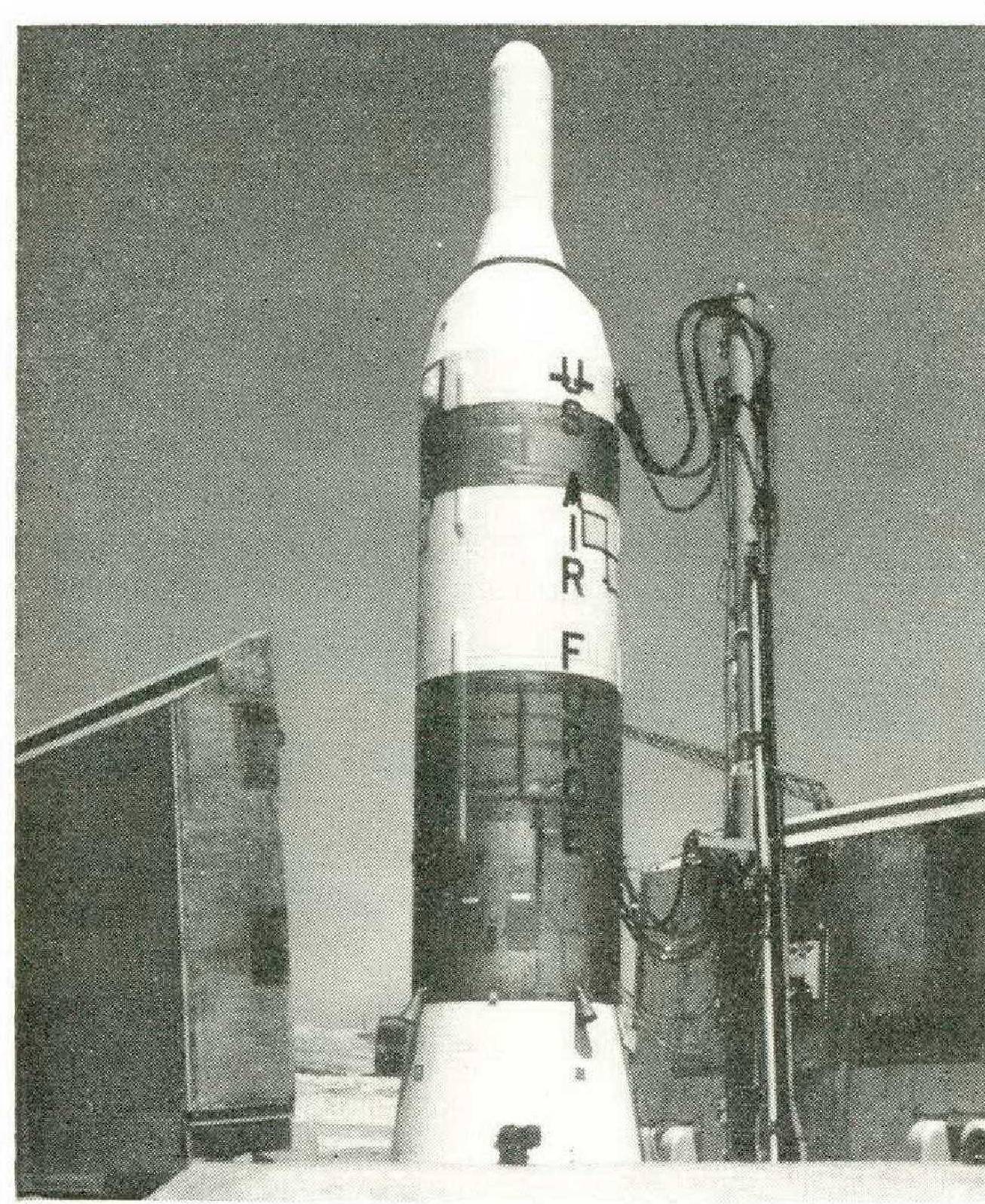
According to American theorists, one interest that has for the past few years been common to both Russia and the United States is the nondissemination of atomic arms, or to put it another way, the limiting of thermonuclear power to the United States and the Soviet Union. The Kennedy Administration from the start sought to prove this to Khrushchev and his men, but in the first phase they met with only limited success.
The following facts may shed light on the reasons for Soviet reluctance. In an early phase in 1961 Soviet technicians considered it clearly vital to continue testing in order to “catch up” (as American technicians put it), to perfect their knowledge and their bombs: in particular, to produce bombs of very large caliber and to test the effects of very high altitude explosions. They prepared their test series behind the screen of a moratorium unilaterally proclaimed by each of the Big Two in succession. After the Russians and Americans had both run a series of tests, negotiations still remained deadlocked over the issue of underground explosions, which from a distance might be mistaken for seismic tremors, thus requiring on-the-spot inspection. In 1962 Khrushchev proposed three such inspections annually; subsequently he withdrew this offer, finally agreeing to sign a treaty that would ban testing in the atmosphere, in space, and under water, while allowing underground tests — that is, tests verifiable only by inspection in Soviet territory. I should add that the treaty itself contains a clause that restricts its effectiveness — each signatory may abrogate it on three months notice if unusual circumstances (of which the signatory is sole judge) make a resumption of testing essential to the national interest.
The very teast that can be said is that Soviet leaders do not seem to have given very high priority to the lest ban; they may worry less about the spread of nuclear weapons, or they may not believe that it can be effectively prevented by agreements of this kind, or possibly both. At any rate, rather than consent to on-the-spot inspection, they preferred to exempt underground tests, the most useful ones for their present purpose — that is, the development of small-caliber weapons.
And they signed the ban, aimed chiefly at China, only after disputes aired in public had made the rift within the Communist camp an established fact. It may have been Khrushchev’s quarrel with Peiping that ultimately persuaded him to sign this agreement that committed him to nothing. As long as he had cause to hope for a reconciliation or compromise with Mao Tse-tung, he refrained from adding fuel to the fire; but once Mao started aspiring to the leadership ot die Communist International and posing as the defender of Marxist-Leninist orthodoxy against Moscow revisionism, there was no longer any point in trying to spare his feelings.
Translation copyright © 1964. by Donbleday & Company. Inc. On the contrary, the test ban, while it has not kept the Chinese from exploding their own atom bomb, does provide an ideological weapon against them in the eyes of the nonaligncd countries which, perhaps spontaneously, perhaps because of the impact of Soviet propaganda, are unanimously opposed to tests and to nuclear arms. China’s refusal to sign the treaty, no matter how legitimate in terms of national self-interest, relegates it to a position of moral inferiority in the contest between the two centers of Marxism-Leninism for the ideological allegiance of the Communist parties in the nonaligned countries.
The efforts of President Kennedy do seem eventually to have made some impression on Khrushchev. Following the Cuban crisis, the Russians agreed to installation of the hot line, symbolizing the kind of communication between enemies essential to the prevention of ultimate disaster. Even prior to the Cuban crisis, a preliminary limited agreement for three years, 1963 through 1965, was reached, at Geneva in June, 1962, between Hugh Dryden, deputy administrator of the National Aeronautics and Space Administration, and Anatoli Blagonravov. It provided for cooperation between Russia and the United States in weather and communications satellites and in the study of the earth’s magnetic field. (Final negotiations took another year; the agreement was signed in Geneva in August, 1963.) Moreover, in Moscow on May 22, 1963, Glenn Scaborg, chairman of the U. S. Atomic Energy Commission, and Andronik Petrosyants, his Russian counterpart, signed a three-year agreement on cooperation in peaceful uses of atomic energy, exchange of scientists, and some joint research.
THE cooperation between the leading nations of the two blocs has timidly opened a small breach in the wall of hostility and mistrust. Will it prevent the spread of atomic arms, as the Americans, if not the Russians, seem to hope? Two studies have been devoted to this problem: one is The Nth Country Problem and Arms Control by W. Davidson, M. Kalkstein, and C. Hohenemser, published in Washington, D.C., January, 1960; the other, published in London in 1962 under the auspices of the Iinstitute of Strategic Studies, is entitled The Spread of Nuclear Weapons, by Leonard Beaton and John Maddox.
The first ends on a pessimistic note, at least if increased membership in the atomic club is regarded as deplorable. Basically, this study means that the manufacture of atomic weapons is not beyond the resources of any medium-size nation. If industrialization and the popularization of nuclear science continue at their present pace, by the end of the century several dozen nations will be able to produce nuclear explosives if they so desire, and at a cost certainly below that of TNT in terms of yield per ton. But possession of a few bombs is not the same as possession of a deterrent, let alone a retaliatory capability. Invulnerable delivery vehicles capable of penetrating enemy defenses are at present inordinately expensive and, unlike bombs, tend quickly to grow obsolete. Therefore, the sole legitimate conclusion that can be drawn from this study is one rather self-evident idea: the growth of the gross national product, a fairly general phenomenon at present, will within the next few decades permit almost any industrialized country, as well as several still underdeveloped ones, to acquire some weapons of mass destruction without having to raise the percentage ratio of its national defense budget in relation to national income.
The British study considers only nine countries as present candidates for nuclear power: Britain, France, China, Canada, Germany, India, Switzerland, Sweden, and Israel. Other countries are omitted, either because they lack the requisite means or because they have shown no interest. I would also exclude Canada, determined not to move in that particular direction for psychological reasons that are partly a mask for political ones. Canada was reluctant to stockpile nuclear arms on Canadian territory; in fact, Diefenbaker’s Conservative government refused categorically. But Canada’s cooperation is vital to the air defense system of the North American continent; Soviet bombers, and probably missiles as well, must traverse that country to reach targets located in the United States. Canada cannot and does not want to refuse cooperation, enabling it to profit from U.S. nuclear power, but this involves some soul-searching.
Sweden and Switzerland both contemplated acquiring nuclear weapons and may not yet have given up the idea. But they would acquire them in the context of a neutrality-oriented diplomacy, with the weapons intended for territorial defense rather than for retaliation. I fail to see in what way the reinforcement of Swiss or Swedish neutrality with a few tactical atomic weapons would add significantly to the instability of the international system or to the dangers threatening mankind.
Germany is a different case altogether. Under the 1954 Treaty of Paris the Federal Republic solemnly forswore atomic, bacteriological, and chemical weapons. There are no testing grounds on German territory. The Bonn government cannot afford to disregard the American veto or the violent Russian reaction bound to meet any attempt to renege on its promise. In the present situation any West German demands could cause tension within the Atlantic alliance, but could not add another member to the atomic club.
There remain three problem areas: Asia, with China, and possibly India in reaction; the Middle East, with Israel and perhaps Egypt; and the two Atlantic powers, Britain and France. These three possibilities do not all have the same implications. The vast majority of Americans, from the President and members of Congress to the man in the street, are spontaneously, unequivocally, and with a clear conscience opposed to the spread of atomic weapons; and they passionately oppose the proliferation of these diabolical instruments not out of selfinterest alone, but for the sake of all mankind.
During a visit to Washington in 1963, when I was introduced by one of President Kennedy’s close advisers to some friends, he whispered, with an apologetic smile, that I was “in favor of the dissemination of atomic weapons,” as though alluding to a wholly incomprehensible aberration on the part of an otherwise quite sane human being. I am not in favor of the dissemination of atomic weapons as such; but I am struck by the fact that Americans, even those least given to hypocrisy, do not feel bothered by the interpretation to which their attitude lends itself in the eyes of everyone else. If they are worried now about polluting the atmosphere, the fact remains that such scruples did not inhibit them as long as they felt it necessary to enlarge their own arsenal. Why, then, should others be more considerate?
WIAT are the arguments that rationally justify the American policy? The first is the increased danger of an accident, either technological or diplomatic. The argument contains a measure of truth, but just how much is hard to determine. It is possible that novice members of the atomic club would be less careful, either because of scientific incompetence or because they need to cut corners for reasons of economy. But even assuming that accidents may happen, as in fact they do in peaceful uses of atomic energy, the consequences would still be confined to the countries directly concerned; it would take an overdose of morbid fantasy to visualize the explosion of a single bomb setting off a worldwide chain of disasters.
Another reason given is that small powers, once they have the bomb, are likely to drag the big ones into an all-out war against their will. This fear is also not wholly without a basis in fact; but here again the American tendency is vastly to exaggerate the dangers of dissemination for the United States and disregard the dangers, real or imagined, to the smaller powers. Americans reason that if a bomb were to drop on New York today, they would know that it was launched by the Soviet Union; tomorrow they could no longer be equally certain and might perhaps unjustly accuse their chief opponent. I find it hard to believe that this scenario bears any resemblance to reality as it will shape up some twenty or thirty years from now or that the United States will then have no way of determining the point of origin of a missile. I readily admit that the risk of catalytic war between major powers is bound to increase if several dozen countries possess nuclear weapons and delivery vehicles, but I doubt if the three sets of present candidates — China-India, Israel-Egypt, and France-Britain — contribute substantially to this danger.
The Middle East is the one region where intervention of atomic weapons on either or both sides would fatally aggravate tensions, for two conclusive reasons. For one, Israel is a small country in close proximity to Egypt, whose cities in turn arc of major importance; this would make for a highly unstable situation in that the advantage of a preemptive strike would be enormous and quite possibly decisive. Furthermore, the stakes in a conflict between Israel and the Arab countries are part and parcel either of the defense or of the reconquest of the land itself, so that wiping out the entire population now occupying the territory would in no way be incompatible with the aims of one of the belligerents. When it comes to imposing a Carthaginian peace, the atomic weapon constitutes a supremely efficient instrument, since extermination of the enemy can precede victory. If there is one area in the world where the big powers have an obligation to block the introduction of nuclear arms, it is certainly the Middle East. Israel and Egypt both signed the partial test ban. Though both sides have missiles, no outside country will for the time being supply warheads, the manufacture of which in turn requires time, money, and outlawed tests.
But however great and perhaps fatal the danger to which Israel and Egypt would expose themselves by introducing nuclear components into their present arms race, it would once again take a fertile imagination to see the Big Two dragged into a holocaust by the possible insanity of Middle Eastern nations. In fact, it seems to me almost certain that once nuclear arms make their appearance in the area, a diplomatic subsystem would automatically detach itself from the global system. The Big Two are less and less able to impose their will upon the small states because the threat of extermination as a measure of constraint is far too disproportionately outrageous to be plausible; but they could convey to one another their intent of nonintervention, or at least they could renounce their promises of unconditional assistance the moment enemies, allies, or uncommitted nations come into possession of atomic weapons.
China’s acquisition of an atomic force will probably lead to consequences that are distinctly unpleasant to contemplate. India may respond by manufacturing bombs in turn; as a result, the Asian subsystem, while not cutting all its ties with the global system, would be much less dependent on it. The spread of atomic weapons would encourage a breakdown in the unity of the global system and would attenuate the bipolarity that the thermonuclear duopoly is now maintaining in one specific and narrow sector of international relations.
In the initial phase, with China an atomic power in much the same sense as France, the change will be chiefly psychological. In the eyes of the underdeveloped countries China will seem to have repealed the Russian miracle and to have raised itself by its own efforts and sacrifices to the level of an advanced industrial civilization. One may also imagine a different reaction, and expect China, guilty of having polluted the atmosphere after the Moscow test ban, to stand morally condemned by the representatives of the nonaligned nations, all of whom are so passionately articulate in their invectives against the French tests. But I am rather inclined to believe that the countries of Latin America, Africa, and Asia will find it in their hearts to forgive China what they cannot forgive France and that Peiping will be hailed for the same technical feat that makes France a criminal.
Regardless of whether the Peiping-Moscow mutual assistance pact is formally abrogated or not, if the Soviet Union keeps aloof, China’s position vis-àvis the United States will not be improved by the acquisition of a few atom bombs. In a way, the European situation of 1946-1953 will be re-enacted, with the United States invulnerable and all of China exposed to the American force. On the other hand, China will have conventional as well as atomic forces, enabling it to strike blows against America’s allies. From the European precedent, we know that such a situation implies a certain degree of stability, despite tensions set up within the coalition between the protector country, sheltered by distance from a direct attack, and the protected countries, open to reprisals because of proximity.
If China eventually becomes a first-rate thermonuclear power able to maintain a balance of sorts with the other members of the atomic club, it would in the long run, perhaps some twenty years from now, be tempted by the extremist doctrine of the atomic shield and the conventional sword. Civen its military superiority over all Asian countries except the Soviet Union, it would be quite enough for China to paralyze the thermonuclear forces of the other big powers in order to impose its rule upon all its neighbors; China has, in fact, started to do just that, even before establishing the balance at a higher level. But beyond these generalities, there is no point in hazarding predictions; much depends on relations between Moscow and Peiping twenty years hence. Restoration of perfect unity within the Communist camp is probably out of the question; this, however, does not mean that the conflict is bound to explode into a full-fledged fight to the death over Russia’s Asian empire.
FLNALLY, a few things remain to be said about France and Britain, the two atomic powers within the Atlantic alliance. The proposition that alliances are incompatible with atomic weapons, because deterrence on behalf of another country is no longer plausible, seems to me paradoxical as well as fallacious, at least for the next twenty years. It is paradoxical to suppose that political-military units tend to shrink in inverse ratio to the growing destructive power of weapons. There is no precedent for assuming that the major powers will fall back on their own territories instead of attempting to reach an accommodation providing for reciprocal respect of their vital interests.
As long as no European country possesses a genuine thermonuclear force of its own — even Britain, relying on the U.S. warning and detection system, is far from it — only the United States will be able to offset the Soviet deterrent. For the next fifteen years a European deterrent would not meet even the minimal requirements for balance; moreover, its existence remains highly improbable, since it would necessitate the cooperation of Britain, which prefers to cooperate with the United States. A genuine federation of European states is as yet nowhere in sight.
I lack the requisite competence to predict the consequences of technological progress, or what I prefer to call the qualitative arms race, in the coming ten or twenty years. In part, the outcome of this race will be decided by the doctrines and intentions of the Big Two.
At the moment, the United States, if we are to believe the American experts, possesses the greater number of missiles, and they are better protected and less vulnerable than the Russian long-range missiles, although the latter are also in the process of being hardened. The Russians, on the other hand, have a large number of medium-range missiles aimed at Western Europe; they have also tested more powerful bombs (among them one of fifty-seven megatons). American experts have opposed U.S. participation in a superbomb race.
Everything known at this time about both the Russian and the American programs would lead one to expect the balance to be maintained for the next ten to fifteen years, at least as regards the relationship between shell and armor. The Soviet superbombs, whether intended to act by blast, heat, or radiation, seem designed for countercity rather than counterforce strategy. The Minuteman, on the other hand, is designed for a different strategy, but its warhead has a power of only one or two megatons; if the Russians are seriously worried about this weapon, they should have no trouble reinforcing the armor of their launching ramps to the point where the increased number of missiles required to destroy each silo would reduce U.S. counterforce capability to a level compatible with Russian security. In any event, there remain the missile-equipped submarines, impossible to track with presently available techniques, and the intermediate-range missiles aimed at targets along the western fringe of the Eurasian land mass — that is, all the cities of Western Europe.
Aside from weapons yet unknown, the one technological revolution conceivable would be an effective defense against missiles. The Russians have displayed on this subject a sanguine optimism, striking in its contrast to the pessimism expressed by President Kennedy in August, 1963. Perfection of anti-missile missiles by one side, though it would still not make the defense 100 percent effective — especially since the other side could conceivably resort to different types of vehicles such as bombers, satellites, and air-to-ground missiles — would nonetheless result in a substantial advantage, with political consequences difficult to foresee.
And finally, the side initiating a vast civil defense program would be ahead to some extent, in its ability to absorb punishment. Neither has constructed or, it seems, ever seriously contemplated the construction of underground shelters in which urban populations could survive thermonuclear explosions and wait out the two or three weeks required for the elimination of radioactivity. In the United States even a very modest program of mass or family fallout shelters received little support in Congress and has not made much headway. Indifference to civil defense is rationalized by the “hostage” theory: by leaving its population unprotected, each side is manifesting its peaceful intent in a concrete and incontrovertible manner. As long as civil defense continues to be neglected, the common interest of the Big Two in not fighting each other will far outweigh the stakes in any conflict. This has never seemed to me altogether convincing. In that case, why not guarantee the enemy invulnerability and penetration for its reprisal weapons?
For the time being the Russians will continue to manufacture superbombs which they no longer need to test; the Americans are relying on large numbers of missiles with warheads of one or several megatons and intend in the next few years to scrap first their B-47 bombers, then their B-52’s, and ultimately perhaps even the supersonic B-58’s. The end of the role of bombers as delivery vehicles is in sight, but fighters, fighter-bombers, or interceptors, probably with vertical takeoff, will be put into operation instead. The major goal of the qualitative arms race in both Russia and America is the anti-missile missile (and possibly also the military exploitation of outer space). After picking up speed in 1961-1962, it seems to have slowed down as a result of prevailing U.S. concepts and Khrushchev’s apparent receptivity to their general tenor. Although the Big Two continue to be enemies on the ideological plane as well as on the level of power relations, they are bent on avoiding armed confrontation wherever possible and, in any event, are determined not to use their most awesome weapons.
To WHAT extent will the qualitative arms race continue to slow down? Will the Kremlin come to agree with some of the President’s advisers that the stockpiling of arms leads to growing insecurity? Or will the Soviets revert tomorrow to pressure tactics, brandish one-hundred-megaton bombs, and boast about the efficacy of anti-missile missiles? Eighteen years of experience have taught us not to mistake the periodic succession of deliberately induced Soviet thaws and freezes for the end of a conflict that time alone, with the aid of new and different clashes, can bring to a definite conclusion.
Inevitably, the Russian-American rapprochement favored by thermonuclear weapons exerts an influence also on the political relations between the Big Two, but the latter cannot yet be completely harmonious. The men in the Kremlin cannot forswear their faith in world revolution without revealing themselves as revisionists, thus proving Mao’s point. Where no serious risk of war exists, the contest between Peiping and Moscow might assume the shape of a verbally intransigent rivalry inspired by ideological fervor. It may conceivably be more difficult to reach a compromise in any given area of the world with a divided Communist camp than it would have been with a unified one. But if the Big Two should openly proclaim their solidarity against war and their relative indifference to the political aspirations of their respective allies, thus allaying some fears, founded or unfounded, mankind would come to see the rivalry between them in a different light and judge the issues between them by different criteria. Will the two blocs as now constituted resist this subtle but profound change of climate?
The qualitative arms race will continue in spite of the test-ban agreement signed by the Big Two. Technological progress in weaponry, silos, and delivery vehicles is self-perpetuating and cannot be arrested at any given point except by a joint decision of both major powers, implemented by an effective inspection system to guarantee observation of the agreement. Since such an agreement will almost certainly not come to pass, the arms race will continue, although not necessarily at top speed. Both the United States and the Soviet Union consider the race exceedingly costly.
In the teeth of violent criticism Secretary McNamara has gone further than any of his predecessors in a program of selective emphasis and elimination among the various weapons systems, and banking on the Polaris and Minuteman missiles for 1965 to 1970 and beyond, he has successively dropped the Skybolt project, long-range air-to-ground missiles, the atomic airplane engine, and even the RS-70, which by the end of the decade was to have replaced the B-52 and B-58. The latter two planes are still operational at present but are scheduled to be scrapped or put on reserve as replacements become available. The Johnson Administration seems to lean toward the thesis (expounded for some years now by the most pacifistically inclined specialists) that the United States should consider unilateral measures of arms control —for example, the reduction of fissionable materials and the scrapping of obsolete bombers — and that the Soviet Union would respond in kind, because such measures conform to the interests of both sides.
Henceforth, in spite of replacing bombers with missiles, in spite of heavier, more numerous, and more accurate missiles, in spite of faster interceptors or fighter-bombers with vertical takeoff ability, neither side is likely to acquire a decisive superiority. That would come about only in case of a very serious error in the choice of weapons systems by one side, or the unilateral perfection of either a missile defense or an offensive weapon so powerful as to obliterate the enemy’s entire reprisal capability in a single blow. Although technically none of these hypotheses can be altogether excluded, it would seem far more likely that whatever advantage either major power possesses at any given moment will not be sufficiently decisive to tempt it into running the risk of all-out war (the more so in view of the fact that if either side regains a substantial first-strike counterforce capability, it must once again fear its rival’s pre-emptive strike).
If the Big Two were alone in the world, they would react to this upper-level stability in one of two ways: either by reducing any lag in conventional arms, as the Americans have done, or by preventing all direct confrontations between armed forces of the two countries, as the Russians seem to be doing. In other words, assuming a growing stability between Russian and American deterrents, either the dissymmetry between the American theory of chess and the Russian theory of poker will continue, or else both the Big Two may adopt the same doctrine, Russian or American; a third possibility is some sort of combination, accompanied by a political détente.
In terms of abstract analysis the most plausible hypothesis is Soviet acceptance of the American conceptual scheme. Escalation to extremes is becoming more and more improbable because of its catastrophic implications for all concerned; therefore, the margin for subatomic operations tends to grow. Russians and Americans, playing chess against one another, would run ever greater risks of local hostilities while trying to reduce the danger of all-out war, but they would end up paradoxically increasing that danger once they smugly came to feel that they had both grasped to perfection the rules jointly agreed upon.
RUSSIAN strategists have served notice that any war between the two power blocs would be total from the day it started, and that they would strike indiscriminately at the economic and human resources as well as the armed forces of the enemy both in Europe and in the United States. Nothing, however, proves that in the hour of truth they would act upon these publicly proclaimed intentions. The idea of limitation, although rejected in theory, may well come to be accepted in practice when the fatal decision has to be made. The American strategists are therefore justified in not entirely discarding this possibility, however slim they may consider it to be.
The proposition I refer to as at once incontrovertible and paradoxical is that the Russians, if they do intend to observe the American rules of the game, have obvious reasons for disguising all such intentions. But if this is true of the Soviet Union, why not also of the United States? Why should the Americans reveal their moves ahead of time while the Russians keep theirs secret? One answer is that the United States is unable to refrain from talking and can create an impression of mystery and mystification only by means of telling all, and then some. The second is that the party diplomatically on the defensive increases the efficacy of its deterrent by stressing the multiplicity of potential responses available.
A third and perhaps most meaningful answer would be that each doctrine breeds its dialectical antithesis in the thinking of the opponent. The Russians, according to their public statements, will not take seriously the speculations of college professors and reject all intermediate stages between the initial explosion of tactical atomic weapons and the all-out use of every atomic and thermonuclear weapon available. In the abstract the Americans are obviously right; it is downright irrational to cling to the all-or-nothing alternative if the “all” involves the atomic death of millions of people. Nevertheless, if the Russians regard this alternative as a means of frightening U.S. leaders, they will not openly renounce it no matter what they may think of it in private.
There remains the fact that the Russians’ geographic situation, including the ability to maneuver along inner lines of communication and local superiority at many points along the line of demarcation, will tend to give the Soviet Union an advantage in the American game once its own deterrent becomes invulnerable.
These exercises in dialectic illustrate the essential nature of the game, the double necessity for each to leave his rival in doubt about the way he is going to play the game and also to prepare in advance the lines of communication between them for use in the hour of truth. Soviet conversion to the doctrine of flexibility would add to the dangers, but given the enormity of the consequences, the players, regardless of how improbable a stroke of really bad luck may be, will include in their calculations not only those decisions an ideal strategist would deem rational, nor yet only those that would appear rational by the standards of the officially adopted doctrine, but also those that rashness, loss of nerve, or sheer insanity may inspire in men of flesh and blood. Barring technological breakthroughs in weapons systems, the relationship between the Big Two in the next ten to twenty years will evolve from a complex dialectic, with neither wholly able to predict in advance the other’s conduct and with each reserving, right up to the very last moment, the chance to influence the other in order to avert the worst.
This game now being played by Russia and the Uited States with growing confidence in their respective mastery of it may be spoiled by the arrival on the scene of some new players. In ten or fifteen years China will in all probability have developed its atomic power enough to be capable of partly immobilizing the American deterrent by threats against Asian states linked to the West. Such a situation would make war between today’s Big Two even less likely than now, because the Soviet Union woidd separate itself from China as the latter acquired the means for an independent strategy.
In the West, the French atomic program has a triple function, or at least it is being justified by three arguments: to prevent the two extra-European states from having a monopoly of atomic technology, to take out insurance against the unforeseeable future and against the long-range trend in U.S. policy, and last, to acquire the prestige that attaches to membership in the atomic club along with the ability to influence American strategy. Cooperation along British lines, even at the price of integration, is in no way incompatible with any of these functions. What it does preclude, however, is pretensions to a wholly independent diplomacy and strategy, which, I am aware, are General de Gaulle’s main concerns. But in this respect I am afraid that his philosophy derives merely from nostalgia for the kind of independence vanished with the good old days.
In the next fifteen years no independent national deterrent will have a security value equal to the presence of American troops on European soil and to the strength of the American commitment that results from it. Those who would like to see the Atlantic alliance replaced by an alliance of the traditional type, with each member free to use atomic weapons as it sees fit and able to rely on automatic support from its allies, have simply failed to grasp the most elementary facts of the new diplomacy shaped by nuclear explosives. What thermonuclear weapons have rendered obsolete is not alliances as such but alliances of the traditional type. The big nations are still able to protect the small ones but will not consent to do so if the latter claim the prerogative of initiating thermonuclear disaster. Alliances will either evolve toward communities or else dissolve altogether; they will certainly not revert to their pre-atomic prototypes.
Fifteen years ago French and other European nationalists failed to understand that the Marshall Plan would eventually lead to the economic independence rather than the enslavement of France and Europe. Those nationalists today refuse to understand that the same holds true in the nuclear sphere. Military independence, assuming that it will remain a goal in the future, presupposes a phase of cooperation with the United States during which French leaders will have to learn the strange game of brandishing threats never to be carried out. They will discover the advantages of a unified strategy for as long a period as independent forces are both too weak and too vulnerable to permit any but the insane poker game of massive retaliation.
The goal, of course, is a Europe fully restored and pacified at last by awareness of its common cultural heritage and by the end of ideological conflicts. But a Western Europe that is not sufficiently armed to offset Soviet power but too much so to retain full American protection would lead neither to peace through equilibrium nor to peace through reconciliation. The men of Moscow would be much less likely to reach agreement with a Europe in which the German Federal Republic is predominant than with the United States. The reunification of Eastern and Western Europe requires a detente between the two blocs rather than a loosening of the ties between the two segments of the Atlantic alliance.