Britain: The Unpolice State
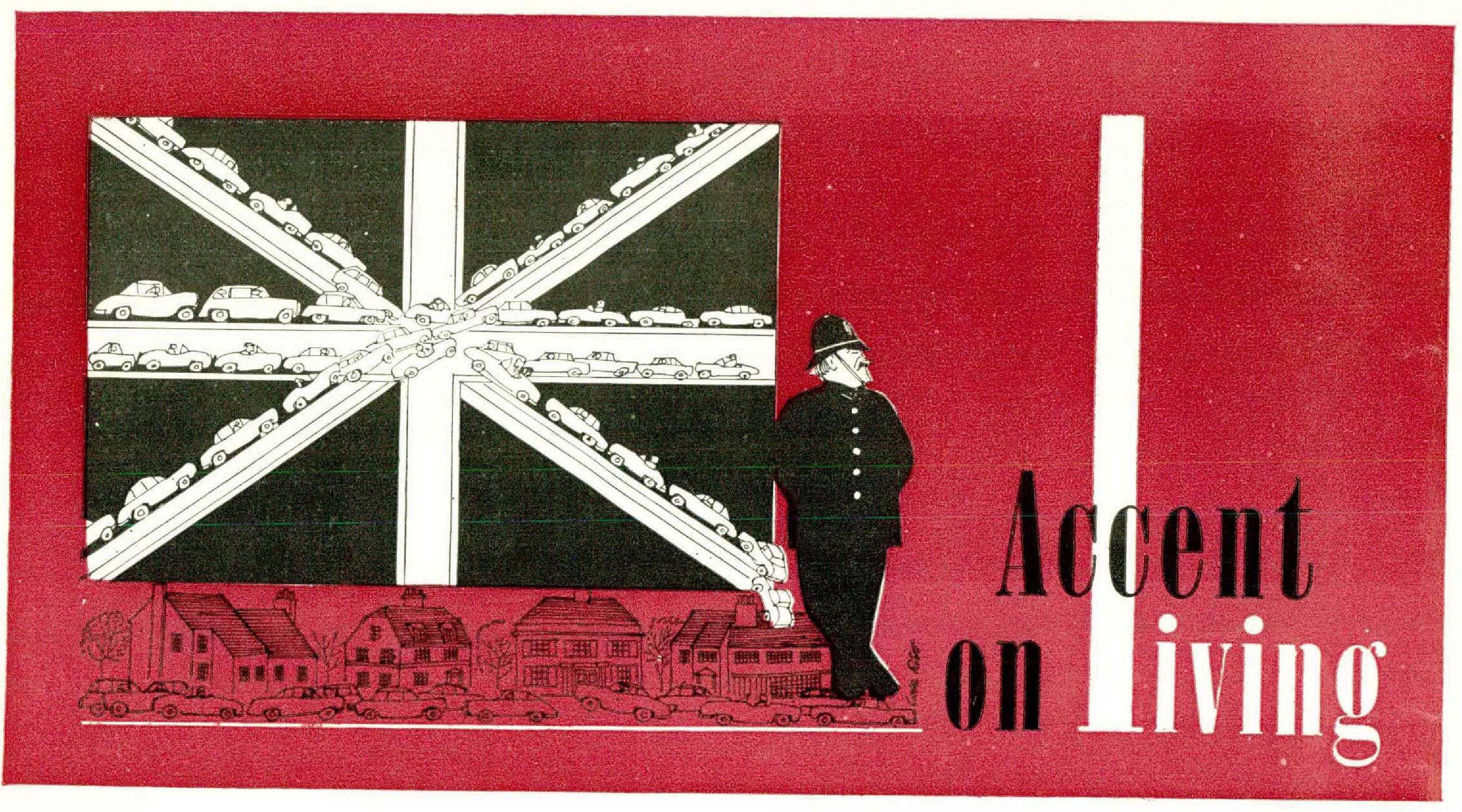
It was around eleven o’clock on a Saturday morning last fall when Ken Purdy and I found ourselves queuing up for the traffic jam at Tonbridge, some thirty-odd miles southeast of London. The Tonbridge jam is notorious, even among the British, and it took us a good hour and a quarter to traverse in fits and starts — two or three car lengths at a time — the half mile or so occupied by the jam.
Traffic had not seemed especially heavy, and we were curious about what could be causing so unyielding a slowdown. The cause, which became apparent as we inched our way through Tonbridge, was simple enough: two intersections (three, to stretch a point), regulated only by conventional traffic lights which continued to shift, hopefully, from red to green at their prescribed interval, quite without regard to the fact that the intersection was blocked by stationary cars. In Danbury, Connecticut, along a narrow main street similar to Tonbridge’s, signs warn that motorists blocking the cross street at an intersection will be arrested, and they are. But throughout the whole tie-up in Tonbridge, we saw not even a police constable, and no effort of any sort by the town authorities to ease matters.
At Reigate, on a weekday afternoon, I encountered a similar jam on the main street — as usual the through route for motorists. With parking on each side, the street is just wide enough for one lane of traffic in each direction. The jam in this case was caused by “road work” in one lane over a section not more than fifty feet in length. The “road work” signs gave due notice that the lane was obstructed. Unhappily, the Reigate authorities had neglected to prevent parking along the curb opposite the work area. The twolane main thoroughfare became, therefore, one-lane at this point, and getting past these fifty feet, again with no guidance from police, took everyone a half hour or more.
The delays in both places were so easily preventable that I raised the question with several friends in the nearby countryside, Why couldn’t a few traffic officers, part-time, if need be, or perhaps serving only on weekends, keep the traffic moving through the one-street bottlenecks of this kind?
The idea that the police could be of use struck my friends as novel and impracticable. “I’m afraid we don’t like the idea of a police state,” was one man’s response. Others felt that the police were untrained for such duty and that drivers knew this and would consequently pay no attention to them. Meanwhile, jams ten and fifteen miles long, taking many hours to traverse, are commonplace on summer weekends in southern England.
Patient and nontooting as he sits in his unpoliced traffic tie-up, the British driver resumes a truly awesome individualism when he is on the open road once again. If the jams are unpoliced, so indeed is the open road, for with no speed limit except in what we would call “thickly settled” areas, the driver can embark on a struggle for survival all by himself, if he so desires. The struggle can take the form of various experiments, to determine how fast the car can go without (a) blowing up or (b) leaving the road; what will result from overtaking another car nearing (a) the top of a hill or (b) a blind corner; and, not least, who owns the middle lane in a threelane road.
Three-lane roads are of course great accident breeders wherever they may be, but their dangers are usually reduced somewhat in our own country by a system of solid and broken white lines. Crossing the solid line when it’s on your side of the road is not only an offense but also a fairly sure course to the hospital, yet the correspondence columns of the British motoring magazines are often given to solemn debate about it: why shouldn’t I cross the solid line when I deem it safe to do so? One of the answers to this question reminded me of the argument that drivers would not pay attention to the untrained police, and so on. It was perfectly all right to cross the solid line, this driver argued, because the people who paint them on the road surface don’t know their business and frequently put them where they are not needed.
What are the rewards for the visitor if his evasive action proves successful against the British individualists? Simply a succession of lovely country scenes and not a beer can in the lot.