Churchill and the Scientists
Long identified with the Massachusetts Institute of Technology, which he served as vice president and dean of engineering from 1932 to 1938, DR. VANNEVAR BUSH left Cambridge to become president of the Carnegie Institution in Washington. There he was selected by President Franklin Delano Roosevelt to head up the extraordinary war team of some six thousand American scientists eventually known as the Office of Scientific Research and Development. With this authority he was brought into close touch with British scientists also working on national defense, and in crises with the Prime Minister himself.
by Vannevar Bush
THROUGHOUT the scientific effort of World War II, our policy in regard to the interchange of secret information among research teams was that any man carrying on weapons development was entitled to all the information necessary for him to proceed with maximum effectiveness toward helping win the war and shorten its duration, but no more. This followed a principle common in military organizations. It was generally accepted as reasonable; although there were those who thought otherwise and expressed themselves vigorously. As a corollary, there was to be no transmission of secret data to an organization because of possible post-war value. The tightest area was in the field of atomic energy, in the Office of Scientific Research and Development and also in the Manhattan District. This, fortunately, set a record for preservation of secrecy, although, as we later learned, it was not perfect.
When it became probable that the atomic program would come to fruition before the end of the war, I went to London. I thought interchange limitations would be discussed, and I visited the President to get instructions before leaving. Characteristically, he was not specific. FDR had previously approved the policy, but when I asked for orders in the event of British objection, I received none whatever.
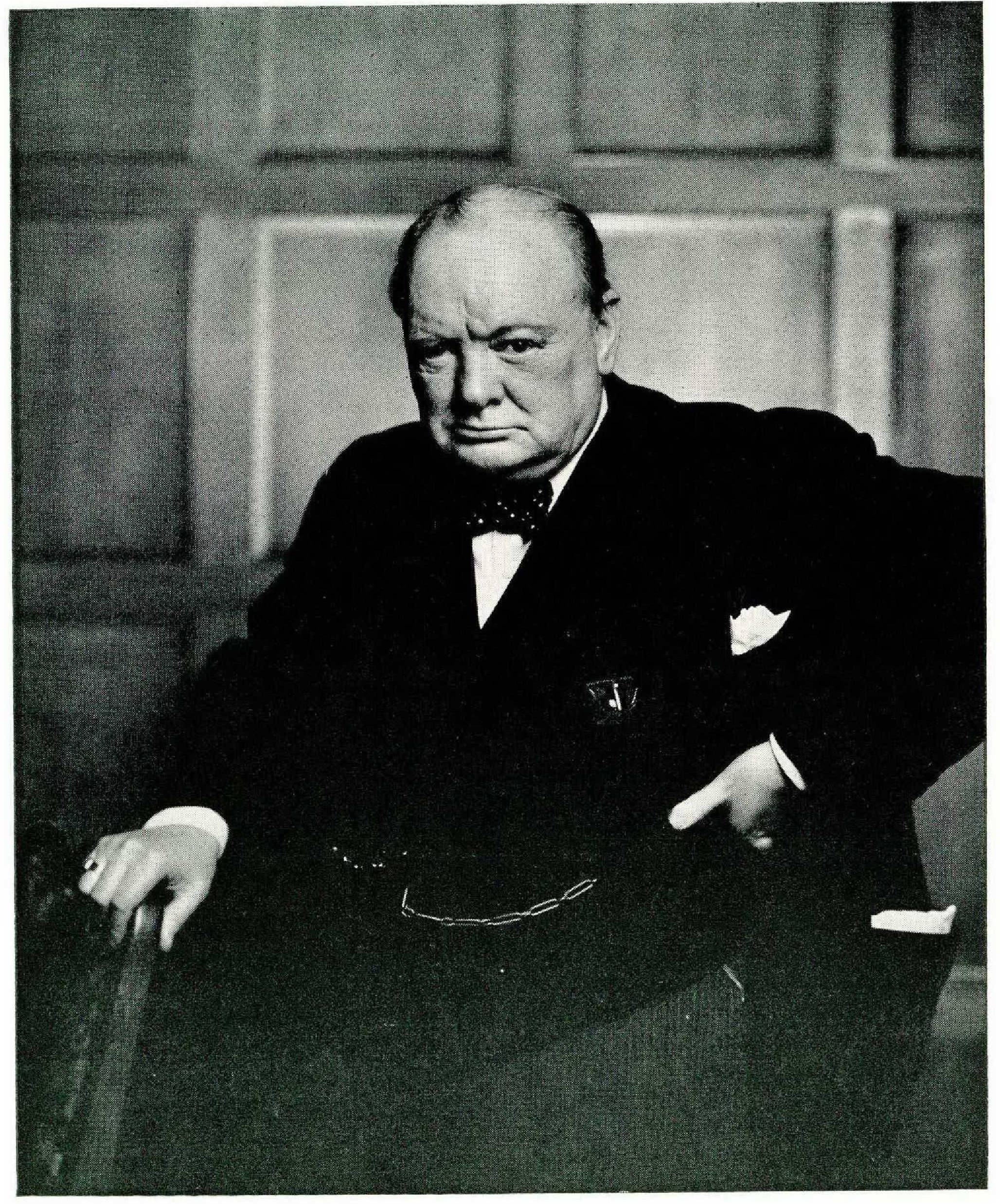
On arriving in London, I went, with Sir Stafford Cripps, to 10 Downing Street to pay my respects to the Prime Minister. The result was explosive. For ten or fifteen minutes I received an exposition of the absurdity of the arrangement, in typically Churchillian language, with some vocabulary not used in public speaking. He did not like the plan, and implied strongly that he did not like me either. Sir Stafford beat a retreat. The First Lord of the Admiralty was waiting in the anteroom, and continued to wait. I did not get a word in edgewise; I did not try to. The only pauses were when the Prime Minister tried to light his cigar, but apparently he had not bitten the end off, and he tossed matches over his shoulder with an emphasis that indicated he would like to toss me after them.
I cannot say I enjoyed the experience at the time, but looking back on it after escaping, I certainly did. For one reason, while many British, no doubt, had similar experiences, it was an unusual one for an American and highly instructive. During the harangue Churchill gave away all his arguments, and in several places showed that he had been misinformed. I closed the session by observing that our Secretary of War was in London and that I certainly was not going to argue the subject in his absence. “Very well,” said the Prime Minister, “we will have a full-dress discussion.” With that I got out — promptly.
The full-dress discussion occurred a few days later, and here Churchill appeared in an entirely different light. There had been time for me to have a thorough discussion with Mr. Stimson. We were fully in agreement, and he asked me to carry the ball at the meeting. Incidentally, Mr. Stimson did this on other occasions, and it had a distinct advantage. It meant that, should I get badly off the reservation, he would be in a position to save the conference and avoid deadlocks. In the few days before we met, there had also been opportunity to confirm that the Prime Minister had some of his facts wrong, and to document these. Also, I had had opportunity to go over tactics with Harvey Bundy, who accompanied the secretary and who was always exceedingly helpful in a pinch.
This meeting was peaceful by comparison. But several times the Prime Minister stated a point and I would say, “I’m sorry, sir, but my information is quite the opposite,” and quote from some official paper. When this occurred, the Prime Minister said nothing, although he did look hard at some of his team, who in turn looked worried. Sir John Anderson and Lord Cherwell were present, but I feel sure incorrect information had not proceeded from either of them. Finally there was a long pause. The Prime Minister looked at the ceiling and then said, “I will make you a proposition.” He proceeded to outline, in entirely different words, almost completely what had been the American position throughout. Mr. Stimson and I promptly said we felt sure the President would approve, and the meeting broke up.
As I was leaving, the Prime Minister shook hands with me. He grabbed me hard and pushed me about a bit, as though to start some sort of wrestling match. He looked me in the eye and said, “I want to see some more of you.” I took this to mean two things. One: “The next time you won’t catch me off base on a fact”; two, perhaps: “If I get you again, God help you.”
The rest of the story has been told accurately and in detail by General Groves, in his account of the Manhattan Project, Now It Can Be Told. The agreement was worked out by Sir John Anderson and myself and became part of the Quebec Agreement. While there was some jockeying, the final result was to reaffirm the principle I have stated.
THERE is one more quirk to this whole affair, and this concerns the President and his relations with the Prime Minister, and it is a strange episode indeed.
Just before the Prime Minister’s full-dress discussion, FDR wrote me a letter which went to my office in Washington. There James Bryant Conant, who handled directly all O.S.R.D. relations with the atomic energy program, transmitted it to me in London. It, of course, went in code, and as often happens, became mutilated in the process. Groves gives the full text. In brief, as written, it instructed me to yield to the British position. As I received it, it did not say anything of the sort. In fact, I read it as supporting exactly what was being done and proceeded blithely on my way. After I got back, Conant and I agreed that it ought to be kept out of circulation for a while. For it certainly called for conveyance of information for post-war rather than war purposes.
Why did FDR write such a note? We will never know all that went on over the transatlantic telephone, and the Prime Minister was a persuasive individual. But something caused a strange reversal.
Roosevelt did not take me to the Quebec conference. Nor did he take Conant or Groves, nor anyone involved in the atomic program, as far as I know. Yet there the agreement on interchange was confirmed. Sir John Anderson was there, and what emerged was close to what he and I had worked out. There were other clauses of broad political implication and questionable wisdom, but that is a different story. After Quebec, my relations with the President remained as cordial as ever, but he never mentioned the episode. I have long wondered just what he thought, having told me to do one thing and being presented with something quite different. I suspect he did not fully realize the dynamite in his letter, or possibly he did and wished he had not written it. At any rate, he did not want to discuss the matter.
One morning Harry Hopkins phoned me and said he had something amusing to tell me, so I hastened to the White House. Our relations were always cordial; if they had not been, the form of the scientific weapons organization would have been quite different from what it became in O.S.R.D. When I entered his office he was reading a “Profile” of himself in the New Yorker. It was searching and not altogether complimentary, and we joked about it for a moment or two. Then he read me a sentence or two from a long letter the Prime Minister had just written FDR. Apparently these long epistles were frequent and were routed through Hopkins, probably by FDR himself. I do not remember the exact language, but the general idea was that the war would go fully as well if I were personally dropped in the middle of the Potomac River. Harry joshed me about it and wanted to know what I had been doing that roused the Prime Minister’s ire. Then he sobered and said, “I do not think the Great White Father needs to see this particular item.” How he handled it, I do not know. I suspect he first phoned the Prime Minister and told him he was deleting it. He was quite capable of just such a step. I had great regard for Hopkins before that event, and more afterward. His utter loyalty to his Chief, his courage, his lack of personal ambition were extraordinary. We were fortunate that he had the President’s complete confidence, and I believe he had Churchill’s as well.
Why did Churchill press so hard on this interchange matter? At the London Conference he stated flatly that he was interested only in winning the war and was not concerned with the post-war or commercial aspects of the matter. I remember that I then asked him how it happened that his principal representative on the subject in the United States was an official of Imperial Chemicals, Ltd. Of course there was no reason other than a post-war one for extending interchange beyond what was necessary for full speed on war programs. I believe Churchill had been convinced by industrial men in Britain that atomic energy, after the war, would solve Britain’s coal problem. None of us at the time could have very clear ideas about the costs of atomic power plants. When Britain was justly downhearted, driven from the Continent and bombed, Churchill could inspire courage and assurance of ultimate victory, not merely because of his unparalleled command of language but also because he so obviously believed absolutely that victory would be attained. In the same way, in the midst of impressive burdens and pressures, he could give deep thought to Britain’s position and problems once victory was won. And when he went after something, he certainly went after it. But why did he take a swipe at me personally? I think he may have thought I had disobeyed my boss’s orders. Of course, I cannot know whether he knew any had been sent me. But failure to follow orders would have been to him a cardinal sin, warranting a departure from international propriety.
AT ANOTHER stage in the war I was in London on anti-submarine matters. It was at a critical time, when submarines were rampant, when it looked as though Britain might become isolated — as though we might, indeed, lose the war by this means — and when new anti-submarine weapons were being rushed into use, as yet little tested in action. One of these was almost entirely British, developed and used with great skill, and another was American. Incidentally, as Stimson’s records show, the British were far ahead of us in appreciating the power of hunter-killer groups and in getting them into action.
It was a tense time. I attended a meeting of the Anti-Submarine Committee of the British War Cabinet, presided over by Churchill. Averell Harriman and Admiral Stark were also there, and a dozen British senior officers. Lord Cherwell sat on Churchill’s right. He and I, presumably, represented primarily the scientific approach. Two things impressed me strongly. First, Churchill’s approach was by no means that of a presiding officer, attempting to focus opinion and bring out the judgment of military experts about the table. It was rather the attitude of a chief, telling his staff what was going to be done, inviting objection, of course, but primarily presenting conclusions arrived at before the meeting.
Second, I was startled when, twice during the meeting, the Prime Minister, in about as senior a gathering as could be brought together in Britain, caught Cherwell up short on statements. It was not that Cherwell seemed to me to say anything out of order. Rather, I gathered that it was intended to convey that he, the Prime Minister, was in full command and would make the decisions, including those on the scientific program. I felt sorry for Cherwell, but he did not seem to mind. He was probably used to it. After all, I suppose Churchill was about the most self-assured individual, not to say egotistical, that has appeared in recent history. And perhaps on balance it is fortunate he was. For no man could have served Britain as he did who did not have consummate self-confidence.
There has been considerable discussion of Cherwell’s character and methods, and a comment on that subject is in order. No doubt he was a strange person in many ways, and thoroughly disliked in British scientific circles. This was in contrast with Sir Henry Tizard, who preceded him as Churchill’s link with British science and who was thoroughly admired and liked on both sides of the ocean. There has been a story told that there was a feud between these two men and that they operated, on important defense matters, in improper manner because of personal animosity. I knew both men and worked with them. There is not the slightest possibility that either would ever have let personal matters interfere with his exercising objective unbiased judgment on scientific matters involving the national defense. They were both too loyal, too much gentlemen, for this. Any other assertion is an unsupported calumny.
Harrod, in his biography of Cherwell, gives a fascinating account of “the Prof” but does not treat his relations to the scientific effort. He had high standing as a scientist and had demonstrated great physical and intellectual courage, for which he was inevitably admired. But he had a manner that, I understand, infuriated people. I never saw this. In fact, on one occasion in the evening, when a group of us were supposed to be struggling with a tough technical problem but were all too mentally exhausted to do anything of the sort, I found him a fascinating companion.
I am inclined to believe that criticism of Cherwell was really directed not against Cherwell but against the system in which he operated. For one thing, I believe the British are generally more tolerant of personal eccentricities than we are, and some resentment of Cherwell which was occasionally encountered seemed much too intense to be accounted for by mere personal dislike. And this leads to a discussion about the difference between British and American methods of linking science with the war effort, and particularly the contrast between the ways in which Churchill and Roosevelt controlled that relationship. Usually the British did not criticize our system, and we did not criticize theirs. For that matter, it was hazardous to criticize Churchill on this side of the water, or to criticize Roosevelt on the other side.
The British had an exceedingly complex system of committees — scientific and joint scientific and military. I never understood it. I do not think the British fully understood it themselves. It worked, but only because the British have an uncanny facility at making a complex, and sometimes absurd, political system function. But it did not focus. The only centralization of the wide scientific and technical effort on military weapons at a time when the art of war was undergoing a revolution, the only link to the supreme authority for all this, was the presence of Cherwell at the Prime Minister’s side.
Cherwell had no authority of his own, controlled no funds, and hence was bound to function merely by interpreting Churchill’s wishes. And he also needed to interpret to Churchill the consensus of those British scientists and military men who, by reason of training, war experience, and position, were best able to judge when a scientific question of great moment arose. Of course, he could do nothing of the sort effectively over the whole broad area, and probably did not attempt to. The results should be traced by a British participant rather than an American. But it was clear to me that there was at least great opportunity for the feeling that competent scientific opinion was not being fully sought and weighed. There was even opportunity for the opinion that scientific judgment in fields remote from his experience was being exercised by Cherwell personally, or even by the Prime Minister himself on the basis of sketchy information.
IT IS much easier to trace how this could lead to difficulty by examining the contrasting system in the United States. Here nearly the entire civilian scientific effort on new weapons — and also research on war medicine, for that matter — centered in the Office of Scientific Research and Development. This included entire responsibility for engineering development up to the point where devices became adopted and went into production, or where, as in the case of the atomic program, very large expenditures became needed, and sometimes beyond this point.
This was a pyramidal structure, broken down first into the National Defense Research Committee, the Committee on Medical Research, a Division Office, a Transition Office, and an Office of Field Services. Then came divisions covering broad fields such as electronics and radar, and finally sections, a hundred or so of them devoted to explicit subjects, such as guided missiles or submarine-seeking torpedoes. There were thousands of contracts with universities, industrial organizations, and specially assembled groups. Each section was in daily contact with the corresponding military officers with responsibilities in their fields.
The range of effort was enormous — proximity fuses, air-to-ground rockets, weapons for the French Maquis, airborne radar, aircraft navigation systems, radar countermeasures, new explosives, sniperscopes by which a sentry could fire at infiltrating Japanese in pitch darkness, insect and shark repellents, blood fractions, tropical diseases. The official history is given by James Phinney Baxter in Scientists Against Time.
The money flowed from Congress directly down through this pyramid. But the projects flowed upward. The men of a section, a group of highly qualified scientists and engineers devoting their entire energies to a particular subject, would see a military need and opportunity in consultation with their military collaborators, examine its feasibility, examine alternatives, predict time schedules, study how it could be introduced in the field, and find a laboratory capable of developing it. Their project would be reviewed at the division and N.D.R.C. or C.M.R. level. But the important point is that a well-conceived project could pass through the entire review procedure, become authorized, and actually get started in a week.
The President created the organization by executive order, financed its early days from executive office funds, assured that it would have access to all secret information it needed for its purposes, and supported it completely and absolutely throughout the war. Never once did he interfere with its functioning in any way. He certainly never imposed his judgment on the relative importance of various weapons on O.S.R.D. This was by no means due to any lack of interest. I remember once I was outlining to him the prospects of some of the very new anti-submarine weapons, when Mrs. Roosevelt entered the office. She had been away for some days, went around to his chair and kissed him, greeted me by my nickname, sat down, and said, “Go ahead, Franklin, we have plenty of time.” After a while she asked a question. The President turned to her, and in three minutes gave her an accurate and clear summary of the status of submarine warfare, the measures being adopted, the promise of new weapons and methods. Here was the most powerful individual in the world, under great stress, and his gracious lady. No wonder I developed intense personal loyalty, and would have cheerfully walked off the dock if he had given the word.
EVERY section of our organization had close liaison with the corresponding British group, through reports, memoranda — as many as a thousand in a week, back and forth — visits, and the activities of an American London office and a British Washington office. There was collaboration of the highest order. The presence of individuals who were trying to work some sort of personal game was so rare as to be smothered in the spirit which prevailed. I can illustrate the teamwork and atmosphere by a statement which applies to O.S.R.D. but which no doubt had its parallel in Britain. There were, perhaps, twentyfive senior men in key positions in the organization. Every one of these, with one exception, who started in a key position finished the war in a key position. The exception had a heart attack. This does not mean there were no clashes of personalities or differences of opinion on policies. There were some hot ones. The point is that determination to get on with the war was never given secondary place.
This atmosphere pervaded relations between scientists and military men. When the effort started in 1940, before we were in the war, there was a gulf a mile wide. The military were generally suspicious of long-haired scientists, and to them an engineer meant the representative of a commercial company trying to sell them something. To meet the latter point, all O.S.R.D. representatives were called scientists, and usually doctors. This jarred some of the tough-minded engineers — for example, the chief engineer of United Fruit, who, with General Bradley’s army at the Normandy invasion, worked out the program, suggested by a sergeant, for converting German beach obstacles into steel beaks to enable tanks to cut down hedgerows, and who was decorated for it on the field of battle. It also jarred some of the men in the atomic bomb program, who knew that the engineering accomplishment in this effort was fully as great as the scientific one. It also has its influence, even today, in the minds of youths who do not know the difference between a scientist and an engineer. But usually the engineers in the organization relaxed and even enjoyed it. Toward the end of the war there was a partnership between civilian scientists and engineers on the one hand, and military officers with a keen grasp of technical matters on the other, which involved mutual respect and led to deep and abiding friendships.
Nothing illustrates this relationship better than the story of the proximity fuse. If it had not been for the atomic bomb, this and centimeter radar would have been the great sagas of the technical war effort. On the face of it, when first proposed, the proximity fuse looked preposterous. It involved building a radio set, with glass tubes and filaments, in the size of a small baking-powder can, putting it in a shell, and firing it off. It would then experience an acceleration of 30,000 G’s, which means that if it weighed an ounce, it would press down on its base with a force of about a ton. After that it would be expected to operate and to be so sensitive that it could tell when it was close to an aircraft and fire the shell. When it first came up I was doubtful that it could be done.
But to make a long story short, it worked. When it went into production, the Navy requested that it be kept in O.S.R.D., and this was done. The Navy officers that provided liaison were two of the finest I ever knew. A financial man from Johns Hopkins helped greatly. But the man in charge and his deputy were physicists, and what was involved was the manufacture of millions of intricate electronic devices in a dozen industrial plants; then testing, installation, and shipment. One of these physicists became the head of one of our most distinguished pure scientific laboratories; the other of General Motors research.
Churchill, in his writings, says the proximity fuse was developed by the British and manufactured by the Americans. This illustrates well the fact that the Prime Minister had too much on his mind to have concerned himself with such matters. Actually, the British started about when we did. But soon it was agreed that this should be an American job, and they quit their efforts and helped us in any way they could. These judgments, under which one or the other took the lead in specific attempts, were not usually formalized in any document; they just happened by mutual consent. The British were being bombed; their scientists were inevitably thinly spread over broader areas than ours were; the place for this sort of tough effort was in the United States, with its great range of electronic facilities.
The fuse was successful. In the Pacific it increased the kill per thousand rounds of five-inch antiaircraft guns by a factor of about five and was important in combating kamikaze attacks. On the shores of England, it furnished the final answer to the buzz bomb attacks on London. At the Battle of the Bulge, used against enemy ground concentrations in the fog, where it could give shrapnel bursts at optimum height, which timed fire could not, it decimated German divisions, saved Liege, and signaled a revolution in ground warfare.
The difficulty of the job is well shown by the German reaction. When the proximity fuse went into action in France, precautions were taken concerning jamming, for it was felt the enemy would promptly set up countermeasures. Teams with instruments were stationed along the front to detect and analyze enemy jamming radiations. The first shells used were of a type that was relatively easily jammed, and these were followed after a few weeks by a second type, on which jamming of the first type would not work. Nothing happened. The enemy field forces reported to Berlin that they were being pasted by electrical proximity fused shells. Berlin told them not to be foolish; the verdammte Amerikaner could obviously do no such thing.
The argument apparently went on until the end of the war. Some American officers, notably Admiral King, opposed the introduction of the proximity fuse in France, on the basis that the Germans would obtain duds and tell the Japanese, who would manufacture it and use it against us. Actually, they would not have given it to the Japs, and even with a sample they could not have put it into production in less than a couple of years. King was tough, but when once one had broken through his shell, which took doing, he was utterly logical and unprejudiced. When he was convinced, he and I went to a Joint Chiefs meeting; he asked the questions to bring out my arguments; and the chiefs voted to use the fuse in France. Twenty-four hours later, I was on my way to Eisenhower’s headquarters; several million shells had been on their way for months. This episode shows, incidentally, the need in war for a scientific organization which heads up to the very top. No admiral could have talked to King the way I had to. He was a rugged individual.
THERE IS another story which illustrates the difference in the ways in which relations were conducted between the scientific effort and the ultimate authority in Britain and here. This is not a pleasant story, as was the proximity fuse. It caused no rift between American and British scientists; in fact, it drew them together in adversity. The British angle has not, I believe, been told; I wish it were. Neither has the American, and it is too long to detail here, but it can be touched upon.
There was a pseudoscientist named Pike. He has since committed suicide, and cannot reply, so I will not be hard on him. He was short on physics, especially short on engineering judgment, but he had lots of ideas, some of them superficially brilliant and intriguing. He had not the slightest concept of what organization and operating in channels mean. Many have not. But he was a consummate salesman of a sort. On one of his schemes, the ramifications of which are too complex to relate, he apparently sold Lord Mountbatten, and, from all appearances, through him the Prime Minister. Pike and Mountbatten visited the Secretary of War and the President, and then appeared in my office. Pike told me the program was approved and going ahead, and asked what I was going to do.
I replied, courteously, I trust, in Mountbatten’s presence, that I took orders from the President and from no one else, and that no project went forward in my shop without adequate review and recommendation by our own group. That was that. The President never mentioned this particular project to me. There was confusion, and real damage was barely avoided. But the scheme never reached its objective, which is indeed fortunate, for putting it into effect would certainly have cost lives.
There was another, of the same general sort. This was a scheme for an ice island. A big plant was to be built which would freeze an enormous block of ice around it. This would provide a landing field in the middle of the ocean for relaying planes to Europe and for anti-submarine patrols. It would be manned to defend itself, and a torpedo from a submarine would just chip off a hunk of ice, which would soon become replaced. It would form a midocean island or aircraft carrier.
Roosevelt did take this one up with me. I judge Churchill had told him about it. I saw it coming and consulted engineers, physical chemists, and Navy men. The interview took five minutes. The President asked me what I thought of it, and I told him I thought it was the bunk; it would take a couple of years at least to develop, was of doubtful feasibility, and would tie up personnel and facilities unduly. Moreover, I told him that if we needed such a thing, the Navy had been studying for a long time an alternative which was better, involved no ice, and made sense. That was the last I heard of it from the President. The Canadians did quite a lot of work on it, actually froze some big blocks of ice, and were to some extent diverted from more sensible efforts.
RADAR was the tough field where British foresight and energy turned the tide in the Battle of Britain. Together, the British and the Americans cut rings about the Nazis and made centimeter radar a magnificent tool for many applications.
Before we were in the war, Henry Tizard came over to arrange interchange of information on radar. Some Britishers objected, on the basis that they were so far ahead of us that we would contribute little. A few American officers objected on just the same basis. Tizard and I had to avoid being seen together too much, for fear we would be regarded as conspiring, as we were in a way. The interchange occurred. Churchill and Roosevelt had the vision to realize that this was only the beginning of inevitable collaboration.
It was indeed found that the British were ahead of us; they had gone much further with the magnetron. We had something to contribute, however, on the receiving aspects of things. Both programs benefited. The magnetron, incidentally, the heart of radar transmission, was mentioned in some early German patents, but appeared first in useful form in British laboratories. Later we helped improve it. The strapped magnetron, a great advance, was developed in an American laboratory by a man who hardly finished high school and who became a physicist the hard way.
A great laboratory at M.I.T. carried the principal burden. It was manned by scientists from a hundred universities and laboratories, including British scientists. One of the most popular and effective men in the laboratory was an Australian, now in charge of very important scientific efforts in his own country. Out of this laboratory, and out of other laboratories in this country and in Britain doing research on radar and allied matters, came a whole new science and engineering, represented after the war by a dozen classic volumes. Loran, the Gee System, for navigating over a target, and the main post-war system for navigating aircraft and ships, was one product. The two systems, radar and loran, had much in common and appeared simultaneously in England and here.
I sat in on some radar conferences. A brilliant new idea would be under discussion. One could not tell from the conversation which ones of the group had conceived it or invented it. Apparently no one cared. Except for accent, one could not tell the Americans from the British. No one — I repeat, no one — made any remarks merely for self-advertising purposes, or said anything to detract from the credit due either country. This was one of the greatest examples in all time of healthy productive collaboration. I wish we could have its equal in peacetime. In some fields of fundamental scientific research, we do approach it.
A war does not create such men as Churchill and Roosevelt. It reveals their true greatness. No man has ever appeared in history for whom the glare of conflict has not revealed limitations. Of Churchill, we might wish that he handled scientific effort with the skill he showed in political relations. Of Roosevelt, we might wish he had exhibited fewer bizarre ideas, such as his concept of the relation of the Chief Executive to the Supreme Court. But of Churchill we may wonder. Perhaps the very traits which sometimes produced confusion in the scientific effort were a part of the characteristics of one of the truly great leaders of all history, who would have been less powerfully effective without them.