In Parliament and Cabinet
THE EARL OF SWINTON served for more than a quarter of a century with Winston Churchill or under him in every government in which he was a minister. A Member of Parliament from 1918 to 1935, Lord Swinton was also president of the Board of Trade and Secretary of State for the Colonies. In 1935 he began a three-year term as Secretary of State for Air, and during the war he was Cabinet Minister President for West Africa and Minister for Civil Aviation.
THE EARL OF SWINTON
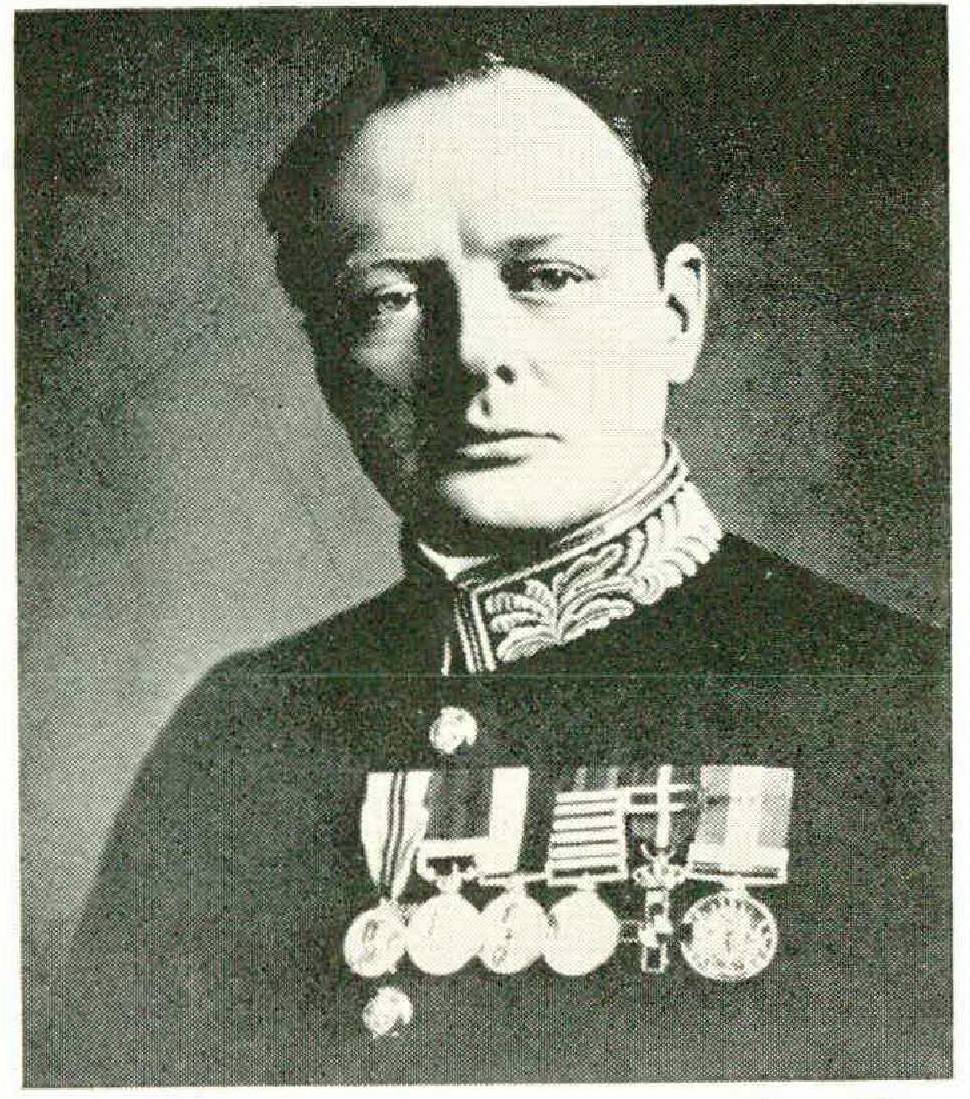
THE adjective “unique” is often misused, but it certainly applies to Winston Churchill. He was unique in achievement, unique in his infinite variety, and unique in having become the adored leader of a party from which he had twice severed himself.
To understand a lot of things that happened to Churchill during World War I and afterward, it is necessary to recall and appraise his early political history. In 1900 Churchill entered the House of Commons as Conservative Member for Oldham and at once proved himself a vivid and effective parliamentarian. Here was a valuable new recruit who might play the part his father had played in infusing new life into the party in the House and in the country.
Within a few years he found himself in conflict with the majority of his party. In the Imperial Conference of 1902, the Commonwealth Premiers, led by Sir Wilfrid Laurier, invited the United Kingdom government to adopt imperial preference. They found a strong supporter in Joseph Chamberlain. This is not the place to puzzle out the involved and muddled story of what Balfour’s Cabinet did or did not agree to or understand. Until 1917, there were no Cabinet minutes and few Cabinet papers. The only contemporary and authoritative record was in the Prime Minister’s letters to the King, and Balfour kept these brief.
In any event, in April, 1903, the Chancellor of the Exchequer, Charles Thomson Ritchie, repealed the corn duty, which would have formed the basis of imperial preference. In May, 1903, Joseph Chamberlain, who felt, with a good deal of justification, that during his absence in South Africa he had been let down, raised the banner of tariff reform and imperial preference at Birmingham. A few months later, Chamberlain and Ritchie both resigned from the government. The Conservative Party was split. The tariff reformers founded the Tariff Reform League; the free traders founded the Free Food League, of which Churchill was a leading member. The great majority of the Conservative Party were in favor of tariff reform in one shape or another.
Feeling became increasingly bitter. Churchill crossed the floor of the House and became a Liberal, and in 1906 he was returned as Liberal Member for northwest Manchester in the landslide which swept the Conservatives out of office for ten years.
It was generally believed in the Conservative Party that Churchill was an opportunist who had deserted his party while the going was good. This was unfair to Churchill, who had sincere convictions on the free trade issue. He had been indoctrinated by Sir Francis Mowatt, the forceful head of the Treasury. No one would accuse Winston of being a profound economist, but free trade became for him an irrefutable dogma, a matter of faith and morals. When he became Chancellor of the Exchequer in Baldwin’s government in 1924, he was, I think, the only free trader in the Cabinet. He always fought his corner, and as President of the Board of Trade, I had to struggle with him over every modest “safeguarding” duty.
Later on, in the Shadow Cabinet of 1929 to 1931, when we were working on a general tariff, Winston threatened to resign. He was, with difficulty, dissuaded by Austen Chamberlain, who told him that if he made that an issue, he would have the whole Conservative Party against him. He did leave us soon afterward over India and conducted a guerrilla war against successive National and Conservative governments from his seat below the gangway up to the outbreak of World War II. From 1922 to 1924 he was out of Parliament and had difficulty in finding a seat.
WINSTON was always a doughty fighter, and his campaign in the 1906 election was a good example. His stinging references to tariff reform — “dear food for the millions, cheap labor for the millionaire” — did little to endear him to his old party. And in 1914, his speeches and actions during the Ulster Home Rule crisis raised Conservative hostility to a level of bitterness rare in our country.
The result of all this was that, though as First Lord of the Admiralty Winston had fought successfully for a strong Navy, had contributed greatly by his own personal effort to the efficiency of naval administration, and had the whole Fleet at its war station when war broke out, in all of which he should on merit have had the support of Conservatives, in the eyes of most of the Conservative Party, Winston could do no right.
This was to have tragic results for Winston and for the country. I shall always think that the worst mistake in World War I was the failure to go on at the Dardanelles. The plan to force the Narrows with the Fleet was Winston’s conception. It came within an ace of success. Not a ship was involved that made any difference in the final issue of the war. The German High Seas Fleet was contained, fought, and ultimately surrendered to the dreadnoughts and battle cruisers Winston had built. The ships that were sunk by mines in the attempt to force the entrance to the Bosporus and the other ships which could have gone on were not needed in the North Sea. The great Turkish guns guarding the Narrows were down to their last twenty shells. Another resolute sweep by the minesweepers, which young Commodore Keyes wanted to send back, another follow-up by the old ships, and we should have been through.
I may appear to speak too dogmatically, because at the time I was merely a junior officer in the Army. But I was told this story afterward by Henry Morgenthau, the American ambassador in Constantinople. The Turks and the Germans were certain the attack would be renewed. General Liman von Sanders, the German general whose business it was to keep the Young Turks up to the mark, had given up hope and ordered his special train to be ready to take him and his staff back to Germany. And then it all collapsed. Admiral Lord Fisher turned against his Chief; the Cabinet (Winston should have made sure of the Prime Minister’s support) got cold feet. A halt was called.
I have called it a tragedy, and so it surely was. If Winston had been allowed to carry on, the Fleet would have got through, Constantinople would have fallen, and Turkey would have been out of the war, the Russian armies could have been supplied through the Black Sea, the war would have been shortened, and almost certainly there would have been no Russian collapse and no Bolshevik Revolution.
Here was an outstanding example of Churchill’s vision. Many books have been written arguing whether Churchill was right in this or that. In that fertile mind, a hundred ideas surged up. I daresay a lot of them were wrong, and Winston was always prepared to drop a bad idea and accept a better, constructive plan. Not without argument — but why not? In the clash of minds, the right ideas emerge.
But I say without hesitation that in the great things, Churchill’s vision was prophetic and right. I have cited the Dardanelles. Between the wars, Churchill was right about Hitler’s character and intentions. In World War II he was right all the time about Russian aims and ambitions. Who doubts this now? After the war, in the historic speeches at Fulton and Geneva, criticized by many at the time on both sides of the Atlantic, he called the Old World and the New to cooperation and combined effort. In those speeches he laid the foundations of NATO and European cooperation. The free world today thanks God for Churchill’s vision. The free world today pays homage to Churchill’s other outstanding quality, his courage.
IN HIS early days, wherever there was a fight, Winston managed to get into it. As Robert Louis Stevenson would have said, he courted danger like a mistress. After the Dardanelles, when the Conservatives joined Asquith’s government, they made it a condition that Churchill should leave the Admiralty. He was given a sinecure office where he could know everything and do nothing. He resigned and went off to fight in Flanders.
His courage in World War II was our inspiration. He always denied that. When someone said, “You inspire the people,” he growled back, “I don’t; I express their spirit.” But we know what his unfailing courage in disaster meant to all of us, to free men and men fighting to be free.
Let me recall two episodes in the darkest days. When the French government was on the verge of surrender, Churchill flew at great personal risk to find the Ministers at Tours and beg them to fight on in Africa, or at least to send the French Fleet there. It was no good. Reynaud had been superseded by Pétain and Laval. When he got back, Winston met a few colleagues. He said he had failed completely and that in a few days the French would surrender. “Then we shall be all alone.” He looked up. “I find that rather inspiring.”
I was with Winston during the first night of Dunkirk. I remember him saying, “I have been Prime Minister for ten days, ten days of unmitigated disaster, and now this; but one thing is sure, we shall win.” He was like that all through the war.
It was, I think, above all, those two qualities, vision and courage, that made all parties not only accept but insist on acclaiming him as the only possible Prime Minister and leader in 1940.
Let me look back and try to appraise Winston as a parliamentarian. He was always a House of Commons man, and he was a great parliamentarian. He was not an impromptu debater of the same facility as Balfour, Asquith, Lloyd George, or Bonar Law. His speeches were always carefully prepared and not infrequently rehearsed. But he had such a knowledge and sense of the House that he could prepare in advance a speech which nearly always fitted the mood and temper of the House.
There comes to mind one example of long ago which impressed me enormously by its tactical sense of the House of Commons. It was in the Dyer Debate in 1921. There had been rioting in Amritsar in the Punjab. General Dyer, an old and experienced soldier, had ordered his troops to fire on a mob in a narrow street, and there were frightful casualties. It may well have been that some firing was justified, but there was no doubt that the use of force was excessive and that the firing should have been disciplined and restrained. The War Office relieved General Dyer of his command.
The general had many friends at home who felt that he had been badly treated, and in particular he had the strong support of Sir Edward Carson, the greatest advocate of his day.
The whole matter was debated in a tense House of Commons. Edwin Montagu, the Secretary of State for India, opened with a most infelicitous speech. He was followed by Carson, who roused the House to fever heat. Carson was followed by Churchill, who had a prepared speech. But such was the feeling of the House that if Winston had plunged straight into his speech, he would have hardly been heard. He realized that he must reduce the temperature of the House. So he embarked on a long, involved, and rather dull disquisition on the legal rights and liabilities of soldiers called in to aid the civil power and the responsibility of the Army Council toward a serving officer. As he meandered on, the House simmered down. Members began to talk to one another. One or two, bored by the anticlimax, got up and walked out.
Then, having reduced the temperature of the House to zero, Winston launched into his speech. It was a great speech. Toward the end he drew a contrasting picture of a young subaltern waiting, stopwatch in hand, with a barrage raging around him, to lead his platoon over the top at the exact moment, compared with an experienced general, exposed to no risk, in command of his troops. The House was deeply moved. The balance of the debate was restored, events were seen in their true perspective, and the government won a comfortable victory.
Without being bitter, which the House of Commons never likes, Winston was a master of the killing phrase. The description of Ramsay MacDonald as the “Boneless Wonder,” led up to by an entertaining memory of playing truant as a small boy at a fun fair on Brighton Pier, was devastating. So was his retort when someone said that X was a very modest man. “Well,” said Winston, “he has a lot to be modest about.”
Like most good speakers, Winston was an actor. The one occasion in the House when a speaker is, by tradition, allowed more than a glass of water to revive him is the budget speech. Winston had by the box a large glass of brandy and soda. “I must now proceed to fortify the revenue” — a pause, during which Winston took a long drink.
During the war, Winston’s speeches were sheer inspiration. There is no need to dilate on those; they still echo around the world.
I HAVE spoken of Winston as a parliamentarian. Let me now recall him as a colleague. My memories go back a long way, for I served with him or under him in every government in which he was a minister from 1920. As a colleague he was always stimulating and loyal; he was grand to work with. Contrary to what some have thought, I never found him arbitrary or autocratic. He was said to like yes-men. I think that was quite untrue. He certainly did not like no-men, and he was tenacious of purpose and in argument. But I always found him willing to listen and, when he was convinced, to change his mind.
I recall one typical example. Winston had asked me to go down to Chartwell to discuss a project he was proposing to include in his budget. He had prepared a long passage for the budget speech, which he proceeded to read to me. I said that as a speech it could not be bettered, but that as a proposal I thought it was open to every objection; it would raise little revenue and would arouse opposition in many quarters. We argued the matter hotly.
After a long argument, Winston glared at me and said, “Well, I suppose we had better have no budget at all.”
I replied, “Far better than have that in it.”
Winston glared; then he grinned. “All right,” he said. “You win.” He tore up the script and gave me a drink.
We generally argued out our problems and differences over a meal. Let no one underrate the importance of ministerial colleagues’ being on close dining terms. I say “dining” advisedly. Lloyd George’s habit of breakfast parties, though in the Gladstonian tradition, was much less agreeable.
The Prime Minister must be the chief. He must choose his own colleagues. If he finds a colleague not good enough, or too difficult to work with, he must get rid of him. Someone has said that a Prime Minister must be a good butcher. But with our doctrine of collective responsibility, the Prime Minister is primus inter pares. Winston always strictly observed this position. Of course, as every Prime Minister does, he would discuss many matters with a few colleagues, but I can recall no instance in peacetime in which any matter of importance was not put before the Cabinet and every minister given the opportunity to express his opinion.
Winston liked opinions to be definite and terse. I remember one minister talking at length without coming to any conclusion. “Well,” Winston interposed, “we are waiting for one of two short words: one is Yes; the other is No.”
In war, the Prime Minister has a personal responsibility which he cannot delegate and can only partly share. Events force decisions upon him daily. He must be something of a dictator. I can only speak of Winston in war as I found him. When he sent me to West Africa in 1942, he said, “You will have absolute power out there, you will be a Cabinet of one, you will get things done, and I will always back you.” He always did. I can only remember two instances, in two years, where we differed. On one I telegraphed to him that, knowing all the conditions on the spot, I was convinced that I was right. Winston at once telegraphed to me to carry on and that he would take care of any trouble at home. The other time, he wired, “I would prefer to do it my way because I have agreed it with Roosevelt; but if you feel we must do it the other way telegraph to us both.” I had no doubt that in this case he was the better judge of the wider considerations, and I did it his way.
I have given these examples to show how far from the truth is the yes-man picture and how good he was to work with as a colleague and chief.
OF ALL the friendships which have benefited mankind, few, if any, can have been more frank or more fruitful than the partnership between Churchill and Roosevelt — the “Former Naval Person” and the President.
The old story of the President’s wheeling himself into Winston’s bedroom at the White House and finding Winston emerging from his bath and Winston saying, “You see, Mr. President, I conceal nothing from you,” was true in essence. It was happily true of their whole relationship. Each understood the mind of the other. They not only planned together, but each would think aloud to the other in their unceasing correspondence. Nothing could have been more fortunate, because one could try out on the other the bad ideas as well as the good before their minds were set.
Someday, I hope most of the telegrams and letters these two exchanged can be published. I think both men would stand even higher in the regard of their peoples if that could be done. Without indiscretion or breach of security, I may be permitted to retail one exchange. After a long run of disastrous sinkings of Allied ships by Uboats, the tide had turned. For two months the sinkings had been far fewer, and many U-boats had been destroyed. Winston thought it would encourage the Allies and dishearten the enemy if the facts were published. The President disagreed. He said that the tide might turn the wrong way again, and if the figures were published, it might make our peoples too complacent. He ended, “It is seldom wise to show the canary to the cat.” Winston riposted, “My cat likes canaries.” Roosevelt telegraphed back, “O.K. Publish.”
As Roosevelt wrote to Churchill, “It is fun to be in the same decade with you.” With all his versatility, Winston was a fascinating companion. He was a charming and courteous host and put every guest at his ease. He won Havenga’s heart by introducing him as “An old friend who has more British lead in his body than any South African and bears no malice.”
One more example. Shortly before Winston retired, De Valera, who was coming to London, told me that he had never met Churchill and that he would very much like to do so. Winston asked him to luncheon. We were a small party of six. It was a great success; we sat for three hours. At the start, they got on to Eire neutrality in the war. You would have thought that this was not an auspicious beginning. Each argued his case strenuously, but with equal sincerity and good humor. Then they got on to Winston’s childhood days in Dublin. De Valera said, “You should come back. Run one of your horses in an Irish race; you would have a great reception.” I think it was after that that Winston bought an Irish horse.
Toward the end of luncheon I said, “You have one other thing in common, as well as both being Prime Ministers: you both escaped from prison.” Winston escaped from Pretoria in the Boer War; De Valera had escaped from Lincoln Gaol in 1916 and got back to Ireland. Each told a graphic story of his adventure. I am half English, half Irish, so I was delighted.
Winston had great qualities and great assets, but the asset he valued highest, and rightly so, was his wife. “And then I married and lived happily ever afterwards.” In a familiar phrase of Winston’s, that was “profoundly true.”
Historians and biographers will assess differently this and that. Of course, Churchill was not always right. But right or wrong, he was always sincere, and in the most dangerous crisis in our history, he was indispensable and invincible.