The Working Day
For six crucial years, from 1940 to 1946, JOHN H. PECK, as private secretary to the Prime Minister, was at Sir Winston’s beck and call at any hour of the day or night. How the great man looked to a twenty-eight-year-old and how remarkably they worked together, we see in the exhilarating pages that follow.
HE SERVED with the 21st Lancers at the Battle of Omdurman in the Sudan in 1898; he figured in a spectacular episode in the Boer War; he was a Member of Parliament almost continuously from the beginning of the century to the day of his death. He first served in a ministerial post 58 years ago and held almost all the great offices of state. He transferred his allegiance from the Conservative to the Liberal Party in 1906, and back again two years later. He became a rebel from the Conservative Party in 1930. On at least two occasions, his political career appeared to have fallen in ruins about him. Yet he was Prime Minister throughout the whole of the active period of the most desperate war in Britain’s history, and again for four difficult years of so-called peace. His interests were at all times wide-ranging and far-reaching. There is no single human being alive or dead who could furnish at firsthand a personal commentary and appreciation of this tremendous life.
Many public figures present one aspect to the world and another to their personal staff and family, as an actor seen from the auditorium differs from the personality observed behind the scenes and from the personality displayed before and after the performance. Winston Churchill was consistently the same: his reactions were predictable; he never put on an act to the extent that he ever deceived himself; and when he did put on an act, he was the first to laugh at himself.
It was this consistency of character, coupled with the simplicity of his aims and his ideals, that explains his astounding powers of endurance, courage, and resilience during the war. He believed — and these beliefs come out very clearly in his History of the English-Speaking Peoples — that a nation survives, flourishes, and produces great art and culture just so long as it is prepared to maintain strong defenses and to undertake the sacrifice that strong defenses entail. Lie believed that a nation’s fate at any given moment, whatever its system of government, depends upon a few strong and courageous personalities. And he believed in the possibility of the individual’s devoting the whole of his talents to the exacting demands of public service and leadership.
He believed that these rules, as simple to formulate as they are difficult to observe, were equally valid for all nations and all periods of history. But he further recognized that this vision of greatness and dedication was vouchsafed only to a few, and these few would be subjected to the envy, mistrust, and blunders or sheer inadequacy of lesser men. In moments of stress, in the intimacy of weekends with only his family and his trusted staff around him, he was fond of quoting Kipling:
Too little to love or to hate.
Leave us alone and you’ll see
How we can drag down the State!
ending up with a splendidly sardonic snarl on the final line:
Churchill often summed up a strong character, particularly one with whom he was having differences, by saying, “He has the root of the matter in him.” He once used this phrase in one of his periodic and always exciting excursions into French. A distinguished French general who had no English was lunching with the Churchills at Chequers, and Winston said of General de Gaulle, “Mon ami, il a la racine de la matière dans lui.” He continued to philosophize, in French, on the conduct of warfare, until he came up with the phrase, “Dans la guerre il est nécessaire de ne minimiser pas les ponches.” Even the polite general could not conceal his blank incomprehension, and Winston was finally obliged to admit defeat and say humbly to anyone who could help, “What is the French for ‘to pull your punches’?”
These beliefs, fortified by the experiences, both triumphant and frustrating, of his own career, determined his attitude toward World War II and his method of conducting it. In 1939 England was in deadly peril, even if only a few recognized it. When the Chamberlain government declared war on Hitler’s Germany, the hated enemy against whom Winston had for years been warning in vain, it was for him a vindication and for England an opportunity for greatness. When he was invited by the Prime Minister to join the War Cabinet as First Lord of the Admiralty, it was his own opportunity for greatness, and he seized it joyfully with both hands, not — and it is vital to an understanding of his character to realize this — because it was his personal ambition to get back into a Cabinet post, but because he genuinely believed (and even his bitterest critics would agree that he had the strongest possible grounds for his belief) that Hitlerite Germany had to be vanquished and that he himself was supremely qualified to play a leading role in Hitler’s defeat.
If, as First Lord of the Admiralty, he ever dreamed that he would become Prime Minister, he never gave anyone the slightest hint or inkling of such an aspiration. His loyalty to Mr. Chamberlain was complete. It was quite compatible with this loyalty that he simply could not confine his interests to naval affairs. He devoted his energies during his eight months at the Admiralty not only to putting the fleet in a state of readiness but also to die general strategy of the war and to the home-front problems of manpower and supply. It was, therefore, ironic that when the discontent in Parliament with Mr. Chamberlain’s conduct of the war came to a head in May, 1940, and his government resigned, the focus of unrest was the failure of the Norwegian campaign, in which Winston Churchill and the Admiralty had played a leading role. Nevertheless, there was a certain inevitability about the choice of Winston Churchill as the leader of a coalition government formed at a time of desperate crisis.
For this was the stuff that history is made of. It was a situation Winston Churchill understood and appreciated: the country threatened with total disaster; the people heroic, but lost without leadership; the enemy implacable; all the political, economic, and national complexities simplified to the single point at issue, survival or defeat; and Churchill himself supremely qualified to retrieve the situation. What more could he want?
How did he do it? To those who were close to him, he made the task seem easy. Certainly one possibility, which the Dunkirk disaster seemed to elevate to a probability, was defeat, but the other alternative to him was not survival — that was an interim phase — but victory. And Winston Churchill’s entire waking life during the war years was devoted to one single objective, victory. The explanation of his endurance, his long hours, his drive and energy is simple. The distinction between work and play, drudgery and hobbies, labor and relaxation did not exist. The conduct of the war was also his play, his hobby, and his relaxation.
WINSTON’S first task was to form his coalition government. The Labor and Liberal parties were willing to serve in Churchill’s Cabinet, and he made two characteristic appointments. One was that of Neville Chamberlain as Lord President of the Council. It says much for the mutual respect of the two men and the traditions of public life that it was possible for the former Prime Minister to serve under his bitter adversary of previous years and to take a lower position in the Cabinet he had previously headed. To the day of Mr. Chamberlain’s death, Churchill treated him with almost exaggerated consideration and courtesy.
The other characteristic appointment was that of Ernest Bevin as Minister of Labor and National Service. Up to that time Bevin had played no part in politics, and one of Churchill’s first acts was to persuade the Labor Party leaders to arrange for the nomination of Bevin as Labor candidate at a by-election in a completely safe Labor constituency. But for Churchill, it is open to question whether Bevin would ever have entered politics. Churchill had long admired Bevin and recognized in him someone of his own stature and caliber. During his months at the Admiralty, Churchill would see Bevin regularly, as Secretary of the Transport and General Workers’ Union, and discuss with him the national problems of manpower and production. When the coalition government was disbanded in the summer of 1945 and party politics reappeared before the general election, nothing hurt Churchill more than the public attacks that Bevin was obliged, for party reasons, to make upon him, and he clung to the hope that Bevin found the task as painful as he did himself.
Politics did not appear to enter into Churchill’s relationships with his Labor colleagues. He was probably most closely drawn to Ernest Bevin and Sir Stafford Cripps, the former by mutual respect and a sympathy of outlook, the latter by similar respect but a total dissimilarity of disposition. Cripps’s personal austerity was always a source of wonder to Churchill, and Cripps enjoyed being teased about it. He particularly enjoyed an occasion when the two lunched together at Chequers, Cripps on his vegetarian dish — nut cutlet — and water, and Churchill on more robust fare. Stafford Cripps had some skin irritation which had inflamed his nose but had evidently not upset his equanimity, for he was genuinely delighted when Winston, his brandy glass in his hand, eyed his colleague and said, “Isn’t it a remarkable dispensation of Providence, Stafford, that I do the drinking and you get the nose!”
It has sometimes been suggested that Churchill as Prime Minister was dictatorial and undemocratic. Certainly he liked to have his own way and to have it fast. Certainly there were many decisions which would be normally taken by the Cabinet as a whole but which were taken on the spot by the Prime Minister. But the pace of the war made this inevitable, and when it happened, he was scrupulous about informing the Cabinet and obtaining its endorsement. As these matters might well arise at odd hours, he was likely to discuss them with any Cabinet ministers who happened to be around or accessible by telephone. His methods of work were systematic and well suited to his disposition, but they taxed the patience and the physical endurance of his Cabinet colleagues and senior advisers to a disturbing degree. It says a great deal for his personal dynamism and the sense of loyalty and sacrifice he could inspire that they endured so much.
Nevertheless, in all his wartime administration, Winston Churchill was scrupulously respectful of all constitutional forms. It may well be that his supreme achievement was not merely to have been the chief instrument of victory, but to have achieved victory through the established democratic system. The doctrine of collective responsibility of the Cabinet was stretched but not broken. The functions and responsibilities of both Houses of Parliament remained unchanged. He strengthened by his personal messages and interventions the system of formal and informal consultation among the members of the Commonwealth. The important news of the progress of the war and his interpretations of strategy and future prospects were given first to Parliament.
When Labor joined in his coalition government, the role of His Majesty’s Loyal Opposition devolved upon the minuscule Independent Labor Party, but an unofficial band of parliamentary critics of Winston’s conduct of the war formed in the ranks of Labor and provided a group of political adversaries. Their strictures exhilarated at the same time as they exasperated him, and they stimulated some of his best political and oratorical performances. But, as always, it was the caliber of the individual opponents that interested him. He always distinguished those who “had the root of the matter in them” from those who aroused in him a suspicion, voiced privately in unambiguous language, that they thought a setback to British arms at any rate offered the consolation of being a setback to the Prime Minister. And out would come, “We are the Little Folk — we!”
IF Winston Churchill had spent the whole of the war as First Lord of the Admiralty, with a Prime Minister in authority over him and a great department to administer below him, the pattern of his daily life would of necessity have been very different. As it was, he was able to organize the conduct of general Cabinet business, strategic planning, and, in fact, the management of the war exactly as he wanted it. His Cabinet colleagues, Chiefs of Staff, senior civil servants, and, of course, his personal staff had to adapt themselves to his routine. They had plenty of practice, since the pattern of his daily life varied remarkably little during the five years of his wartime premiership. Many of the details of this pattern throw much light on his character and methods.
The day began, when he woke up between 8:15 and 8:45, with a call on his bedside telephone to summon an officer from the Map Room to show him the morning Sitreps — situation reports on military operations, U-boat attack and counterattack, British and German air raids, all the details of the day-to-day progress of the war. With breakfast he would examine the daily newspapers, at least nine in number. He always did this himself and never relied on any press reader or system of clipping or marking. He was, in fact, an expert skimmer. Thus equipped with the latest news from the fighting fronts abroad and the latest trends and comments from the political front at home, he could start work on the Box.
The Box merits a section to itself in a picture of Winston Churchill, since its arrangement was peculiarly his own and it was in a sense the nerve center of his war effort. It was a black dispatch box to which only the Prime Minister and his personal staff carried the keys. In it were a series of foolscap-size numbered cardboard folders, and into these all the Prime Minister’s work would be placed by his private secretaries. The usual headings were:
Top of the Box
Foreign Office Telegrams
Service Telegrams
Periodical Returns
Parliamentary Questions
For Signature
To See
General Ismay (reports from Chiefs of Staff)
Answers Other (from other than Chiefs of Staff)
Ecclesiastical
R Week-End
Some of these need explaining. “Top of the Box” contained the material culled from the other folders which the senior private secretary on duty considered to be really urgent. Selecting the right items was sometimes hazardous. If the system was not to be self-defeating, the “Top of the Box” folder had to be kept small, and urgency had to be measured not solely by objective standards of importance, deadlines, and so on, but in part subjectively by the degree of the Prime Minister’s personal interest. His personal staff, therefore, had to see and understand what was in his mind, and he relied upon us to be able to do this.
“Periodical Returns” was the key to an important piece of Churchillian method. He was always keenly interested in the development of new equipment — radar, shell fuses, rockets, bombsights, new tanks — and he understood to the full the absolute necessity in military operations of punctual delivery dates of aircraft and all munitions of war. During the first desperate months of his premiership, survival depended upon it. At the same time, on the personal plane he understood that while the confidence and energy of his colleagues and senior officers were observable, the war effort largely depended upon the drive and determination of lower echelons with whom he could not be in personal contact. I never myself heard Winston Churchill mention the word “Dardanelles,” but in his war memoirs, describing the forming of his administration, he says: “I was ruined for the time being in 1915 over the Dardanelles, and a supreme enterprise was cast away, through my trying to carry out a major and cardinal operation of war from a subordinate position.” Now that he had the power, he was resolved to ensure that there should be no weak links anywhere.
Moreover, he himself wanted to know what was going on. He therefore sent out to his ministers a stream of written requests (always written: “Let it be very clearly understood that all directions emanating from me are made in writing” — July 19, 1940) for monthly, fortnightly, weekly, or even daily returns on production, technical developments, manpower, training, reinforcements, which he would then scrutinize with care. Producing these returns was understandably unpopular, but it put all concerned on notice that the P. M. was on the warpath, and a minister might be instructed at any time to bring with him the official concerned to explain the figures in person. Where delays or other unsatisfactory situations were thus disclosed, they were often due to priorities or procedures operating elsewhere, and an adjustment decided upon at the top would solve or ease the problems of the official or department concerned. The merits of the system soon came to be recognized. It was a characteristic of Churchill’s administration that there was no part of the war effort so obscure that it might not suddenly be picked up in the glare of an intense and highly penetrating searchlight.
“To See” was a misleading title, since it included many items on which some sort of action was likely to follow. But any attempt to anticipate which of them would merely be initialed off and which would move the P. M. to take action would have been doomed to failure. So we did not try, and “To See” contained most of the Prime Minister’s routine work.
A possibly unexpected aspect of Winston Churchill is hinted at in the folder marked “Ecclesiastical.” It is the duty of the Sovereign, as head of the Church of England, to appoint the archbishops and bishops and a large number of the lesser clergy whose livings are in the direct gift of the Crown. On making such appointments, the Sovereign acts upon the advice of the Prime Minister, and it is the duty of a member of the staff of 10 Downing Street to make the necessary inquiries in ecclesiastical and other quarters and submit recommendations to the P. M. about the advice to be tendered to the Sovereign.
It is almost certainly true that not for very many years had such detailed and painstaking researches been made to ensure that the Sovereign received the best possible advice as in Churchill’s wartime administration. It cannot be said that this was because Churchill himself was an expert on Church affairs, or gave ecclesiastical appointments priority over the conduct of the war. In fact, the secretary on his staff concerned happened to believe passionately that the Church of England was as good or as bad as its clergy and that it mattered a great deal if the right men were in the right posts. Moreover, Brendan Bracken, one of Winston Churchill’s closest associates, happened also to be greatly interested in Church affairs. But the fact remains that Churchill himself was concerned to see that he was given the best and most thorough advice available; if this was part of his duties as Prime Minister, then it had to be done properly. So it was.
The most revealing part of the Box was the folder called “R Week-End.” This contained only files marked with this cryptic title by the Prime Minister himself. It meant that he was deferring consideration of them until the comparative calm of the following weekend at Chequers, the official country retreat of prime ministers, but by the time the weekend came, guests would have been invited to Chequers, some crisis or planning conference would intervene, and the “R WeekEnd” file would sit for another week.
It contained two types of papers. There were the ones Winston was interested in and really intended to study at leisure and pronounce upon. There were others, indigestible or uninteresting, often the result of some initiative of his own which he had decided to abandon. But as he was never prepared to admit that he was abandoning any subject, or that he had lost interest in it, much ingenuity was required on the part of his staff, in the way of submitting draft instructions to ministers or proposals for disposing of the subject otherwise, to enable him to get rid of the thing without loss of face. When the maneuver was too transparent, we had to be prepared for some eloquent criticism within the privacy of No. 10, but we were secure in the knowledge that Winston Churchill trusted his personal staff absolutely and that in our dealings on his behalf with the rest of the government machine he would, if necessary, back us to the hilt.
The Box contained the paper work. But this took up only part of his time. Much of the day was spent in talk, either on the telephone or in person with ministers, Chiefs of Staff, the secretary of the Cabinet summoned to visit him. Meetings of the Cabinet and the Defense Committee, which had to be set up a few days in advance for the agenda to be circulated and papers prepared and studied, took place two or three times a week. The Prime Minister was likely to postpone or cancel these meetings for reasons which appeared to him good and sufficient but to his harassed colleagues sometimes seemed to border on the capricious.
WINSTON CHURCHILL, during his wartime premiership, probably did nearly half his work in bed. He worked in bed every morning until there was something to get up for. Every afternoon he would retire for a siesta, an hour or more of solid sleep, as he had the blessed gift of falling into a sound sleep within minutes of the lights being put out and the curtains drawn. On waking, he would work in bed, again until something compelled him to get up. On many days the two events which roused him from bed were lunch and dinner — a life so sedentary, if not supine, that it might appear physically disastrous. Yet he spent many weekends watching troop training, anti-invasion preparations, and trials of new weapons, and he displayed energy and endurance to outlast many younger and apparently more able-bodied mortals. One result of his working methods was that he could, and regularly did, work on after dinner until one, two, or three in the morning, and bed by midnight was a bonus for the staff on duty with him that night.
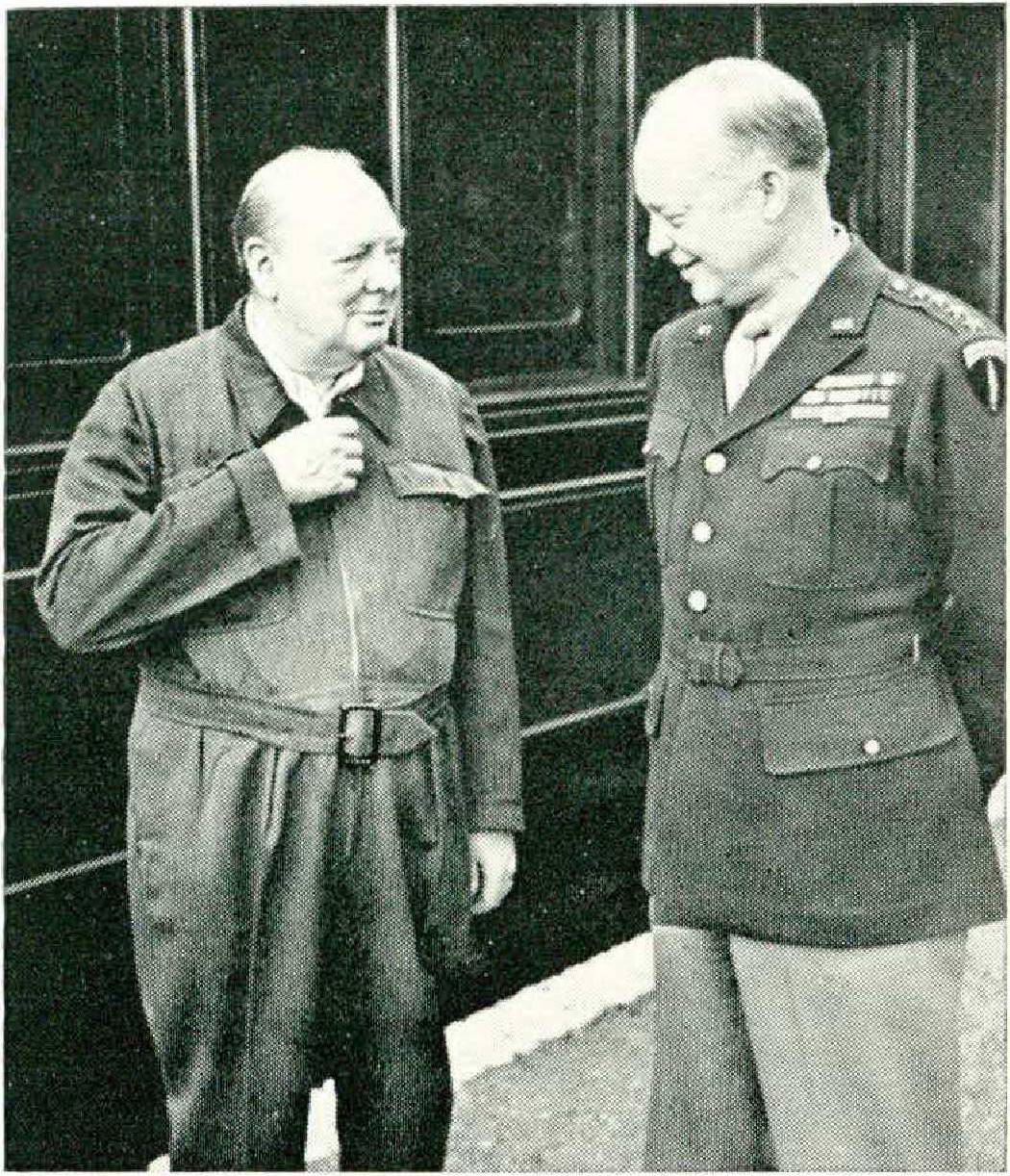
It sounds eccentric and egocentric, but it was extremely practical. There was, in fact, a virtually self-contained nucleus of government which could operate anywhere in the country: the Prime Minister, a private secretary on duty with him, one or two shorthand typists, a telephone fitted with secrecy equipment, a private secretary on duty at 10 Downing Street as “rear link” when the P. M. was away, and a service of army dispatch riders on motorcycles carrying the telegrams and other papers to wherever he might be. A train was made up of rolling stock that was unsuitable for general use under wartime conditions but suitable for a mobile office and sleeping quarters, and in this Winston Churchill could tour the country and simultaneously be in contact with technicians and scientists, workers in the factories and troops in the field, and with the whole apparatus of government in Whitehall.
The only event which upset the routine of his other work was the imminence of a major speech. Every word of the great wartime speeches was his own. Their composition followed a regular routine. For a week before a major speech had to be made in the House of Commons or on a great public occasion, it would be increasingly difficult to persuade him to deal with any but the simplest of urgent matters, and a mounting pile of papers would be left to be dealt with later.
There would be growing anxiety on the part of the staff lest the speech would never be composed at all, until at the last possible moment, usually just before dinner, Winston would say, with a twinkle in his eye, “I shall need two young ladies tonight.” This was the instruction to have both his shorthand typists on duty simultaneously, instead of alternating on evening duty, as they normally did. He would then dictate the entire speech, usually with only one break, at what he judged, pretty accurately, to be the halfway point, when the first typist would go off and start on the first part while he dictated the rest of the speech to the other. Sometimes he would break off for a complete day, but normally the first draft was produced at a single sitting.
At this point, his staff would take over, and the speech, or relevant sections of it, would be sent to the ministers concerned, the Chiefs of Staff, and the secretary of the Cabinet. It was their responsibility to vet it for points of fact and detail, and particularly security. The decision on how much to tell the enemy about our strategy and the progress of the war was always delicate.
Comments and amendments from all these sources then had to be collated on a master copy and explained to the Prime Minister. He would change his original draft only if he was convinced of the necessity to do so, and suggesting amendments was not a task to be embarked upon lightly. A comparison of the original draft of any of his wartime speeches with the finished product would disclose surprisingly few second thoughts on his part or errors of fact and judgment which required correction by his advisers.
He would never have tolerated even the suggestion of using anyone else’s draft. The greatness of his speeches sprang from the total mastery of his subject and his command of the language which he used.
Strictly speaking, it might be argued that he read his speeches. It is true that on all but the rarest — and, incidentally, the least successful — occasions he had before him a full text set out in unusually large type, with the lines indented in graduated groups of three, and when he reached the bottom of a page he turned over to the next one. He did not consciously memorize his speeches. But the general effect was of a man who was restating something which he had also had committed to paper the day before.
THIS description of Churchill’s working life may portray a picture of unremitting toil, without relaxation or rest. The reality was somewhat different. Granted that the distinction between work and play, business and pleasure, did not apply to the wartime Winston Churchill, he nevertheless found opportunity for diversions which were partly genuine relaxation, partly background for a sort of periodical retreat into some monastery of the mind to which he would retire and brood. Lunch and dinner were usually lengthy affairs. There were guests more often than not, and Winston’s conversation was wide-ranging and often gay. He was a talker rather than a conversationalist, but sometimes a chance remark would start in him some train of thought which had to be pursued in a remote and disconcerting silence.
At Chequers a cinema had been installed, and films were shown on most weekend evenings. He enjoyed them, particularly films on warlike, patriotic, or heroic themes. But if the plot was at all intricate, he would quickly lose the thread, and it was clear that he was only following with half his mind. As the films usually started after a leisurely dinner, they were rarely finished by midnight. But then he might be in the mood for music. This entailed playing the gramophone in the drafty ill-lit Great Hall, usually the same three or four French military marches, infinitely repeated, while the Prime Minister paced slowly up and down, up and down, in silence. No one ever knew, or asked, what he thought about during this endless sentry go, on guard over his private meditations.
But it was at Chartwell, his own country home, that he came nearest to laying aside the burden of the war. There were the same direct telephone line, the dispatch riders, the personal staff; but there were also the whole paraphernalia of his deeply loving and deeply loved family and his home, the cottage he had built himself, the gardens, his golden carp in the lily pool, and his geese on the lake. One goose he was particularly attached to, because if he stood on the terrace and bellowed across the valley a call approximately transliterated “Ah — wah — wah,” the goose would reply from the lake with a distant “Honk honk,” and Winston believed that he was the only person whom the goose would answer.
There was one dreadful summer’s evening when Winston drove down from London accompanied by a general noted for his tact and skill in dealing with the Prime Minister, and his first act was to demonstrate his exclusive dialogue with his pet goose. What imp urged the general to tempt fortune by following suit and calling “Ah — wah — wah” across the valley will never be known, but, to the frozen horror of those around, the goose replied, “Honk honk.” The Prime Minister was not only put out; he was genuinely grieved by the perfidy of his goose.
Chartwell was home, but Winston at Chartwell displayed no facets of his character which were not apparent elsewhere. He was at all times completely himself, consistent both in his majestic grasp of war and government and in his personal foibles and weaknesses.
ARTISTS and sculptors have collectively done a great, if unwitting, disservice to Winston Churchill. They have contrived to perpetuate a single aspect of his appearance and character, the “bulldog at bay,” typifying a dogged and indomitable defiance in the face of heavy odds. But this aspect, characteristic as it is, is as incomplete as if he were always portrayed as Churchill the benign elder statesman, Churchill the painter, Churchill the humorist, Churchill the lover of children and animals. He was all of these things, and it would require genius of a high order to suggest them all in a single work of art. But words are more flexible, and it may be permitted that one who served him throughout his wartime premiership should offer some personal observations on this remarkable man.
All men change as they pass through life. But, whereas many change by discarding some interests and activities and substituting others, Winston Churchill seems to have been one of those rare characters who change by addition, who absorb and digest all their experiences and grow in stature as a result. If one regards the years 1936 to 1946, or, say, his sixty-second to seventy-second year, as the culmination of his achievement, one can recognize that in this period his earlier traits and interests manifested themselves consistently upon the wider scene. Thus his love of adventure made it impossible to conduct the war from the Cabinet Room or an air-raid shelter. It led him onto the roof to watch the bombing of London, to the Normandy beachheads and the Riviera landings, where his presence could serve no useful purpose; on hazardous air journeys to Moscow, the Mediterranean, and Washington, where the policy issues at stake fully justified the risks; and on one fantastic afternoon in July, 1945, on a sudden tour on foot, lightly guarded and escorted, through the ruins of Berlin, with the defeated German population milling around — and applauding him!
He appeared to be without fear, and his own particular problem was to balance his personal desire to be physically in the thick of the fight with the national necessity to preserve the irreplaceable leader. His attitude toward the possibility of assassination was simple. He considered that there was no protection against the lunatic spur-of-the-moment killer. Elaborate security precautions and bodyguards could offer only limited protection, at a heavy price in inconvenience and political disadvantage. But the calculating killer, or enemy agent, needed time to lay his plans. Therefore, the best protection was surprise, and a tour of Berlin decided on impulse at half an hour’s notice involved very little personal risk.
From the wide, if eclectic, reading of his early years, he learned the strength of English prose as an instrument of expression and persuasion, and therefore of power. Churchill will live in the history of literature as well as world politics for the magnificence of his prose, both spoken and written, and the classical simplicity by which he achieved his effects. Occasionally there are false notes and lapses into rhetoric for its own sake, but they are few and far between. The reason is that there was always something to say. His love of his country, his loathing of Nazi Germany, and his belief in the association of Great Britain and the United States came from the heart.
The setbacks he suffered in his career and the general accumulation of his experiences had left their mark. He tended to be suspicious of all civil servants unless he knew them personally, when he would trust and respect them completely. He hated changes on his personal staff, and a newcomer was likely to be treated with a surly disregard for his first two or three weeks. Then, provided he had displayed the necessary blend of tact, toughness, and initiative, the Prime Minister would accept him completely.
Churchill was most at ease in the company of politicians, soldiers, and sailors. He never appeared fully to accept the implications of air power. He resented the large number of men required in a noncombatant role to keep one fighter pilot or tank crew at grips with the enemy. Yet he was keenly interested in scientific and technical development. He never pretended to understand the mechanics of radar or the magnetic mine, but he was quick to comprehend the tactical implications of new weapons.
Guided by his scientific adviser, Lord Cherwell, he would give scientists and engineers working on promising projects every kind of stimulus, including expeditions on weekends to watch development trials. He regarded war as something to be fought by fighting men in the front line, armed with the best equipment and supported overall by the historical weapon of economic blockade. To believe that propaganda and sabotage were significant methods of warfare was alien to his nature. He accepted them, but it cannot be said that once he was satisfied with the competence of those responsible, he devoted much personal attention to them.
The Churchillian method had its limitations. It required, briefly, that Winston Churchill should be in control of the situation. Just as his system of work was practicable provided that he was Prime Minister, so his general conduct of the war was at its best when Great Britain was fighting alone. He had never been Foreign Secretary, and he made up for this by taking a lively, and at times controversial, interest in foreign affairs.
His two great preoccupations were, of course, relations with the United States and relations with Soviet Russia. During the worst period of 1940, part of his belief in victory was based on his conviction that in the struggle against Hitler, Britain was fighting America’s war as well and that in the last resort the United States could not let Hitler win. As 1941 dragged on, he had moments of despondency, especially when Soviet Russia was in the fight and America was not. “The American Constitution,” he grumbled one day, “was designed to keep the U.S.A. clear of European entanglements, and by God it has stood the test of time.”
But he was only rarely in this mood. In the bleak winter of the blitz, he once summed up the American position, as he saw it, to a visiting congressman who needed much convincing of the British capacity to resist a German invasion. “But, Mr. Churchill,” persisted the visitor, “suppose your calculations are proved wrong, and the Germans overrun Britain. What happens then?” Churchill looked at him for a long time, and said quietly, “With our dying hand we will pass on the torch.”
The German invasion of Russia produced an instant reaction in Winston Churchill. He immediately broadcast to the nation his declaration that anyone fighting Hitler was Britain’s ally, and he never swerved from this line, even though Stalin’s conduct, especially over the Warsaw uprising in 1944, often moved him to white-hot anger. From Pearl Harbor onward he regarded the result of the war as a foregone conclusion. The issue was no longer survival; it was the method and timing of victory. And, unlike some of his colleagues and Allies, he persistently refused to consider what would come after victory. To hold together the Alliance and to defeat Hitler in the shortest possible time were overriding considerations.
Even in the great controversy over whether the Anglo-American armies should aim at Vienna from northern Italy or be broken up to aid the Normandy landings, his arguments were as much strategic as political. And for Winston Churchill the war became progressively more difficult as the emphasis shifted from fighting a hated adversary single-handed to collaborating with or arguing against, and preferably convincing, two great Allies, to one of which he was linked by blood, his personal convictions, and the national interest, while the other stood for a political system comprising everything he most loathed.
And yet he somehow emerged at the end much the same person as at the beginning, with the same humanity, humor, and unexpected displays of emotion. The personal glimpses that remain vivid to me after eighteen years and more seem to be spread evenly over the war. The first time I ever saw him, he was working in bed in Admiralty House. He ignored me for ten minutes, while at intervals he sat up and stroked a large black cat and said, “Poor pussy.” Finally he looked at me standing there and said, “Poor pussy. He has just had a very painful operation. His name is Nelson. So you’ve come to work for me. Good.” I was in.
During one of the early night raids on London there was a burst of gunfire at 1:30 A.M., and Churchill came down the stairs of 10 Downing Street wearing an ornate Chinese quilted dressing gown and a tin hat, with his gas mask in his hand. He saw himself in the large gilt mirror, stopped, laughed more than I had ever heard him, and said, “Modern warfare produces some most unusual spectacles. How many bombers tonight?” Driving down to Chequers at dusk one Friday evening, when the bombing was at its worst, he saw a very long queue of people lined up outside a shop in a poor quarter of London, and he stopped and sent his detective to see what the shortage was that caused it. It was a queue for birdseed. Winston wept.
There was another Friday in the blitz when he was preparing to go to Chequers.
“Who is coining with me?”
“I am, sir.”
“Where is your wife?”
“At her first-aid post.”
“Has she shelter?”
“Yes, sir.”
“Are you worried about her?”
“No more than usual.”
“All right. You can come.”
Finally, there was the day in July, 1945, when he flew home from the Potsdam Conference for the results of the general election. As the returns came in, it became clear that his Conservative government had been rejected by the British people in an overwhelming political landslide. The great days were over. At first he seemed dazed and deeply wounded. Then he became philosophical, mused a little on the workings of democracy, tendered his resignation to the King, and prepared to assume the role of leader of His Majesty’s Loyal Opposition, in his old and beloved battlefield, the House of Commons.