Three Shapes of Love
How to play an old Irish game, and how to discover “ the human thing to do” — these are among the talents explained in this new short story by one of Ireland’s finest living writers, who is also author of VIVE moi!, anenchanting autobiography recently published by Atlantic-Little, Brown.
SEAN O’FAOLAIN
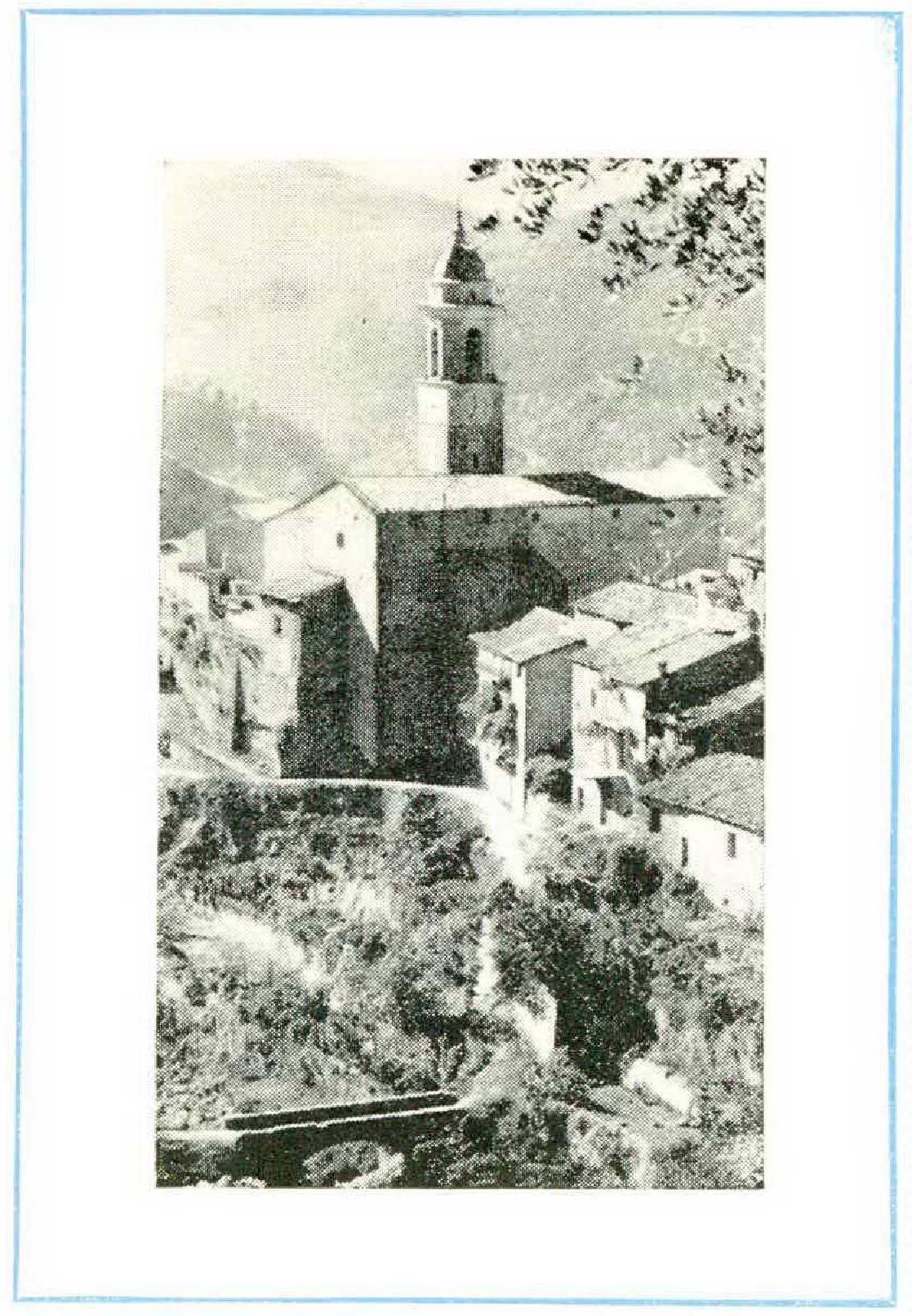
IT IS not always cold in the Basses-Alpes, but on that late September evening (was it as long as ten years ago?) when I rang his presbytery bell, it was very cold. The only answer to my call was the wind funneling down his flagged street, narrow as a bedspread and smelly as a bedpan. It was like aerial gunnery aimed over thirty miles of forests and ravines to strike the sea five miles out beyond the warm beaches of Nice, where I had toasted myself that morning in the Riviera sun. Was I to have to spend the night alone up here in Argons? And, if so, was there even a half-decent hotel in Argons? It would be dusk within an hour. I rang again and pressed against his studded door. It opened, and a woman passed hastily out into the narrow street. All I saw was a snapshot glimpse of a brightly made-up mouth in a dark face, a stocky figure, well dressed, a bit overblown in the Italian way that you so often see along this border. Afterward I wondered if she had been wearing a long black veil like a war widow. the old housekeeper glared at me with two sooty eyes from under a topknot like the ace of spades, accepted my card and my tiny letter of introduction, closed the door within an inch of its jamb, and backed into the house, and I forgot everything except what the Abbé de Saint Laurent had told me about him a few days before in his sunbathed little study in Nice.
“Argons?” he had said. “In that case I know the very man for you. You must call on my good confrere the Abbé Morfé. He will tell you everything you want to know about the traditional life of the Basses-Alpes.”
And straightway he sat to his desk and began to write on a small sheet of paper, murmuring over one sunlit shoulder as he wrote:
“He is not French, of course. Although you would never suspect it, he has been with us so long — for at least thirty years. He is an Irishman. One of several who volunteered for the French mission after the war when we were badly in need of priests. As we still are. You may talk to him freely. Not” — he smiled back at me around the corner of his glasses — “that you will need to. He will do the talking. How do you spell your name? Thank you. A very outspoken man. Sometimes, I think, a little too outspoken. But” — and here he turned right around to me — “zealous! Beyond my vocabulary. A downright man. And absolutely fearless.” He turned back to his desk to inscribe the tiny envelope. “The perfect priest for the mountains. Ireland, as you must know, was never Romanized. So you, as an Englishman” — he did not observe my sigh; I am always being mistaken for an Englishman — “will understand readily what I mean when I say that he represents the best, the very best, of l’église des barbares.”
He folded his small letter into its small envelope, handed it to me courteously, and wafted me upward toward nether Gaul.
As IF under another wild blast of wind, the door was flung open. I saw a powerful-looking countryman. His face was the color of raw bacon cured by the sun and the wind. In his left hand he held my card, in his right a fat claw hammer which he flung behind the door with such a clatter that for a second I was taken aback by the violence of the gesture; all the more so because he was shouting into the house, “Mais,je vous ai dis que je la connais pas!” He turned to me, warmly welcoming, and cried, “Come in, Sean! Come in!” and I was straightway back in the County Mayo: though in Ireland only a Protestant clergyman would have looked so indigent. His soutane was old and dusty, his boots were unlaced, he wore an old, fraying straw hat on the poll of his balding head, he was smoking a pipe mended with twine.
“I was making a coop for the hens!” he said.
“I’m interrupting you?”
“The most pleasant interruption in the world!” He laughed, and with one big hand on my shoulder he drew me in and invited me to stay not only for the night but for as long as I pleased; to which I cautiously replied that it could, alas, only be for one night. When we were in his living room — oh, the joy of that sizzling log fire! — he at once produced a full bottle of Tullamore Dew, which, I noticed, was not only dusty but had never been opened. He sank as slowly as an elephant into his leathercovered armchair and began to talk nonstop about Ireland.
Everything in the room was of the region, and it was all as darkly impersonal as a convent: the handwrought firedogs, the heavy furniture that had obviously been made on the spot a long time ago, the graying, pious prints, the brown tiles, the adzmarked beams under the ceiling that had once been white plaster and was now tea-colored from years of woodsmoke and nicotine. As my feet thawed my heart rose — all this was exactly the sort of thing I needed for my article. But for well over an hour he did not give me a chance to ask him any of the questions that had brought me to his door. He asked the questions, and rarely waited for my answers. I could see only three tokens of our common country: the until-now unopened bottle of Irish whiskey; the corner of the Sunday Independent, still in its folder, still bearing its green Irish stamp, edging out from under the papers of the Midi; and a small cushion embroidered with green and red leprechauns bulging from under his fat elbow. I could imagine it coming to him, with a “Merry Christmas,” from some distant Deirdre or Mary. At long last he let Ireland drop. Touching the Abbé’s note (a little frigidly?), he said:
“Well, so you are going to write about us? And what have you discovered so far, pray?”
“More or less what you’d expect.”
“And,” a little guardedly, “what would I expect?”
“What every traveler in a strange place expects, that the truth about every place is the sum of every body’s contradictions.”
“Such as?”
“Well, for example, everybody I meet east of the Var tells me that the old, traditional life now exists nowhere except west of the Var, and everybody west of the Var tells me that if I want to see the old ways, I must come up here into the mountains. What would you say to that?”
He sniffed, and at once struck the chord that dominated everything that was to follow.
“Do you know phwat it is?” he said in a buttermilk brogue, with a buttermilk smile, “I’m not sure that I’m fit to tawlk about this ould counthry at all, at all. ‘Tis a quare counthry. To tell you the honesht truth, Sean, I’m gettin’ a bit fed up with the Frinch. I have to live with them you know.”
Meaning that I was just a tourist? The jab and the brogue delighted and alerted me. A false brogue, as every Irishman knows, is a sure sign that the speaker is about to say something so edgy and true that he wants to blunt the hurt of it by presenting it as a kind of family joke. I said, adopting the same sword-in-the-scabbard technique:
“Shure and all, isn’t it a bit late in the day for you to be feeling that way now, Father? After all your thirty-odd years shepherding thim?”
He looked at me unamiably. A point apiece. We were playing that ancient Irish game known as conversational poker, a game which nobody can win and nobody can lose because nobody may utter the open truth, but everybody must give and take a few sharp smacks of it or the game is no good at all.
“Better late than never,” he said sourly. “As is the way with most of us? Eh?”
He began to talk slowly. Was he feeling his way into my mind or into his own? He casually refreshed my glass, but not his own. But as we progressed I thought I noticed a difference in his way of playing the Game — if we were playing the Game. After all, he was a priest, and a French priest, and a French priest of the mountains — a man for whom the stakes in every game are infinite.
“The Basses-Alpes? Mind you, Sean, the BasscsAlpes aren’t such a bad counthry at all. Not rich, of course. Anyway, not rich the way the coast is rich. But it has things the coast never had and never will have. There are people who like to bask on the Riviera, who like to have Nice sunny apartments and Nice sunny congregations. But, sure, the Riviera isn’t counthry at all! What is the Riviera but one blooming esplanade forty miles long? A string of international resorts without a stem of local character. Without any character! Without any values except cold, commercial cash values. But we aren’t poor either. The land down there — you’ve seen it — is all ravined and gorged. Hard, stony uplands. With their olive groves abandoned, and their villages crumbling or turned into tourist traps, and their farmhouses for sale to foreigners. And all the young people going or gone. Gone! Lured away down to the bright lights along the coast. All of them wanting to be croupiers, or traffic cops in white helmets, or factory workers in white overalls. When I think of places like St. Paul! A sink of iniquity I call it. For all I know it may be a place that you like to visit. And for good reasons: comfortable hotels, good food. But fifty years ago that was a decent little country hill-village. What is it today? Packed to the last corner with what, with whom? The haut monde! Paahrisians! Bikinis and beach pajamas! Do you know who the organist in that little church is today? A Protestant! And glad to have him. And now don’t start talking to me about arty-arty chapels like that one by Matisse up in Vence. A chapel? It’s a bathroom designed by a freethinker.”
“Was Matisse a freethinker?”
“You can have him! Listen! There’s one thing on earth that I can’t stand, and that’s milk-andwater Catholics.”
His eyes glinted. If this was, by any chance, a jab at me, maybe we were still playing the Game.
“Up here it is different. Up here the forests mean — well, you might call it comparative wealth for some and a good living for all. So our people have stayed on. The bright lights are farther away.” His voice slowed. “Yes, our people have stayed on.”
“And” — I leaned forward eagerly — “kept the old life ways?”
He knocked his pipe out with slow, careful taps on the head of a firedog.
“I’ll explain to you what I mean by milk-andwater religion. I know of instances of women in these parts deliberately going off and having affairs — and I mean respectable, married women with families — for no reason but because it is the modern fashion. Women born and reared in these parts, copying — that’s all it is — the ways of places they think better than their own. To be as good as the best. To be in the fashion. I find that utterly contemptible.”
He was so passionate about it that I demurred, though cautiously, since he felt so strongly about it.
“Surely,” I proposed gently, “one must go by cases? I mean a woman might be terribly unhappy. Her husband might be a boor or a bore or even a drunk. She might have met with some man whom she wished she had married, some man she thought she loved — ”
“That has nothing whatever to do with it! I could understand it if there was a bit of real passion in it. I could make allowances. I could even forgive it. It is my job to forgive. But they do it for the most vulgar of all reasons: just to be up to the minute. They do it simply to have something to boast about at the tea table.”
“And the men?”
“The same! People like that have no religion, no character. They have nothing. That’s what I mean by milk-and-water religion.”
“And for this you blame the gentry?”
“I never mentioned the gentry.”
“You said they want to be as good as the best. To be in the fashion. Which best? Whose fashion? The nobs’?”
“You never get this sort of thing among the gentry, certainly not among the real noblesse. Oh, of course, you will find sinners among them, as you will everywhere. The flesh is the flesh, high or low. But this thing doesn’t come from the flesh. It isn’t even honest sensuality. It comes from the corruption of the mind. It comes from meanness of the mind. It’s plain, vulgar, bloody tomfoolery. It is indifference. It is spiritual death. It is apostasy.”
HE SLAPPED the side of his armchair. An uncomfortable silence fell on us. Was he always as irascible as this?
“Maybe I’m in a pessimistic mood,” he grumbled. “Gimme your glass. I’m a bad host. Maybe what I need is a week after the grouse in County Mayo.”
“Aye,” I said, more than willing to return to the Game. “They say there’s nothing like a good grouse for a bad theologian.”
“Why is it bad theology, pray?”
“Well, after all, ‘the greatest of these is charity.’ ”
“Oho! There is always charity.”
(He sounded as if he were a bit sick of Charity.)
“This couldn’t be a long backwash from the French Revolution? I notice your little street here is called the Rue Carnot.”
“There is also,” he parried back, “a Rue Saint Roch. That’s San Rocco. The good Italian influence. The bond with Rome.”
“Yes,” I said dryly. “I noticed that Italian influence. In the Place Garibaldi.”
He snarled it: “That crew!”
We both laughed. Just then that old Ace of Spades came in to say in her sullen voice: “Dinner is served, Father. And that lady telephoned to say the funeral will be tomorrow at nine o’clock.”
He looked hard at her.
“Anastasia, do you know this Madame Bailly?”
“She has been living in Alberon this five years.”
“Funny that I can’t remember her. I’ll just ring Father Benoit.” He turned to me. “He is one of my curates. We have a big parish. We divide it among the three of us.”
I had driven up through Alberon: one of those small places with a couple of sawmills, and with more garages than hotels, which means that everything goes stone-dead after October when the big passes get clogged with snow.
“Let’s eat!”
We went into his dining room. As he flung out his serviette and began to pour the wine, he said: “The poor woman’s husband was killed this afternoon in an accident. A tree fell right across his back. He owned a hotel, a garage, and a sawmill in Alberon. She came about the funeral.” He paused in the act of Filling his own glass, “Bailly? I know a couple of Baillys around Grasse. And,” he growled, “nothing good about any of them.”
“Liberals?” I teased.
“Puh! You mentioned Garibaldi. And Carnot. It would be a very interesting study for you to find out at what date these names came in — and at what date a lot of other things began to come in. I don’t want you to misunderstand me about the gentry. When all is said and done they are still the best people in France. They’re on the way out, of course. They have no political gumption. And no money. And no influence. Your liberals, as you choose to call them, are pushing them over the last edge of the ravines. What’s left of them!” He sipped his wine and frowned. “Bailly? Somehow or other that name keeps ringing a bell somewhere in what’s left of my poor old head.”
“Haven’t you the Liber Animarum?” I asked, meaning the thick black notebook I had been shown once in an Irish presbytery by an old priest who had been a dear friend of mine. These stubby books have a page to every parishioner: name, business, address, married or single, whether he practices his religion or not, and sometimes, though rarely, an intimate comment if the priest considers it necessary to probe more deeply. He snorted.
“Ha! Liber Animarum, how are you? ‘Tis easy seen that you come from Holy Ireland. Themselves and their card indexes. What I call IBM Catholicism. It’s as much as my two curates and myself can do to get around to visiting our parishioners once every two years. If that! And sometimes none too welcome! Have you any idea at all of the size of our parishes? If it wasn’t for our housekeepers — ” He stopped dead. He sighed. “I must be getting old. I’m losing my grip.”
He rang the little brass bell on the table and waited for her to appear at the door.
“ Tell me,” he said. “Do you really know this Madame Badly?”
“Everybody in Alberon knows her.”
“Yes, yes, you told me she is from Alberon.”
“I said she lives in Alberon.”
He pushed his chair back and faced her.
“Anastasia! What are you trying to say exactly? Where did she come from?”
“Cannes.”
“And Badly married her and brought her to Alberon five years ago?”
“M. Bailly’s wife and four children are living in Grasse with his mother.”
There was a long silence. He said, “Badly sent them away?”
Her sooty eyes stared at him. Her shoulders barely moved. He thanked her and nodded her out. He pushed his dinner away, and his face was pale about his tightly clenched lips, the only part of that ruddy face that could grow pale.
“Five years! What sort of a priest am I? What sort of a parish do I run? Under my very nose! And now this person has the insolence to come here and ask me to give him a Christian burial! I’ll soon put a stop to that!”
“My God! You can’t refuse to bury the man? You can’t let him be put into a hole in the ground like an animal?”
“And do you think that after leading this kind of life, giving public scandal for five years, openly and brazenly, that I am going to give him public burial now as a good Catholic? What would my parishioners say? Do you think that it’s for this I came here thirty-three years ago, to bless scandalmongers like those two apostates?”
“Isn’t that a Hit extreme? Sinners, yes. Call them that if you like. But in mere charity — ”
“Charity! Everybody always talks to me about charity! What is charity?”
“Love, I suppose. I suppose those two unfortunate people loved one another.”
“And his wife? And his four children? Did he love them?”
“But he may, even at the last minute, have hoped for forgiveness. If you had been there when that tree fell on him, would you not have given him Extreme Unction? Anointed his eyes and hands and mouth, and prayed for his forgiveness?”
Outside, a wild rush of wind rattled leaves against the pane like a million clamoring fingers.
“Well, I was not there,” he said heavily. “He died as he lived, struck down by the hand of God. I’m going to phone Father Benoit.”
Alone in the room I tried to visualize that stocky Italianate woman I had seen hurrying away from his door. I tried to see her and her dead lover in their hotel in Alberon, and I realized that this was one life story that I would never know. All I could imagine was a hundred spade-heads like old Anastasia in that little hill town besieging her with their silence and their bitter eyes. He came back and slumped into his chair.
“He is out.”
I sat opposite him, and I thought, And here is another life story that I will never know! After a few moments he said quietly:
“Charity, Sean, is a virtue. It is, as you say, love: the love of all things through God, the love of God in all things. As for your love, human love? It is that, too. As Saint Bonaventure said, it is the life that couples the lover to the beloved. Vita copulans amantem cum amato. But it is that in the name of God, for God and by God. One act of love in a lifetime is an immensity. But one mortal sin can of itself destroy all love, and all life, as that man destroyed two lives over and over again before the eyes of the world.” He stopped and got up again. “This thing must be ended publicly. As it was begun publicly. I must go there at once.”
“Tonight?”
We both looked at the black window. The mistral was at its full force. A wild sheaf of leaves whistled horizontally past the glass.
“Let me drive you,” I offered miserably.
“I’d be glad if you did. I’m in no fit state to drive.”
We buttoned ourselves up in our overcoats, pulled on our berets, and crushed into my little Fiat 600. He directed me on the long, winding road where the woods on each side waved in one solid mass like the sea. I was too busy watching the road to talk. All the way he never spoke except to say “Fork left,” or “Right here.” I felt like a man driving an executioner to the place of execution, and I did not know which of the two of us I disliked the more at that moment. When we entered Alberon, the streets were empty and dark. Two cafés were lighted, their windows opaque with condensed moisture. He suddenly said, revealing that he had been thinking in that language:
“C’est dans la Place. Il s’appelle le Chamois.”
It was a three-story house with the usual Alpine roof, pitched to a peak and smoothing out at the base to let the weight of snow slide down and melt on the gutters. On the ground floor there was a café, all dark and buttoned up. Two windows on the story above it were lighted. When he got out and was ringing at the door, I withdrew to the center of the little Place to park and wait. It took a couple of rings to produce an answer. When the door opened, I saw, against the light inside, the dark outline of the woman who called herself Madame Bailly. He stepped inside at once, and I was alone with the mistral, the darkness, and the empty Place.
The perfect priest for the mountains. Getting a bit fed up with the Frinch. Nice people and Nice apartments. Absolutely fearless. Downright. A finger on a switch lit up two more windows upstairs. Vita copulans amantem cum amato. Would he be laid out in there on his bed — of love? Zealous beyond my vocabulary. The mistral blew around and around me in moaning circles. Two men, an older and a younger, came, heads down, into the square from the left. I saw them pause at the closedup Café le Chamois, look at its dark window, and make some gestures that could only mean, “Ah, yes! I heard that —” Then one of them stretched one arm forward and they went on again, heads down, to, I presumed, one of the other two cafés. After another long wait the two extra windows went dark. Still he did not come out. One mortal act of love in a lifetime is an immensity. One mortal sin can destroy the whole of that love and of that life forever. Damn it, why doesn’t he finish her off quickly?
At last a flood of light beamed out on the pavement as the door opened, and I saw his great bulky outline. He was shaking hands with the woman in black, but as I peered forward I saw that it was not the same woman. He bowed to her and looked around for me. I drove over to meet him. She slowly closed the door; he clambered in and silently waved me onward.
I could not see his face in the darkness, but by the dashboard light I saw his hand lying loosely on his thigh, shaking like a man with the palsy.
“Madame Bailly?” I said.
“She came down from Grasse. With her four children. For the funeral.”
“There will be a funeral?”
“Could I refuse his wife?”
“And the other?”
He spoke so softly I could barely hear him.
“The two of them are there together. Comforting one another.”
No more was said until we were back in his dark presbytery. There, still in his beret and his long overcoat, he turned on me a face twisted by agony and cried:
“Did I do right?”
“You did the human thing, Father.”
“Ah! The human thing?” He shook his head, uncomforted. He leaned with one big hand on the high mantelshelf and looked into the gray ash of the fireplace. I looked at it too. It crept around under the wind like a lot of little insects.
“I could never have believed,” he whispered, “that so much love existed in the world.”