Big Browns in the Crystal
The founder and headmaster of the Colorado Rocky Mountain School in Carbondale, John Holden has enjoyed as a fringe benefit some of the finest dry-fly fishing to be found in the Southwest.
by JOHN S. HOLDEN
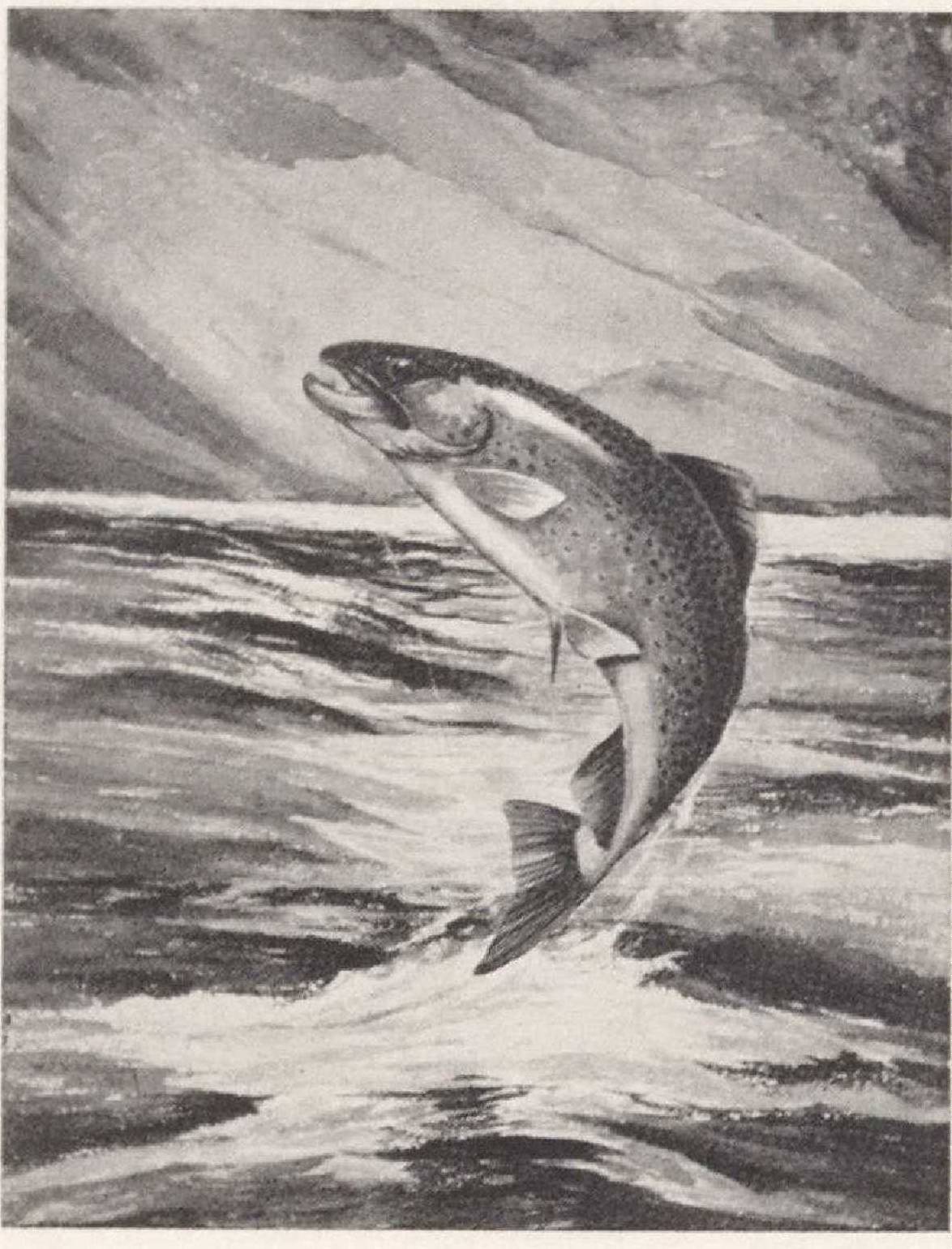
ANNE and I came out to Colorado eleven years ago to establish a coeducational college preparatory boarding school somewhat like the school in Vermont where we had taught for seventeen years. We were fortunate in finding a ranch at the junction of the Crystal and Roaring Fork rivers. At first we rented, but now the school owns about half a mile along the Roaring Fork and a mile and a half along the Crystal. In the early, trying years I used to have to get away from the strain oner in a while, particularly in the summer when the financial crises seemed to descend on me. At first I knew nothing about river fishing. The conversion from wet-fly dropper to dry-fly caster was long, slow, and hard on my pride. But the wonderful thing about fishing is that it is completely absorbing whether the fish are taking your Hies or ignoring them.
My problems vanished while I was on the river; I never did get an ulcer, even when a real estate agent’s sign went up at the edge of the most important property, the piece which we had to buy in order to make a go of the school. I won’t say I thought out solutions to the school’s problems on the river. However, walking home at dusk or back into the office refreshed, I did find solutions. The senses are sharpened, too, so that besides the fish, one notices the birds, the insects, the trees and flowers along the bank, the wind, light or strong, the clouds, the smells, the sounds, and the feel of rocks underfoot.
The Roaring Fork Valley at Carbondale is 6000 feet above sea level. The rivers are filled with snow water from the Elk Mountains, a string of 14,000-footers that include the Maroon Bells, Pyramid, Snowmass, Capitol, Daly, Massive, Elbert, and Castle. These are all hidden from view in the valley because of Mount Sopris, which rises a sheer 6800 feet right out of the valley floor. I’ve seen only one other place where the vertical rise from the immediate valley to the top is greater. That, of course, is Mount Shasta, where the road is 3500 feet and the top is 14,000 feet. We don’t pretend to have the best fishing on our rivers. Paved roads run along beside most of them. There is very little posted water. The fish are well educated by swarms of fishermen,
One July day, when the Crystal River was still high but almost clear and beginning to go down, I left school carrying my clumsy waders, my net, creel, and rod, my vest bulging with flies, dope, leader material, and gadgets all very functional.
I always start below the spot where I expect the big fish to be. In this way I get warmed up before the critical casts arc necessary. This day I started in a relatively unproductive stretch, stripped out some line, and cast into some fairly swift current. Bang, and it was just luck, not my reaction, that set the size fourteen hook. The fish seemed very heavy and the river mighty swift for that light leader. I held my breath as the fish twisted the line around a stick. Usually this maneuver means good-bye. But again I was lucky. I reached the stick and untangled the line before the fish could exert much force on it. I was careful, so careful that I did manage to land a seventeen-inch German brown. In the next forty-five minutes I had two more browns and a rainbow of almost the same size in my creel.
My equipment consists of an 1890 vintage Orvis rod, originally eight feet long but now a few inches shorter. It has been rewrapped by a local craftsman. The reel is a Pcrrine automatic with backing and HDH line. I usually start with a tapered gut leader, tying on nylon tippets when it gets too short. Theoretically at least, the gut leader sinks and helps to puli the nylon down; I wish it would work as well as it is supposed to. The more flexible nylon lets the fly follow the slightest move of the current without drag, but it is really hard to keep the leader below the surface of the water when the fly is floating. There are preparations on the market for this that work fairly well. One friend uses lava soap, another uses the slime on the side of the first fish he catches, but if I can’t sink my leader, I sometimes can’t catch any fish. After we moved into our new home with its modern dishwasher, I found a preparation that seems to be the best yet. It is called Dishdry —a silicone that removes the surface tension so that no drops will remain on glasses and china in the drying process, I keep one pocket flap saturated with the stuff and draw my leader through it when I want the leader to sink. When it dries, I add water. One application smeared on the pocket flap will last all day in that way. I carry in my pocket spools of Claddings 1X, 3X, and 5X limp monofilament. My favorite flies for this water are Ginger Quill, Betty McNull, Red Variant, Pink Lady, and the Wulff tied Royal Coachman. I seldom use anything larger than a size twelve or smaller than a size sixteen hook.
The brush that grows along the bank makes it necessary for me to wade for most of my fishing, I have learned to move cautiously for two reasons: first, the worthwhile fish take warning from the slightest hint of danger, and I don’t want to give them that hint; second, I want to live for another day. Too many wader wearers who were good swimmers have drowned in big rivers because they misjudged the current. When I first started fishing the Crystal, I discovered very quickly how slippery the rocks were. Later I found that for me the surest footing comes from a felt sole. Waders are better for me than boots because I always forget that water can pour in over the top.
Three years ago the state of Colorado started to allow year-round fishing in practically all waters. The Fish and Game Commission is of the opinion that this system is best because it avoids the extraordinary strain of opening day and distributes the fishing load more evenlv throughout the year. Employees ot the hatcheries can stock streams all year long without having to do the largest part of their work at one time, and spawning follows no fixed time schedule when three species populate the streams. Since last season was the best we had bad in years, this system seems like a move in the right direction.
I like to begin my fishing after high water has passed. This can be any time between early June and the first of August depending on the snow pack above timberline. The water is murky when it is that high and extremely dangerous for one who wades. I am always much too busy at graduation time, but after the students and their parents have departed and the tempo slows down, I await the coming of that day when there seems to be a kind of intoxication about the eagerness of the trout to devour the flies on and often above the surface. This period ends with the full moon. After that the fish are there; the water is low and crystal clear. The fisherman has to become an angler, an artist, in order to coax them to bite. During low water I come to know where each big fish makes his home. They usually come up to look me over once but scorn my offering. If one doesn’t rise at least to say hello, I can be pretty sure that some wiser fisherman than I has had him for supper. One thing I know, though: hardware stingers don’t get many trout in that kind of water.
JOHN WILSON, our neighbor across the river from the school, keeps asking me why f use such light leaders and tiny flies when I’m fishing for the biggest fish in the river. I never answer him directly because I hate to admit that I have a wild dream that the light tackle will attract some monster that no other rig could get and that I will miraculously have the skill to land him without breaking the flimsy thread that looled him. However, every time I lose a fly in a fish I get a little wiser about what gauge leader to use,
John fishes wet with an eight-pound test leader and Lakes more and better trout than I do. He’s been at it longer. One day, though, he lost his line and broke his rod on something that must have been a lot bigger than eight pounds. It was at dusk, in the hole just above the school property where the old bridge abutment is. When the fish struck, John said it felt like an atomic sub heading lot the Pacific. Nobody has caught anything bigger than six pounds in our river for quite a while, so maybe it’s still there.
One day John and I met on either side of the river, just like Robert Frost and his neighbor across the wall. It was late June, and there was a tremendous body of lively water between us. He was fishing wet flies working downstream, and I was fishing dry working up. Something took his offering first; he whistled to me to look. I did till something struck my fly. There we were, proud and nervous at the same time, both fighting leviathans. In that kind of water, fish have the advantage. Their own strength plus the unbelievable force of the water is enough to beat any fisherman and any combination of tackle. Nevertheless, they seem to turn and work upstream at just the time the backing is about to run out. We were both so busy that we had only one or two chances to exchange glances. He beached his fish, I netted mine, and then we held up our catches for mutual admiration. His was more than twenty inches long, mine a little smaller.
It was beginning to get dark. He was immediately onto another. So was I. One fish knew enough to keep going downstream. John had a real light on his hands. He went after it as fast as he could go over the boulders, splashing, staggering, and cautious not to get drawn into the real current. My fish delighted me by choosing to go upstream. It wasn’t long, though, before mine, too, decided to go down with the flood. I couldn’t go with it because of the overhanging alders on my side. I knew what would happen before the backing hit the knot. The slack line came back very easily. In the meantime John’s fish had turned upstream. As I watched, John was beaching him, but the hook broke as the fish was half in and half out of the water. John dove and literally tackled the fish. He came up dripping onto both knees and one hand, like his primordial ancestors. By the gills he was holding twenty-six inches of brown trout. It is amazing what a trout can do to the dignity of a man.
John Wilson, who is a sedate real estate agent by day, is the perfect neighbor to have across the river. We have never interfered with each other’s fishing. When the water is low, it might be a problem. He never comes near the pool where I’m working the water, and I always give him a wide berth. But off the river we like to compare notes, and I try to get him talking about his boyhood in the valley. He remembers the old mining camps after they’d been abandoned when there were still new shovels, kegs of unopened nails, cupboards full of canned food. When the bottom dropped out of the silver market, people never even bothered to go back up the mountains to pack their belongings.
He remembers, too, when the Crystal River was crystal twelve months of the year. Today, every thunderstorm turns the river brown, black, yellow, or red depending on which stream, which tributary caught the worst of the storm. Today, the spring runoff has the stream riled up for from two to eight weeks. There arc a few streams that seem to run clear no matter how much rain there has been, but these are the streams where no sheep grazing has been allowed by the National Forest supervisor. Sheep by the thousands arc still allowed on the meadows above timberline in many National Forest areas. Though the policy has been to cut back the grazing permits gradually, these sharp-hooved creatures do cat the high grasses down very short every summer.
Sheep aren’t the only reason for our muddy streams, though. Every spring I lead an expedition up to the twelve-thousand-foot level of Mount Sopris to enjoy the magnificent skiing. Every year at snow line we notice a strange phenomenon. The ground looks as though it had been plowed. Everywhere rodents have dug tunnels just below the surface and have cut roots while leaving the raw dirt on top. We’ve done such a good job of killing off predators that we now have an overabundance of mice, shrews, moles, gophers, ground squirrels, and marmots. They’re all nice little creatures to have around, but they really cut up the ground.
California has just repealed the law that gave hunters bounty for killing mountain lions. Now Colorado is one of the last states to have such a bounty, and people tell me that all the big cats killed in Utah and Wyoming are brought down to Colorado for the fifty-dollar bounty. Cattlemen today are realizing that these creatures were really their friends. These lions are essentially cowardly, always attacking die weakest animals, the sickly ones that might be spreading disease among the others. They control the rodents and keep the deer herds small, healthier, and much less of a nuisance. Bobcats and coyotes are a help in this way, too. My selfish motive is that I’d like to have clear streams again, but I’d certainly like to see those bounties taken off.
Every year now we get tremendous mud slides all the way to the bottom of the valley. Twice I’ve been caught between two of them. Natives know that in 1940 a mud slide wiped out half of the town of Marble and closed the marble quarry. Of course we know that the mountains are always “taking from the top to broaden the base,” but we don’t need to speed up this process to the extent that we have thus far done in the twentieth century.
John tends to blame the muddy water mostly on the sheep. I guess I do too. Cattle, deer, and elk have larger hooves and don’t eat as close to the ground. We both notice that the Crystal runs muddy much more often than the Roaring Fork or the Frying Pan and that more sheep go up it for grazing.
The hardest fishing is in the three more or less still pools above the school in low water. I get the feeling that the trout here have superior intellects. Sometimes I observe a pool from a distance and see not a ripple on the surface. But as I approach, there are rises everywhere. Each rise stops as soon as my casts reach that part of the pool, and the best I have to offer is ignored completely. I am inclined to believe that they started rising just to have a look at this strange fisherman who thinks he’s going to tempt them with an artificial fly.
Occasionally I set out to fish with relatively heavy tackle, approach the first pool carefully from below, observe a number of rises, work slowly up to the head meeting only refusals. Before working the next pool I switch to a 5X leader. Then I fish it even more carefully, see no rises at all, and suddenly leviathan strikes. If the leader survives the setting of the hook, it never lasts more than a minute after that, and I go home with the satisfaction of knowing that there is something worthwhile waiting for me the next time I try the river.
Then there are days of brilliant sunshine when nothing I do will sink the leader. Thin as it is, it sits on top of the water casting a shadow that looks like a naval hawser, and even those freshly stocked trout won’t bite. I use my special surfacc-tensioncutting formula, and still it won’t sink. This is the day I knock off the barb on a rock on a back cast, and I’m ready to give it all up when I notice the grandfather of them all in the water above me. in spite of my nervousness, I manage to drop the fly just ahead of him and watch him twitch but not rise as it drifts by. After perhaps six more casts and no more luck I switch to a homemade brown hackle and try again. This time he rises and takes a live fly not two inches from mine. I’m ready to give up but cast again just for spite. This time he strikes my fly, sets the hook himself, and heads for midstream. I know the tricks of these browns. He can’t saw off the leader on a sharp rock and get away with it with me. He can’t get the leader snagged under a big boulder in the middle of the stream. He runs madly for a while and then takes refuge in the eddy of a large black volcanic rock, nuzzling in the weeds to see if he can find a snag. Gently I ease him out of there only to face a worse crisis as he bolts downstream faster than I can follow. Then, for no apparent reason he starts working back toward me. By this time I am shaking all over from sheer exhaustion, so I rest a bit, hold him in some relatively swift water, and hope that it is wearing him out. Again, gradually and slowly I move toward him, and there he is, with the big, characteristic spots of the brown trout shining on his sides, so close that I can sec the white borders as well as the red-orange centers. As best I can judge, I have spent more than half an hour working this brute up and down the river. By all the rules of Isaak Walton he must be completely worn out. So out comes the net and away goes the fish in the strongest, most vicious burst I have ever seen. Away, too, goes my dream of walking into the kitchen with this prize, far too big for my creel.
Every year I have one or two experiences like that, and every year I get a little more eannv and a little more familiar with the tricks of the big trout in the Crystal River. One summer I had an equally large trout on my line for just as long a time, again on a size fourteen hook. This one simply loosened up the hook with all his playing, and just before I was ready to net him. rolled quietly over, and the hook slid out of his jaw.
Sometimes I wonder if I can ever train myself to be ready for the completely unexpected. The really big ones often come from nowhere, and the surprise causes an involuntary reaction that spoils my chances. Buck fever. No matter how hard I try, I can’t outguess them.
The smallest of our pools is the most amazing. No matter how many people fish it, there are still fish there, big fish. One summer, late in August, I learned the reason why. All along the east bank, under the alders and cottonwoods, are beaver holes, and I suspect that this is a network of tunnels. They aren’t visible until the water is very low. I realize now that in the open water, just in front of the largest of these openings, is the spot where I consistently see rises and often take fish. It is a difficult cast, a threc-foot-wide opening between overhanging alders. No one who walks the cast bank of this pool catches anything. A footfall over their hidden haven is a telegraphed warning.
Sometimes when I am fishing this pool at dusk I hear a loud splash and know that Mr. Beaver has decided to have a little fun with me. I think that these interesting creatures have a sense of humor. I know that they purposely call attention to themselves on many occasions. And I know too that they sometimes ostracize a fellow beaver. We saw this happen once in a sand dune in the Great Sand Dunes National Monument. The park naturalist there told us that this ostracizing is fairly common and accounts for the fact that there are both colonies and single dwellings. One day I was hip-deep working my small pool when a beaver swam by within two feet of my boots. He wasn’t a bit concerned. Local bait fishermen tell me that you’re in luck when a beaver swims by because his swimming stirs up the bottom, and trout always follow to pick up what they can in the wake.