Pope Paul Vi
Sanche de Gramont is a free-lance writer who lives in Rome and has followed closely the inner and outer workings of the historic Second Vatican Council, now convening for its last session. Sifted from his observations is this sharply drawn portrait of Rope Paul VI, whose complex personality has made his role in the ecumenical movement largely misunderstood.
BY SANCHE DE GRAMONT
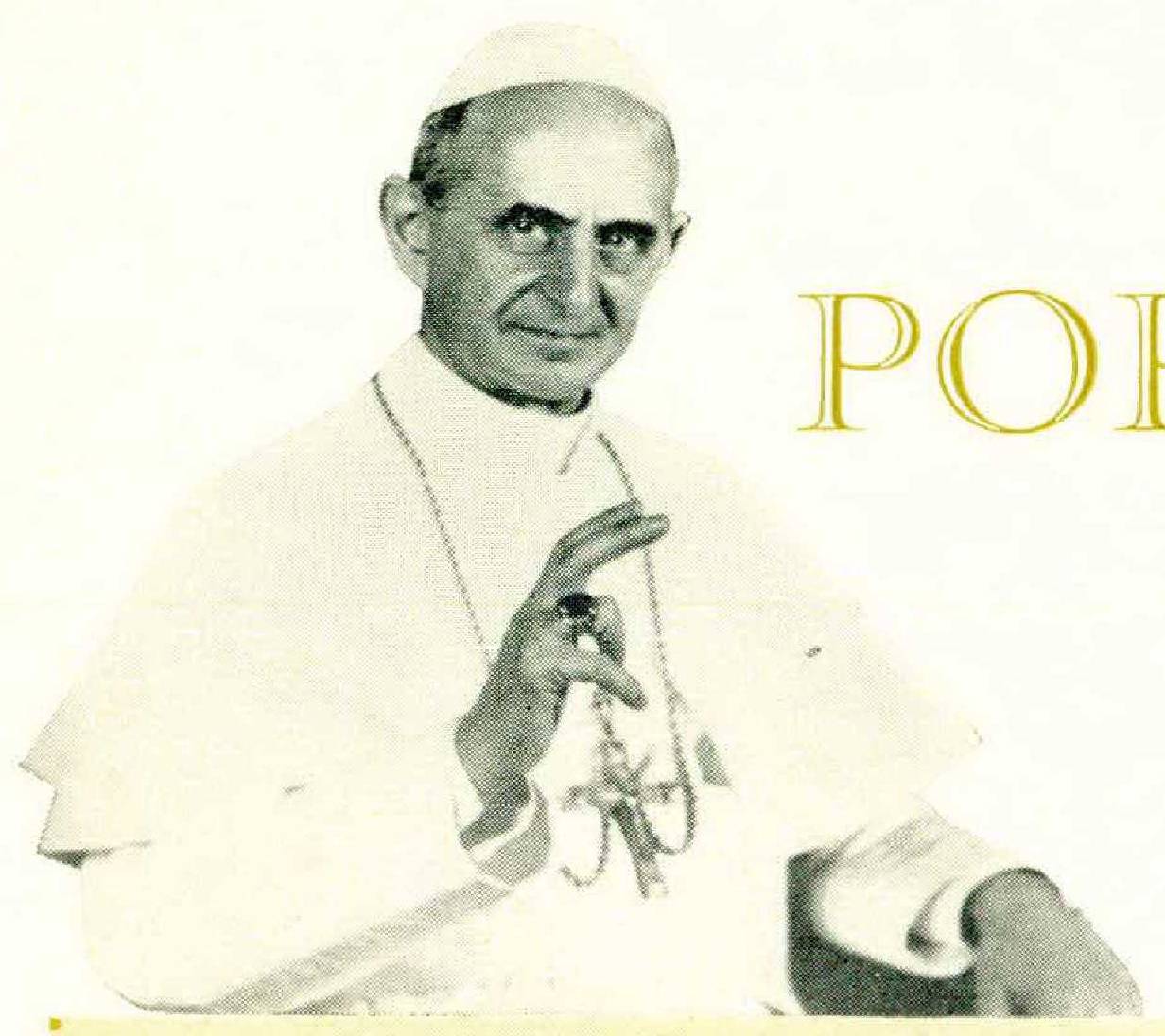
THE memory of “good Pope John” is still strong. In the twenty-seven months since succeeding him, Paul VI has as yet been unable to establish the kind of rapport with the world that made of his bulky predecessor a nondenominational father figure. When compared with John XXIII, Paul seems stilted and rather bloodless, with his spare five-foot-ten-inch frame, clifflike forehead, beakish nose, and slight but determined chin. In most photographs, his gaze is severe and somewhat reproving, while John’s sense of humor made him immune to solemnity.
The press has labeled Paul a Hamlet, inscrutable, equivocal, and hesitant. The Italian priesteditor of a respected ecclesiastical publication has privately criticized him as a weak and ineffectual Pope, a throwback to the Counter Reformation rather than the leader of the most far-reaching renewal in Church history, the Second Vatican Council. “The Pope,” according to this editor, “abhors dialogue. Talking to him is a curious experience. He listens attentively until something you say strikes a response. Then he withdraws into himself, his voice gets deeper, his eyes focus beyond you, and you realize he is no longer with you. Distaste for the give and take of conversation makes it difficult for the Pope to say no when he is asked for something directly. He often supports the viewpoint of the last person he has seen. . . . He is easily swayed by specialists. When a professor of theology like Cardinal Browne [the Irish Dominican] tells the Pope ‘Your Holiness, in all conscience I cannot accept collegiality as in harmony with the doctrine of the church’ the Pope is impressed. When a distinguished canon lawyer like Cardinal Roberti says that a point of order is contrary to Council procedure, the Pope listens.”
Even his friends and close collaborators are puzzled by the complexity of his mind and personality. Cardinal Augustin Bea, the subtle German Jesuit who heads the Secretariat for the Promotion of Christian Unity, has written that the Pope’s “slim and rather austere figure, the vigor which shines in his face, tense in recollection or in reaching for the goals which his will proposes, even the rather dark complexion of his face, do not tend to popular appeal. . . . Again, his long sojourn in the Secretariat of State, whose extremely delicate work demands great prudence and circumspection, too easily leads many to suspect that this or that word, this or that gesture or attitude, is studied and calculated rather than the spontaneous expression of his mind. . . .”
Like any other chief of state, a Pope is known by his words, and in reading over Paul VI’s major allocutions, one is easily reminded of Andre Gide’s confession that he could never win an argument because he was always too clearly aware of the merits of the other person’s position.
The classic example of Paul’s oratory is considered to be his speech to the Curia shortly before the second session of the Council opened in the fall of 1963. He began by showering praise on the Vatican bureaucracy, fondly recalling his own thirty years in its ranks, the friendships he had formed, the importance of its offices, and its long, devoted, and selfless service. He then went on to a systematic denunciation of the Curia, pointing out that it needed a larger vision and better ecumenical preparation. He concluded with a veiled warning that the Curia’s powers would be curbed. This dialectical style is less easy to grasp than the forthright homilies of his recent predecessors.
Another key to the Pauline style is his insistence on the dignities of his office. He often sounds like a man who has to keep repeating who he is because he is not quite sure everyone will believe him. At an audience on February 6, 1964, he told the assembled faithful, “This, dearest sons, is what an audience with the Pope should leave in your souls: the impression, indeed the stupor and the joy, of a meeting with the Vicar of Christ.” Paul includes several such self-defining phrases in nearly every large audience.
To understand this insistence, one must go back to Cardinal Montini’s funeral Mass sermon in Milan’s Duomo four days after the death of John XXIII in June of 1963. The sermon was a pledge to continue the Ecumenical Council and the rest of John’s work — in other words, a statement of availability as John’s successor. “Pope John,” said Montini, “has shown us some paths which it would be wise to follow. . . . Can we ever turn away from paths so masterfully traced? It seems to me we cannot.”
As long as the Council lasts, Paul’s pontificate will be overshadowed by what might be called his “pre-election campaign pledge” to continue the work of Pope John. But while he encourages reforms as John did, he worries lest they diminish the papacy. He has to reconcile the spirit of change that has swept the Church with the protection of the office he has inherited. His greatest fear is that history will record that the papacy began to crumble during his pontificate and with it the structure of the Church as it has been known for two thousand years.
The self-appointed mission to safeguard papal supremacy has resulted in Paul’s rather mild interest in the ecumenical movement. He has chosen to emphasize a rigid definition of the papacy which is totally unacceptable to Protestants and Eastern Orthodox. He personally sees little hope at present for Christian unity, for he told the editor of an English-language Catholic publication in December, 1964, that he did not think ecumenism could go beyond “friendship and a spirit of openness.”
Again, to protect his authority, Paul absolutely refuses to side with Council factions even when their cause seems just. It is this that has brought him the most disfavor of all. At the close of the last session he was accused of standing idly by as a small core of conservatives mousetrapped the progressive majority and delayed the voting on the religious-liberty declaration, which recognizes every man’s right to choose his religion according to his conscience.
Since the conservatives cannot muster the voting strength to win on the Council floor, they are forced to work behind the scenes. They tried to stop the religious-liberty declaration, claiming that it is contrary to the teachings of the Popes. When none of their stratagems worked, they caught the majority on a point of order as the document was coming up for a vote. About one hundred conservatives signed a petition asking for more time to study the declaration. The ten-man Council presidency granted the delay. The stunned majority appealed to the Pope with a petition signed by eight hundred Council fathers. Paul gently but firmly turned them down.
The Pope refused to take sides in what was clearly a struggle between conciliar power groups, and the disappointed majority left Rome thinking that he had closed ranks with the conservatives. But there are no real grounds for believing this. Tactically, Paul is convinced that the only way to lead the Council without loss of personal authority is to stay above the fray. Philosophically, he is far removed from the conservative mentality, which is governed by excessive caution, suspicion of outsiders, inability to adapt to change, and a polemical spirit that invariably gives way to invective.
IF POPE PAUL is not burdened by this narrow and defensive brand of Catholicism, it may be because he did not follow the usual pattern of Italian youths to the priesthood. At the turn of the century, when Giovanni Battista Montini grew up in the Lombard town of Concesio, it was common for Italian mothers to decide when their sons reached the age of ten that they had the divine call — they were sent to a “piccolo seminario” and given cassocks to wear over their short pants. Montini’s first inclination, however, was to become a crusading Catholic journalist like his father, Giorgio, editor of Il Cittadino di Brescia. He founded his school paper and edited it until he was forced to drop out of school at the age of sixteen because of coughing attacks. He was tutored at home by a Jesuit for two years, and in 1916 he was turned down by the draft. It was then that he entered a seminary. Again, poor health made him follow the classes at home. As a result, he first wore a cassock only a few months before his ordination in Brescia Cathedral in 1920. By Italian standards, his was a late vocation.
At various times in his career, Montini showed the kind of enthusiasm and openness to new ideas which is totally foreign to the conservative mentality. His qualities of quiet efficiency and singleminded devotion to his work made him rise fast in the Curia, and after World War II he became one of two Substitute Secretaries of State for Pius XII, who served as his own Secretary of State. One of the reasons he fell from Pius’ favor was his sympathy with the French worker-priest movement. He defended it even after it had earned the disapproval of the Holy Office, when a small number of worker-priests had fallen away or been arrested in Communist-inspired street riots. His admiration for the work of progressive French theologians like Father Yves Congar and Henri de Lubac made him somewhat of a liberal in the eves of other Curia men. When he translated the works of the French Catholic thinker Jacques Maritain, he was accused by conservatives of bringing il Maritanismo to Italy.
Again, when he was named Archbishop of Milan in 1955, he showed that he was eager to use new ideas. The archdiocese sprawls over five provinces, and its nine-hundred-odd parishes administer to the spiritual needs of nearly four million souls. During the seven and a half years Montini spent there, more than one million immigrants from the rural south arrived to swell its size. His mission in Milan was twofold: to prevent the Communists from recruiting the new proletariat from the south, and to halt the dechristianization of the industrial bourgeoisie. Although he may not have won the love of the Milanese, whose suspicion of things Roman extends even to the Church, and although he may not have convinced the workers he was one of them, Montini accomplished his dual mission in a whirlwind of activity. He visited factories, sipped martinis with businessmen, donned a miner’s helmet to visit coal mines, and delivered sermons in industrial suburbs.
As a result, he came to be known by some as “archbishop of the workers,” and by others as “the chairman of the board.” To help southern immigrants, he recruited Neapolitan priests, created welcoming services, organized low-cost pensiones, and assisted the needy. He sold Church land to finance the building of 62 churches and 141 chapels and persuaded Agnelli of Fiat to give him a 30 percent discount on tiny, beetlelike Seicento cars, which he distributed to priests in remote parishes. He was in fact Italy’s first brickand-mortar bishop.
THE indecisiveness attributed today to Pope Paul was never evident in Milan; there he was known for rash decisions. He gave his imprimatur to a comic-strip Bible, only to withdraw it when he realized the project was in bad taste. He gave a historian access to church archives so that he could study the ecclesiastical trial of a misbehaving medieval nun; the resulting book, spiced with licentious details, carried Archbishop Montini’s written permission and signature.
It was not the product of a conservative mentality who was elected to the papacy after vowing to carry out John’s program. But it was a man who realized that to preserve unity in the Church hierarchy when it was being put to the stress of the Council, the conservative minority could not be disregarded. Throughout the third session, the conservatives badgered Paul with their misgivings. He listened patiently to their gloomy warnings of a disintegrating Church, and at the same time tried to make them soften their resistance. His efforts were misunderstood as favoritism, and disgruntled bishops, as they left the Council, called him a “power bloc Pope” and a “chess player.”
What they failed to grasp is that Paul does not want winners and losers, victors and vanquished. He is sensitive to the precedent of the First Vatican Council in 1870: one hundred bishops deserted it rather than vote against papal infallibility, and liberal Catholics protesting papal infallibility founded the “Old Catholic” religion, which still has several hundred thousand members in Switzerland and Germany. Riding roughshod over the minority would have created a small knot of mutinous, permanently embittered men, lost forever to the currents of reform. Warnings from France last May showed that the danger of schism is real. Bishop Andre Pailler of Rouen said in a speech at a Catholic Action Congress, “The Council has created a crisis in the French church. . . . I do not think I am being pessimistic in saying that after the promulgation of the texts on religious liberty and schema thirteen [the Church in the modern world] a schism is to be feared. It would affect only a small number . . . but the letters we receive now show a refusal to obey and a loyalty to a certain vision of the church, which could well be the start of a schism.”
This kind of alarmist rhetoric, coming from the eldest and least tractable daughter of the Church, may be intended to persuade the Pope that certain reforms should be curbed. It is also an indication that his efforts to reconcile the Church’s rear guard have failed.
Two days before the Council ended last year, Paul received the College of Cardinals in the Consistorial Hall. Discussing the conservative resistance with Cardinal Franciscus König of Vienna, Paul confided, “Ho tentato, forse fine a accesso, di conciliare questa gente.” (“I have tried, perhaps too
hard, to win over these people.”) At the same time, Paul was disenchanted with the opportunism of certain progressive prelates. One of the best known is the dynamic, leonine Cardinal of Malines-Brussels, Leon-Joseph Suenens, who was considered so influential in the Council’s second session that it was dubbed the “Council of Malines.” In that session, Cardinal Suenens made an impassioned speech urging the admittance of women auditors to the Council. He already knew that Pope Paul had decided to admit women at the end of the second session. In a rare burst of anger provoked by Suenens’ grandstand performance, Paul banged his fist on a table and declared, ”Va bene, if that is the way things are, women will not be admitted until the third session.”And they were not.
IT WAS with evident relief that Paul promised in his closing speech last November that “the Ecumenical Council will have its definite conclusion in the fourth session.” For good measure, he repeated at a Christmas Eve audience for cardinals and members of the Curia that the fourth session of the Council will be “without doubt the last.” The Council is a burden to Paul. History will give John XXIII credit for convening it, while Paul has reaped its difficulties. Only when the Council is over can he devote himself to his own program, the broad outlines of which are already manifest: the elimination of the medieval trappings of the Church, an increased role for himself in world affairs, and the conversion to Catholicism of the underdeveloped non-Christian peoples of the “third world.”
The Pope’s intention to jettison “the fuss and feathers” of the papacy was revealed on the day of his coronation, when he predicted that hereafter papal coronations would be nothing more than the enthronement of the Bishop of Rome. The next indication came when Paul received the Roman nobility at its annual New Year’s audience in January of 1964. After flattering the nobles with a review of their contributions to the Church and to Italy’s national life, Paul told his traditional allies of centuries that their services were no longer needed since he was no longer a temporal ruler. He came before them empty-handed, he said, unable to confer the usual patronage.
During his trip to Bombay last December there was a significant contrast between the papal legate, Cardinal Agagianian, resplendently surrounded by a detachment of Vatican noble guards, and the Pope, who refused the traditional retinue and settled for six plainclothesmen from the Vatican gendarmerie. Paul also simplified the Council ceremonial. Gone were the giant flabelli (“ostrichfeather fans”) and other relies of ostentatious times which made papal entrances on the portable throne seem like those of an Oriental satrap. In the same spirit, he gave away his three-tiered papal crown, a symbol of temporal sovereignty borrowed from Charlemagne. He redecorated his apartments, discarding the legacy of the Renaissance — gilt cherubs, red damask wall hangings, a gold and enamel throne — in favor of indirect lighting, potted plants, modern Swedish furniture, and a rectangular marble throne without fringed canopy. An English prelate who visited the apartments recently said they were “quite like the director’s office of any large corporation.”
Paul’s fondness for the uncluttered and the functional does not stop at interior decoration: the ten curial congregations have been advised to streamline their archaic working methods and to start thinking about a retirement age of sixty-five or seventy, which would get rid of a considerable amount of dead wood.
But the obsolete clutter of Vatican ceremonial and working methods is easier to do away with than the pronouncements of previous Popes which the discoveries of science and the needs of humanity have rendered equally archaic. The most delicate problem facing the Church today is probably birth control. Pius XI and Pius XII, in their encyclicals and addresses, erected a kind of doctrinal cage in which today’s Catholic is trapped, unable to benefit from the scientific developments in the field. New forms of contraception such as the pill fall under the veto of all artificial contraception, expressed in 1930 by Pius XI in his encyclical Casti Connubi.
Pope Paul has had the wisdom to defer to a commission of experts instead of further stiffening the Church position with dogmatic pronouncements. He is prepared to act on a clear mandate from this commission if some way can be found to adjust its suggestions to the law laid down by previous Popes. The fifty-member commission met secretly in Rome last April and was unable to reach the “substantial majority opinion” the Pope had called for. There were insoluble differences between the experts in demography, medicine, psychiatry, and moral theology. They are said to be still discussing the use of a pill to correct the regular cycle of women, which would simply be an extension of the rhythm method already allowed Catholics. They are far from agreement on the kind of pill that induces temporary sterilization. However, Catholics can draw some comfort from the Pope’s willingness to be guided by present fact as well as past doctrine.
Paul has already demonstrated his eagerness to arbitrate international quarrels. Here again he is heir to Pope John, who wrote the encyclical Pacem in Terris because he believed he was responsible for making the Russians back down in the Cuban missile crisis. John had written privately to Khrushchev, imploring him for the sake of world peace not to send any more missiles to Cuba, and when the Soviet ships turned back, he came to the conclusion that it was his doing. IT is natural for Popes to have more faith in divine intervention than in power politics, and Paul has taken up the arbiter’s olive branch, although he has been more public than John about his offers of good offices. He wrote in his encyclical Ecclesiam Suam that “we shall be ready to intervene, where an opportunity presents itself, in order to assist the contending parties to find honorable and fraternal solutions for their disputes.” During the Cyprus crisis, he wrote to Greek and Turkish leaders, imploring them to suspend hostilities. In the midst of the Dominican Republic’s civil war, he asked his nuncio to mediate a cease-fire, and the Vatican hummed with unusual midnight activity as Paul received the latest bulletins from his man in Santo Domingo. One would have to go back to Alexander VI, who in 1493 proclaimed the line of demarcation between Spanish and Portuguese colonies in the new world, to find an international dispute successfully mediated by a Pope, but Paul seems determined to keep trying.
THE final panel in the Pauline triptych is his concern with the evangelization of non-Christian peoples in India, Africa, and Asia. As an Indian bishop commented shortly before Paul left for Bombay, “The Pope may come to feel that the faith of six million Catholics in India is stronger than the faith of sixty million Catholics in Italy.” When Paul announced his trip to India in a Council speech, a Protestant observer said, “Now he’s touched all the bases.” Indeed, Paul seems to have appointed himself personal ambassador of Christianity to the heathens, to the astonishment of many Catholics brought up to believe that Popes are the most sedentary of men. “It used to be something,” remarked the Italian writer Ignazio Silone, “if the Pope went from Rome to Vignoni on a mule.”
The papal wanderlust dates from the end of the inconclusive second session of the Council, when Paul announced that he would travel to the Holy Land. Council fathers thought the highly publicized pilgrimage was a diversionary tactic to distract attention from the disappointing session. It was not understood at the time that the Pope was launching what is becoming known as the “tenth crusade.” Paul made no secret of his plan to convert the “third world,” and wrote in Ecclesiam Suam that “it extends to the boundless horizons of those who are termed emerging nations, but taken as a whole, it is a world which offers the church not one, but a hundred forms of possible contacts, of which some are unimpeded and beckoning, some are sensitive and complex, and unfortunately in these days many are hostile and impervious to friendly dialogue.” An English bishop remarked, “He thinks he must pick up where Paul of Tarsus left off.”
One can in fact discern a messianic fervor breaking through Paul’s reserve whenever he goes abroad. In the Holy Land, he retraced the steps of Christ’s agony with an insistence that some found embarrassing. When he plunged his left hand deep into the hole of the rock where Christ’s cross is said to have been jammed, and when his trembling voice uttered the first words of the Mass in the Church of the Holy Sepulchre, one had the uncomfortable feeling of being made to watch an intensely private moment.
Once the Council is over and its reforms begin to seep through the Church hierarchy, Paul can be expected to devote his considerable energy to the previously mentioned themes. He is in a sense the synthesis of his two predecessors, combining John’s instinctive gift for action with Pius XII’s deliberative and scholarly mind. In the midst of the postconciliar upheaval, Paul will continue to guard the powers of his office, sometimes rendering judgments of Solomon, and sometimes emulating the strategy of the British Crown after the treaty of Vienna, which consisted in always attacking the strongest European nation to keep the balance of power. Those who persist in thinking of him as a Hamlet should remember that Hamlet was never a king.
Some years ago, while pro-Secretary of State, Paul received a young Vatican diplomat leaving for his first nunciature in a Latin-American country. “To succeed,” he told him, “you must first have a clear idea of what you want, then be patient even to the point at times of appearing to be weak, until you are strong enough to get it.” The man who gave this advice was sixty-eight on September 26, in his prime as Popes go. He should have enough time to live up to his prescriptions.