A Soft Touch
In her country place on the outskirts of Danvers, Massachusetts, Elizabeth R. Choate has been hostess to a number of stray animals, some of which, like The Man Who Came to Dinner, slay on for quite a time.
IN THE days before welfare became a matter of national concern, our New England towns provided food and lodging, which usually consisted of bread, milk, and beans, for one night to itinerants. The shelter in small communities was a shack known as the Tramp House. During the day a handout at kitchen doors was not uncommon, and I have been told that the more generous homes bore some mystic sign, such as an unobtrusive pile of stones at the entrance or a faintly scratched symbol on the gate, to direct the kings of the road. I am inclined to think that the animals of Putnamville have put their soft-touch mark on mine, for all sorts of dogs keep turning up at my house.
My husband Bob’s hair had a peculiar way of standing straight up when he was surprised. Therefore, one morning as I was broiling his breakfast bacon, I saw that something had disturbed him, for his usually well-groomed hair was upright. He seemed upset when he said, “Will you please go and look at the thing on the front step.”I found a huge old hound, comfortably ensconced, who had appeared from nowhere. I invited her into the house, where she settled down in the hall, seemingly forever. I called her Granny because she was white around the muzzle, outrageously fat, and there was no doubt that she had mothered dozens of puppies during her long life. I was most hospitable to Granny, who howled companionably when I talked to her. But suddenly, like a bird of passage, she departed as mysteriously as she came. Another time, a young beagle jumped over my terrace wall, bashing down a bed of heliotrope as he landed. He made an instant nuisance of himself by scratching up all the doors in the house, but what was worse, he didn’t know the difference between inside and out, and while I like beagles, his behavior infuriated me. Although I advertised this paragon urgently in all the local papers, he was never claimed. And at last, with the help of the Massachusetts Society for the Prevention of Cruelty to Animals, he was given to a stable; the only place for the likes of him.
My daughter Elizabeth, knowing very well that I make all animals welcome at my door, came to call one hot afternoon last summer bringing with her a stray she found wandering at my gate. I did not blame Elizabeth for taking pity on this bewildered creature; however, I was not particularly keen about having a big wet dog, covered with black mud, fling itself full length on the beige carpet in my living room. Elizabeth, who is completely mushy-hearted in her own way, then went home to her immaculate house, reasonably amused at having saddled me with this problem and certain that I would be sympathetic toward it.
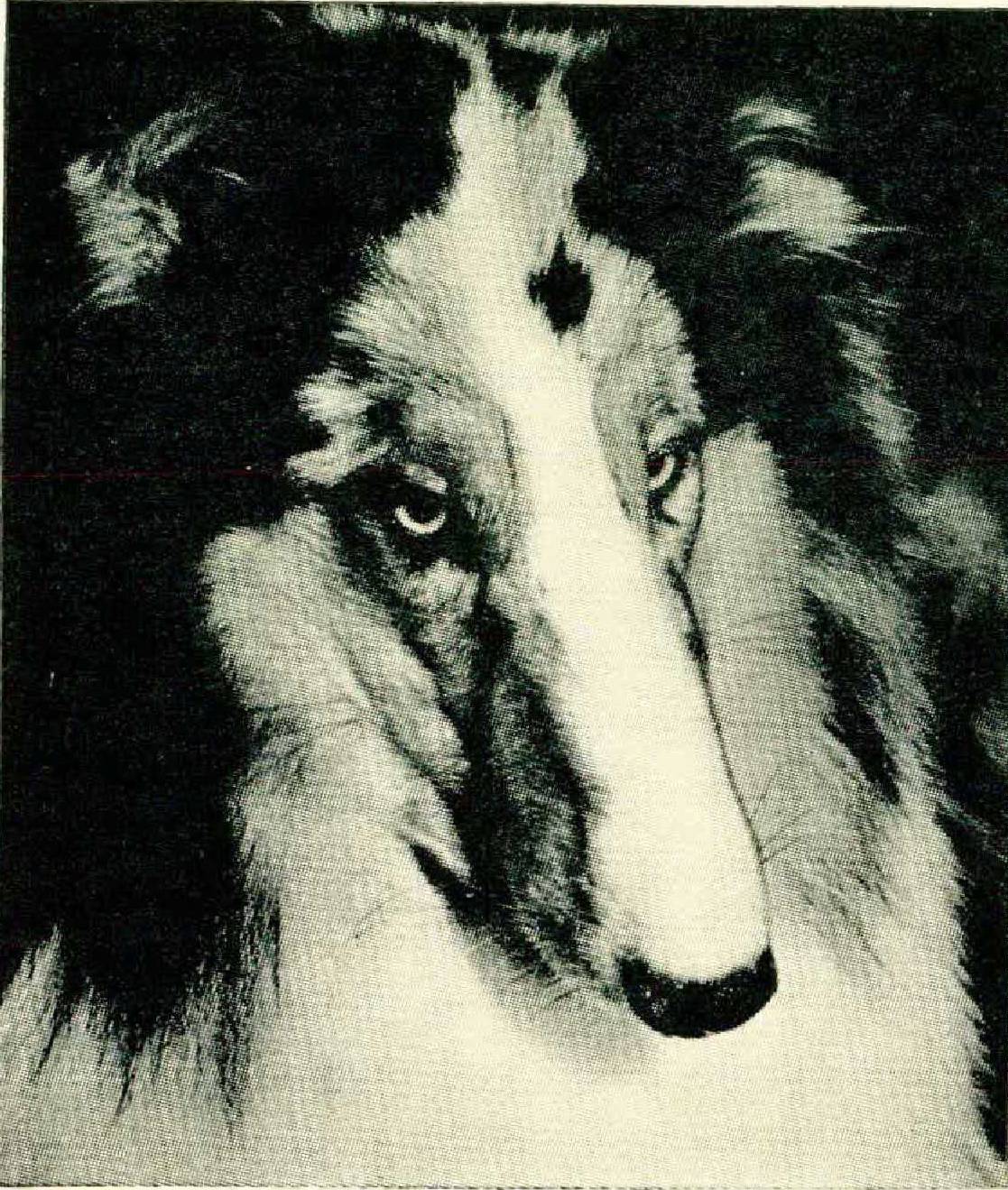
Hours later, when my visitor had rested, I discovered that she lacked any name or license tag on her collar. The condition of her teeth told me that she was young, while one look at her stomach disclosed the scar from an operation. It was also evident that she was somebody’s gentle pet. She was a black and white collie, almost purebred but not quite. Her eyes were a little too large, and her skull and muzzle wider than those of her elite cousins of the show-ring. Nevertheless, she displayed the grace and elegance which are outstanding traits of the collie breed.
That evening I called the authorities, but no one seemed to be worried about losing her, and I was faced with the choice of keeping her in my house or turning an unlicensed clog over to the pound, where I knew that by law she could be destroyed if unclaimed within ten days. After looking into her troubled eyes and searching my conscience, I decided she could stay with me until her owner was located. She ate some supper with ladylike delicacy and stretched out with a groan of fatigue on a mattress in my well-used front hall; then I retired, fervently hoping that the peace of the night would not be rent by homesick yowls. In the morning I rather dreaded what her deportment might have been, but was greeted only by a low whimper and a tentatively waving tail. I let her outside, thinking that she might now orient herself and go home, but to my dismay she chose to lie quietly on the stoep. What to do, but ask her in for breakfast?
As time went by, she proved to be sensible and unassuming. She clung to me like a limpet, showing the protective instinct which shepherds have bred into their dogs for more than two centuries. She did not quarrel with my Sealyhams, attending strictly to her own business, as all working dogs should. Plainly she belonged in a family where there were children, from the affectionate greeting she extended to those who visited my house. When anyone came to the front door, her ears pricked up, with a spark of hope lighting her eyes, and she assumed the alert look so attractive in collies. But this fleeting expression soon died as she realized the person she was expecting had not come. Day by day she tore my heart, and in spite of her good manners, I knew that in a quiet way she was just marking time until she was reunited with her family. I spent my evenings telephoning every dog officer for miles around, but the only lost collie on record was an unfortunate tan male.
By now, Lassie — for my grandson told me decisively that must be her name — slept in my room on a blanket, moving only when I spoke to her in the dawn; then she came softly to my bedside with a dainty morning kiss. Lassie was in perfect health, but in my judgment she was too fat and lacked muscle tone. Besides, no one had bothered to groom her since winter, and her heavy undercoat lay in dense mats. Accordingly, I combed out a bushel of the old hair and saw to it that she was fed a high-protein diet with plenty of fresh meat. Shortly her coat assumed a new sheen, and her physical condition improved.
A big dog needs plenty of exercise, and as Lassie barely left the house during the day, I formed the habit of taking her for a long walk at the edge of evening. One of my pastures is planted to bird’sfoot trefoil, a drought-resistant member of the alfalfa family. When it blooms, the field turns into a soft yellow carpet, much enjoyed by the bees, who make celestial honey from the nectar. Here the black and white dog presented a graceful sight as she raced across the green and yellow background, and I could not help fancying that she might well be running over the borderland of her ancestors. Lassie and I always proceeded from this pasture down a wood lane to the nearby swamp, where an astonishing thing has taken place. Some years ago I sent to England for seed of the water forget-me-not, myosotis palustris semper florens, to sow in a little brook which flows into the swamp; now the plants have spread their pale blue mist downstream, covering nearly an acre. Big clumps of royal fern contribute formal accents, while the foliage of the lowly skunk cabbage and jack-in-the-pulpit provide a bold contrast to the otherwise delicate flora.
Much as I love this swamp, it is headquarters for mosquitoes, of which there was a particularly ferocious crop last year. These did not bother Lassie, and if any succeeded in penetrating her thick coat, she brushed them off as she crashed through bushes or wallowed in the brown ooze of the bog. Needless to say, this was not true in my case, and when the sun set, these man-eaters convened in swarms to feast upon me with such voracity that in spite of every repellent, there were times when I thought only a transfusion could restore my bloodstream to normal after our walks. In truth, I often tore up the hill to the sanctuary of my house in a fury of irritation, with Lassie bounding on ahead, she having no conception of why I chose to finish our tour with what was to her such a delightful sprint. I continued subjecting myself to this torture because I hated to deny Lassie the one pleasure she enjoyed so much. My heart sank as she made endless trips to the door long before our appointed time to set forth, but how was I to say, “No, I am covered with itchy bites, and I cannot take you walking tonight.”
The first time I took Lassie out with me in the car I was surprised to have this otherwise docile dog behave badly. She tramped over the seats whining, panting, and barking in a frenzy of excitement, until it finally dawned on me that she supposed I was taking her home. That night she ate no supper and appeared to be so utterly downcast that I thought it kinder from then on to leave her behind. Thereafter her spirits revived.
The days went by with no sign of Lassie’s owner, and being already endowed with a kennel of more than thirty Sealyhams, I was appalled by the sheer lunacy of keeping her permanently. Therefore, I began canvassing my reliable friends who might be trusted to shelter a waif, but nobody was exactly in a position to take on another dog. They were already saturated with pets or going on vacation. In spite of my arguments that here was the perfect dog, young, spayed, housebroken, and fond of children, my friends turned a deaf ear, and Lassie stayed on with me.
One fine day the telephone rang, and my neighbor the dog officer said, “I think I know who owns that collie.” He gave me a local number to call, where a delighted lady assured me that she would be at my home immediately. And in ten minutes she drove up with three small children. Before they had time to get out of the car, Lassie went wild: I thought she would wriggle out of her skin as she threw herself yelping into the arms of her family. A great reunion took place in the hall; the oldest child, a girl of about ten, kept repeating, “Lucky, darling Lucky, where have you been?” Then the others began to cry, their mother cried, and I cried to see how happy they were, for there are no tears in the world more beautiful than the tears of joy. The lady told me that they had owned Lucky since she was a tiny puppy, and her daughter became really ill when she learned Lucky was missing. In fact, she cried so much that it had been necessary to give her a sedative to calm her down. Presently they all drove off without a backward glance, headed for the town hall to buy Lucky her missing license. I stood at the door watching them go away with the hollow feeling that no matter how fortunate the outcome, I would miss my gentle visitor. As I turned back into the hall it seemed emptier than it had ever been before, and I realized that there would be no quiet companion to sit beside me in the evenings, no more twilight walks, no long nose resting on my knee, and no shadow to follow my every move. It was then that I knew I had done it again and given my heart to a dog.
The explanation of how Lucky was lost proved to be a strange combination of circumstances. Her family were in the process of moving to my town from out of state, and before settling in their new home, they went to a camp in Maine, leaving Lucky in the care of some friends whose son took her fishing with him at the reservoir across the street from my gate. Here she must have become confused and failed to follow the boy’s bicycle, but instead wandered about not knowing where home actually was. At this point, Elizabeth stepped into the picture.
Later in the summer I made an abortive attempt to keep in touch with Lucky, suspecting that her family might go back to Maine over the Labor Day holiday and leave her stranded again, but when I offered to keep her for a few days I got a chilly reception to my hospitality, together with the impression that her family believed that I was quite fond enough of her already. I have never heard from them again.