The Rise and Fall of Elmer Zilch
Few American magazines have matched the rocketlike course of BALLYHOO,which in 1931 went from its beginning to a circulation of 2,000,000 and then vanished without trace from the American scene. Norman Anthony, its editor and creator, now lives in Garrison, New York, where he does free-lance writing, editorial consultation, and television work.
THE occasional gyrations of the stock market bring back the nightmarish memory of 1929, and a freakish financial paradox that occurred during its aftermath. At that time I was editor of Life, a highly successful humorous weekly, owned and published by Charles Dana Gibson, but with very little humor in it, despite my efforts to inject some fun in the family. The reason for this was that a big percentage of the magazine’s contents consisted of what is known in the trade as “class” advertising, so the wit had to be as genteel and straitlaced as the pompadoured beauties Gibson drew; the Madison Avenue boys were the real editors, not me, and they demanded that their precious ads be surrounded by, or adjacent to, pure type in order to give them a proper setting.
It was a very unfunny situation, but I was loath to give up a princely income, so I had acquired the “When in Rome” attitude, with a Brooks Brothers toga that bent at the knees; and when the clouds began to gather I was confident that Charles Dana and his vested interests would weather the storm. However, when the Big Crash came, advertising revenues dropped faster than the plummeting stocks, and I was out of a job. I wrote to all the editorial sources I knew, seeking any kind of work. The only reply I got was from a publisher of pulp magazines, asking me to drop in and see him. and when I did he wanted to know how I’d like to bring out a new humor monthly. I, in turn, suggested he ought to see a good psychiatrist, but when he offered me the munificent salary of seventy-five dollars a week, and assured me I could get out any kind of magazine I liked, the temptation, to say nothing of my pressing need of money, was too much, and I took the job. I still don’t know whether he was nuts or shrewd. All I know is that today he is head of one of the biggest publishing empires in the country.
Anyway, I was assigned to an office not much larger than a phone booth, and my new employer informed me I could spend $500 for extra material (my weekly budget at Life had been $5000). It was the tag end of a sweltering hot summer, the only relief a cold shower bath in the stock room, which I used two or three times a day, wondering what kind of humorous monthly I might get out and why in hell I was doing it. There was one consoling thought, though; I wouldn’t have to worry about the advertisers, as the pulps produced in this Turkish bath relied entirely on newsstand sales for profit. It was then that an idea — or rather, two ideas — trickled off my fevered brow. Why not turn out a really funny magazine for a change, and it would give me a chance to revenge myself on the Madison Avenue gang.
I became a one-man editorial staff, including an art department (I had been an alleged humorous artist prior to my editorships), and with the aforesaid nemesis in mind I decided to call my brainchild Ballyhoo. I spent the $500 for twenty-five of the funniest cartoons I could find, and following the opinion-making trend, I featured an imposinglooking editorial page headlined “Whither are We Drifting?” with nothing on it but the words blah, blah,blah. I also had an imposing masthead proclaiming Elmer Zilch as editor in chief, and a dozen other ass. editors were listed as Charles Dana Zilch, Franklin D. Zilch, and so forth. Running through the thirty-two rotogravure pages was a repetition of the hoary “Who was that lady I seen you with” joke in several different languages. Outside of three or four vicious satires (one was a Bitten, Button,Beaten & Osborn board meeting; the other, Vanity Fair’s “We Nominate for the Hall of Fame” — I nominated Polly Adler), that’s all the type matter there was.
At that time (B.C. — Before Cancer) the cigarette manufacturers were claiming everything but eternal youth for their different brands; the slogan of Old Gold was “Keep Kissable,” and Lucky Strikes were “Kind to Your Throat,” so I had a field day burlesquing their ads. The Old Gold one depicted a Big Business Executive baring his posterior for his employees, and Lucky Strikes were “Kind to Your Kneecap.”
The toilet paper advertisers were even then trying to stick their foot in the parlor door, and, digging through the archives of old-time photographs, I found a picture of a group of nice Nellies seated around a tea table which I printed with the caption “The Talk Changed from Issues to Tissues.” To my delight, I also found a daguerreotype of a very pompous-looking gent with a flourishing black mustache and pince-nez, and the moment I saw it I knew it was Elmer Zilch in person; ironically, he bore a startling resemblance to my Good Samaritan publisher.
Only once did I run into trouble with those oldtime photos, and that was when I ran a picture of a trio of gay young blades in a Central Park rowboat for a “Join the Navy and See the World” poster. To my horror, after it was published, I received a letter from a law firm informing me that the boatman in the center was Alfred Emanuel Smith, for whom I had eagerly voted when he ran for President. Practically in tears, I phoned his office in the Empire State Building, and to my surprise he answered the phone. When I tried to explain how sorry I was, he laughed heartily and in that gravel voice of his said, “Forget it, son.”
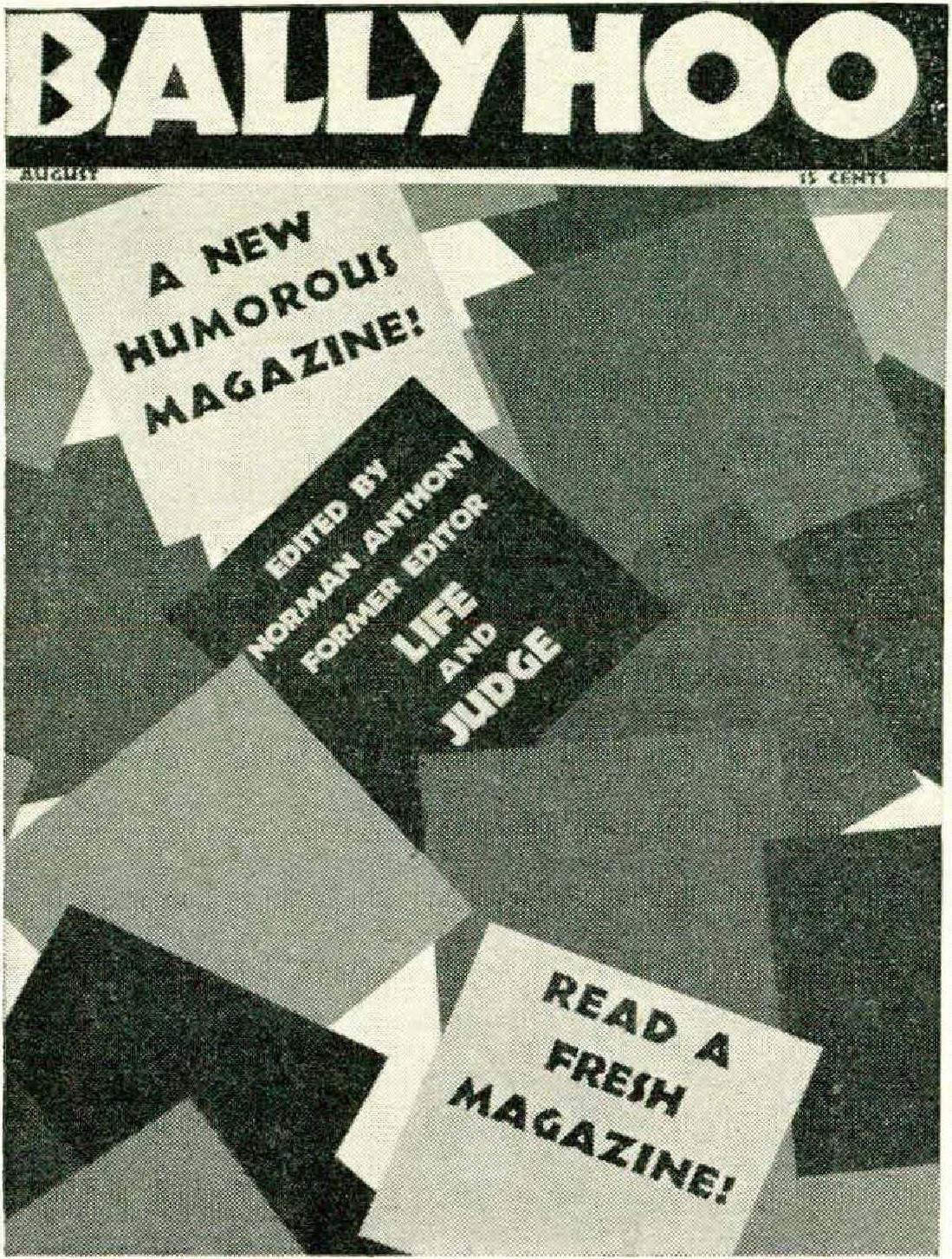
The great sales gimmick in 1931 was cellophane, so I sold the DuPont Company on the idea of giving me enough of the stuff to wrap the first edition of Ballyhoo in, with the slogan “Read a FRESH Magazine!” Heretofore the covers of humorous periodicals — Puck, Judge, and Life— had been color drawings, usually very bad puns; but the reproductions cost too much, so Ballyhoo’s cover was simply a crazy quilt of colored squares for eye-catching purposes.
WHEN the first edition of 100,000 was put on the stands, my boss said we would have to wait until we saw how it sold before starting a second issue, so I retired to my one-room, one-wife, and two-dog apartment overlooking a hospital, feeling somewhat like an outpatient and convinced that my brainchild had been born to blush unseen. A week later the boss phoned me with the astonishing news that the entire edition had sold out, that I should hurry down and start working on the next one. I couldn’t believe it, nor could I have believed that within six months Ballyhoo would skyrocket to a 2,000,000 circulation - this during the worst period of the Depression. Even in good times humor magazines had never sold more than 100,000, and often fell far below that. It was a publishing freak, and the only explanation I could think of was that people were so low in spirits that they were hungry for a laugh and fed up to the teeth by the current fraudulent advertising. The gaily colored cover, wrapped in cellophane, might have had something to do with it; people noticed other people laughing at it, and their curiosity was aroused.
Once again I was in the money, and had a drawing account ten times that of my original salary, plus a percentage of the profits. Every few months my Good Samaritan publisher would hand me some treasury certificates and suggest that I put the money in an annuity, but instead I put it in circulation. When Ballyhoo finally died of anemia I was right back where I had started, but I’d had a lot more fun than the speculators who lost their shirts in the stock market.
Ballyhoo was such a sensational success that despite our scurrilous attacks on Madison Avenue, the ad boys wanted to get in on the act; one agency actually paid us to burlesque its radio account, so we obliged with a picture of their infernal machine and the slogan “All the Crap in the World at Your Fingertips.” Hysteria repeats itself; television advertising is in the same state today as magazine advertising was thirty years ago. There’s more fiction in the commercials than in the TV plays, and the worst part of it is that they keep repeating the fiction over and over again, with the same naive idea their predecessors had — that if you say a thing often enough, people will begin to believe the fiction; in other words, they still think they’re talking to a twelve-year-old audience.
The success of Ballyhoo of course brought out a flood of imitators, and in their endeavor to attract attention they resorted to plain smut, and we were tarred with the same stick. Ballyhoo’s humor was satirical rather than smutty; one cartoon, for example, showed the rear view of a lady, with an enormous posterior, bending over a telephone table and saying, “Go on, dearie, I’m all ears!” Another cartoon, which created a minor sensation, pictured a naked lady sitting in a bathtub along with a trio of gentlemen, and she is talking indignantly into the phone. The caption: “Desk clerk, did I or did I not order a room with a private bath!” It was so popular that in the next issue the bathtub was longer and contained more gentlemen, with the same caption. In the following number the bathtub covered a double-page spread and a well-known caricaturist had such notables as Roosevelt, Churchill, and Mahatma Gandhi joining the lone lady.
We even kidded our “naughty reputation" in one issue by having a double front cover, the one underneath titled The Ladies’ Home Companion, with a Whistler’s Mother type of painting. This was for people who didn’t want to be seen reading such a disreputable sheet; all they had to do was tear off the top cover. Another cover had a hole the shape of a keyhole cut in it, and through the opening could be seen a naked pair of female legs up to the Plimsoll line, but when the cover was turned back the picture turned out to be a dummy in a department store window; the caption: “Honi soit qui mal y pense!”
Nevertheless, the postal authorities brought suit against us; the case was tried in Washington; and when the prosecuting attorney attempted to prove Ballyhoo was an obscene magazine, the affair turned into a riot. I was nervous at the trial because on the last page of the issue he used as a horrible example, there was a burlesque “Lady Pipperal" ad which I had run in a moment of weakness. It pictured a bum on a park bench covered with a bed sheet; the slogan: “The World’s Biggest Sheet House.” The jury was the average run-of-the-mill panel; each juror was furnished with a copy of the magazine, and with its gaily colored front and back covers, they looked like a church choir gone crazy. The prosecutor then proceeded with deadly earnestness, going through the number page by page and explaining why certain jokes and sketches were highly objectionable. By the time he had gotten halfway through there were suppressed titters from the jury and the crowded courtroom, and when he went into a scathing analysis of a full-page cartoon, they were laughing openly.
This was a picture of the boardroom of the National Bolt & Nut Company; at the head of the conference table stood a dignified, frock-coated president holding up in his hand a small glass case containing an ordinary hexagonal nut. The caption was, “Gentlemen, prepare for a laugh; this is one of our competitor’s nuts.” The attorney’s heroic efforts to explain the obscenity was the hilarious high spot of the trial, especially his solemn dissertation on the similarity of the genital organs and Anglo-Saxon slang. I was the only sober person in the room and kept thinking, “Oh, boy, wait until he gets to that sheet ad.” To my relieved surprise he ignored it completely, and I realized afterward that visually the ad looked perfectly innocent. It was scatological only when read aloud.
We were acquitted, but, curiously, the stigma remained. A few months later, when I dropped in at Harry’s American Bar in Paris, the owner escorted me to the men’s room and proudly showed me the walls, completely covered with pages from Ballyhoo. Another time, when I was laid up with the flu and called in a neighborhood doctor, he sat on the edge of my bed leering at me and telling me dirty stories until I kicked him out.
Humor is a curious and delicate medium; the closer it is to tragedy, the funnier it is, like the show-off leaping high in the air off a springboard and at the peak of a beautiful swan dive discovering there’s no water in the pool. Also, the closer humor is to vulgarity, the funnier it is — the double entendre, for example — but it has to be handled cleverly or it becomes plain dirty, as it did with my Philistine physician. Close-to-the-border humor requires a sophisticated but unleering approach, the way it is handled today by the new crop of comedians; it’s mischievous rather than vulgar. In addition, some people seem to have the knack of making off-color stories unobjectionable, while others produce just an embarrassed silence.
THE success of Ballyhoo brought out many byproducts — a Ballyhoo tie, a lipstick, even a bra — but the most unfortunate by-product was the Ballyhoo Revue of ‘32, of which I was author, coproducer, and eventually the chief angel. It was considered a natural, an intimate satirical revue like the magazine, and my dream of being a big producer was realized when the theatrical section of the New York Times printed a caricature of me lolling in the third row of the empty theater, watching a rehearsal. I think I hold the record for high prices for theater tickets; that seat cost me $100,000. On the road tryout our intimate little revue was augmented by the Broadway professionals, who decided the show needed “glorifying,” which meant a longer chorus line, an Albertina Rasch ballet, and professional gagmen to supply additional skits. One of them, for example, had Willie Howard, the star, carrying a new toilet bowl into a crowded subway car. The bowl was wrapped in brown paper, but it was obvious from the shape what it was, and the so-called humor rose from a lady sitting on it and her conversation about the suburbs with a woman friend. I had pleaded to kill the sketch but was outvoted, and I knew the only chance of saving it from sheer vulgarity was to have it played by a high-class comedienne like Helen Broderick, who had done a similar sketch in a Music Box Revue. I had my way, but unfortunately she became ill before the New York opening — purposely, I suspect — and her part was taken by a low vaudeville actress. The way she gushed, “Oh, I just love Flushing!”, was enough to make the blood run cold.
There was also a nudist-camp sketch in which the players stood modestly behind a waist-high hedge, but the suggestive, leering glances of the actors made my blood run even colder. “If you run those two sketches,” Heywood Broun warned me, “the newspaper critics will blame the magazine.”He was so right; the newspapers had no love for Ballyhoo, because the skyrocketing sales had hurt their sales. The old stigma had again raised its ugly head. Come to think of it, I should have seen the handwriting on the wall the two weeks we played in Atlantic City prior to the New York opening. The entire company was quartered at the Claridge Hotel; in addition, there were scenery officials, costumers, several other angels, and their girlfriends (from our chorus), with gay parties lasting all night, and all of this was charged to the production. The morning after the Saturday night closing, it was discovered there wasn’t enough money to pay the bill, which included $750 for “damage to room furnishings.” The management withheld all our baggage, and we were stranded, but I was in so deep by this time and so imbued with “the show must go on" spirit that I gave the hotel a personal check.
In spite of the unanimous panning by the critics, the Ballyhoo Revue ran for nearly five months, and I must admit that the two off-color sketches got the biggest laughs; as did the “Quartette from Lucia” routine that Willie Howard had been doing for years, in which, during the singing, he kept ogling the low-cut bosom of the diva beside him. The main trouble with the show was that the capacity take of the Forty-fourth Street Theatre was $32,000 a week; our overhead was $35,000. The only happy recollection of that unmusical experience was my discovering a young comedian named Bob Hope in a vaudeville act in a Brooklyn movie house and hiring him for the revue. On the road, my coproducers thought he stunk and almost fired him, but he stayed on, and I hear he has done pretty well since then.
THE magazine, luckily, had a longer run — nine years, to be exact — but during that first year relations between my Good Samaritan publisher and myself became a bit strained, as he had agreed verbally to give me 25 percent of the net profits but had changed his mind and the percentage to 10 percent. I told my troubles to a brother editor and speakeasy companion, Ray Long of the Cosmopolitan, who advised that the thing to do was to impress my boss enough to shame him into giving me my just deserts. Accordingly, Ray invited us to lunch, called for us in his chauffeured RollsRoyce, and we broke bread in the Oak Room at the Plaza. It was indeed impressive, but it didn’t impress my boss one damn bit. When we returned to the office and I again brought up the subject of our agreement, he very carelully explained how, by juggling the expenses of his other magazines, I would eventually get only what he wanted me to have. He was so disarmingly honest about it that I gave up the ghost of my 25 percent and was even thankful I was getting any largess at all.
Like all fads, Ballyhoo started to fade, and I tried to resuscitate it by resorting to the ideas I’d used on the old Judge, such as bringing out special issues — a burlesque advertising number (the forerunner of Ballyhoo), a Christmas number in July, a Ladies’ Home Journal number. My first-aid treatment had been so successful with Judge that it had gotten me the editorship of Life. Ballyhoo, too, went in for special issues, even a Reader’s Digest burlesque, printed in their small size, and they helped lift our sagging circulation, but only temporarily. Also, during that period another publisher brought out a magazine that was even more daring with its risqué cartoons and added enough sophisticated literary features (and size) to give it a semblance of class. It was called Esquire.
The month our circulation dipped below 100,000 my boss called me into his office, sadly informed me there was no more profit in the magazine, and added that Ballyhoo was hurting his other periodicals!
With an “It’s been nice knowing you" expression on his face, he assured me I’d have no trouble getting another big job, and he seemed so confident I almost believed him. However, there were no offers; I was just an unemployed nonconformist, and about as popular with big business as an Internal Revenue agent.