Where the Roads End
pleasures and places
BY POLLY REDFORD
When, after 2161 miles of billboards, gas stations, trailer parks, discount stores, used-car lots, gift courts, motels, shopping centers, bars, bait shops, junkyards, and pizza palaces, U.S. 1 finally stops dead at the Key West Naval Base, America stops too. That is, the paved, plastic America comes to an end with its first and most typical of highways. But, surprisingly enough, there is another America —the remnants of one, anyway —even in Florida. It begins where all roads end.
On beyond Key West lie Barracouta Key and Man Key and Woman Key and Boca Grande Key, low mangrove islands scattered among shallow grassy flats full of conch and sponges, bonefish and wading birds. Farther west lie the Marquesas, a black and green and yellow lagoon ringed like an atoll by a circle of islands inhabited only by cormorants, herons, egrets, ibis, and frigate birds; and forty miles beyond them, our strangest national park, the Dry Tortugas: seven sand islands and shifting shoals out in mid-ocean where there is one of the greatest wildlife spectacles on the continent and surely one of its most grandiose historical boondoggles.
The fishing is superb. It was for the fishing, combined with skin diving and bird watching, that my husband and I and our two small boys chartered a motorboat from Key West for a short midsummer cruise.
A summer solstice spent at die T ropic of Cancer for as close to the tropic as Castro will allow) discourages most people, but most people never leave the highway and don’t know how to keep cool. In our bathing suits and old T-shirts we were cooler there at high noon on a midsummer day than we were a month later, gasping and panting our way through the Bronx Zoo. And summer, between May and October, is the time to go to Tortugas. It is the season of tarpon, of terns and turtles, when the sun is high and the water calm and clear for long lazy days in the sea. Much of this can be enjoyed all along the Florida Keys in the off-season: what makes the Tortugas so special is their utter isolation.
Reykjavík or Singapore or Santiago is more easily reached than Fort Jefferson National Monument, exposed as it is on one side to the winds and currents of the Gulf of Mexico and on the other to the tides and caprices of the nascent Gulf Stream (here called the Florida Current). These bodies of water seldom agree, and their point of greatest dispute is a passage between them called Rebecca Shoal Channel. This is the barrier that cuts the Dry Tortugas off from the rest of the United States. Called Flapjack Passage by local fishermen, it’s well named, as we can testify after several hours spent in its twelve-foot seas. They are steep and toss you suddenly into the air, where you hang poised for a moment while your stomach turns over, just like a pancake, before you flop down hard again.
So it is the Flapjack Passage, not the National Park Service, that keeps Tortugas wild, by shutting out the ubiquitous outboard skiffs and cruisers that overrun the rest of Florida waters. That, and their dryness, for no water, gasoline, supplies, or anything else is available at Fort Jefferson. When at last you drop anchor in Garden Key Harbor, there is nothing to be seen but a ruined fort and, in summer, 100,000 birds.
The fort and the birds make up the entire history of the Dry Tortugas. It was the birds that brought Ponce de León there in June of 1513. How could he miss them? He came on the twenty-first, the summer solstice, just as we did 452 years later; and he must have seen them, as we did, from miles away, swarming like a cloud of giant insects above the low scrub growth that is the only vegetation these islets can support. One hundred thousand sooty terns mingled with brown noddies and pursued by rapacious flocks of magnificent frigate birds (soaringblack pirates with seven-foot wingspans) can hardly be overlooked. He found also a fine anchorage and large numbers of sea turtles and seals to restock his ships. The seals vanished long ago, bm some turtles still survive and return each spring to lay their eggs in the sand on the islands that Ponce named after them: Tortugas,
Turtles and birds dominated the scene for the next three centuries, and by 1832 when Audubon visited the Dry Tortugas, a brisk trade in tern eggs had developed in Havana and also at Key West, where commercial eggers sold them for twelve and a half cents a dozen. In time the birds would probably have been destroyed if the islands had not become a military reservation, but in 1845 the U.S. Army decided to build a chain of impregnable fortresses along the coast from Maine to Mississippi. Though the invention of the rifled cannon made this Maginot Line obsolete long before it was finished, some of the forts — like Fort William in New York Harbor — have survived to make fine historical monuments because they were never used and so were spared the wear and tear of battle. And of all these phantom fortresses, the greatest, grandest, and most glorious was Fort Jefferson: a mile in circumference and bristling with useless columbiads, howitzers, and 15-inch rodman smoothbores set among forty-two million bricks worth of machicolations, battlements, bastions, embrasures, magazines, galleries, ports, terrepleins, casements, ramparts, and parapets.
It is our American Neuschwanstein. The Corps of Engineers spent thirty years and three and one half million dollars to build it, and in the beginning its foundations were considered a great engineering feat because they were one of the first underwater jobs (cofferdams and steam pumps) undertaken by the corps. But by 1858 when Louis Agassiz came to visit —• the birds, not the fort — its walls had begun to crack, and a year later some of them had sunk twelve inches. Unabashed, the engineers rebuilt and went on building through the Civil War and afterward, when the fort became a federal prison; and on through the yellow lever epidemic of 1867, when Samuel A. Mudd (the doctor who went to prison for setting John Wilkes Booth’s broken leg) earned himself a pardon by treating sick troops; and on for another six years until hurricane damage and another epidemic finally made them give up.

And there it stands, miles of empty echoing red-brick galleries, a vast parade ground now green and filled with cattle egrets, a few rusty gun carriages, unfinished gunports overlooking the sea, a couple of muzzle-loaders, and lots of cactus on the battlements, and some of the biggest queen angelfish I’ve ever seen, swimming in the moat.
We found the moat really the best place to enjoy Fort Jefferson. One languid afternoon we waded and floated our way clear around the fort in water so warm and buoyant that we lay motionless on the surface like crocodiles for a half hour at a time while the boys splashed and poked around the base of the wall looking for snappers, angelfish, and parrot fish. Lying on our backs, arms outstretched, we admired the frigate birds hanging still and silent a hundred feet above us. The red-brick cliff filling half our horizon makes a perpetual updraft, on which they lay as effortlessly as we did on the water.
Finally, when our faces got too hot, we would slowly turn over, adjust our face masks, and watch the conches creep through the grass or join the boys in their search for lobsters among the crannies where the wall had cracked and split.
Halfway around, a sudden summer rain came down cold and hard; thunder boomed against the wall; and 100,000 birds took to the air at once (as they always do when it rains), wheeling and screaming with a sound Audubon described as almost lifting him off his feet. We took refuge underwater, looking up at the surface now dimpled and pitted with heavy raindrops instead of the shining mirror of a sunny day.
When the sun reappeared and we left the moat at last, our hands and feet and even our lips were wrinkled; we were so waterlogged that the sand and the air felt like a strange, almost hostile, environment.
There is better skin diving yet just outside the moat, where magnificent displays of staghorn and brain coral, sea fans, sea whips, and sponges lie west of the fort, but this was not junior skin diving, so we saw them from the rangers’ glass-bottom boat. “Junior skin diving” in our family lexicon means a depth of no more than five feet, no strong currents, sharks, or large barracuda. With a six-year-old and a nine-yearold in tow, we stick to shallow-water fish watching. And the shallows arc in fact lovelier than any deep reef, for beyond six feet colors begin to fade.
Less than a mile south of the fort in four feet of protected water, we found brilliant marine gardens that equal anything in the West Indies. Here sea fans, gorgonians, and brain coral shelter a many-colored display of wrasses, blue runner, hogfish, grouper, angelfish, mangrove and yellowtail snapper, blue tang, sergeant major, doctorfish, parrot fish, neon gobies, butterfly fish — small editions of the big ones that move out into deeper water as they mature.
We count ourselves among those Florida eccentrics who watch fish simply for the joy of their shape and color and motion, just as bird watchers look at birds. The two hobbies are so alike that some of us do both: fish watching in summer when the land is hot and buggy and many birds have down north, bird watching in winter when the water is rough and cloudy and fish leave the shallows for deeper reefs. The charm of Tortugas is that one can do both simultaneously.

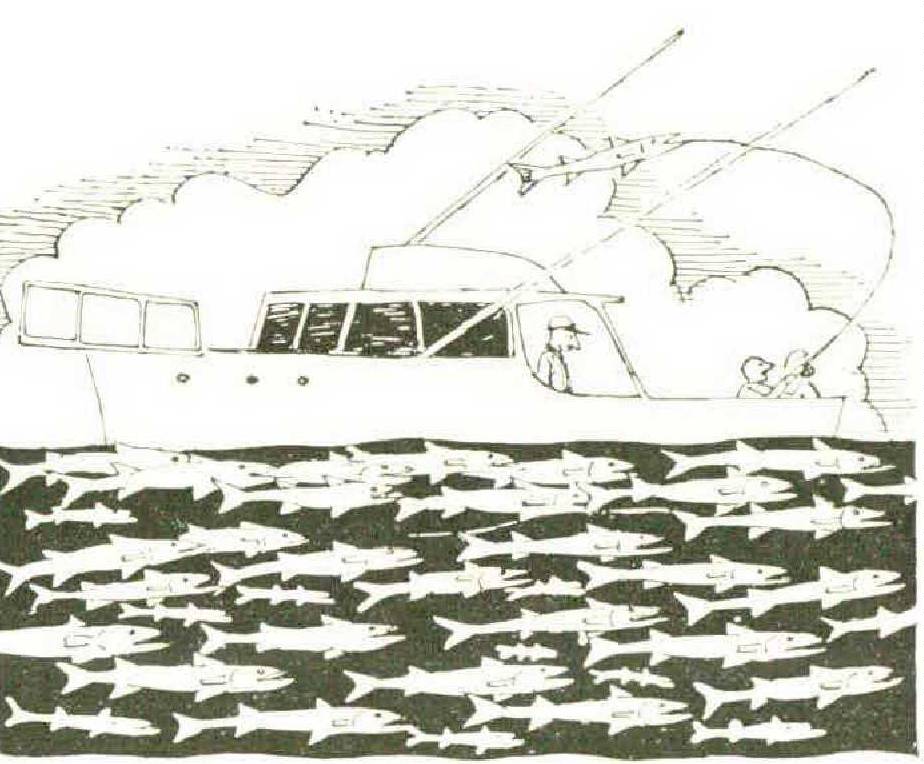
And when you’re tired of watching little fish you can catch the big ones, trolling, casting, drifting, bottom fishing, for this national monument includes over seventy square miles of water surrounding the islands. Within this area neither commercial nor spear fishing is allowed, and conch and lobster are limited to two a day per person. Thus the few anglers who come here can still see what Florida waters were like before the automobile, the outboard, and the spear gun. In three hours one morning we caught more than three hundred pounds of yellowtail, grouper, and margate, and we weren’t trying very hard because we threw back all but a few yellowtail, which we kept for supper. For once, even our fish-happy nine-yearold was satisfied — until we got back to the anchorage, when he threw his line over the side and promptly pulled in a thirty-pound barracuda.
By the time he released it, his blue jeans were so fishy I could stand it no longer. I made him change, took the offending pants, rigged a washing line, and threw them overboard, hoping to soak off some of the offending smell. Immediately, a six-foot cuda appeared, circling slowly and hungrily beneath them. After that, baths were no longer taken over the side but on deck with buckets of seawater sloshed over the victim.
I shall not tell about the tarpon we caught, for no one would believe me.
But the most important fishery at Tortugas is pink shrimp, fifteen to twenty million pounds a year, whose value is now greater than that of all the tuna or salmon in the nation. Only recently has it been discovered that the shrimp spawn at Tortugas, and then, mysteriously, the microscopic larvae swim a hundred miles north to the brackish waters of Everglades National Park on the mainland. When they reach maturity they swim back just as mysteriously as they went.
In the same way, turtles come back every summer from no one knows where to lay their eggs on Tortugas beaches, and so also do the terns. It was here that John B. Watson, the father of behaviorism, came in 1907 to catch terns, which he then marked with paint and shipped off to Havana, Galveston, and Cape Hatteras. Within a week after their release, most of them were back on their nests at Bird Key. The experiment was a crucial one for ornithology and psychology, and new discoveries are in the making, for every summer along with the turtles and the terns come the birdbanders — volunteers from the Florida Audubon Society, the state museum, and the National Park Service armed with mist nets, notebooks, and pliers. Since 1937 they have banded some 138,000 birds and recaptured 7500. Of the latter, 111 were found to be eighteen years or older, an ornithological record for this ternery, which is one of the few protected colonies of sooty terns in the world.
So, in the long run, who can deny that Fort Jefferson has paid for itself? Though it never fired a shot in anger, its bricks have weathered to a lovely rose-red, its gunports frame charming views of the sea, and in spring the trees in its parade ground shelter thousands of migrant warblers, which is more than can be said for most defense projects. And who knows? Perhaps our rocket launchers may turn out to be ideal nest sites for white ibis.
Until that time, Fort Jefferson sleeps on safely beyond the end of the road.
In the past year, a tourist boat has been running between Key West and Tortugas. Schedules have been erratic, but it has been possible to visit the fort for a day (or a week or a weekend if you pack in your own food, water, and bedding). Anyone interested should write for details to Superintendent, Everglades National Park, Box 279, Homestead, Florida, 33030.