A Spoonful of Nothing
How to create a boom in Lucky Mints and a cult in malted milks is here described by Sam Toperoff of New York, a teacher of English, a poet of considerable originality, and a prose writer whose first short story the ATLANTIC is proud to publish.
by Sam Toperoff
THE first store I remember at all clearly — I must have been about nine or ten — was a large store on a windy corner in the Bay Ridge section of Brooklyn. In this neighborhood only Scandinavians moved freely through the streets, so I had to run home from school every day to avoid a beating.
“Stand and fight just once,” my father urged.
“But there ain’t one. There’s a whole bunch.”
“Then grab a rock and say you’ll throw it at the first one who comes close to you. A big smooth one that you can throw straight. Then they’ll leave you alone all right.” His advice seemed a bit extreme, and his logic was not irrefutable.
“What if I miss?”
“Then you’ve got to stand and fight. They’ll respect you for it.”
“What if I hit one of them with it and kill him or something?”
“You won’t,” he reasoned.
This strategy was formulated on a Friday evening; I decided to take my stand against the forces of oppression and bigotry the following Monday after School. I’d try the entire gambit: threat, rock, fight.
Just before noon on Saturday — I was coming back from a long, solitary practice dash through the park (just in case) — I saw a crowd, a mob, in front of my father’s store. I tried to push through a couple of times, but I couldn’t. Finally, on the curb and from between a man’s legs, I saw the heart of the matter — my little bald-headed father and strapping Mr. Hjelmann, the father of my chief after-school tormentor. Twenty or thirty big blond men surrounded the two, and none were simpálico with my father. Hjelmann was holding a splintered hockey stick over my father’s head and was making an appeal for retribution to the crowd, and, it seemed, to Odin as well.
“My Kurt, he don’t lie. You all know that,” he said, in that ingratiating sliding musical scale Swedes use when they speak English. “He bought this stick just yesterday, and the very first time he uses it, it splits. Hah! It must have been split when he bought it. Now I want a new, a good one — or the money.” This last was an ultimatum.
“There was nothing wrong with that stick; I swear it,” my father pleaded. “When he bought it, I told him to check it over carefully because I knew it was a breakable item. As a matter of fact, I checked it over very carefully myself. Very carefully. Nothing wrong with that stick when I sold it.” The crowd muttered its disbelief.
Hjelmann would have none of it: “And I say it was split!”
“You can shout all you want; there was nothing wrong with that stick when I sold it. I’d stake my reputation on it.” He turned to go back into the store, but Hjelmann grabbed his shirt and spun him around. He began to swing the stick at my father’s head, and my father threw up a protective arm and sank, cringing, down to one knee. But the blow never came; Hjelmann’s feint had meant only to embarrass, and it succeeded. The crowd started to chuckle, and Hjelmann obviously enjoyed being top banana: he held my father’s shirt at the shoulder and faked three or four more blows; each brought a cringing response from my humiliated father. I tried to hide my face to keep him from seeing me watching.
“Cheap kike,” Hjelmann said, finally dealing with real issues; “I want that money from you.” He tried to mimic a Yiddish dialect. Somehow it sounded strained and foolish, an insult turned back on the insulter.
“Cheap Yoo,” the chorus echoed.
My father twisted away and his shirt tore, and Hjelmann stood with a handful of blue cloth. The “Cheap Yoo” was indeed paying. His face was red, and his eyes were covered by a moist film, and the muscles in his jaw twitched as he moved toward the store, but none in the crowd of large men would let him out of their circle. Hjelmann was quickly on him again; he grabbed the strings of his apron and undid the bow: “Not so fast. I’m not done with you yet, you cheap ki —”
The punch my father threw was so crisp and clean that I’ll remember it always. As Hjelmann was spinning him by his apron strings, my father brought a short, clean right hand up to the Big Swede’s solar plexus, and Hjelmann fell pathetically. The crowd went silent. The man standing over me whispered to a friend, “Ah, did you see the little Yoo? Some punch.” Peculiar things happen to a man who is hit perfectly and with force in the solar plexus, the most debilitating of which is that he cannot regain his breath for the longest time. He becomes a farcical battler because although he may want to get up and retaliate, he simply cannot; he sucks air and gasps pitifully.
“Get up Hjelmann, for Christ’s sake,” some of the men hollered. My father took a fighting position over the stricken Hjelmann; his anger and the loosened apron hanging off him foolishly made him look particularly ferocious. Hjelmann, at first, couldn’t get up; after a while, he wouldn’t get up. Finally his little wife came to get him, and the crowd began to disperse. As they left, some murmured a grudging paean: “Did you see it, how fast?” “Some Yoo!”
Although it was warming to know that my progenitor had a quick right hand, the fact didn’t really save me from trouble: as a matter of fact, a good many more boys wanted to see if the son of the fastest “Yoo-ish” right hand in Bay Ridge had commensurate speed. He didn’t. But he survived.
THERE was no reason to doubt my father. I knew Kurt Hjelmann lied. But the Lucky Mints episode unsettled my obedient confidence in my father’s integrity.
He always had an eye out for attention getters — “something to attract the kids” — so when the salesman from the candy wholesaler said, “Listen, they’re starting to move all over the city. Try a box, and if they don’t move, I’ll take back what you got left, and I won’t charge you for what you can’t move,” he was sold. When the chocolatecovered mints arrived, they were prominently displayed in the penny-candy case. My father had inserted in the back of the box an unlined threeby-five card on which he had printed artistically in red and black crayon:
LUCKEY MINTS 1¢
The mints arrived on a Saturday evening, and it wasn’t until 12:30 Monday afternoon that the first mint was sold. During the school lunch break, about thirty grammar school kids usually swept into the store. Most bought penny candy, some stole comic books. From about 12:10 on, all hands (my mother, my sister, and I) had to be at duty stations and ready for action. This meant that I had to be one of the first kids out of school, run home, wolf down my tuna fish sandwich and chocolate milk shake, and assume my post at the magazine rack before the other kids arrived.
My father distributed the penny candy, a critical, nerve-wracking station: “Gimmee some belly buttons — some shoe leather — and a hooten with nuts — hey, what’s those Lucky Mints?”
“If you pick a red mint, you get two pieces of penny candy free,” my father explained maybe a hundred times that first day. He sold a few mints, but no winners.
The mints were rectangular with the corners rounded off, about an inch long and half an inch high. The chocolate which covered the filler was dark and bitter. The white filler was the consistency of halvah and tasted like Ipana; the red filler, though rare, was inferior.
Tuesday there was a crowd of about seven kids around the candy case ordering away, revoking, re-ordering, re-revoking. A little girl with a pronounced lisp asked for a mint. “Which one? Point to it,” demanded my father, out of patience. She didn’t even know that she was a contestant. She pointed. “Bite it,” the boys urged. It was red. “You won!” “Hey, Frances won.” “Hey mister, she won.”
“You get two free pieces of penny candy, Frances,” my father said reluctantly, and the Lucky Mints boom was on.
“Give me that one!”
“I want that one !”
“I was first.”
“That one!”
“I want that one in the corner. No, the other corner!”
Half a box was gone before 1 P.M. There were two winners in addition to Frances. By evening all the mints in the box were sold, so my father got on the pay phone and ordered four more boxes, but they couldn’t be delivered before Saturday morning. He repeated ten times an hour, from 8 A.M. till 7 P.M., all that week, for his tiny clientele, “More mints Saturday morning — more mints Saturday morning.” On Saturday two boxes of mints arrived in the evening. Since the kids had no school and had attacked the store relentlessly from 7 A.M. on, this day must rank as one of my father’s very toughest. But at least the mints were here. More were wanted — indeed, needed — but at least some were here.
The week’s secession from combat had given the two camps a chance to regroup and make new demands. The kids demanded the right to pick out their mints. My father acceded to their terms provided that the mint they touched first was the mint they purchased. He, probably because the supply was limited, decided that each mint would now cost three cents and that the prize would be a piece of nickel candy. The increase forced a few buyers right out of the market; most got a stake somehow.
The mints were placed on the end of the soda fountain: each tiny customer stepped up on the footrest of the last stool, slapped three clammy pennies on the wet marble, and carefully looked the mints over for some unique characteristic. The main problem that the croupier had was to give each player a chance to study but not a period so long that those waiting to play became restless and offensive. The average scrutiny was about thirty seconds, ample time to conjure up a red mint, even for a kid. The contemplation never passed in silence. The deliberate players seemed to fare a bit better; all but one winner that day studied the terrain very carefully. And if the deliberation in choosing a Lucky Mint tended to be overly long, you should have timed the choice of a prize! The nickel candy case had become my new responsibility—the Lucky Mints had made stealing comic books passé.
All the mints were eaten, so the customer was getting something tangible for his mother’s money — not nourishing, but at least tangible. My father, as commissioner of the “Game,” made further rules changes: a winner could not take his prize in more mints — some had tried. This rule ensured that no single three-cent purchase could break die bank. A new layer of mints, he declared, could not be started until there were fewer than five mints on the layer then in action; and a new layer could be begun only at an active player’s request.
The school kids began to appear at unusual times — at 10 A.M. on a weekday, for example. A particularly compulsive type might ask permission of the teacher to go to the bathroom; he’d pick up the large wooden pass, run down the stairs, check the street from behind the heavy oak door, and scamper the two and a half blocks to the casino. A leisurely purchase then would eliminate the pressure and noise that militate against a truly personal preference. Choosing at unhurried times, this type felt, minimized the “house” odds.
The demand for mints was constant; searching, hopeful eyes hovered continually above the enigmatic mints. In order to meet this overwhelming demand, my father began making trips to the Manhattan wholesaler, pleading in person for an extra box or two.
RED MIDTBOW was a red-haired, red-faced butcher of about thirty-five. He worked two stores away and was the first adult to try to pick a Lucky Mint. Red and my father were natural antagonists. My father mistrusted Finns; and Red, a Finn, taunted him continually about the Finnish bravery in facing down the Russians in 1939. Each man respected the other, but the taunting never ceased.
My father had just served Red a large cherry Coke to wash down the ham sandwich he always brought in with him, when the early school kids arrived and demanded that my father start the action. The box of mints was always taken off the fountain when not in use. The childish excitement attracted Red. When the rules were explained, he reached into his apron for some pennies. “I’ll try once,” he announced. The kids made a path. Red slapped down three cents. Looked the field over. Chose. Bit off a small piece. White. A loser. Three more pennies. A choice. A small bite. White. Five picks, five white mints, five losers. He handed the nibbled mints out to the kids, an act of generosity which made him a very popular loser.
My father taunted: “It’s not as easy as it looks, is it? It takes a knack you just ain’t got. There’s a little kid in here yesterday; he picked three for four. Right?”
“Joey it was,” a kid reinforced my father.
“I’ll try once more; I must have some more pennies here,” said Red. But he didn’t have any more, so he put a quarter on the counter.
My father had the two dimes and two pennies on the counter even before Red could be sure it was actually a quarter. Red scowled over the mints. His blue eyes moved from mint to mint registering “definitely not,” “too light,” “I’ll come back to this one,” “looks almost too good.” His thirty seconds were expended on the first row. “You can’t take all day — that’s the rules,” my father taunted. The group of kids, which by now was quite large, observed the confrontation between “house” and “plunger” with reverence and awe. Slowly Red examined. He refused to be hurried. “Look, I’ll give you your money back,” bluffed my father. “These kids want to pick. They’ve got to get back to school.”
“How’s come we don’t get to see the bottoms?” asked Red slowly, head down, eyes upraised.
“Because this is how they come in the box,” answered my father, sensing trouble. Was the Finn trying to hedge?
“We should be entitled to see the whole damned mint for our money. You can’t tell anything from the tops. Isn’t that right?” He was making a blatant emotional appeal to the kids, and losers besides.
“The man’s right. We should get to see the whole mint for our money.” This was the consensus of the twelve or fifteen urchins backing Red. What could my father do? To refuse to comply might mean insurrection or, worse, rumors that he had been running a crooked box of mints. “Turn ‘em all over,” Red said.
My father turned all the mints over, and to the great dismay of the insurgents, all he had revealed were the very ordinary bottoms of some forty very ordinary mints, He had been worried that perhaps the bottoms were marked, but now that even the bottoms were identical, he was positively chipper. “OK, OK, you’ve bothered me long enough and kept these kids waiting too long. Pick!” Now it was my father’s turn to play to the crowd, and the fickle crowd responded. “Yeah, mister, hurry up. Don’t take all day. We want to play too. We’ll be late for school.”
Red was in a bind. He picked quickly. Bit. A winner! A red mint! A winner! He was ecstatic. “You get a free nickel candy. Who’s next?” My father was stunned; he spoke mechanically.
“OK, later,” said Red. “I want to try again.” Long deliberation. A choice. Another winner. “You see, it’s all in the bottom of the mints,” he announced.
“All right, you win another candy bar. Who’s next?” My father was whipped. Red passed out the two winning mints, grabbed a Baby Ruth and a box of Black Grows from my nickel counter, and left. The kids admired the two winning mints long after Red left. My father began to study the bottoms of the mints as intently as the kids. He could discern no distinguishing characteristics. There were none.
Red Midtbow re-enacted his success daily. Never did he select more than five mints after that first day, and never did he get fewer than two winners. One Friday he had four out of five. And after each success he’d announce that the secret was in the bottoms. During quiet moments, my father and I scrutinized the bottoms and picked likely prospects, but rarely did we pick a winner, and we certainly didn’t work out a pattern of success like Red’s. Red’s success, which mocked the laws of probability, suggested to my father that Red “knew something.” A decision was made, and “house” machinery moved swiftly into action.
My father ordered me to take a reserve box of Lucky Mints back to the kitchen and there to empty carefully the contents on the table. After I’d done his bidding, he appeared with a very thin, very long needle. With this instrument he pricked, with surgical care, the thin layer of dark chocolate on top of the mint, twisted the needle ever so slightly until the smallest hole was discernible, and examined the hole carefully under a bright table lamp which he had plugged in. “See, you can see it’s white.” He smoothed over the rupture with his fingernail and then with his thumb, the heat from the lamp helping to blend the chocolate.
“Do this with all the mints in the box. Put the red ones over here.” He was out to get Red this time, I thought. “Gall me when you’re finished.” There were three hundred mints in the box, and about twenty of them turned out to be red. He came at my call and inspected my work. As I expected, he improved my repairs in about a dozen instances. “Now put them back, but just two red ones in each layer. Don’t put any in the top layer. I want only ten in the box, but none on the top. You can have what’s left over.” I wasn’t elated.
When Red arrived, the box of rigged mints was ready; only a few mints were gone from the top layer. Red’s style of play had changed. He’d stand off to the side and examine the mints as others were playing. Between players, he’d quickly plunk down three cents and grab, in most cases, a winner. On the day of the big fix, Red watched, but chose not.
“What’s the matter, Red? System not working?” taunted my father.
“Don’t see anything I like,” was Red’s blasé answer.
Red’s decision not to play convinced my father that Red could, indeed, spot a winner when he saw one. Red’s knack had left the combatants unequal; whatever Red knew, if anything, could even overcome my father’s attempt at control. Red didn’t have to play. He leaned over the fountain, holding up his head with one ham-hand, drumming on the marble with the stubby fingers of the other. He simply did not choose to choose, and my father’s sidelong glances could not stimulate him.
Was he waiting until the top layer was gone? Would he then quickly pick the two winners remaining in the next layer? My father, it was obvious, was thinking the worst. His forehead was knotted, his eyebrows arched, his upper lip sweated.
Suddenly, before the top layer had been consumed, Red slapped three pennies on the fountain. My father relaxed and smiled as wryly as he could (the wry smile was not in his repertoire). “Are you sure you want to play now?” He couldn’t resist one last taunt.
“Y-e-s-s. I think I see something I like.”
“Y’ sure now?”
“Yup.”
Before all, Red picked a corner mint from the top layer. Before all, he held it up to his mouth and bit off half the mint. Red. A winner. The crowd whispered its admiration.
My father was struck dumb. He slowly scooped up the pennies. “He wins a nickel candy,” he said metallically.
“That’s all that looks good this time,” said Red with a wink to the crowd, but intended for my father.
As Red was choosing his nickel candy, my father, who had come slowly to his senses, glared a threat in my direction that made the Black Grows head south.
NOR did my father reform when we moved from the cynicism of Brooklyn to the lush innocence of Queens. Regeneration and a return to the soil were the reasons given for the move, but the degeneration of my father continued apace.
In the early forties the distinction between a milk shake and a malted was not widely appreciated. When a customer asked my father for a chocolate milk shake, he’d invariably rejoin, “Now you’re sure you don’t want a malted?
“What’s the difference?”
“What’s the difference? Hah! In a malted you get Horlicks Malted Milk Powder but it’s a nickel more!” With most customers the “nickel more” clinched the sale.
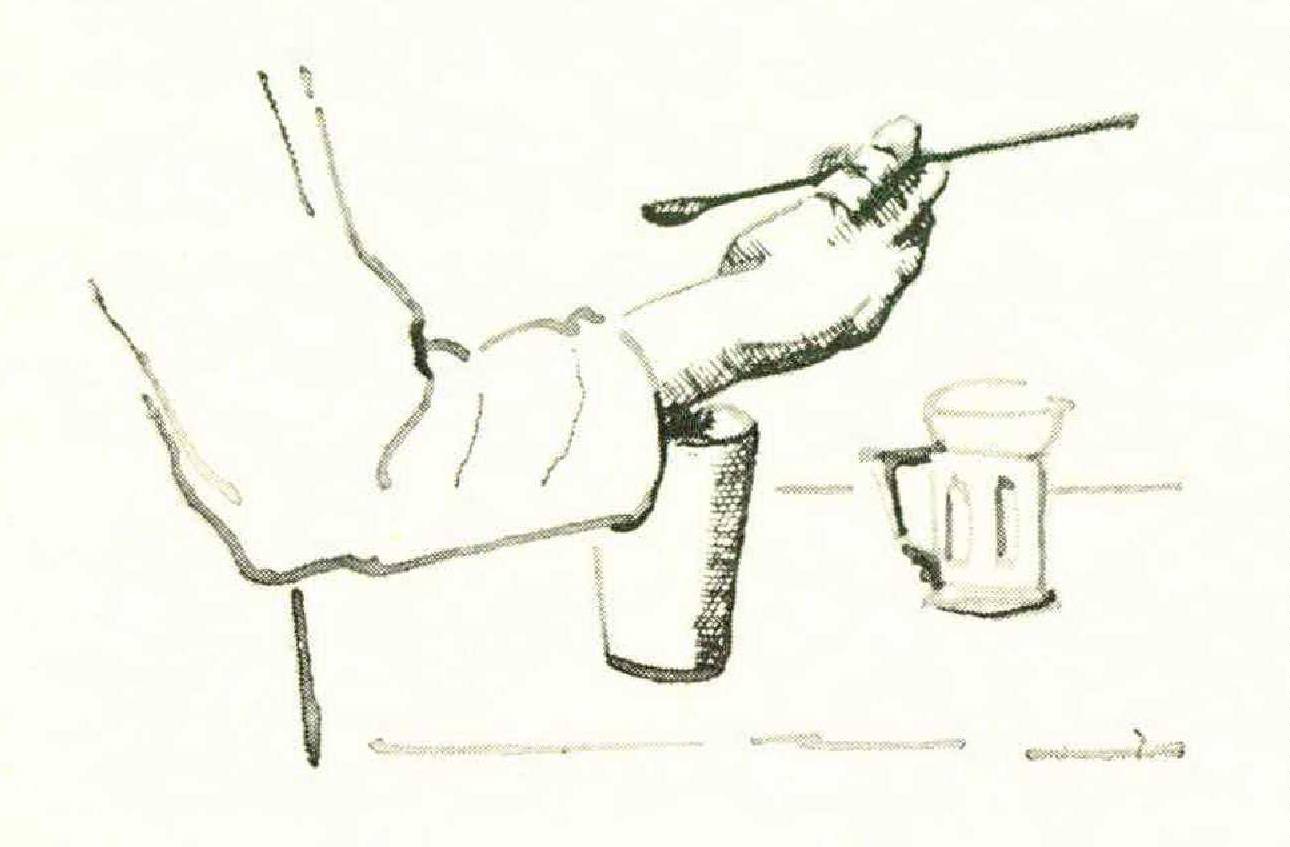
Then my father would move swiftly into action, buoyed by the fact that few Queens entrepreneurs were in his class as salesmen—certainly not Frankel down on the next corner. Into the metal malted container went two virile squirts of chocolate syrup; then the milk, with ice forming always in the bottle neck (“I keep the coldest milk in this city!”); a large scoop of chocolate ice cream; then off with the top of the Horlicks canister. Inside the canister, buried in the health-giving powder, lived a long-stemmed, bent, silver-green spoon which in better days had served exclusively in ice cream sodas. My father would load the spoon with the powder, tap it gently against the inside of the canister, and hold it up to eye level to assure himself and his patient that the spoonful was indeed level. Spoon back, canister top replaced snugly, container on malted machine, and in about a minute and a half the marvelous result was an extremely cold, unusually rich, unusually malty, chocolate malted. My father, with the help of Horlicks, transformed the drinking habits of hundreds.
But the Horlicks powder couldn’t hold out forever. For some reason, it escapes me now, after the powder in the canister was exhausted (it took about six months), my father bought a small jar of the stuff and simply left the jar open inside the old canister. The canister was majestic, and even I could see that the jar was not a proper replacement. But it isn’t until this moment that it occurs to me to question why the powder in the jar was not simply emptied into the Horlicks canister. Anyway, the malted process was slightly changed. Everything was as I’ve described it, but the malted powder was no longer a level spoonful; in fact, only the tip of the spoon was covered with malt powder. No longer was the bent spoon raised to eye level; the spoon was barely out of the canister when it was quickly thrust back and the top of the canister clapped on. The result now was an extremely cold, somewhat malty, chocolate malted.
My father’s malted customers were a breed unto themselves. They were thriving. But, as is inevitable with candy-store elixirs, the jar of Horlicks powder in the empty canister gave out. That jar lasted twice as long as the original canister, but it was replaced, I am almost ashamed to admit, with nothing at all. Procedural complications in the making of a malted (still five cents more than a milk shake) arose.
The empty jar remained in the empty canister. When what was essentially a milk shake was ready to become a malted, my lather would take the top off the Horlicks canister, and with a dramatic, digging-scooping motion of his right arm and the entire right side of his body, he seemed to be tapping the mother lode. There was not a trace of powder in either canister, jar, or on the spoon. He quickly dashed the spoonful of nothing into the malted container, hitting the spoon loudly against the side in order to shake off every last health-giving grain. Spoon replaced. Container on machine. Minute and a half. The result? A cold, chocolate “malted.” What else?
The process, the deception, continued for years. The war ended. I grew larger (I was thirteen) and had to serve my soda-fountain apprenticeship. The malted-milk cult dominated the fountain. I can only recall one regular milk-shake drinker — he hated FDR. I, too, in my time learned to fake “malteds.” I could fake a pretty damned good “malted,” I thought. But if my father was near the fountain when I was faking a “malted,” he could not resist coming over, taking my “malted” off the overworked machine, and giving his customers a bonus by adding half a spoonful more of nothing from the Horlicks canister. This conditioned reflex met always with the silent approval of his “malted” cult.
Sometimes his bogus malteds traveled. (They didn’t travel very well, however.) He would get an occasional call for a chocolate malted “to go” to the beauty parlor across the street, next to the draft board. I usually carried the “malted” in its metal container covered with a paper napkin. I hated the smell of the damned place. I’d take a deep breath of air before I went in and try to hold it until I was safely back outside. I could barely stand it while the fat, smelly women slowly poured the “malted” into small glasses, fished around for the money, and finally turned me loose.
I was going out to play ball one day when my father told me to take a “malted” over to the beauty parlor. The store was empty; I sat at the fountain thumbing through a comic book. Alone in the store with a disinterested thirteen-year-old kid — his own son! — my old man squirted the syrup, added the milk and ice cream, took the top off the Horlicks Malted Milk Powder canister, and noisily put a spoonful of nothing into the chocolate milk shake, and —