Barber, the Bard, and the Barge
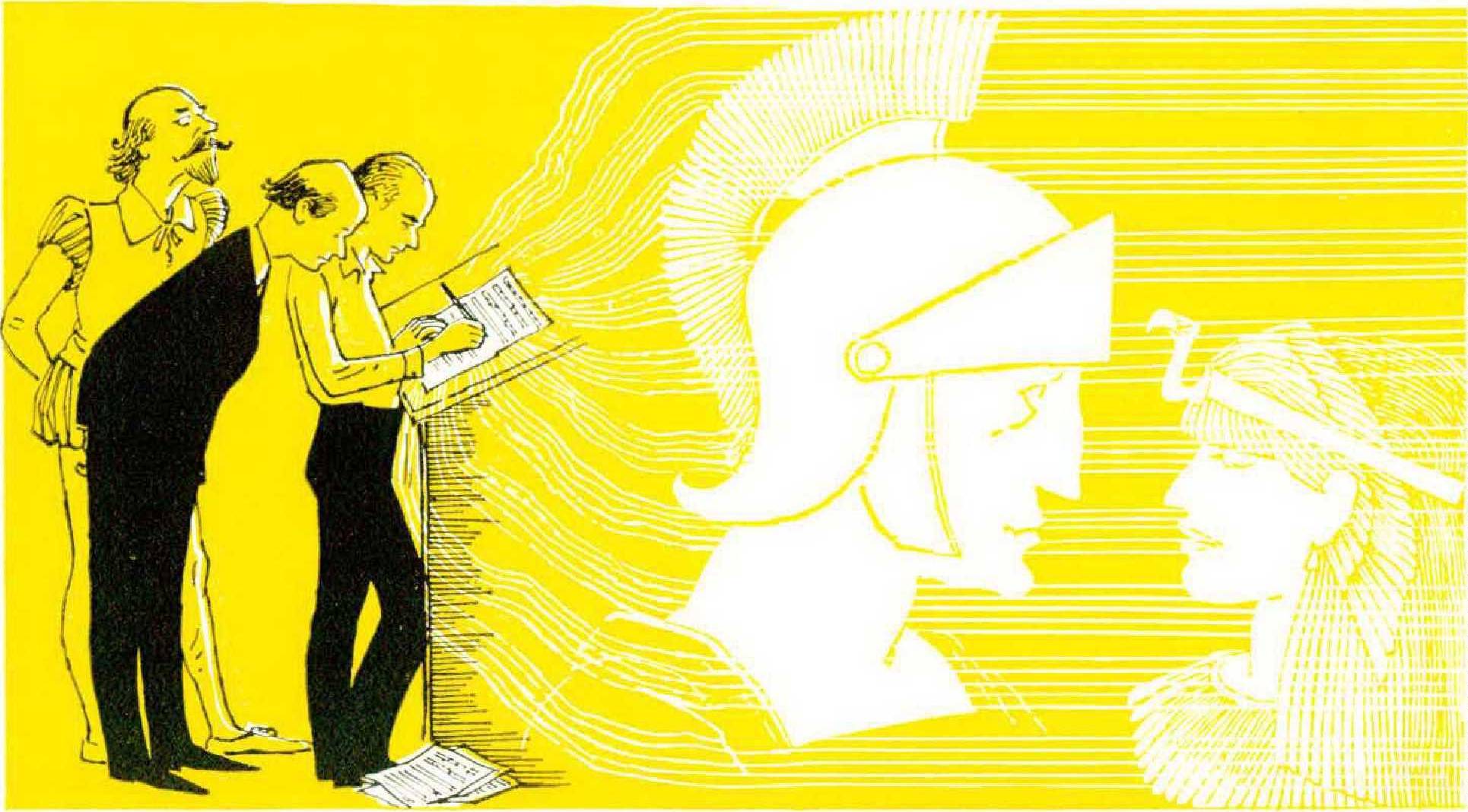
It takes almost as long nowadays to write a new opera as to build a new opera house. Such, at least, has been the experience of Samuel Barber, the American composer commissioned to write the opening-night opera for the new Metropolitan Opera House at Lincoln Center. The house has been a-building, in its major construction phase, for three years, and Mr. Barber has been working on his Antony and Cleopatra, based on Shakespeare’s play, for two.
“When I remember that Debussy spent ten years writing Pelléas et Mélisande, I feel better,” said Mr. Barber. “But when I think that Verdi wrote Aïda in six months . . . how was that possible?”
Mr. Barber was talking on a summer day fat the New York office of his publishers, G. Schirmer), at a point when the finishing touches were being put on both the opera house and the opera. At the handsome marble edifice workmen were tacking down the red carpel on the lobby floor preparatory to the September 16 opening, and at Schirmer’s Mr. Barber was preparing to return to his studio home in Mount Kisco, New York, to finish up his orchestration.
“I orchestrate standing up at a wall desk, like a clerk in an oldfashioned office,” he said. “It’s good for the back.”
At fifty-six, Sam Barber is a handsome, well-built man whose hair is graying at the temples. Physically he resembles a successful businessman more than a successful composer, though perhaps the two are no longer mutually exclusive. The Metropolitan Opera is no bastion of modernity, but it badly wanted a new American work (as well as an all-American cast) to inaugurate its new home, and Barber, an admired and accomplished composer who works largely in traditional molds, was an obvious choice.
Considerably less obvious was the choice of subject, which was left to the composer.
“I prefer to work with contemporary texts,” explained Barber. “ I talked to Tennessee Williams and James Baldwin about a possible libretto, but they were just not very interested in opera. I talked to Thornton Wilder, too, but that didn’t work out either. Then while I was mulling it over, suddenly I thought of Antony and Cleopatra. It’s perhaps my favorite Shakespeare play. I know some actors consider it much too long and somewhat unsuccessful as a play, but it has wonderful poetry in it. Right from the start Leontyne Price had been very much in everybody’s mind for an important role at the opening. And Antony and Cleopatra certainly provided that. So you see, Shakespeare really proved to be quite an amenable librettist for the occasion.”
Barber had one more suggestion. He wanted Franco Zeffirelli, the Italian director-designer, brought into the picture, even though it meant breaking the all-American pattern the Met would have preferred. General Manager Rudolf Bing agreed, and details were worked out among the three men at the rear of Bing’s box during an intermission in the Zeffirelli production of Verdi’s Folstaff two seasons ago. Later the parts were parceled out: Cleopatra for Price, Antony for the young Puerto Rican bass Justino Diaz, Caesar for tenor Jess Thomas, and Enobarbus for bass-baritone Ezio Flagello, with Thomas Schippers, long associated with Barber, conducting.
The job of condensing and adapting Shakespeare’s play into a libretto was undertaken by Barber and Zeffirelli, although only the latter is given official credit on the title page. The Met arranged for a Ford Foundation grant — its size undisclosed — to pay Barber; and the cost of the production was met by a particularly philanthropic member of the board of directors, Francis Goelet.
“He’s a generous man,” said Barber. “It’s a very big production.”
It is, as a matter of fact, the most expensive production in the history of the Metropolitan Opera, with its total cost reaching $200,000. Aïda two years ago was a mere $150,000 (commented a member of the Met administration).
Antony and Cleopatra has no fewer than thirty solo parts, an oversize chorus, a vast orchestra, and is divided into three acts and nineteen scenes. It has land battles, sea battles, dances of jugglers and slave girls, a drunken revel, and even an apparition or two. In its scope it provides the kind of grandeur and panoply the Met regards as appropriate to the inauguration of a new house, especially a house with the prairie-like stage and intricate machinery of the Lincoln Center palace
Barber himself seems a bit awed by the size of the production the Met is planning. “I said ‘chorus,’ ” he remarked, “and discovered it was going to be a chorus of a hundred and twenty. I also found there were going to be a hundred and twenty supers in the costumes of the various political divisions of the Romans and Egyptians. Actually, Shakespeare’s Antony and Cleopatra is a very sophisticated play and by no means spectacular. There’s a dichotomy between the struggle for political power and the great passion which blazes through to sheer poetry at the end. What I’m trying to say is that for this occasion, the opening of a new opera house, the spectacular side is being emphasized more than it has to be. This opera is suitable for smaller productions too.”
Barber’s vocal music has always been regarded as eminently singable. His aunt was the renowned American contralto Louise Homer, and he was trained as a singer himself. He once made a recording (for RCA Victor) of his line setting, for baritone and orchestra, of Matthew Arnold’s “Dover Beach.” His only previous opera, Vanessa, to a libretto by his friend Gian-Carlo Menotti, besides winning the Pulitzer Prize in 1958, has attained eighteen performances in three Met seasons, which is considered not bad. A strongly lyric impulse has also underlain most of his instrumental works, beginning with the famous Adagio for Strings in 1938.
So, despite the inclusion in his large orchestra of such instruments as piano, guitar, antique cymbals, extra percussion, and stage brass, it will be no surprise to find the voices, both solo and choral, carrying most of the musical and dramatic burden.
“The characters speak in different musical languages,” said Mr. Barber. “Shakespeare’s lines for Cleopatra were easiest to set because they’re very loose and lyrical. They’re scarcely in iambic pentameter, lambic pentameter is hard to set to music, you know. The worst thing in the world to set is a sonnet. I’ve rather stylized some of the music a bit. When Antony is having a verbal feud with Caesar, I’ve characterized the Romans’ rigidity and the tightness of their language by a fugato passage — a real fugato, with inversions, augmentations, and all. It begins right here at the words ‘I learn you take things ill which are not so.’ ”
Barber pointed to the place in the manuscript score of Act I spread out before him and began to sing in a healthy baritone, demonstrating the repeated entrances of the subject in its various voices. He obviously enjoyed singing it, and it sounded wonderful.
The chorus —all 120 voices of it — plays a considerable part in Antony and Cleopatra. The opening scene, subtitled “A vision of the Empire: Jews, Persians, Africans, Romans, Greeks, Soldiers,” is entirely choral; Barber and Zeffirelli assembled the text for it from passages scattered throughout the play. The chorus also pronounces a kind of benediction (“She looks like sleep. As she would catch another Antony” — originally Caesar’s) at the final curtain. It even gets to comment, with various wondering interjections, on Enobarbus’ famous description of Cleopatra’s barge. This Mr. Barber characterized not as an aria but as an “interrupted narration” — with Cleopatra, incidentally, appearing as a vision during the passage.
For all his enthusiasm for Shakespeare’s lyricism, Mr. Barber acknowledged that, Cleopatra aside, some problematic moments had arisen. “I ran into a couple of tongue twisters,” he said, “lines not of a very lyrical nature. You come to a line like ‘You have broken the article of your oath which you shall never have tongue to charge me with’ — it isn’t as easy to set that to music as ‘All alone by the telephone.’ ”
After Mr. Barber had completed the first act, a rather unusual procedure was followed. The score was performed and taped at a recording studio, with an excellent young soprano named Sara Mac Endich singing the Cleopatra role. This served two purposes, aside from giving all concerned an opportunity to hear how the opera actually sounded: it demonstrated the timing of the scenes in the act, and it was useful to the singers in studying their parts. A tape of the act was also sent during the summer months to Zeffirelli, who by now was back in Italy, deep in another, somewhat different Shakespeare project, a film version of The Taming of the Shrew, with Richard Burton and Elizabeth Taylor.
Barber declines to estimate where Antony and Cleopatra is likely to stand in his canon of complete works, or to say whether he is conscious of new musical departures in writing it. He acknowledges that it is larger in scope than Vanessa, but cheerfully admits that he has come up with a traditional opera divisible into traditional parts — arias, ensembles, dances, and the rest. He has been classified as a “neo-romantic” by Gilbert Chase in America’s Music, possibly the most authoritative and comprehensive book in its field. Mr. Chase goes on to say of Barber’s later works: “His feeling for traditional forms appears to be gradually uniting with a trend toward dissonant counterpoint and polyharmony. He is slowly catching up with the twentieth century.”
Barber chuckled when the passage was read to him. “I don’t think I’ve caught up with the twentieth century at all,” he said. “You would have to be aleatoric, electronic, and everything else. Even Boulez is out of date. Mr. Chase is being much too kind. As for whether Antony and Cleopatra breaks any new ground for me musically, I’d rather not answer. You’d best answer it for yourself after you hear it.”
As operatic subject matter, the Cleopatra story is not exactly a novelty. Mr. Barber said he had counted up thirty-five previous treatments in Grove’s Dictionary. His isn’t even the first American version of the story to be given at the Met, for it was antedated by Henry Hadley’s Cleopatra’s Might in 1920. “I wonder what that was like,” said Mr. Barber thoughtfully. In any case, the choice of an American opera performed by an American cast for the opening of the new house will be a marked contrast to the opening of the old one in 1883, when a French opera (Gounod’s Faust, then twenty-four years old) was performed by a mostly Italian cast.
Whatever success it may achieve at the Met or subsequently, Antony and Cleopatra is unlikely to make Sam Barber a wealthy man. From a composer’s standpoint, opera is not a very marketable commodity. Schirmcr’s is printing a complete vocal-piano score of Antony and Cleopatra, but the full orchestral score will be published only in the form of photostats of Mr. Barber’s manuscript. The parts from which the instrumentalists will play on opening night will also be copies of the original, just as in Mozart’s day, except that now the copying is done photographically rather than by hand.
So far no other opera house has put in a formal bid to produce Antony and Cleopatra. “There have been a few nibbles, but that’s all, said Mr. Barber with a faint smile. “They always wait to see how the first one goes.”
Record Reviews

Beethoven: Trio in B-flat Major, Opus 97, “ Arehduke”
Eugene Istomin, pianist; Isaac Stern, violinist; Leonard Rose, cellist; Columbia MS-6819 (stereo) and ML-6219
This is a record to renew one’s faith in music as an expression of human nobility. The Archduke Trio is one of Beethoven’s most stirring and beautiful works in any form, and these three fine musicians give it a closely knit yet broadly conceived performance that makes it seem intensely personal and intimate. Isaac Stern is established as one of the great virtuosi of the day, but a recording like this is a measure of his qualities of musical leadership and dedication as well as of his mastery of his instrument.
Hindemith: Ludus Tonalis
Käbi Laretei, pianist; Philips PHS900096 (stereo) and 500096
Ludus Tonalis ("Play of Tones”) is the not very alluring title Paul Hindemith gave this set of “Studies in Counterpoint, Tonal Organization and Piano Playing.” But though his purpose may have been pedagogic, somewhat like Bach’s in The Well-Tempered Clavier, he came up with a series of piano pieces that have a vitality and variety of their own. Counterpoint has had no more resolute an exponent than Hindemith in this century, and in Ludus Tonalis he demonstrates convincingly the adaptability of ancient forms to modern uses. Käbi Laretei, the sympathetic and strong-lingered pianist, certainly seems capable of holding up her end of an artistic household — her husband is Swedish film director Ingmar Bergman.
Honegger: Pacific 231 (two versions)
Leonard Bernstein conducting New YorkPhilharmonic; Columbia MS-6659 (stereo) and ML-6059
Maurice Abravanel conducting Utah Symphony Orchestra; Vanguard VSD-71156 (stereo) and VRS-1156
Pacific 231 still is pretty exciting stuff. Honegger wrote it in 1923 as a musical statement of his “visual impression and physical enjoyment” of a railroad locomotive. And it really does sound like a train, gathering strength and majesty as it goes, reaching a peak of what Honegger termed lyrical exuberance. The music is, of course, an exercise in orchestral virtuosity, and there is more of this in Bernstein’s orchestra than in Abravanel’s. Curiously, though Pacific 231 takes only six minutes, it leaves a far more powerful impression than any of the other works on either of these records. The Columbia release also contains Honegger’s Rugby and Pastorale d’Été plus Debussy’s Rhapsodie for saxophone and clarinet with orchestra; the Vanguard offers Varèse’s Ameriques and Milhaud’s L’Homme et Son Desir, two highly percussive pieces, the first being an ambitious if not altogether successful sound portrait of New York in the 1920s.
Duke Ellington’s Concert of Sacred Music
Duke Ellington and his orchestra, with Brock Peters, Esther Marrow, Jimmy McPhail, Bunny Briggs, and the Herman McCoy Choir; RCA Victor LSP3582 (stereo) and LPM-3582
Psalm 150’s injunction to “Praise Him with the sound of the trumpet . . . Praise Him upon the loud cymbals” was never obeyed more explicitly than here, where the praising is done by an entire jazz band. Duke Ellington’s Sacred Concert was recorded on the scene at the Fifth Avenue Presbyterian Church in New York, and it makes for a fascinating, if not altogether liturgical, listening experience. At times, as when Brock Peters delivers a set of rhyming couplets giving a modern picture of chaos, it seems a bit banal and contrived, but its best passages (mostly the instrumental ones) are nothing short of magnificent.
Harold Sings Arlen (with friend)
Harold Arlen and Barbra Streisand, singers, with orchestra conducted by Peter Matz; Columbia OS-2920 (stereo) and OL-6520
Harold Arlen not only has composed the music for some of the most celebrated American popular songs (“Blues in the Night,” “Ding-Dong! The Witch Is Dead,” “For Every Man There’s a Woman,” “House of Flowers,” and others), he also knows how to sing them with more feeling and clarity than many a professional performer. Apparently he has been entertaining his friends for years with private recitals; here he has put one on records. (The “friend” coyly included in the title is none other than Barbra Streisand, who sings two of the numbers.) This is altogether an attractive record; so much so that one wishes Arlen would make new recordings of such other Arlen “standards” as “Stormy Weather” and “I Got a Right to Sing the Blues.”
The Mad Show
Directed by Steven Vinaver, with Linda Lavin, MacIntyre Dixon, Dick Libertini, Paul Sand, and Jo Anne Worley; Columbia OS-2930 (stereo) and OL-6530
This long-running off-Broadway revue loses its madcap visual appeal in its transfer to recording, but its general air of perky irreverence comes through intact. Mary Rodgers’ music is just right for the pointed lyrics of Marshall Barer and Larry Siegel; the result is an amiable, occasionally ribald collection of satiric songs. Some of the targets, such as movies, television, and football, are fairly obvious, but The Mad Show also has some slyly pertinent comment to offer on such matters as American family life. The song that seems to be particularly relished by younger listeners is entitled, simply, “Eccch!” There’s no great subtlety here, but the attitude, if not the sound, is prevalent throughout the show.
Way On West
Mae West, singer, with anonymous band; Tower 5028 {monaural)
Mac West is, as they say, no chicken. But she Lakes to rock ‘n’ roll like . . . oh, well, a duck to water. Singing such songs as “Treat Him Right,” “When a Man Loves a Woman,” “You Turn Me On,” and “If You Gotta Go,” she displays a natural sense of rhythmic bounciness and the voice to carry her through. Her innate ability to kid sexiness while embodying it adds quite a distinctive touch to the songs. Things do get a bit repetitive after a while — the lady’s range, both of voice and subject matter, is limited — but it’s all good, clean fun. Fairly clean, that is.