Mead
British writer MARGERY SHARP gained a reputation in the United States with her novel THE NUTMEG TREE in 1937. This is her first appearance in the ATLANTIC.
Driving to Holy Vale, on an island in the Scillies, by pony cart in 1936 was probably much like driving there in 1736, or 1536, or even earlier — the dividing line probably the introduction of iron tire to wooden wheel. The cart was definitely unsprung: each jolt when the hairy pony stumbled shot uncushioned up the backbone straight to the base of the skull. Why the pony stumbled so often was partly on account of his age and partly because the lane leading down to the vale had never been made. It was essentially a wide rut, in winter probably a watercourse. On either side grew blackberry bushes, honeysuckles, clovers, and a sort of scentless mignonette.
It was very hot. Even the bees (increasingly numerous, murmurous) seemed burdened by more than pollen. (Buzzing a bourdon to their burden.) As the pony plodded downward, his hairy coat collected flies. He was an off-white pony. Quite soon his coat looked expensively ermine-tailed.
We had come to buy honey in the comb. Mead was far from our minds.
The vale itself turned out to be no more than a dell, or dingle, deeply embowered in more blackberry bushes, more honeysuckle. It brimmed with sunshine as with some tangible golden fluid. It was even hotter than the lane, and fuller of bees and flies; their combined buzzing and humming produced an effect on the eardrums like organ stops left out. In the center of this dell, upon a patch of turf some ten yards across, stood a very small cottage with a bench by the door. The beehives were scattered over the slopes higher up where the heather was.
We dismounted and knocked. There was a long pause. The pony went to sleep on his legs. Presently a tall old man came out and sold us four combs of honey. We had wanted six (being commissioned by friends at the hotel), but he said four was all he could spare. His voice was wonderfully low and soothing — a trait I had noticed before among beemasters, in fact among a whole conference of them gathered at Charleston, South Carolina.
When we had paid,
“Have you ever tasted mead?” asked the old man.
We said no.
“Then have a drop,” said the old man.
The grave courtesy of his manner, also a certain authority, put refusal out of the question. It would have been like refusing a gourd offered by Jonah. We sat down on the bench while he went in and came out again with three small squat tumblers that looked like bottle ends worn smooth by the tide. The green-tinged glass was so thick it was impossible to tell what mead looked like. Following our host’s example we took it in sips.
This was the first time we had drunk mead, and rather oddly, I cannot remember its taste. Perhaps mead has no taste. On the palate it was liqueurish, almost overbland; there was no backlash. However, nothing could have been more pleasant than to sit there in the sun listening to the flies and the bees and smelling the clover and the honeysuckle and the mignonette.
“Have another,” said the old man.
We hesitated.
“It has no effect,” said the old man.
We did not accept a third because he was obviously going to refuse payment. Our glasses again empty, we climbed back into the cart and woke the pony. To re-enter the lane pointing the right way necessitated a preliminary circuit of the cottage; evidently the pony was still half-asleep, for he went round five or six times before hitting the gap.
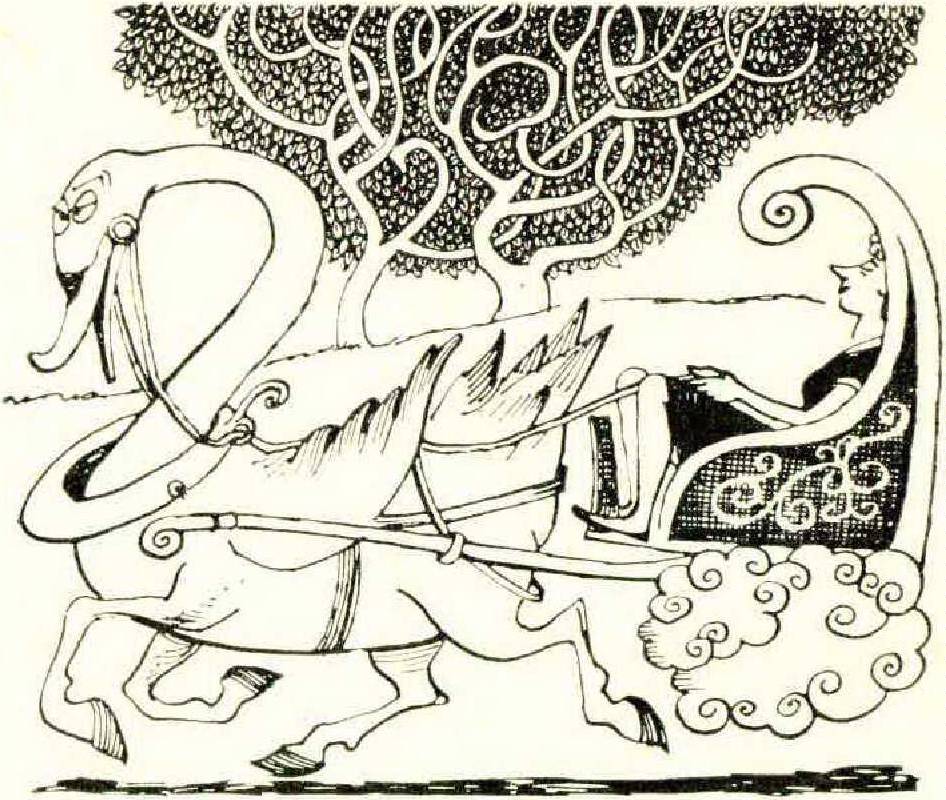
As everyone knows, it is always more comfortable driving a pony cart uphill than down; not a single spine-shattering jolt marred the ascent. We might have been on springs. We might have been in a Rolls-Royce, so smooth and effortless our progress. We might have been on the back of Lohengrin’s swan. The pony had indeed (we both now remarked on it) a pronouncedly swanlike curve to his neck; perhaps a touch of Arab? Nor was it nearly so hot in the lane, with ten-foot blackberries interlaced arcade-like overhead. Some of their branches bore grapes, others figs. Honeysuckles on the other hand confined themselves to carpeting the ground and emitting delicious odors when crushed — a nice example of modesty to giant clovers thrusting their heads practically into one’s lap and singing the Hallelujah Chorus. But how to snub them, with the pony taking solo bass? We ourselves arrived back singing seconds.
Otherwise mead has no effect whatever.