The Witches of 1966
I got in touch with Miss Ruth Tongue, co-author of Folktales of England, by devious means and called her at her home, which is a cottage in the middle of a deer park near a village some seven miles from Taunton, Somerset. Despite the fact that she didn’t know me, and there wasn’t even the scrappiest of introductions, Miss Tongue expressed no surprise when I telephoned. “Witches,” she repeated, “in Somerset, are there? Dear me, you seem to know more about it than I do.” Silence, then a sudden chuckle, and she agreed to meet me for lunch at the Castle Hotel in Taunton the next day.
The train was late, and Miss Tongue was waiting for me in the foyer. She wore a red and blue plaid cloak, thick red wool stockings, and a round hat made of patterned Shetland wool that sat on her head like a crown. My first impression was of a slimmer Margaret Rutherford.
“I’m nearly blind,” she said, indicating the walking stick she used. “They’re going to try and do something, but it’s a dreadful nuisance. ”
We went into the dining room, and Miss Tongue loosened her cloak, ordered a glass of grapefruit juice, sighed briskly, and came straight to the point. “First of all,” she said, “witches won’t talk to an outsider. I know several men and women witches who live in these parts, but it wouldn’t do any good if I were to take you to them.” She paused and looked at me through the pink-frame glasses she wore. “I can tell you some things,” she said slowly, “just a few little things here and a few little things there. If you keep your mind open and listen carefully, you will learn,” She laughed. “It’s a bit like trying to do a jigsaw puzzle when some of the pieces are missing.”
I asked her if she was an active witch, and she told me she elected not to practice the craft as her main interest was in West Country folklore and herbal medicine. “I’m a Chimes child,” she confided. This meant she was born between midnight on a Friday and cockcrow on Saturday. She said there was a lot more attached to the day of the week and hour of birth than mere ancient superstition. “You mean the ‘Monday’s child is fair of face’ jingle?” I asked. She nodded and told me a local Somerset rhyme.
Miss Tongue said that Chimes children make the best doctors, farmers, musicians, and poets. They also have a natural capacity for white witchcraft. “Except some don’t realize they have this power, and so it never gets developed, which is a great pity.”
In Somerset the word witch is used only when referring to black witchcraft — white witches are called charmers, conjurers, or wise ones.
When Miss Tongue was a little girl she lived in Taunton Castle, and because of being a Chimes child the local wise ones would tell her things. “Blacksmiths are particularly gifted people,” she said. “Horns are a sign of power, either evil or good, and the upturned horseshoe nailed to a door for luck represents the lunar horns of the Moon Goddess, Goddess of Fertility, or the Great Mother. The goddess has other names: Cybele, the crescent moon; Selene, the full moon; and Pale Hechete, the waning or dark moon. Hechete, the most powerful of all three, is sometimes referred to as the Goddess of the Crossroads — traditional meeting place for witches.”
The waiter brought our main course, and Miss Tongue went on to talk of the late Dr. Margaret Murray, whom she had known. Dr. Murray was a well-established Egyptologist when she started her research of witchcraft, approaching the subject from the anthropological view. According to Dr. Murray, long before Christianity there was an organized religion in Western Europe with well-defined rites. The two main festivals were May Eve and November Eve, indicating that this cult was pre-agricultural, coming before the solstitial division of the year. The witches of 1966 still celebrate these two dates as being the most important festivals. The fertility rites paid little attention to crops and harvest but focused on the increase of livestock. The god of the cult was at first an animal and later a two-faced man wearing a horned headdress. A present-day male witch (they don’t call themselves warlocks), told me that this idea of two faces was because the god was masked, which meant he had his own real face as well as that of the mask.
“Remains of fertility dances are still performed in Abbots Bromley, Staffordshire,” said Miss Tongue. “Eight male dancers go from village to village, and they wear actual antlers on their heads.” She explained that this had no connection with the black witchcraft practice of wearing a two-horned headdress with a cross fixed to either horn and a black anti-Christian candle in the center.
Miss Tongue then told me of an old spell used to harm an enemy by driving a nail through the person’s footprint. “It lamed them instantly,” she said, “prevented them from getting around and doing their dirty work. Mind you, this was a special nail the blacksmith made solely for that purpose.” She popped a piece of roast chicken into her mouth and continued cheerfully. “Shape shifting,” she said. “The last witch to be executed in England was hanged right here in Somerset in 1666. They hanged her because she used to change herself into a hare and cause damage to farms. There is a café a few miles away in Brendon Hills called Lady and a Hare.” Miss Tongue paused for a moment. “Oh, yes,” she said, “shape shifting was a terribly common thing. There’s the story of the young boy watching the horses and hounds in hot pursuit of a fox. ‘Run, Granny,’ he shouted, ‘run! run!’ Then later on they’d find the old lady back in her cottage gasping and panting for breath.”
Miss Tongue told me that witches didn’t like to be hanged. They much preferred to be burned because that way their power was destroyed with them and their children were safe. Hanging didn’t destroy their power, which could then pass on to their descendants. “Fire eliminates all,” said Miss Tongue, as she chose a steamed pudding for dessert.
I waited for her to continue. “It’s fear,” she said; “fear of the unknown darkness within is just as basic today as it ever was. I know people even now who keep loads in boxes as their familiars. Goose feathers have a magic property also. One man uses feathers from a gander for his witch’s ladder — that’s a rope, about five feet long, with certain feathers on it. It’s used to summon people. Once he casts the spell that person will and must come to him.”
We adjourned to the hotel lounge for coffee, and Miss Tongue accepted a cigarette before proceeding to tell me a few other “little things.”
“Witchcraft thrives on dark hours,” she said. “In olden days all the farms closed down on the eve of Candlemas [February 1], and the whole family retired to bed. ‘Put your box of matches away, for tomorrow will be Candlemas Day.’ No lights were visible, and the countryside was plunged into darkness. The custom is dying out now, but it still exists in more remote rural areas.”
We talked on, and Miss Tongue told me two stories. The first was about the circle of standing stones at Stanton Drew, near Bath. One Saturday evening there was a wedding party, and the guests were dancing. When the hour approached midnight the piper refused to play for them into the Sabbath, so they raised the devil, literally, who at once provided music. The party gaily continued, but at daybreak all the dancers suddenly turned into stone. According to legend, anyone who tries to count the number of stones in the circle will die within the year.
The second story was about the Drawing the Line spell. There was an open country road with a rhine (dike) on either side of it which was the only means of access to the nearest town. All the farmers drove their sheep and cattle along this road to market. One particular farmer, who was a witch, put a spell on the road to stop the others from driving their animals in to be sold. He drew an invisible line across the path, and neither man nor beast could pass it. The only way the line could be broken, thereby releasing the spell, was to get someone to cross it from the opposite direction. “That is a true story,” said Miss Tongue. She hesitated, then added: “There is another way to dispel the invisible line, which involves salt or a piece of bread and the striking of three matches in a special fashion, using crisscross signs.”
We finished our coffee in silence; then Miss Tongue gathered together her handbag, walking stick, and a pair of wool mittens. “Yes,” she said, “the old religion has never really died, it simply went underground for a time. Now the craft is springing to the surface again” — she made a piano-playing motion with one hand—“a little bit here and a little bit there.”
I was lucky enough to get an introduction to a coven of witches who practice the craft in London. The shape of power in a coven is rather like a pyramid. At the top is the high priestess, next comes the high priest, and then the elders. Witchcraft is basically a religion — a form of nature worship. The names of the witch gods and goddesses are kept secret; they are not considered entities but symbolic leaders of the various rites performed. One of the main concepts of the craft is to work and think in symbols because it increases the force of power raised by the group.
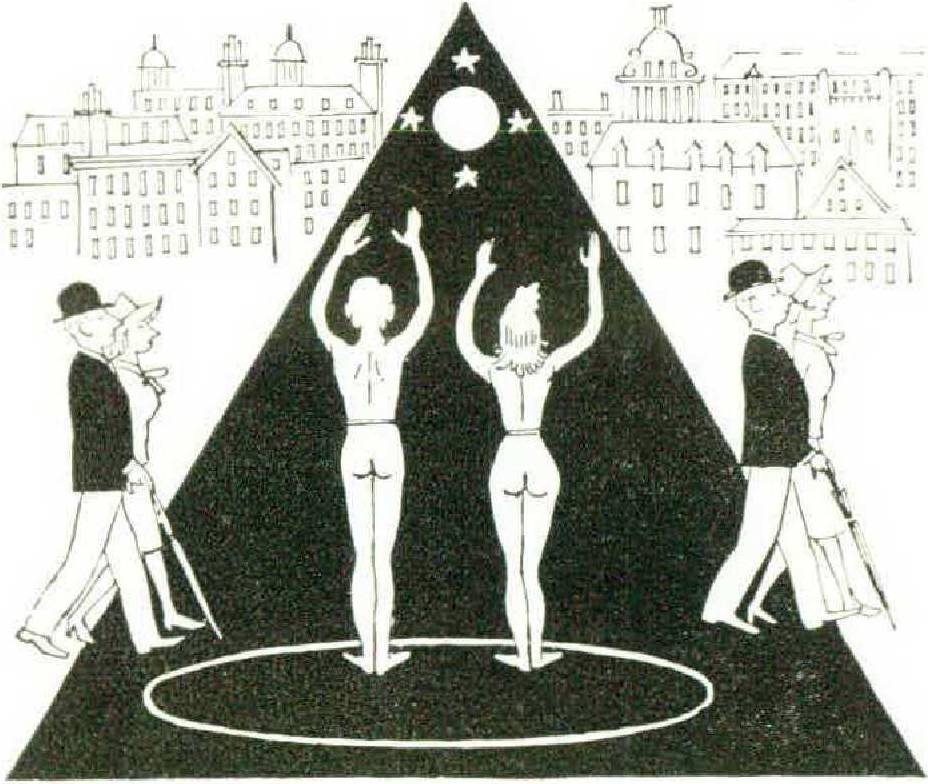
A nine-foot circle is drawn with the sacred black-handled knife called an athame, and within this circle the priest and priestess represent the witch gods. British covens mostly hold their meetings indoors for a purely practical reason — the weather. As it is therefore impossible to draw the circle in earth, it is marked out with chalk or charcoal after first being traced by the athame.
Altogether there are eight festivals during the year. These are divided into the four great sabbaths, which fall on May Eve, August Eve (also known as Lammas), November Eve, and Candlemas. The remaining four are the spring equinox on March 21, the summer solstice on June 21, the autumn equinox on September 21, and the winter solstice (sometimes referred to as Yule) on December 21. The sabbaths are older and tie in with the breeding season of animals. There are special ceremonies for each festival, and, if possible, new members are initiated at these times. Covens vary from one part of the country to the other, but in general the rituals follow a similar pattern. Apart from the festivals, the covens meet once a month as near as possible to the time of the full moon to celebrate a less important ceremony known as the Esbat.
The men witches in the London coven outnumber the women, and there are more than the traditional thirteen members in the group, which includes a doctor, a secretary, a lawyer, a civil servant, and a factory worker. Ray, the high priestess, told me: “Thirteen is not necessarily an ideal number for a group working in a nine-foot circle. More speed of energy is generated with additional people.”
As well as being a high priestess, Ray (who is a registered nurse) is also the liaison officer for southern and West Country covens in England. She impressed me as being a forthright, sensible woman. “We are all so sick and tired of those ridiculous stories about witches. We don’t eat babies, nor do we fly over chimney tops on broomsticks.”
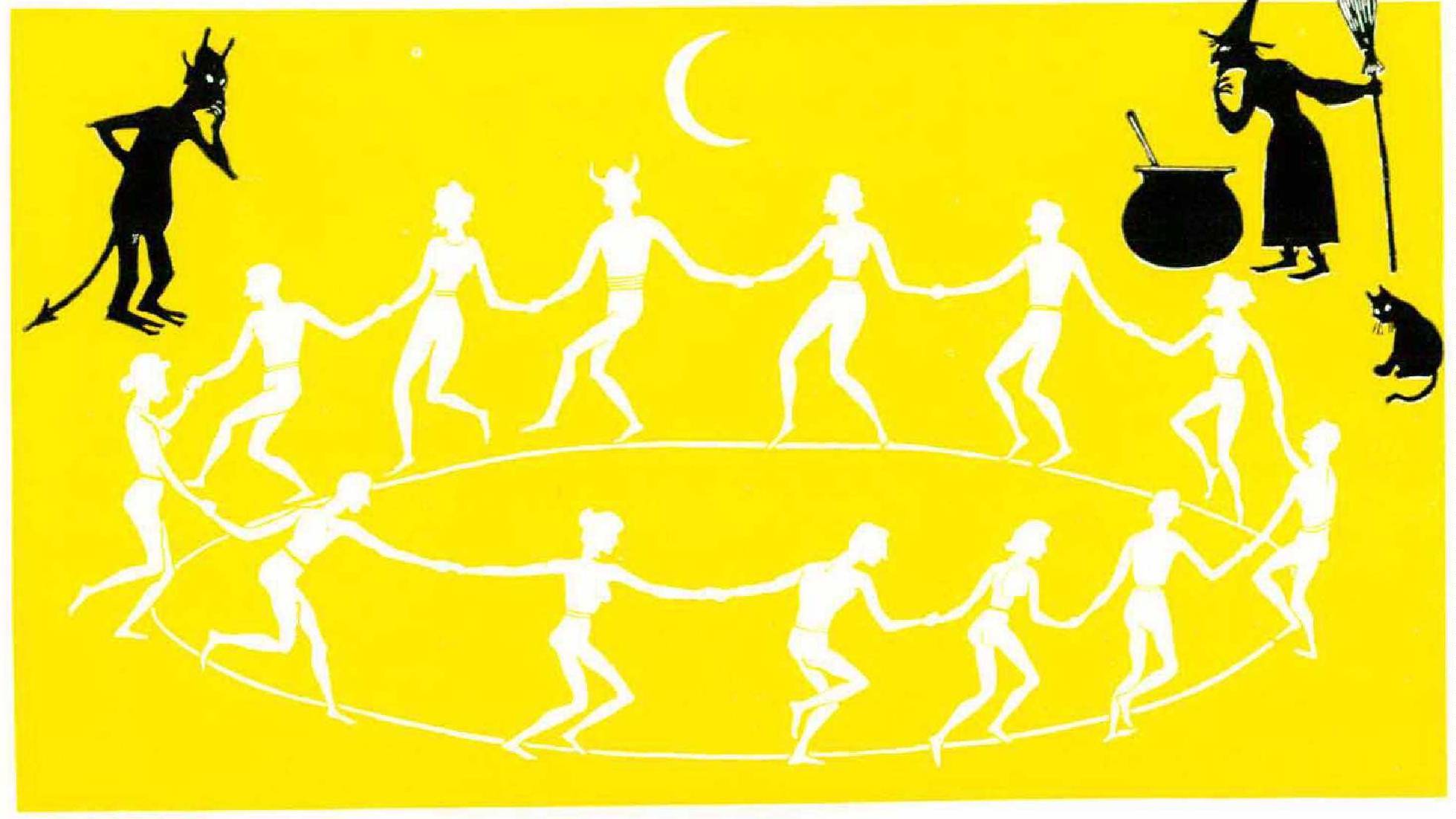
I asked her what was the main purpose of being a witch apart from observing the various rituals. “Basically our aim is to help others by using our collective power,” Ray said, “and we succeed usually.” The coven receives many requests for aid from people in trouble — usually the problem is to do with health. The priest or priestess tells the group what “the business at hand” is, and sometimes they will concentrate on a picture of the person they are going to help, frequently a total stranger. They chant in a rhyming, unknown language, and holding hands, dance around the circle. Unlike some other covens, the London one doesn’t use any music but will occasionally have drums. At no given time the dance will suddenly stop—“it just happens that way,” Ray said. Then the group concentrates on the healing wish, summoning up their collective force until something “rather like an electric current” vibrates through them. In cases of very serious work, and only then, they perform the ritual of Drawing Down the Moon. Ray explained that this was a drawing down of power from outside and was very rarely done.
By the same token, the force generated by the group can be used in another way. For example, if someone is spreading malicious gossip and causing harm, then a doll might be made in his or her likeness. The lips of the doll are stitched together amid the proper incantation, and I was told the result is very effective in silencing the troublemaker.
The art of developing this power of concentration takes time and a great deal of practice. There are special exercises that help develop discipline of mind. The beginner starts off thinking of something relatively easy, such as a triangle or some other simple shape, and gradually works up to more advanced levels. The idea is to empty the mind of everything but the desired image and retain that picture for as long as possible.
Arthur, a quiet-spoken man in his forties, is the high priest of the coven. When I asked him why he had become a witch, his answer was very similar to that given by the other witches. “It was a gradual thing,” he said. “I was seeking for something without knowing exactly what that something was. I was dissatisfied with the way of life offered by Christianity, and one day I began to read about the craft. The whole concept of the cult fascinated me, and I read all the books I could get hold of on the subject. Then I met someone who put me in touch with the coven.”
Every Wednesday evening members who are free meet at Ray’s house. These gatherings are informal over cups of tea or coffee and are a means of getting to know a prospective member, by letting him come and join in the general conversation. Arthur told me they don’t ask the candidate any special questions, but just talk. If the person seems genuinely keen on joining, he is given a list of recommended books to read. “Is there any reason why you would turn someone down?” I asked. “Only if we felt they wouldn’t fit in with the rest of our group or if we thought they weren’t truly sincere,” Arthur said. “Unfortunately,” he added, “because of the public’s growing interest in the craft, we get the occasional crank or thrill-seeker trying to join. Some will even offer us money to be accepted. Most of all we don’t want a person seeking a prop or crutch. The craft believes that all strength and power has to come from within the individual.”
I became friendly with an attractive young witch named Bronwen, who is engaged to be married to another witch. Bronwen grew up in a tiny village in west Wales, and her father once said to her when she was a child: “Don’t mind the pictures of witches you see in storybooks with their funny hats and ugly faces. You know real witches here in the village, and they don’t look like that at all. They are ordinary men and women.” After studying medieval literature at a university, Bronwen came to London to work as a teacher. It was only then that she became actively interested in the craft, and now she is a high priestess in her own right and could start a coven if she wished. When Ray is absent for any reason, Bronwen takes her place.
Bronwen told me as much as she is allowed to about what happens at the festivals. There is a strict vow of secrecy; even Ray’s husband is never permitted to attend because he is not a witch.
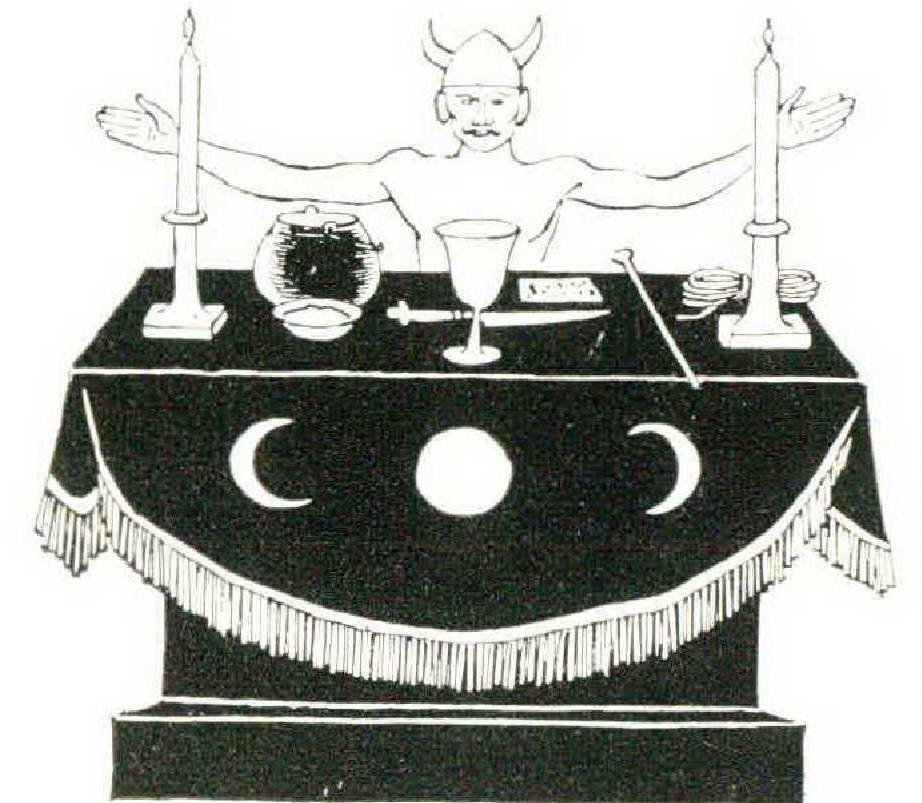
All members of the coven are naked and wear a garter, really their white initiation string, around their waist. The priestess has three, signifying the material, mental, and spiritual aspects of life. The women wear necklaces, which can be made of pearls, metal, glass beads, and so on. The necklace is a circle, and therefore another symbol of eternity. The priestess wears a special silver bracelet on her arm (silver is the color of the moon) engraved with symbols and her witch name. There is an altar on which are placed various tools of the craft: a silver chalice, candles (which in this coven are not black but usually a color suitable to the time of year, such as green for May Eve), a wand generally made from hazelwood, a small caldron, a censer filled with incense, a pentacle which is a flat piece of metal engraved with witch signs, a length of cord, a scourge, a bowl filled with salt, and the black-handled athame. Each tool has a special meaning. The caldron represents water and the Mother Goddess; the wand is the male phallus and fire; both salt and the scourge symbolize purification; the pentacle is earth; the athame is air; and the cord is the spirit that unites all elements.
Some use is made of belladonna and also the amanita mushroom, which is either brewed or eaten raw. The mushroom has the effect of heightening awareness and can even produce hallucinations. Scrying, which is a form of crystal gazing, is a common practice, and witches divine things in water, black ink, dark mirrors, or a polished stone.
Along with the Druids, witches believe in reincarnation of the spirit. This follows the natural law of change brought about by the seasons. Winter is the apparent death of the earth, and spring the rebirth. Without life there cannot he death, and vice versa. Thus the Horned God represents both fertility and death — not the Christian concept of the devil at all. The witches believe in a destructive force and a changing rather than death per se.
As high priest, Arthur comes into his own during the winter months when he represents the Horned God of the underworld. “Starting with Halloween, our November Eve festival, the god is honored rather than the priestess,” he said. “It’s to do with the germination of the seed in the ground, and I wear the horned headdress, a two-horned helmet rather like a Viking’s. There’s a special short ceremony, and the women salute me with a kiss.”
On May Eve the priestess again takes over, and this is the time when fertility rites are performed. Again the ceremony is purely symbolic, and not, as I had previously thought, a wild sex orgy. Arthur did tell me one story about last May Eve and a married couple who attended. Nine months later their baby was born. “I hasten to add,” he said, “that conception did not take place at our festival!” There are special dances for May Eve, one of them being the jumping dance, to make the crops grow tall. Another one Arthur told me about is the fire dance, which they do if they are able to celebrate the rites outdoors. They light a bonfire, and holding hands dance right through the hot embers without anyone hurting himself.
Bronwen could disclose very little about the actual initiation, which is kept a top secret. The ceremony lasts for approximately a half hour. “I remember how scared I was before being initiated,” Bronwen said. The candidates are blindfolded, and their hands tied behind their backs before they are led naked into the circle. According to custom, Arthur initiates all women members and Ray the men. The leader of the coven touches their breasts with the athame and warns them it is better to die than join the craft with fear in their hearts. The wording of the ritual then offers them the chance to change their minds and turn back. “Perfect love and perfect trust” is the reply. Many covens “purify” the newcomer by a token scourging — first three times, then seven, then nine, and finally twenty-one. The London coven doesn’t observe this part. The tools of the craft are shown, and then the novitiates are consecrated with oil and wine. The members each have their own athame, which they make themselves and keep always. They don’t hang these knives on the garter cord around their waist but carry them in one hand. At the end of the initiation the coven has traditional cakes and wine, which are served at every Esbat and festival.
There is a second initiation when the person concerned becomes a high priest or priestess. This differs from the first in that there is no blindfolding and it is the candidate who “scourges” the priest or priestess, but with three times the number of strokes. At the second degree initiation the candidate receives a red garter string and may then choose a witch name.
When I asked Ray if she believed black magic was practiced today, she was quite firm in her conviction that it was not. Certainly some incidents which have been attributed to black witchcraft were more likely to have been the work of vandals or people with a warped sense of humor. For instance, there was the case of a pig’s head which was placed on a wooden cross between two other crosses on Tooting Bec Common, a London suburban park. “Yes,” said Ray, “and didn’t they all feel silly when they found out it was done by teen-agers from a local school!” However, not so innocent was what happened two years ago at St. Nicholas Church, Bramber, a village near Brighton. I spoke to the Reverend Ernest Streets, who was the rector there at the time. He told me he arrived at the church early one Sunday morning to find a huge stone cross had been dislodged from a grave in the churchyard and placed against the main door along with a pile of rocks. Statues of angels had been broken and thrown on the ground. The door itself was covered with such black-magic marks as a circle with a dot and cross drawn through it.
“It made me very wrathful,” said the Reverend Streets, “so I called down the church’s curse upon those responsible. I cursed them and their families until they should repent.” Shortly afterward the cross was replaced one night, and the rector then removed the curse.
Another incident happened at a Norman church named St. Mary’s in the village of Westham, Sussex. I spoke to Mr. Walter Binsted, who was, and still is, a bell ringer there.
“It was the time of the church’s Christmas fair,” he said, “and I was standing at the gate just as dusk was falling. Four young men passed me and went into the church. After a while it was quite dark, and I thought they would need some light, so I went inside to put it on for them. The men were standing with their backs to me, facing the altar, and chanting in some foreign language. I don’t know what it was, but it wasn’t English. They had taken four candles from the altar and placed them, lighted, on the floor so they formed a cross.”
Mr. Binsted ran next door to the church hall and fetched the vicar, the Reverend Harold Coulthurst, an elderly man who is now dead. Together they went back to the church, and the vicar challenged the men. They roughly pushed him aside and ran off. Later, when the police came, they noticed that the cross on the altar had been spat upon with great thoroughness. The vicar was convinced it was black witchcraft and reconsecrated everything, including the altar cloth.
Although the white witches are strongly in the majority, there is still a lot of superstition connected with the craft. Bronwen told me about a young Catholic college girl who was introduced to her one Sunday morning. Upon discovering that Bronwen was a witch, she gasped, “Oh, dear, I’ve just come from Mass!”, and seemed afraid to shake hands in case Bronwen might disappear in a cloud of smoke.
“There are many of us now,” said Arthur, “and the number keeps growing all the time. The old religion is a deep-rooted thing. Don’t forget witchcraft was practiced long before Christianity came on the scene, yet despite persecution by church and state, it managed to survive through the centuries.”
Ray was getting a bad cold and doctoring herself with her own special recipe — a raw onion sandwich, which she detests but claims works very well. Amid much facemaking, she finished it and poured another cup of tea. “Our gods,” she said, “became the Christian concept of the devil, although they did borrow the female deity from us when they discovered a need for a mother image to worship.”
I asked her what the basic premise of the cult was, and she said, “We worship the god or goddess incarnate in human form according to the natural cycles of the year. It is basically a very simple belief, which is precisely what makes it so strong. Nature doesn’t change because of the atomic bomb or television. We believe in helping people, and most of all we believe in joy.”
Arthur looked serious. “One day we shall regain our place of esteem in the world.” He smiled and added, “Until then, merry meet, merry part” — which is the witches’ farewell.