Consensus Politics: End of an Experiment
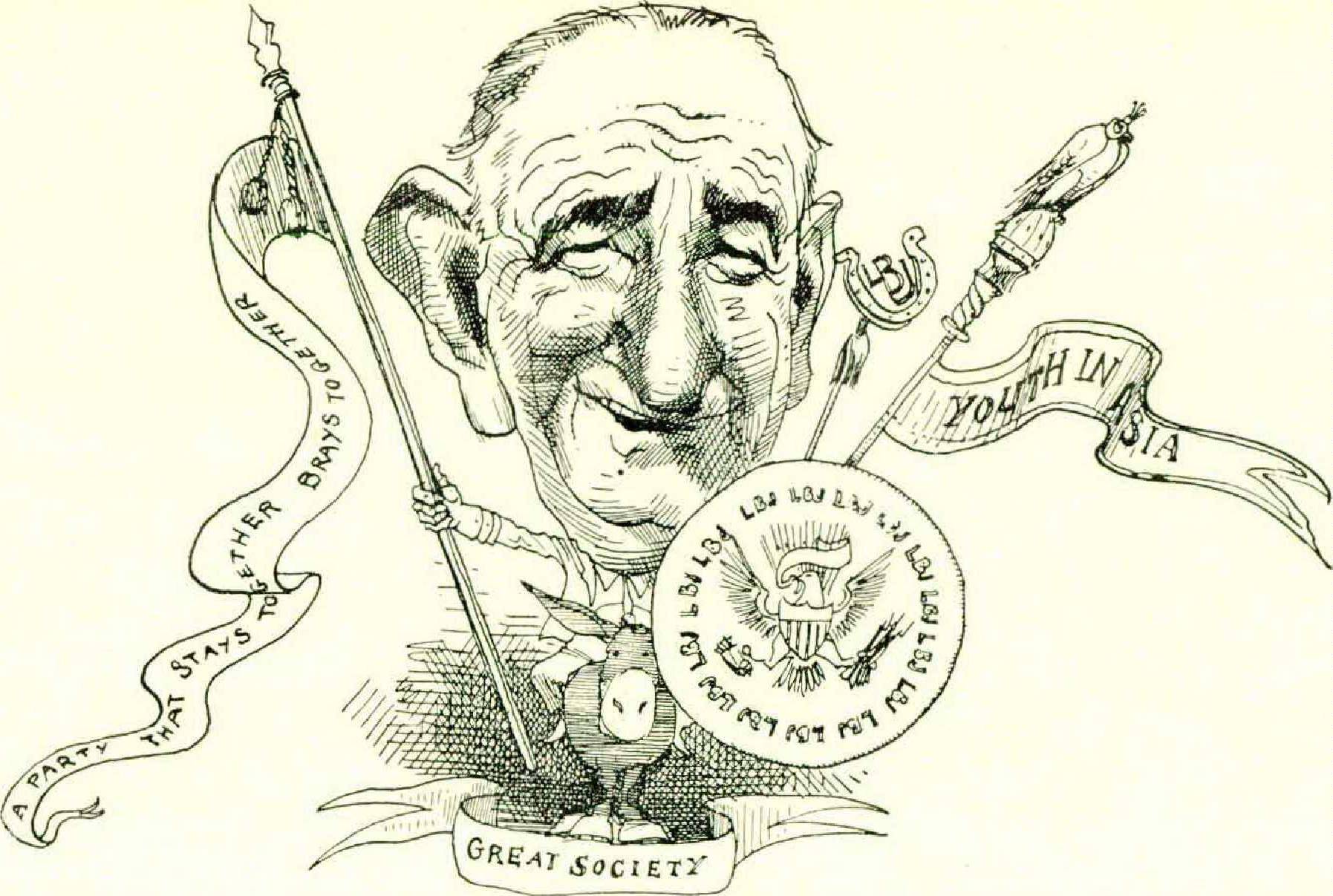
by David S. Broder
THE conversation was in the tiny anteroom just off the formal Oval Office. It is a place where Lyndon B. Johnson likes to relax with a cool drink for an hour or two during his long working day. It was Friday evening, August 21, 1964, the Friday before the opening of the Democratic convention which would demonstrate to all the world that this remarkable man, twice frustrated in Democratic conventions, now controlled the Democratic Party, lock, stock, and pork barrel. Lyndon Johnson had become the Democrats’ President by the acts of two other men—John F. Kennedy and Lee Harvey Oswald — but in this next week he would put the indelible stamp of his personality on that party in everything from the choice of the vice presidential nominee to the decorations in Atlantic City’s Convention Hall.
Now, on the eve of what he knew would be his triumph, he was indulging his favorite sport of reading his public opinion polls to two callers. He rattled off his percentages from this state and that, and then remarked on what seemed to him the most significant finding of them all.
“You see,” he said, jabbing his finger at one page of the bulky report on a Midwestern state, “right here’s the reason I’m going to win this thing so big. You ask a voter who classifies himself as a liberal what he thinks I am, and he says ‘a liberal.’ You ask a voter who calls himself a conservative what I am, and he says ‘a conservative.’ You ask a voter who calls himself a middle-roader, and that’s what he calls me. They all think I’m on their side.”
Mr. Johnson fashioned his campaign for the presidency on that premise and won the most sweeping popular-vote victory in American history. Before and after that election, he tried to make the Democratic Party a home for all those voters who thought Lyndon Johnson was “on their side,” and in so doing, he markedly changed the character of that party.
Today the polls make far less pleasant reading for the President. The consensus he sought is crumbling visibly. His party is in serious difficulty in the major states, and a breach appears to be opening between the President and his Vice President on one side, and younger Democrats who identify themselves with the cause of the Kennedys on the other.
None of this is news, of course, but the rudimentary facts must be set down as a preliminary to the examination of cause and effect. I hope to outline in the next few pages a theory — and admittedly, it is no more than a theory — of what might be called the rise, the flourishing, and the decline of Lyndon Johnson’s “consensus politics.”
The hardest thing for a journalist to do is to recognize a genuinely unique occurrence. So many events are just variants in the familiar pattern that we tend to seek out resemblances and ignore what is original. The Johnson era in Democratic politics is, I believe, unique. Let us begin with a simple but little-noted fact. Lyndon Johnson is the first President in our lifetime and longer who comes from a one-party state. The pressures of nominating-convention politics normally operate to produce presidential candidates from the swing states with big blocs of electoral votes, where the two-party competition is most fierce — men like Dewey and Roosevelt of New York, Stevenson of Illinois, Nixon of California, and Kennedy of Massachusetts.
The Party in Power
In April the ATLANTICinvited three topflight political reporters to examine the policies, the men, and the money of the Republican Parly. This month we present an equally sharp study of the Democratic Party: LBJ’s short-lived experiment in consensus politics; the state of Democratic finances; and the most fascinating rivalry within the party, that between the Johnson and the Kennedy forces. David S. Broder, who has been covering Lyndon .Johnson ‘s shifting relationship to the Democratic Party since 1955, resigned recently from the Washington bureau of the New York TIMESto become the chief political reporter and columnist for the Washington POST.
Lyndon Johnson is the product of a very different kind of politics. While Texas has voted occasionally for a Republican presidential candidate and currently has one Republican senator, the affairs of the state, in both Austin and Washington, have been managed throughout Lyndon Johnson’s lifetime almost exclusively by and through the Democratic Party. The real power struggles in Texas politics have been resolved, not between the parties, but within the Democratic Party — and for thirty years Lyndon Johnson has had an ever increasing role in resolving them.
I believe that the President’s “consensus politics” is rooted in his Texas experience. In Texas, the Democratic Party for years has included most of the major elements found in the national Democratic Party: labor, the Negro and Mexican-American minorities, farmers, small-business men, and the less prosperous portions of the middle class.
But in addition to all these groups, the Texas Democratic Party has also included and effectively represented big-business men, oil and gas men, banking and insurance men, the educated, the wealthy, and the wellborn — the groups that in two-party states provide the money and manpower for the Republican Party. In fact, the Texas Democratic Party includes many who are in everything but their nominal allegiance Republicans.
I well remember my shock when, as an outsider, in the spring of 1960 I attended the state Democratic convention in Austin which endorsed Lyndon Johnson as favorite-son candidate for President. The members of the Dallas County delegation were openly wearing Nixon buttons on their lapels, but so flexible was the definition of a Democrat in Texas, even a Democratic convention delegate, that no one challenged their right to be there. Four years later, when Mr. Johnson was finally on the ballot for President, many of those old Nixon-Democrats worked for him and helped him carry Dallas.
It is no exaggeration to say that Representative and Senator Johnson and his colleagues in the Texas Democratic Party for many years suppressed the emergence of a Republican Party there by taking in and giving service and satisfaction to the business groups and others who normally would have financed and supported the Republican Party.
Thus, when that same Lyndon Johnson as President of the United States said he viewed the Democratic Party as “a great big tent,” big enough to hold Henry Ford II and Walter Reuther, Martin Luther King and Orval Faubus, John Connally and William Fitts Ryan, he was simply applying on the national scale a technique that had kept the Democrats in control of Texas for generations.
SOMETHING FOR EVERYBODY
The Johnsonian technique involves more than just the standard political wisdom of staying in the middle of the road. What makes it unique is its willful effort to expand personal and party support to the point where the opposition is left with nothing to organize except fringe-group sentiments. When the opposition obliges as nicely as the Republicans did in 1964, the technique can be dazzlingly successful.
The Model-T-for-Texas Democratic Party that emerged with a landslide majority from the 1964 election was a different creature from what it had been up until that time. Not all the differences were understood by the Democratic officeholders, officials, and workers who cheered Lyndon Johnson’s inaugural. Nor was there any reason why any of them except the Texans should have been able to guess what the consequences would be. For it was that rare thing — something new in politics.
With the experience of almost three years of Johnsonian politics now behind us, we can see at least five distinguishing characteristics of his leadership techniques and their effects on the Democratic Party. First, his consensus politics is based on support from diverse elements of the electorate. To hold this wide variety of support, the President as party leader must provide some sort of incentive or reward to each of the major groups in his assembly.
Thus, Mr. Johnson was required last January, even in a time of rising defense expenditures, to lay before Congress a broad-front program of domestic proposals: from civil rights, to improvement of cities, to health and education measures, to repeal of right-to-work laws, to reform of election and campaign spending regulations. Not all these programs, by any stretch of the imagination, were of vital importance to him at the moment, but each of them had significance, at least as a symbol, to one or more of the groups that supported him. As Samuel Lubell wrote, “The instrument that Johnson wielded with truly revolutionary political impact was the federal budget. No previous budget had ever been so contrived to ‘do something’ for every major economic interest in the nation — medicare for pensioners, tax rebates for business, loosened production controls and a subsidy boost for farmers, antipoverty grants for Appalachia and for Negro slums, educational aids for a generally school-conscious public.” The President had so many irons in the fire, one Democratic congressmen remarked, “he damn near put the fire out.” Such prodigality is necessary, for a consensus President cannot concentrate on one goal at a time without seeing his coalition split.
A second characteristic of Johnson-style politics is that it depends for its success largely on the skill, negotiating ability, and maneuvering of the President. Only the top man is in touch with all the diverse elements of his coalition. Only he knows how strong the civil rights bill must be to keep Martin Luther King pacified, whether the auto manufacturers will or will not put on all their pressure to kill reimposition of the excise taxes, whether George Meany will really cut off funds to Democratic candidates if 14(b) is not repealed. “This is,” a veteran politician told the Associated Press’s Saul Pett, “the most personalized presidency in our history.”
COURTING THE LEADERS
A third characteristic, closely related, is that in consensus politics the President’s relationships with “group leaders” are more crucial than his relationship to the general public. The tip-off to Johnsonstyle politics came in the parade of personages through his White House office in the first shattering days after the assassination — foreign rulers first; then the rulers of the various domestic domains, the congressional satraps, the governors, the labor leaders, the top businessmen, the civil rights spokesmen, and, not least, the clergymen. Everyone with an identifiable constituency was drawn in to support the President in those first few critical weeks — and none of them has knowingly been cast out since.
Several, of course, have left of their own volition, some because they disagreed with the President’s policies, others for more personal reasons. Mr. Johnson tends to be demanding of those who profess unquestioned loyalty but is accommodating to those who show signs of resistance. The turnover in his personal staff has been high. The rate of attrition in personal friendships among old and intimate political allies like Senator Mike Mansfield and Governor John Connally has been equally severe. But it is significant that neither of these men, nor any of the labor, business, or minority group leaders who have shown an inclination to wander off the LBJ ranch from time to time, has been allowed to stray far away. Mr. Johnson’s politics do not permit him to indulge in the luxury of letting personal feuds imperil vital political alliances.
His reaction is always to reach out for the enemy and bring him back into camp. In the midst of the 1964 campaign, Mr. Johnson went straight from a partisan rally in downtown Indianapolis to a private luncheon with the city’s archconservative publisher, Eugene Pulliam, a close personal friend of Barry Goldwater’s. (He called on him again when starting his 1966 political forays in Indianapolis.) The President will do political business with anyone, and partly as a result of that fact, he commands deep-felt attachment from few.
Here we come to a crucial difference — crucial in its implications for the Democratic Party — between the Johnson leadership and that of a Roosevelt or a Kennedy, who based their power on their personal popularity with millions of individual voters. Their leadership necessarily involved the alienation, from themselves and their party, of millions of others. Some historians have suggested that Roosevelt practiced a form of consensus politics in his first term and even later, when he included Republicans in his wartime Cabinet. But, like Kennedy (who was automatically alienated by religion and the civil rights issue from millions of voters), he reveled in the opposition of businessmen and freely invoked the rhetoric of party loyalty. Both men were loved for the enemies they made. Mr. Johnson is not. The enthusiasm he stirs in the public at large is negligible.
He would not, as Roosevelt did, think that he could appeal to the mine workers over the head of John L. Lewis. In this summer’s frustrating airlines strike, his appeals were always to the Machinists’ Union officials, not the rank and file. His technique is to court the leaders — George Meany, Martin Luther King, the members of the Business Council, and, not least, Everett Dirksen — and count on them to keep their constituents in line. In Texas they had a saying, “Lyndon Johnson doesn’t have an organization; he uses everybody else’s.” It recognized the history of his ever shifting alliances within the state, but more profoundly, it reflected the fundamental nature of his leadership — that Mr. Johnson does not deal with The Public; he deals with a great many little publics, and he deals with them through their leaders.
That is why, even though he advocates and enacts programs of far-reaching social consequences, this President is fundamentally, like almost every other Texas politician, an Establishment man. He recognizes as legitimate other men’s claims to power in the areas they control. He seeks solutions to problems that will permit them to preserve their power base as he preserves his. He is protective of their status and interests, and they in turn tend to protect him.
NO PARTISANSHIP
The fourth general characteristic of consensus politics stems directly from the basic Johnsonian technique we have been describing. His politics automatically minimizes the degree of partisanship that is permitted and reduces the role of the party organization in government. Partisanship, like race prejudice or class warfare, is the enemy of consensus. The decimation of the Democratic Party structure — the abolition of the centralized voter-registration effort that was the keystone of the Kennedy campaign, the 50 percent cutback in manpower at the Democratic National Committee, the collapse of communications between Washington and state party chairmen — all these things have been described by critics as an expression of the antagonism to party organization that has been growing for eighteen years in Mr. Johnson, ever since he ended the first phase of his political career as a loyal Roosevelt agent within the Democratic Party.
The man who fought the Democratic National Committee openly in Paul Butler’s day has told its current proprietors, “I’m damned if I can see why one guy and a couple of secretaries can’t run that thing.” Under him, the national party is beginning to resemble the Texas party, where the formal structure of state and county chairmen exists only on paper.
In Texas, the governor runs the state convention, just as Mr. Johnson ran the 1964 national convention. Officeholders and candidates build their own personal organizations. Sometimes they use them to help each other and sometimes to war on each other. When a party campaign must be organized in a presidential year, the work is done by lawyerlobbyists, men on loan from the big companies and union business agents. That is the way Lyndon Johnson staffed the key spots in his national presidential campaign. These part-time lawyer-lobbyists are his substitute-in-readiness for the party organization which the Kennedys had begun to build and he has methodically torn down.
But all this, I believe, reflects something more fundamental than the “Texanization” of the party structure. A party organization, in textbook terms, functions on vertical lines to unite the purpose and power of the President and his national committee with those of Democratic governors and their state committees and local Democratic officeholders and their committees. But consensus politics operates on horizontal lines, with the President reaching out, across party barriers, for other leaders, who in turn bring along their followers to his cause. Thus, it is almost inevitable that a consensus President from a one-party state would ignore the party organization.
NEGOTIATION BUT NO DEBATE
Fifth and finally, consensus politics emphasizes decision-making by private negotiation, not public debate. Debate only arouses strong feelings and tends to lock people into antagonistic positions. Consensus politics tries to minimize such feelings and encourages everyone to maneuver his group into position for a compromise. The President’s favorite plea “Come, let us reason together” does not mean “Let us gather in our schools, our legislative halls, or even around our television sets and hear our wisest men debate the issue, that we may arrive at a reasoned judgment.” Rather, it translates, “Come, let us act like the practical men we are, sit down around the table, shut the doors, and work this thing out on a basis we can all live with.”
There are hundreds of Washington anecdotes, from his days as Senate leader right up to his latest devices for avoiding press conferences, which illustrate Mr. Johnson’s inherent antagonism to public debate as a positive function of democratic decisionmaking. My own favorite story concerns the phone call he made to Senator J. W. Ful bright two years ago, after Fulbright had delivered his celebrated speech on “old myths and new realities.”
This was long before their serious split on Dominican and Vietnam policy and at a point where Fulbright’s purpose was nothing more or less than to reopen the basic assumptions of American foreign policy to critical public examination. As the senator tells it, Mr. Johnson’s remarks were in the vein of, “Bill, old pal, you know my door is always open to you. There’s no need for you to go soundin’ off on the Senate floor if you’ve got some little old thing that’s troublin’ you. You just trot on down here, and we’ll see if we can’t take care of it for you.”
Abhorrence of public debate has its necessary concomitant in the effort to enforce strict secrecy and to keep the press out of the way during the decision-making or negotiating stages of policy formation. The technique is a useful, almost necessary device for a consensus President. But, as with Fulbright, it involves serious risks of alienating not only those who disagree with the final decisions but also those who disapprove of the methods by which they are reached.
Simply to describe such a system is to indicate how far it diverges from the sort of presidential leadership and party leadership we have known in the past. Indeed, it is so alien to the concepts and patterns of modern American politics that it seems remarkable in retrospect that President Johnson could make it work at all, let alone flourish as brilliantly as it did from his accession in 1963 through the end of the 1965 congressional session. I know of no other explanation for its success than the genius of the man for this peculiar style of politics — and “genius” is, I believe, the proper word.
Entering office in a time of national shock and grief, he refused to permit the nation to be paralyzed by its emotions, but instead harnessed them for a great forward thrust in the field of social legislation and civil rights. In the 1964 campaign, if he did not generate mass adulation, he concocted a substitute for it, blending fear-of-Goldwater with his own superenergized appearance as circus barker-cumpreacher-cumpolitician-cum - handshakercum-haranguer, that registered as strongly at the polls as if it had been a genuine ground swell of affection. In 1965, he whipped through the Congress the greatest mass of social legislation in thirty years, so great that it all but destroyed a generation of theoreticians’ strictures about the inability of Congress to keep pace with the country’s needs.
THE SQUEEZE IS ON
The President has come a cropper, it now appears, on Vietnam. The rising cost of that war, in human terms and in treasure, is forcing the consensus President to do that which is most difficult and politically dangerous for him and his party: to assign priorities and choose between goals. In his salad days of 1964 and 1965, President Johnson managed almost literally to keep everybody happy. So long as profits stayed high, what did businessmen care if he squandered, as they put it, $2 billion in a war on poverty? If income taxes were being reduced for the young father, what did he care if the President simultaneously was boosting benefits and adding Medicare for the elderly?
But now the squeeze is clearly on. All year long the Administration has been walking the tightrope on a tax increase or a Reserve call-up, either of which would signal an end to domestic business as usual. In avoiding them, it has resorted to economic policies that have brought both tight money and inflation. Politically, the once happy allies of the Great Society consensus are chewing on each other. Labor is angry over the failure to repeal 14(b); the farmers are blaming Freeman for allegedly trying to slow the rise in food prices; the South is sore at the school desegregation “guidelines”; and even the freshman Democrats elected on Mr. Johnson’s coattails are chafing visibly at the rubber-stamp label.
As Alan L. Otten pointed out in the Wall Street Journal, the stance Mr. Johnson was forced to take in Congress this year was difficult to defend. He told Congress first “that it cannot cut any of his proposals a penny, because every cent is urgently needed to overcome long-accumulated and burdensome national deficiencies, but, second, that it cannot add a penny to what he has asked because that would aggravate inflationary pressures.”
Mr. Otten noted, “This does not sit well with Congress. Many Senators and Representatives feel the President cannot reasonably expect to have it both ways. . . . Many have turned Mr. Johnson’s two-edged argument to suit their own purposes, rather than his. If filling unmet needs is as important as the Chief Executive says, most lawmakers can’t see why they shouldn’t take care of a few of their own constituents’ needs along with the President’s. . . . Alternatively, if inflation is as ominous as the President portrays it when attacking increases in his budget, many Congressmen would be glad to help combat this dire threat by spiking a few of the innovations he’s proposed.”
The slippage of control must be galling to Mr. Johnson, especially when added to the frustration he frequently expresses at the obduracy of the other side in the Vietnam war. The President’s whole political technique is geared to resolving issues, not letting them drag on. But here are those damned Communists, and neither bombings nor diplomatic blandishments will bring them to the conference table where men can “reason together.”
While Vietnam is the source of the President’s miseries and the Democrats’ political problems, I am inclined to believe that if consensus politics had not foundered there, it would have been impaled on some other foreign crisis. The flaw in the system is that in this world no man’s antennae, not even Lyndon Johnson’s, are sensitive enough to warn him away from all the places where collisions can occur. An exceptionally smart politician can play the angles and maintain the delicate balance of forces inside Texas. He may even, for a time, under fortuitous circumstances, keep his equilibrium amid the shifting currents of the American economy and national politics. But the world will not hold still for the Johnson treatment.
Philip L. Geyclin points out in his excellent book, Lyndon B. Johnson and the World, that an essential ingredient of his success as a Senate leader, and in domestic politics, was his “sense of timing that told him the moment was not propitious.” But, Mr. Geyelin correctly notes, no President, not even this one, can set the timetable for other nations or command international decisions to wait “until he has his ducks in a row.” In the Dominican crisis and others, Mr. Johnson was forced to act hastily and saw spur-of-the-moment decisions turn sour.
A second factor noted by Mr. Geyelin is Mr. Johnson’s lack of intimate knowledge of the players and methods of international politics. “The trouble with foreigners,” he quotes him as saying in a wonderfully Johnsonian remark, “is that they’re not like the folks you were reared with.” Finally, by deepest instinct, Mr. Johnson is a mediator of conflict, a reactor to other men’s initiatives. But the United States is not the middleman in world affairs; it is the most powerful nation and must take actions that other countries may find objectionable. This consensus President, some of his former advisers have said, lacks the confidence in his own instincts on foreign affairs to play the role assigned to him by the circumstances of history.
THE BIGGEST PROBLEM OF ALL
Be that as it may, Vietnam has shattered the consensus which the President labored to achieve. The consequences for his party and, indeed, the future of our politics are likely to be substantial.
More serious than the war itself, in political terms, is the spreading doubt about the President’s capacity to end it on terms acceptable to the American people. If our view of Mr. Johnson is correct, if he is a political leader whose power rests not on widespread popular affection but on his capacity to solve the problems that threaten to disrupt the society, then his failure to resolve the prolonged conflict in Vietnam is certainly costly. What kind of problem-solver is it who cannot solve the biggest problem of them all?
The aura of omniscience and omnipotence so carefully cultivated during the 1964 campaign, the “Let Old Lyndon Take Care of Your Needs” psychology, once damaged will be hard to restore.
In visible ways, the Johnsonian system of consensus politics is coming unstuck. Debate, which he sought to stifle, is raging in the Senate, in the universities, and in the political campaign. The Republicans he sought to disperse or co-opt are regaining their identity and their sense of direction. Business leaders, civil rights leaders, labor leaders, and farm leaders, finding him preoccupied with the one great unsolved problem of Vietnam, are seeking independently to make their own political arrangements.
Younger Democrats, resentful of what they take to be his insistence on rigid support for his policy in Vietnam, are forsaking his leadership. Their disaffection is heightened by his habit, essential to his operations as a consensus President, of dealing with the politics of Congress and the fifty states on the seniority principle, favoring men of his own generation over the ambitious youngsters on their way up. The 1966 campaign among Democrats has turned out to be much more of an every-man-for-himself struggle for survival than the ratification of the Great Society President Johnson had in mind.
How all this will end no one can know. But it seems to me unlikely that consensus polities will prove to be more than a passing phenomenon.
There is a change in generations coming in American politics, more likely in 1972 than in 1968, but coming certainly. The struggle that is emerging is a battle for the allegiance of the. intellectuals and the young between the Kennedys and their allies in the Democratic Party, on one hand, and the bright new faces of the Republican Party — the Evanses, the Chafees, the Hatfields, and their like — on the other. The President barely speaks the language of this new generation. His methods of politics are not likely to be carried over into their era of ascendancy.
But even before these men in their forties have their turn, the politics of consensus will probably go into decline. Presuming that Mr. Johnson is willing and able to run again in 1968, he would clearly be the favorite. But never again, I daresay, even if he serves a second full term, will his rule be as unchallenged as it was in his first two years in office.
Should he give way in 1968, it would probably be to one of four men in their fifties — Hubert Humphrey, George Romney, Richard Nixon, or Ronald Reagan. All of them, it might be noted, come from the normal presidential breeding ground of competitive two-party states, and none of them seems remotely capable of adopting the peculiar Johnsonian style of consensus politics.
At some future date, we may conceivably have a President who is a super-Johnson — with the background and skill for manipulating the entire spectrum of domestic interests, plus the personality to attract genuine mass support, plus a sure touch in foreign affairs. Such a combination sounds more like a messiah than a President, however, and I for one do not expect to see him.
Meantime, even at this short remove, I find myself marveling at the unique and short-lived political artistry of Lyndon Johnson’s 1963-1965 experiment in consensus politics. Look back on it in wonder; we shall not see its like again. Even the Democrats now realize that, like it or not, twoparty politics is returning. For my taste, it will not be a moment too soon.