Freedom and the Old Heave-Ho
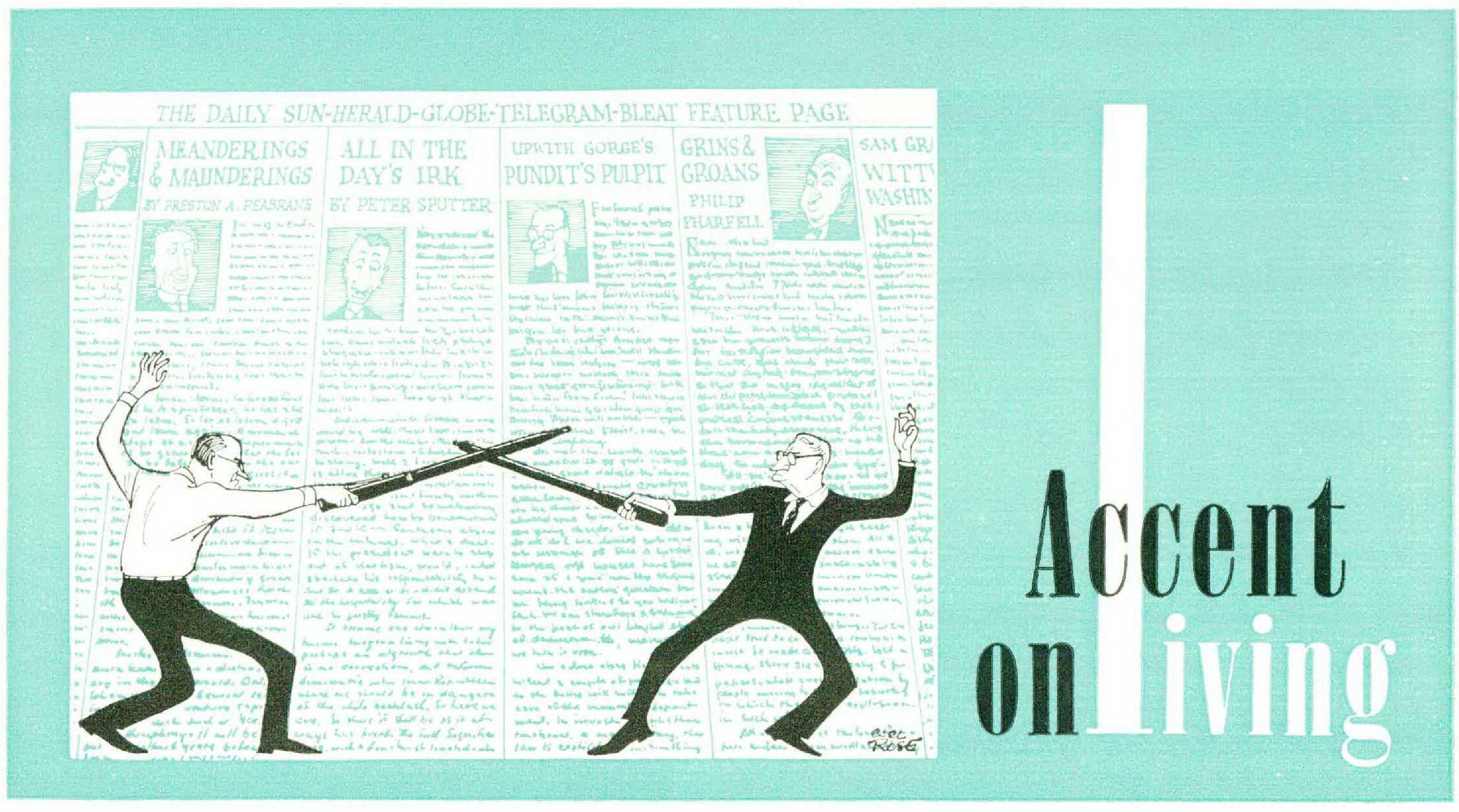
There was a fine flurry among its readers recently when a college professor wrote to a newspaper suggesting that it drop a certain syndicated column. I forget the reasoning advanced by the letter writer, and it would seem to me idle in the case of the columnist concerned to suggest that one of his productions is any worse than his others. But the professor’s complaint was naïve in its assumption that a columnist is published or discarded for the intrinsic quality of his work, whereas his notoriety is a much more likely reason for his appearance in the first place. If readers are angered enough to write letters denouncing him, the newspaper is moved to self-approval: our columnist is being read. Letters of praise, which must necessarily be akin to the columnist’s outlook on life, are taken gravely at par. As its conclusive grounds for putting the columnist into print, the newspaper asserts its obligation to reflect various points of view, even though the point of view in this case is so childishly self-centered and irrational as to bring the reader no more than a series of the columnist’s tantrums, which, like the Beatles’ theological pronouncements, are not worth even misinterpreting.
The professor-complainant was immediately in deep water. Naturally he was beset by readers who thought the columnist’s tantrums to be veritable beacons in the wasteland that is our nation today. More complicated were retorts from readers who believed that any professor proposing to omit publishing anything was an enemy of academic freedom, while collateral opinion assailed him as one who would destroy freedom of the press and thereby as one opposed to constitutional government in the United States. The professor was treading the fringes of dictatorship, the police state. In the academic world, one gathers, a professor should be entitled to commemorate Benedict Arnold as the Father of His Country and to flunk all dissenters, provided, of course, that he can find a history department willing to hire him to do so and a publisher who foresees a big future for a textbook along those lines. Columnist and professor alike enjoy one slight advantage over the ordinary workingman in the tree society: it is perfectly all right for the newspaper and the college not to hire them in the first place, but it’s all wrong to get rid of them, no matter how nonsensical they become. Anyhow, why shouldn’t we want to know how the Beatles feel about Vietnam? They have a right to their opinions, haven’t they?
At the risk of oversimplification, I suggest that the issues raised by the proposal to drop the columnist are less tangled than they might seem. A reason for dropping him could lie in an opinion oncc expressed to me by an old friend, a Londoner, largeminded, kindly, and quite incapable of thinking meanly about anything. Only once over the years of our friendship did I ever hear him make a disparaging comment on another person, in this case on a former friend who had calumniated him most outrageously and who had just got himself into a characteristically unpleasant lot of headlines.
I mentioned the headlines to my friend. A mess, I said. My friend agreed. “I’m afraid —” he began. He paused, weighing carefully the seriousness of the accusation he was about to make, and it was probably the worst thing he was ever going to say about anyone: “I’m afraid the fellow is simply an ass.”