The Power of the Press
BY C. MICHAEL CURTIS
C. MICHAEL CURTISbecame a newspaperman in New York City after serving with the CornellDAILY SUN,and joined the editorial staff of theATLANTICin 1963.
Everyone, by now, knows about the discovery of two Harvard biologists, that newspapers, magazines, and other paper products contain a substance which renders certain insects impotent, implying a magnificent new strategy for insect control. Among the publications rated highest for their impotence factor were the New York Times, Wall Street Journal, Boston Globe, Science, and Scientific American. The London Times and Nature, on the other hand, were observed to have curtailed the sex lives of insects to no extent whatever.
As with many other controversial scientific experiments, the investigations reported to the proceedings of the National Academy of Sciences were sharply scaled down to the innocuous observations that skeptical professionals might accept. The incredible findings that the Harvard scientists chose not to divulge are described here for the first time.
In testing the New York Times editorial page, for example, insect control groups were observed to have worked themselves into a frenzy of sociability while crawling over a column known as “The Observer,” only to stumble into reluctant civility at the border of Arthur Krock’s column from Washington and finally to perish in the gray wastes of the editorial columns on the left side of the page. The mortality rate resulting from tests of the Letters to the Editor section were inconclusive, depending upon who of an unconquerable host of retired civil servants had come forward with his in extenso clarification of recent developments in American foreign or domestic policymaking.
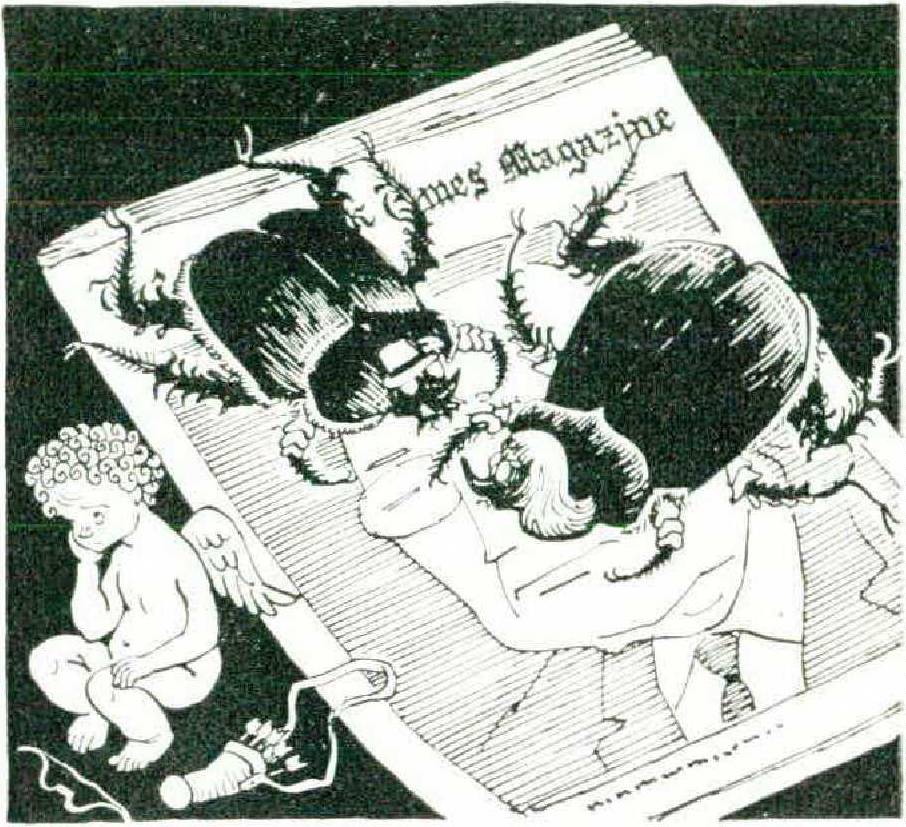
Further complicating the Times study was the considerable ambivalence of insect reaction to the Times Sunday Magazine. Only lassitude was observed among subjects exploring the revisitations of Eastern European Communist Satellites or New York intellectual fashions. But the magazine’s four-color advertising pages, characteristically scattered with shapely women wearing very little clothing, provoked extreme hypertension of a manifestly sexual nature among the rhinoceros beetles chosen for this sample testing.
Confirming the samples’ general conclusions, however, were insect reactions to the Sunday Times Book Review, which ranged from ordinary boredom to acute narcosis.
The Harvard biologists discovered that the characteristic of the Times most frequently inducing insect mesmerization was the fully transcribed presidential press conference, state of the nation address, or learned statement from 483 marine biologists unanimously disapproving U.S. policy in Southeast Asia, West Germany, north Philadelphia, and east Chicago.
The other newspapers cited in the Harvard Report accepted the analysis of their impotence factors with mixed feelings. The editors of the Wall Street Journal reportedly received the news with modest selfcongratulation, though the Boston Globe, mortified by what it took to be a damaging comparison with its chief competitor, the Boston Herald, immediately launched its campaign to deny a federal judgeship to Francis X. Morrissey, and won itself a Pulitzer Prize.
The reaction of the London Times is well known. Apprehensive at the thought that its format was unnaturally stimulating to insects, and fearing that the peril to its readers could be still more alarming, the Times removed advertisements from its front page and filled those column inches with what it steadfastly describes as a report of current events.
Additional random samplings from the unpublished reports of the Harvard biologists reveal the following: The highest insect-impotence factors in all American publishing were recorded by Clare Booth Luce’s column in McCall’s, the film reviews of Bosley Crowther, book reviews by W. F. Rickenbacker in the National Review, Barry Goldwater’s newspaper column, Status Magazine, the fortyseven extant episodes of Hugh Hefner’s Playboy Philosophy, and the daily sports columns of Arthur Daley.