Zagarolo
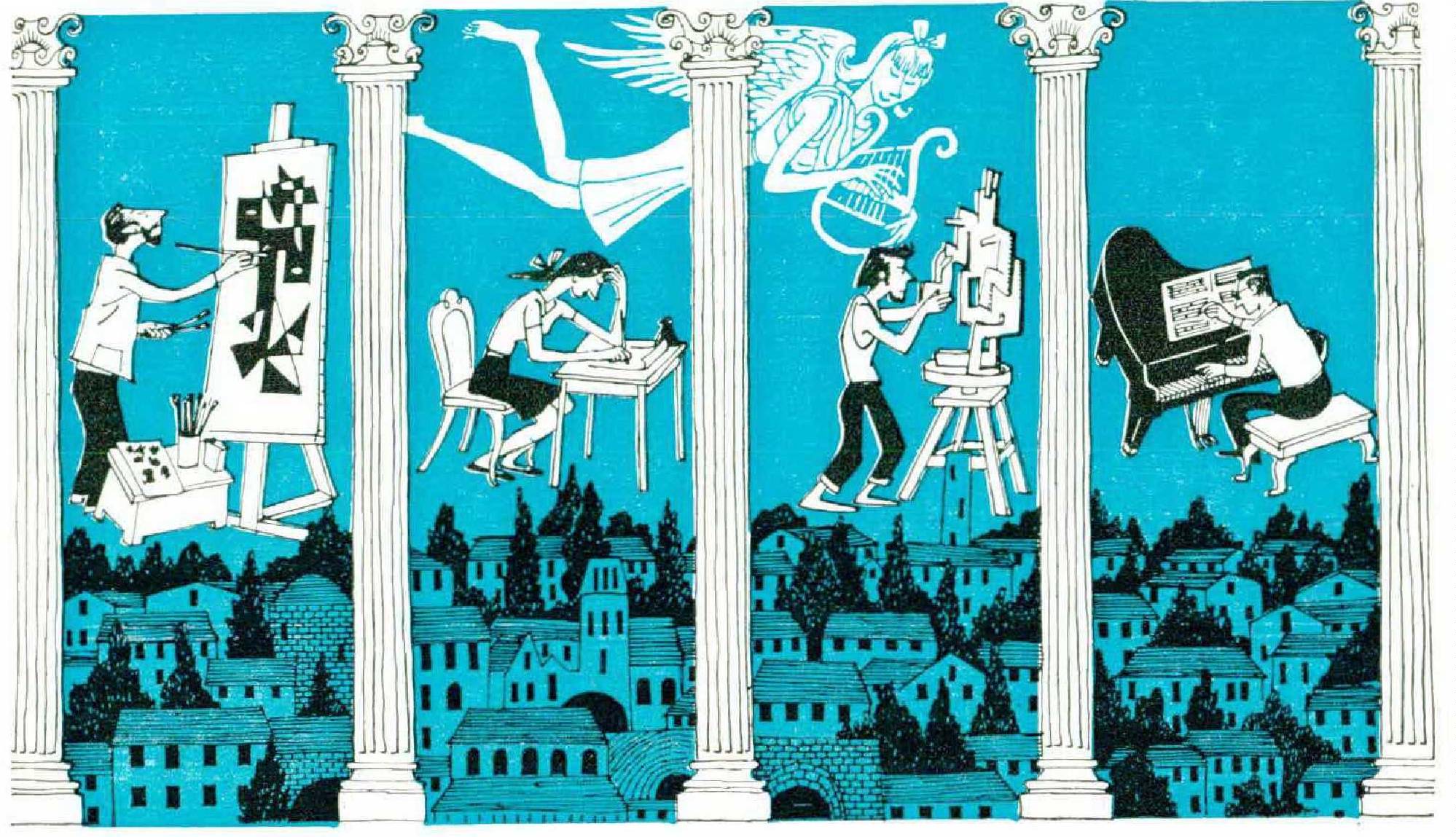
A Roman princess, Elvina Rospigliosi-Pallavicini, for the last two years has been running a one-woman cultural program at her own expense and in her own fortress-palace at Zagarolo.
So far, she has given music recitals, several exhibitions of antiques, pictures, and arts ménagers; she has held some debates on contemporary problems and also a festa of Roman gastronomy. This has all been something of a dry run, although the recital by the Gonfalone Choir of Rome was an outstanding success. Now, however, she can reckon on a viable organization for the future, and each summer (May to October) she intends to give recitals, exhibitions, discussion sessions, and festas which will embrace an increasingly wide scope and importance, ranging from seventeenthcentury Rome to contemporary American civilization and to current philosophy and handcrafts, with a stress on American art (which she feels Romans do not know enough about) and Roman antique furniture, her major personal interests.
What is particularly pleasing is that she intends to offer hospitality in her nearby villa to foreign (and particularly American) painters, sculptors, composers, and writers who are participating in the affairs of Zagarolo. And when the palace’s restoration, which has been going on for many years, is complete, she is turning over the entire top floor to a summer residence for young artists. That such a private program is being initiated at all is to be welcomed; that it is being done by a woman makes it surprising; and that this initiator is a Roman aristocrat makes it even more remarkable, because the Roman aristocracy, though it has much to offer in this field, tends to live very much to itself.
Zagarolo is a little-known town of some 5000 souls which sits on a hillock in a green valley fifteen miles from Rome. Scarcely a building has been altered or added in more than two centuries, though the town is far, far older. Like the other Roman hill towns of Tivoli, Palestrina, and Frascati-Tusculum, Zagarolo reaches back to the prehistory of our civilization and is haunted by the mythical Greeks, the fabulous Etruscans, and the forgotten Praenestines, who founded most of these towns before Romulus and Remus plowed the boundaries of Rome.
One approaches Zagarolo by hairpin bends up the side of a hill to arrive at a classic seventeenth-century monumental gateway. Behind this is a 1000-yard arrow-straight cobbled street plainly of Roman inspiration and lined with tumbledown sixteenth-century houses. This leads steeply up to yet another grandiose gateway and the market square.
Here the first thing one notices is a little Renaissance loggia, which shades customers of the local café. To the right and left are small but handsome palaces, with columned facades that serve respectively as town hall and bank; on the other flank is a late-Renaissance church of considerable dignity. This charming and usually lively square leads into a main street with shops and wellpreserved seventeenthand eighteenth-century houses. From this main street the hill falls away sharply on both sides, so that the side streets become little more than alleyways, staircases, and tunnels. But they are of great beauty and give one glimpses between the houses of the valley below, and unexpected perspectives of girls on balconies bending over their embroidery and cheerful old women sitting in the sun to warm their bones. The names of these passageways are interesting: one tricky staircase is called Danger Alley, one which narrows to be less than three feet wide is called Kissthe-girls Steps, while another tenyard-long street is called the Road of the Beautiful Virgins (and it is from these parts that for centuries Roman artists have always recruited their models). Back on the main street, one quickly comes to a second piazza, where Princess Pallavicini’s ducal palace is located.
This was first built as a bastion in the thirteenth century to dominate the valley on both sides, although it must have been a fortress of some sort even in Roman days, as it is recorded that Sulla took refuge there from Marius at the time of the Social War. Little archaeological research has been done here, but it is well known that the valley is full of Roman tombs, temples, and villas. At the back of the palace is yet another square that is a perfect hemisphere of sixteenth-century houses. Its shape marks it without doubt as once having been a Roman amphitheater.
This fortress became the seat of a duchy given to Marcantonio Colonna by the reigning pontiff as a reward for his part in defeating the Turkish fleet at Lepanto. Soon after, two handsome three-story residential wings were added. These are what one sees from the square today.
The fortress thus turned into a palace, and the walls and those ceilings which were not of carved and painted wood were frescoed. It is not known who did these frescoes, though Raphael’s pupil Giulio Romano and his assistants, who were working in the district at the time, have often been given credit for them. Other frescoes were added in the early eighteenth century.
The fortress’ ground floor, particularly the entrance, still retains something of its stern military past in its architectural form, and one feels that the sergeant of the guard in clanking armor might well be in the next room. The piano nobile, however, is gay and airy, and one would be more correctly dressed with a powdered wig in its magnificent rooms. This change of spirit is quickly explained because Zagarolo Palace became the property of the Rospigliosi pope, Clement IX, who began restoring and modernizing the palace in late baroque times, making it his summer retreat, where life was both seriously cultivated and elegantly countrified with festas, fireworks, and fairs. One cannot help but feel that the emulation of Pope Clement (and of the subsequent Rospigliosi princes who carried on this pleasant task) is somehow the mainspring of Princess Pallavicini’s enterprise.
Goffredo Lizzani is the architect responsible for the current restoration of the palace. He looks more like a retired British cavalry colonel of a studious bent than a Roman, and lives in a modern apartment in an ancient Via Giulia palace surrounded by his collection of rare books and treasures. He said to me: “It would appear that Zagarolo was never much lived in during its long life and that sometime in the last century it was finally abandoned. The local people then used it for any and every purpose. However, out of simple superstition, they first painted over the frescoes.”
During the last war, the palace returned to its original use: it became a barracks, but this time for German soldiers. Later it was taken over by three hundred families who had lost their homes, a cinema was set up in one of the great halls, and shabby offices were installed in rooms with carved-wood ceilings. Some of these offices still exist, unused and awaiting restoration, and it is particularly fascinating to compare what was with what is now after Lizzani has been at work.
As late as the early 1950s the palace was still a wreck, and only in the last few months have the remaining families of squatters been accommodated elsewhere. The fifteen major rooms were liberated of the paint with which the superstitious locals had covered the walls and ceilings, and frescoes nearly four hundred years old were revealed in an astonishingly fine state of preservation. The prospects for the future are equally encouraging, judging from the small specimen patches which have been cleaned in many other rooms. There are still dozens of rooms to restore, and the task of paint-removing will continue, with delicate chipping and painstaking work with a knife.
A hanging garden has been built by Imerio Maffeis, a young landscape gardener from Bergamo who is fast rising to fame for his inborn capacity to construct natural beauty. This garden stands on a foundation of centuries-old buildings which once served as storerooms and wine cellars, and has a lawn and a dais big enough to accommodate five hundred spectators and a small orchestra. It is now open to the public all year round.
The great rooms of Zagarolo Palace are an admirable site for Princess Pallavicini’s exhibitions of antiques of the seventeenth century. This period of Roman furniture is little known even to experts, as not a great deal has ever been put on the market and the bulk of it is still owned by the families which had it made in the first place. Princess Pallavicini, who has some very fine pieces herself, has succeeded in persuading a few dozen Roman princes to lend their best pieces for her first exhibition, things which for the most part have never been seen except by guests of the respective princes.
Roman furniture, like Roman architecture and music, was always some five decades ahead of that of France, Germany, and England in style; thus, what is seicento Italian (that is, seventeenth century) is Louis Quinze (1715-1774) in France. Roman (and Venetian) baroque music has well regained its international status with Monteverdi, Palestrina, Carissimi, Scarlatti, and many other equally famous names. Baroque architecture, too, is fast regaining its good name now that the aspersions thrown at it during the Age of Reason, when the very word Rome was anathema, are fading to oblivion. The furniture of this age is closely connected to the architecture in that both are monumental: great consoles with voluptuously carved and gilded wooden infrastructures, surmounted by filteen-foot-high framed mirrors, are the trademark of the Roman palaces, but equally one finds elegant spinets lacquered and painted with putti and harps, in which all the structure is of sculpted bronze figures; there are mirrors painted in the manner of the eighteenth-century Frenchman Boucher but made in Rome in the seventeenth century, and others with carved-wood frames so intricate and filled with human figures that, to present-day tastes, it seems almost a waste to have done such fine work on a mirror. Perhaps the most signal mark of the seicento is the use of fine marbles, especially of antico marbles — that is, those which no longer exist, as their mines in Africa and Syria were exhausted by the Romans before the fall of the Empire.
The tradition of Rome was, and still is, that of fine craftsmanship. One of the reasons for this is that in the sixteenth century St. Michael’s Institute was founded. This institute gathered up all the unwanted urchins of Rome and taught them to be skilled craftsmen. Early in the 1700s, a tapestry school was added to St. Michael’s which still exists; it is also exhibiting at Princess Pallavicini’s Zagarolo Palace. Another reason, and perhaps a more important one, for Rome’s fine craftsmanship is that most of the great architects who saw to the interior decoration of the palaces, men like Borromini, Bernini, Algardi, Mario de’Fiori, and Pietro da Cortona, were also sculptors and painters and well understood how to get the most out of their materials and the craftsmen they directed.
When in Rome, a trip to Zagarolo is more than worthwhile just to see the town and palace. A small foreign colony of writers and painters has settled outside the walls, and two young American architects have become so fascinated with the fife of the people in this ancient city that they are making a prolonged research and, they hope, an equally fascinating book. With Princess Pallavicini’s new program starting, it would also be worthwhile contacting the Pallavicini Association (Palazzo Pallavicini, Quirinal Hill, Rome; telephone, Rome 471224) to see what is going on there. Arrangements are being made, for example, on a long-term basis with the New York Museum of Modern Art and international galleries to mount art shows, and with the Rome academies and the U.S. Embassy to organize recitals on summer evenings in the delightful hanging gardens, while privately Princess Pallavicini will be fixing other seriously civilized and elegantly countrified pleasures such as Pope Clement would have enjoyed too.
Zagarolo is a town with an infinite past; it is becoming one with a future full of activity in the ambience and the spirit that was once the envy of Europe.