Once Around the "Ring"
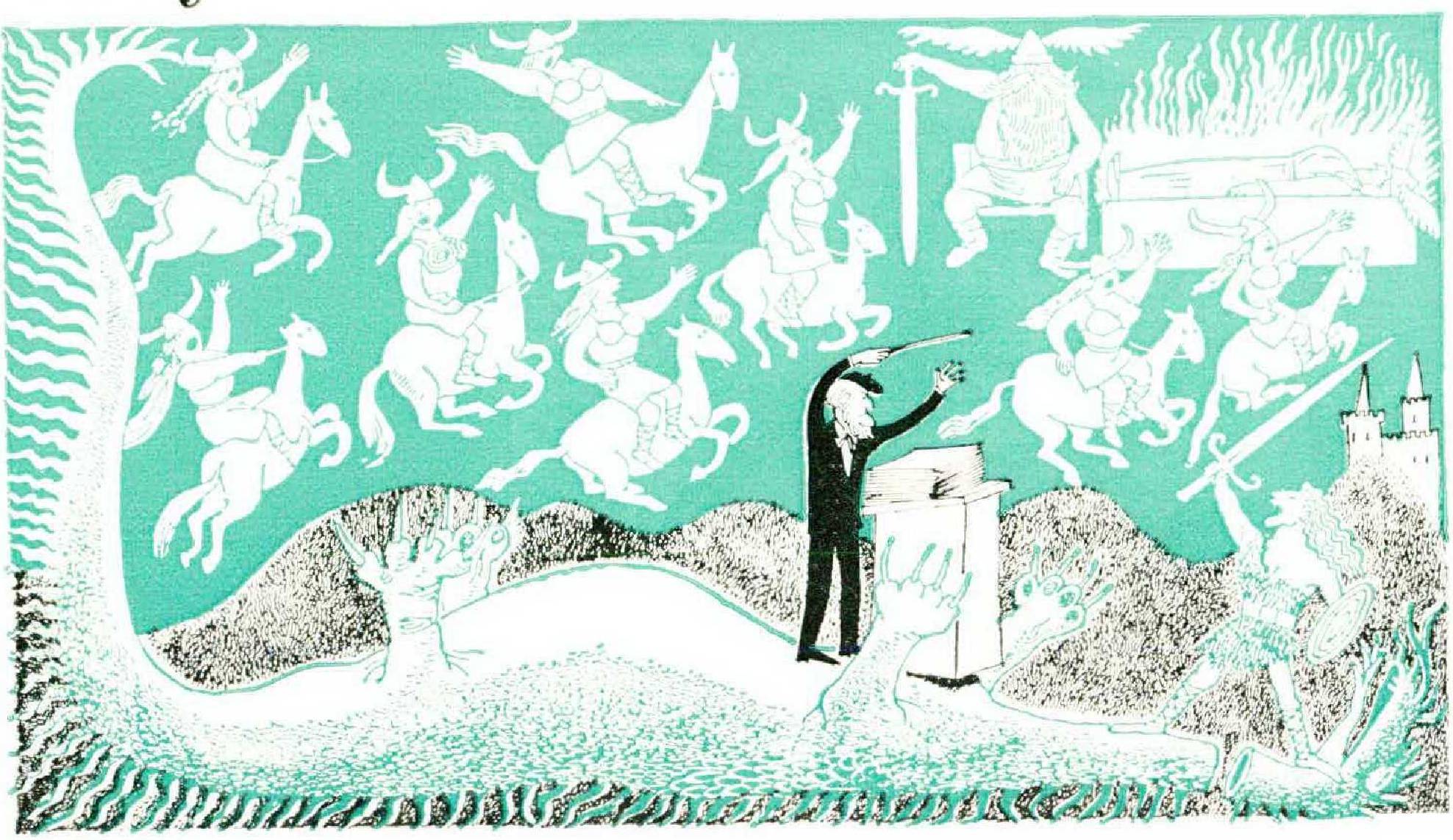
they shall have music
BY HERBERT KUPFERBERG
“Die Walküre” once wrote Bernard Shaw, “is endured by the average man because it contains four scenes for which he would sit out a Scotch sermon or even a House of Commons debate.” Shaw, who was visiting Bayreuth at the time (the summer of 1896) in his capacity of music critic for a London journal, then went on to enumerate the four high points: the Act I love duct, the Todesverkündigung or Announcement of Death in Act II, and the Ride of the Valkyries and Magic Fire Music in Act III.
He also acknowledged with cheerful candor that even for the initiated, in whose front ranks he counted himself prominently, a complete fourhour Walküre was something of a trial unless performed by exceptional artists, which apparently was not the case on that particular afternoon. In fact, Shaw reported that the first act had come close to being “a succès de sommeil,” with some of the singers excelling “in the art of making five minutes seem like twenty.”
Shaw, it should be noted, had gone to Bayreuth not merely to listen to Walküre, but to attend the four Ring of the Nibelungs operas, of which Walküre is only No. 2. To visit Bayreuth at that time was the onlyway an Englishman could hear the complete Ring, and G.B.S. dilated in his reports not only upon the performances themselves but upon the seasickness of a Channel crossing, the weariness of the journey, and the general expensiveness of the whole project.
Actually, although Bayreuth longago lost its Wagner monopoly, Ring cycles are by no means a commonplace even today. Few of the world’s opera houses undertake them; in fact, they are less frequent at the Metropolitan nowadays than they were in the 1930s, when Kirsten Flagstad and Lauritz Melchior excelled in the art of making twenty Wagnerian minutes seem like five.
The last live Ring I heard was in 1962, when Erich Leinsdorf conducted it twice at the Met, as one of his last services to New York before removing his talents to Boston. Now I have just heard a Ring again, but this time on records, for with its new recording of Die Walküre conducted by Georg Solti, London has just achieved the first integral Ring cycle ever recorded (OSA-1509, stereo; A-4509, monaural: five records).
The first, but not the last. The men of Deutsche Grammophon are laboring assiduously, like Alberich’s minions underground, to bring forth still another Ring, this to be conducted by Herbert von Karajan. It will be some time before the DGG project is completed; its progress will presumably be tied in with von Karajan’s creation of a new Ring, both as director and designer, at the new Metropolitan Opera House over the next few years. But with one Ring finished and another starting, it is obvious that the Nibelung saga, every last note and every last minute of it, is more accessible today both to perfect and imperfect Wagnerites than at any other time since it was completed ninety years ago.
The old saw has it that Wagner has his wonderful moments — and the half hours between them. Of the sheer length of the Ring there is no doubt. Played end to end, the four operas take some sixteen hours — two and a half for Rheingold, four for Walküre, four and a half for Siegfried, and five for Götterdämmerung. Personages in the cycle have a depressing habit of saying, in effect, “a funny thing happened to me on the way to Valhalla.” Perhaps the most crushing repetition of all is delivered by Siegfried when, just before the final scene of the last opera, he unaccountably remarks to Hagen and Gunther: “Say but the word and I will tell you stories of my youth” — meaning a not very brief synopsis of almost the entire saga to date. It is true that they both assent, but it is equally true that Hagen stabs Siegfried to death before he has finished. Wagner’s psychological insight may have run even deeper than he himself suspected.
Wagner fortunately provided sufficient musical and literary challenges to occupy a listener’s mind should the performance itself begin to slacken its grip. The leitmotivs continue to possess a fascination of their own; the thrill of recognition never fails to stimulate even a veteran Wagncrite as Renunciation, Ring, Curse, Sword, Valhalla, Arrogance of Power, Gold’s Dominion, and the other basic themes weave their way in and out of the musical fabric in various combinations and intertwinings. Less serious students can, of course, play lighter games to while away the half hours, such as recalling the names of the three Misses Rheingold, which happen to be Woglinde, Wellgunde, and Flosshilde, or reciting to themselves quietly the names of all nine of the Valkyrie sisters, possibly arranging them in alphabetical order, thus: Brünnhilde, Gerhilde, Grimgerde, Helmwige, Ortlinde, Rossweisse, Schwertleite, Siegrune, and Waltraute.
But London’s new recording of Die Walküre is of such intensity as to leave little inclination for such pastimes. London began its Ring in 1959, under the general supervision of producer John Culshaw, with the issuance of the opening Das Rheingold. Solti was the conductor, George London the Wotan, Kirsten Flagstad the Fricka. Siegfried, the third in the sequence, and Götterdämmerung, the fourth, followed, and now the appearance of Walküre completes the project.
Although Solti conducts the cycle, it has not proved possible to have the same character performed by the same singer in each of the operas. Consistent casting is also one of the problems that plague stage productions of the complete cycle, and it always is disturbing in a Ring stretched out over several weeks to see the various personages change not only in voice, but in size, shape, and general demeanor as the drama unfolds.
Actually, Mr. Culshaw has done fairly well in holding his casts together. George London gave way to Hans Hotter as Wotan after the first album, and the death of Flagstad necessitated a new Fricka in the person of Christa Ludwig, but others have remained constant throughout. The crowning glory of the cycle is the Brünnhilde of Birgit Nilsson; her ample, clear, and fresh-sounding voice resounds through all three of the operas in which she appears, and never to greater effect than in Walküre.
To quote Shaw once more, some of the singers in the early days of Bayreuth “were mere animated beer casks, too lazy and conceited to practice the self-control and physical training that is expected as a matter of course from an acrobat, a jockey or a pugilist.” No visual estimates are possible, of course, but in this recording of Die Walküre it can be reported that nobody sounds like an animated beer cask. It is interesting to observe that only one of the four leading singers, Hotter, is German; Nilsson is Swedish, Régine Crespin (Sieglinde) French, James King (Siegmund) American, while Solti himself was born in Budapest.
Both Crespin and Ludwig are as admirable in their roles as Nilsson is in hers. Crespin is a Sieglinde who for once seems thoroughly feminine and desirable, and Ludwig manages to turn that Wagnerian scold-andnag Fricka into a woman who is at least endurable. Hans Hotter is a singer past his prime, with his baritone voice no longer under full command. Seasoned artist that he is, he makes a virtue of necessity by singing Wotan in a subdued rather than a stentorian manner, so that the god becomes strangely human and unforbidding. Solti’s conducting, as it has been through the other Ring albums, is majestic and masterful, and the full presence of the Wagnerian orchestra, not excepting the Wagnerian brass, has been captured by the engineers. For all that, there are more exciting Rides of the Valkyries to be heard on records; the conductor seems almost too determined not to let the orchestral excitement get out of hand here, and the result is a tidy but rather tame Ride, almost as if the Valkyries had traded in their war steeds for Volkswagens.
The appearance of new releases of Wagner recordings has by no means impeded the reissuance of old ones. The imported Odeon label, distributed here by Angel, makes available two long-playing records devoted to the complete Act III of Die Meistersinger as recorded in Dresden in June, 1938. The performers include Margarete Teschemacher as Eva, Torsten Ralf as Walther, Hans Hermann Nissen as Hans Sachs, and Eugene Fuchs as Beckmesser, with Karl Böhm conducting (E-80983 and E-80984, monaural only).
This was considered a magnificent recording in its day, and it retains substantial impact nearly thirty years later. Nissen was an outstanding Hans Sachs, with a rich and intelligently used voice. (He is said to be still singing, in his seventies, in Germany, which seems to argue for a certain skill in utilizing his vocal resources.) Mostly, though, this old Meistersinger recording is notable for its excellence of ensemble, in which the Wagnerian proportions are maintained without submerging the individual protagonists.
Incidentally, the real Hans Sachs — the actual sixteenth-century shoemaker-composer upon whom Wagner’s character was based — has made his first appearance on the record lists in the form of a Deutsche Grammophon release devoted to early Renaissance music (ARC73222, stereo; 3222, monaural). One side ot the record contains fourteen selections from the Locheimer Liederbuch and the Fundamentum Organisandi, respectively a popular songbook and an organ instruction manual dating from around 1455. The other side is given over to five songs by Sachs, who lived in Nuremberg from 1494 to 1576, doubtlessly without suspecting that a Richard Wagner would come along three hundred years later to immortalize him.
Actually, Hans Sachs’s songs, which arc sung here by the tenor Friedrich Brückner-Rüggeberg and the baritone Rudolf Aue, unaccompanied, are rather lengthy homilies, set in a droning medieval plainsong that grows monotonous and wearisome after a while. There is a certain academic interest in listening to this record, and some feeling of the thought and personality of the original Meistersinger. But how he did go on! If Wagner’s Hans Sachs, for all of his kindliness and understanding, seems a bit long-winded at times, he at least has history on his side.
Record Reviews
Beethoven: Piano Sonata No. 26 in E-flat, Opus 81a, “Les Adieux”
Mozart: Piano Sonata No. 10 in C, K. 330
Van Cliburn, pianst; RCA Victor LSC2931 (stereo) and LM-2931
It is somewhat startling to find Van Cliburn, the exponent of the romantic piano concerto, recording sonatas by Mozart and Beethoven that require quite a different kind of pianism. Moreover, he provides the necessary style of playing quite unstintingly, for these are performances of elegance, taste, and discipline. Cliburn has often been criticized for playing and replaying the same works; perhaps this record is an indication that he is now ready to undertake a different, and in its way more demanding, repertory.
Serge Koussevitzky and the Boston Symphony Orchestra (Playing Tchaikovsky’s Symphony No. 5 in E Minor; Brahms’s Symphony No. 4 in E Minor, and Academic Festival Overture; Rachmaninoff’s Vocalise, Opus 34, No. 14; Rimsky-Korsakov’s “The Battle of Kershenetz”; Hanson’s Serenade for Flute, Harp, and String Orchestra;Foote’s Suite for Strings in E; and Shostakovich’s Symphony No. 9)
RCA Victor VCM-6174 (monaural only): three records
Koussevitzky’s entry into Victor’s Treasury series is long overdue, but at least it has been accomplished handsomely, with an excellent sound sheen to these reissues dating mainly from the mid-1940s. The records, which arc available either in album form or individually, vividly illustrate two of “Koussy’s” major attributes - his penchant for broadly romantic Russian music, and his interest in the music of his own time. Everything in the album bears the unmistakable stamp of the man and his great orchestra, but for me, at least, the summit of the set is reached in the surging, singing, yet cleanly detailed Tchaikovsky Fifth. Is it trite to say that they don’t play it like that anymore?
Wanhal: Symphony in G Minor Mozart: Symphony No. 25 in G Minor, K. 183
The Mozart Society Players; Baroque 2859 (stereo) and 1859
This record is instructive in comparing the achievements of talent and genius. Johann Baptist Wanhal was a friend and contemporary of Mozart’s, who once played with him in a quartet (Haydn and Dittersdorf were the other members — it must have been quite an ensemble!). He also was an accomplished composer, and his G Minor symphony abounds in lovely melodies and skillful scoring. And then one listens, on the reverse, to Mozart’s G Minor — and only the “little” G Minor, K. 183, at that — and is engrossed almost immediately not only by the distinctive themes but by the imaginative modulations and the rich development section. The contrast is striking, and totally convincing. The origin of the Mozart Society Players is not given; one would guess they are a Central European group, and certainly they play ably enough. The Baroque label is a subsidiary of Everest Records.
I Love My Love
Louis Halsey conducting the Elizabethan Singers, with Owen Brannigan, bass, and Wilfred Parry, pianist; Argo ZRG5490 (stereo) and RG-496
This record bears the subtitle “A Recital of English Songs,” and its contents range from simple country ballads to compositions by Holst, Vaughan Williams, and Britten. But always the spirit is that of the English folk song, and there are many memorable ones to be heard — the beautiful “O Waly, Waly” in an arrangement by Britten; the traditional begging song “Soul Cake” (“If you haven’t got a penny, a ha’penny will do: If you haven’t got a ha’penny, it’s God bless you”); a rousing wassail by Vaughan Williams; and many others. Owen Brannigan has a fine bass voice, and he finds himself in excellent musical company here. The words of the songs are provided in a leaflet, and very welcome they are.
The Royal Highland Fusiliers — Regimeutul Rand, Pipes, Drums, and Bugles
London International SW-99425 (stereo) and TW-91425
The Royal Highland Fusiliers, the latest of the British regimental outfits to tour the United States, have left behind them a particularly stirring memento of their visit in this collection of Scottish marches, reels, and dances. Few recordings catch the skirl of the bagpipes so brilliantly, and the military band repertoire encompasses such homegrown melodies as “Flora MacDonald’s Lament,” “The Bonny Lass o’ Ballochmoyle,” and “The Bonny Brown Maid.” The climactic number is “Scotland the Brave,” performed by the combined forces — a resounding challenge to any sound system.
Thurber: The Thirteen Clocks
Lauren Bacall, reader; Pathways of Sound POS-1039/40 (monaural): two records
James Thurber’s fable “The Thirteen Clocks” is a strange mixture of the bizarre and the comic, with its general tone established by the Duke of Coffin Castle when he remarks: “We all have flaws, and mine is being wicked.” All sorts of odd characters people the story, which manages to have fun with fairy tales while being a perfectly good one itself. Lauren Bacall turns out to be an ideal choice to read the lengthy story, taking all the parts, pointing up the rhymes in the versified portions, and even singing a song or two. The household’s two resident fairy-tale experts, torn from their homework for a consultation, sat engrossed in Miss Bacall’s narration to the very end.