Bobby
A weekend at the lake with his young nephew seemed innocuous enough, but this Samaritan did not know a simple fact about Bobby: he is an unforgettable monster. Mr. Whitehill’s most recent novel, PRECIOUS LITTLE, has just been published by Scribner’s.
A Story by Joseph Whitehill
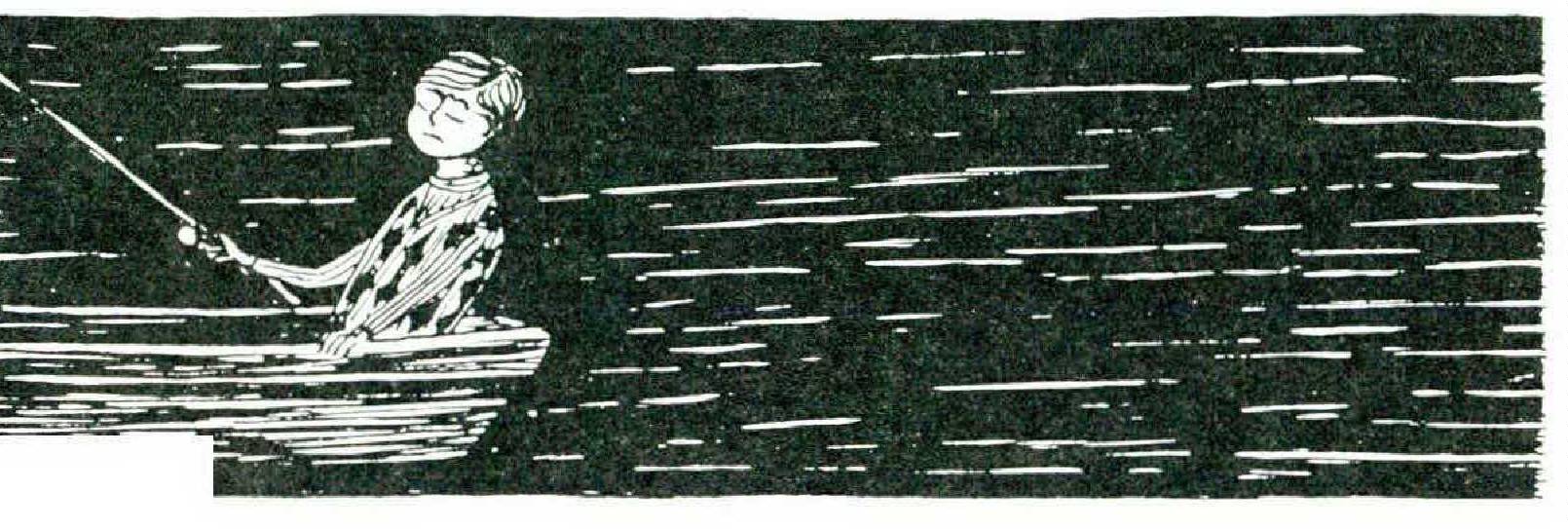
YOU’VE drowned your minnow again,” John Dimit said kindly. His nephew was only a beginner, but minnows, nevertheless, were fifty cents a dozen.
Bobby Sands, a golden twelve, pouted at the whitening bait he dangled before his eyes. “Is that just a figure of speech, or do they really drown? I mean, how can they drown if they live in water? Uncle John, how?”
John watched the parcel of ripples from the boy’s lurching in the boat wash over his red and white float, making it lift and nod. After the ripples it lay dead in the flat water; his big and wary crappie had gone again, cautioned away by the wrongness of the bait’s motion, “When you snatch your line up like that every two minutes to look at it, you make water go the wrong way through its gills. And it swallows water, too. That’s what we call drowning the minnow.”
Bobby leaned over the transom and hauled up the floating minnow bucket. Another parcel of ripples tossed John’s float. The bang of the bucket echoed in the hot oak forest on the shore of the cove. Water spewed from the holes of the bucket onto the seat. Happily, the boy chased the fluttering stranded minnows about the bottom of the bucket with his urgent hand. John closed his eyes, saying, “If you weren’t quite so rough with them, they’d live longer. I’ve had this one on for almost an hour.” The minnow bucket plunged to the water in free fall and struck with a bruising shock. John opened his eyes. “Now, ease it through back of the dorsal fin, just above the spine. If you go through the spine, that kills them too.”
“I think you simply know how to pick stronger minnows than I do.” (“No, no,” whispered John.) “What does a minnow become if it’s allowed to grow up?”
“A shiner. Like a little carp.”
“Can I take one home for a pet tomorrow night?”
“If there’s any left alive by then.”
“Well, we could buy a new one, of course. I’ll give you the money myself. How much does one cost?”
“They’re fifty cents a dozen. Suppose you tell me.”
“Well, of course. That’s a little over four cents apiece. A nickel ought to buy a strong one.”
“You ought to put ON your hat.”
“I don’t burn. I tan.”
“I’ve heard that one before.”
Bobby did not put on his hat, nor, after brief hesitation, did his uncle insist.
Last night in Tulsa, after an uncomfortable half hour in his sister Francy’s hot little house, John had invited the boy to come to the lake with him for the weekend, had invited him inevitably, without picking his words, when he had found that things there were now so bad that Sam Sands, his brother-in-law, was sleeping on the couch in the living room. All that half hour he had inwardly squirmed under the deep and separate attentions of Sam and Francy, the searching inspection that befalls an outsider in a house where divorce is gathering itself. In his numb discomfort his only commentary response was to invite their boy away.
This morning, dressing in the predawn darkness, he had considered calling Kathy Breen at the Grand Lake Lodge to warn her he was bringing the boy, to ask her please to make space for him in their weekend. Because it was so early, and she would have worked late in the tavern downstairs, he had decided against it. Let her make the space when she saw him.
John Dimit was a bachelor of forty-five, a production engineer in a handsome brick geophysical plant that stood alone on a meadowed hill southeast of Tulsa. Not aggressive or ambitious or willfully charming, he accepted that his eleventhousand-dollar salary would not grow much in the years to his retirement, and that he would not likely become one of the small good breed upstairs, the smiling, tanned, well-tailored six, the tough young men who ran the company. Further, he knew he was too old, as age counts among electronics men, to be like the brilliant young tigers, all with master’s degrees, who wore Hathaway Aertex shirts in Development. He filled his place well; his job and he were the same size, and he was endlessly secure in it. He owned a Chevrolet three years old, and a fiber glass boat with a twenty-five horsepower engine on it, and every year he took a trip to Michigan to see his mother.
He had first met Kathy Breen twelve years ago, when she and her drunkard husband had bought the old wooden Grand Lake Lodge that sat like a wrecked crate on the limestone shore, and had begun sleeping with her the next year. After the timely death of her husband, he and Kathy had considered marriage, but when her two grown children heard of it, they laughed with alarm and laughed her out of it. Half of the lodge, under intestate proceedings, was theirs, and they had lively hopes for the other half in time. Their mother’s marriage would dilute both principal and income, since they would probably have to hire the management they now got for nothing. Their dissuasion had all the sincerity of true, bright greed, and was in the end successful. John Dimit had accepted the refusal without argument, since argument of any kind exhausted him and made his stomach burn. He spent every weekend at the lodge as a favored, but paying, guest.
At sunrise this morning he had knocked on his sister’s door and had stood in the hall stupid with sleep while she, pale in robe and curlers, recited explicit instructions to him about the supervision of Bobby’s diet, bowels, manners, and bedtime. He accepted from the mute Sam a little case containing Bobby’s pajamas and toilet articles and his asthma pills. Sam looked wrecked. Bobby sat resting on his knees in the tangled sheets of his father’s couch. When the instruction and admonishment were over, he rose and left the house looking straight ahead, mumbling his good-byes. His reciprocally besieged parents stood on opposite sides of the doorway, ignoring each other, to watch John and Bobby leave.
During the two-hour bore of the turnpike, John had volunteered no conversation, preoccupied as he was with the metabolic mysteries of the cooling and stilling of his sister’s marriage. He had watched the grim maturing of a divorce before, when decent people with no practice at it must inventory everything they hold in common—things and haunts, friends and children—for division, assignment, and sometimes throwing away. People like Francy and Sam, with orderly minds and no taste for the sharings of cold compromise, would never rest until everything had been taken out of commonage. John liked Sam, and was depressed at this choiceless prospect of losing him.
“What’s that, Uncle John?” In a pasture off the turnpike a black machine nodded silently, swinging its counterweights.
“An oil well.”
“Why doesn’t it have a big tower on top of it like the ones in books? Like the ones over in Oklahoma City?”
“This is a shallow well. They use a portable derrick on a truck to pull the tubing and the rods. In the deep wells, where there’s a lot of pipe and rods and they’re heavy, it’s cheaper to leave the drilling derrick in place for when they have to clean it out and replace the pump.”
“Is everything in business done a certain way because it’s cheaper than some other way?”
“Yes.”
“Pretty stingy, boy.”
AT THE end of their good large breakfast in the sway-floored restaurant of the lodge, Kathy Breen had come down from her rooms dressed for the day, seeking John and finding John and Bobby. “Hello. Where’d you get him?”
“This is my sister’s boy, Bobby Sands.”
“Well, now.”
“Bobby, time to go have a bowel movement. In the lobby, around by the stairs.”
“But I don’t need to.”
“Go on anyway and try.”
“That gives you hemorrhoids.”
“Oh, God,” Kathy said, laughing.
“Listen, buddy, we’re not going to sit around here discussing it in front of a lady. Go on.”
Bobby lifted his fair fine eyebrows and said, “Lady?” Then he left.
“I apologize,” John said.
“No need, dear. Is he going to stay tonight?”
“Yes. His parents are fighting.”
“With you?”
“No, with each other.”
“I mean, is he going to stay with you?”
John smiled at her. She was gray-haired and plain and somewhat thick across the back of her shoulders. He believed she was several years older than he, but had never inquired how many. “I thought you might give him the connecting room to mine, Fifteen to my Seventeen.”
“All right.” She seemed satisfied.
John’s fishing was not the obsessed kind of many of her customers. He never stayed out all night, or motored miles up and down the lake, or spent a great deal of money for equipment. Later in the morning in the boat, therefore, he was not offended when Bobby sighed loudly and said he was bored. They had been anchored here for several hours over one of the three crappie holes — brush piles sunk deep with concrete blocks — that the lodge kept baited for private gain, and had taken only four fish, all too small to be interesting. The eleven o’clock sun shone down with great force into the windless cove; the boy was flushed under his squinting eyes, and sweat made runnels in the white down of his jaw.
John slowly lifted his long cane pole. His minnow was still twitching. “How about a swim?”
“I don’t have my suit.”
“You don’t need a suit. Nobody can see you.”
“Oh, no. I could never swim without my suit. And that water looks dirty.”
John considered his reply while he hauled up the little cast-iron mushroom anchor by its clothesline rope. “Swim in your underwear, then. But the water’s not dirty; that’s very fine clay that hasn’t settled out yet. Down near the dam the water’s clear.” He surged the anchor up and down below the surface to wash off black mud that had come up with it, then he lifted it in and pushed it under a seat. He rowed with short strokes, facing forward, until the stem of the boat rasped lightly on the gravel shore. “Better not to dive around here. There’s lots of stumps.” He followed the boy out over the bow, and turned to pull the lightened boat farther up. He undressed without looking at Bobby, laid his clothes on the little foredeck, and waded out into the warm water. At thigh depth he stopped and sat down to float, looking out to the sparkling lake. He heard Bobby, after several minutes of a deciding silence, wade in splashing and humming. In the side of his eye he saw that the boy was wearing his little white underwear.
“How far is it across the cove here, Uncle John?”
John paddled himself backward into the shallows where he could rest on his elbows and look across the cove. “I guess a couple hundred feet.”
“Let’s swim over.”
“Not me. I’m lazy.” In the very shallows the water was almost hot, like a bath.
Bobby said, “I think I will.”
“Are you a good swimmer?”
“Good swimmer? I’m excellent!”
But when John saw him fall stomach-first, with his face to the sky, and begin a flailing, swivelheaded stroke into deep water, he knew at once that the boy would not make it. John let him struggle ten feet more, then, when he still kept on, pushed off in a breaststroke to catch him. The boy’s blue eyes were walling with fear when John reached him and aimed him back toward the shore. He reached safe footing without help, and when he had finished panting and gagging, said angrily, “This is a perfectly filthy place to swim!” He waded out to put on his clothes. Neither mentioned the incident afterward.
KATHY BREEN ate her lunch with them in the restaurant of the lodge. Patiently, she worked all through the hamburgers and French fries to reach Bobby with a matter that might interest him; she recalled last week’s hydroplane races, and an eighty-pound catfish that had got pooled below the dam when the penstocks were shut, and the hailstorm last year when the stones were so large they would not go into a highball glass. Bobby answered with skeptical monosyllables and an occasional private smile, not looking at her. He spoke only to his uncle, and during the length of the meal, asked him the following questions: If, in the old days, it took two horses to pull a one-share plow, why does a tractor need a thirty-horsepower engine to pull only four blades? Why are ministers’ children so often failures? Does a cash register actually count money, or just keep it? If all the sparkles of sunlight on the lake there were brought together in one place, would they sum up to one reflection equal in strength to the reflection of one sun in still water, or more, or less? How does an ovum know to harden itself against further penetration after one viable sperm has entered it?
John made answers to each, more or less complete as the subjects were near or far from his province, and then suggested that it was time for Bobby’s nap.
“I’m really not sleepy.”
John finished his beer with a long sloping swallow. “I promised your mother.”
“Even Mother can’t make me sleep if I’m not sleepy.”
“Look, I’ve got to get a little nap myself. Why can’t you just rest on your bed and read?”
Bobby grinned and leaned forward with his palms up ingratiatingly. “Look, I’m learning so much up here ... I‘ll go down to the dock and look at the boats while you nap, all right? All right.” He was out of his chair and through the door and skip-running down the long wooden stairs all in one fluid movement.
“Just a little spoiled,” Kathy commented, leaning back to light a cigarette.
John shook his head shortly, and got up saying, “Excuse me a second. How many rings for the dock?”
“Three long.”
John cranked the wall telephone, and when the dockmaster answered faintly, said, “Chris, this is John Dimit. My little nephew just started down there. Would you keep an eye on him for an hour or so? He can’t swim for sour apples. Thanks. Just keep him out of trouble.”
He went back to the table to stand so that his hip touched Kathy’s shoulder lightly, a gesture neatly concealed from the other customers and the waitress. “He’s not spoiled so much as precocious. Will I see you in a little while?”
“You’ll be asleep in two minutes. I know you.”
“Then wake me up.'’
“I’ll see.”
Half an hour later in his room, John was wakened not by Kathy but by the dockmaster’s telephone call. He sat on the edge of the bed until reality tumbled back together, then answered, “Yes?”
“This is Chris down to the dock. I had to run the boy off, Mr. Dimit. He was out floating around in your boat trying to start the motor.”
“All right. Thanks.”
Just as John replaced the handset, Bobby fell in through the door from the balcony, panting and indignant and laughing. “That man on the dock is a brute!”
“He just called me.”
“Oh. Well. Well, if I hadn’t been so slow figuring out the pressure system on your gas tank, I’d be long gone by now!”
“It’s against the law up here for boys under sixteen —” John Dimit followed the boy’s stare to the other door, the one that gave on the hall. It opened quietly and slowly, and Kathy backed in, watching the hall, wearing her kimono.
She closed the door softly, holding the knob to prevent the click, then turned and said a small “Oh,” with her hand at her throat. She gazed at Bobby with her head lifted and her mouth pursed as if to sip from a high glass. Bobby looked only at his uncle, wearing a popeyed solemnity and surprise that John, even in his fluster, sensed was largely affected. In the brief triangular episode that followed, sentences were begun one way and finished another, glances were given and averted, and gestures were lifted and dropped, until John, under the heavy pressure of Christian sense, solved it to Kathy’s loss and Bobby’s gain. Kathy went smoking to her own rooms, and John took Bobby down to the dock.
There they fueled the boat full and embarked on a long fast trip down the thirty miles of glaring lake to the dam. Bobby drove all the way down and back, bouncing on the seat, wrenching the wheel to make shallow, spraying turns, and yelling into the warm wind. John hung on glumly and thought about his sister’s marriage, Kathy’s great white thighs, and a double bourbon.
It was past five o’clock and still hot when John wearily climbed the stairs after Bobby. He was much dried and his eyes hurt and the backs of his hands and neck suffered at a thought. Bobby’s energy seemed undiminished; the only evident effects of the day’s sun on him were the high pink of his skin and the slight snarl in his voice.
In the lobby, John paused to buy a large jar of Noxzema from Kathy; she said nothing as she rang up the sale, but looked several times from the man to the boy. John started toward the hall and the cool shower and the big drink waiting in his room, but Bobby called him back. He had found the Coke machine and needed a dime. John hooked his pants pocket open with the forefinger of his left hand to ease the pain when he put in his right. He felt a dime and brought it out between straight fingers.
In the pause between the dropping of the dime in the slot and the rumbling delivery of the bottle, Bobby looked, saw, and screeched, “Hey, Uncle John! I haven’t seen that one !” He was jabbing his finger at an easel poster advertising a Three Stooges movie at the little theater in Grove.
“Oh, Jesus,” John whispered, and smiled faintly. “I was hoping you wouldn’t notice that.”
Bobby hung hard on his uncle’s sleeve. “But you’re not supposed to miss any of them!”
“I’ve managed to miss all but one. All but half of that one, too.”
“Please.”
“We’ll talk about it after dinner.”
In his room, Bobby flopped on the bed to read from a much-rolled comic book of violence, and refused to take a shower. Bemused with pouring whiskey into a tumbler, John said before he reasoned his strategy, “No shower, no movie.” The boy yelled as he ran to the bathroom, and yelled all the way through his shower. John bit his tongue.
By efficiently carrying his glass about with him in his room and into his own shower, John finished three strong highballs before dinner. By the time he followed Bobby into the dining room his sunburned hands and neck had quieted well. He waved about the room to the customers who recognized him, and sat where Kathy showed him to. While Bobby disappeared into the menu, John said to her, ”I guess I’ve got to take him to that movie tonight.”
Kathy did not look up from her pad, but her pencil twitched. “You could drop him there and pick him up afterward. What would you like for dinner?”
“Yes, I could, couldn’t I?” Bobby’s eyes rose above the menu and watched him. “No, no, it wouldn’t do. Better not.” Bobby’s eyes dropped again. “Ah — fried chicken, Roquefort, and a Bud. Bobby, what looks good to you?”
The menu came down at once, and Bobby said, blinking rapidly, “I think I’ll have the shrimp cocktail, and this sixteen-ounce T-bone steak with mushrooms, and the baked potato with chives and sour cream, and the tossed salad with Italian dressing. That steak is medium rare.”
“My God,” John said. He flinched at five dollars’ worth of dinner for a twelve-year-old boy, flinched even through the normal before-dinner mist of menu generosity he got from fatigue and whiskey.
Kathy looked disapproving. “You want him to have all that?”
“Anything you order you eat,” John told him. “Or no movie.”
Calmly, avoiding the quarrel he could rightly have picked, Bobby said, “Really, Uncle John, I’m starved. All this fresh air and sunshine and swimming.”
John nodded to Kathy, who left to give the pad to one of the waitresses and take her place again behind the cash register. Frequently during dinner John found her eyes on him, and could give her back nothing more meaningful than an apologetic wink or shrug.
While the boy ate, cleverly and rapidly, he asked the following questions: Why do some fluorescent lights start instantly, while others flicker and delay? Where is the safest place in the house during a nuclear attack? What is Kathy Breen’s background? Why don’t you have a bigger boat, with a cabin on it for shade? Can Kathy Breen go into any room in the lodge, just because she owns it? Why don’t you like the Three Stooges? What do you get out of all that whiskey and beer you drink?
John gave the best answers he could.
Though he slowed toward the end, Bobby ate all his dinner, leaving only the radish slices in his salad. He ate apple pie with ice cream on it for dessert, and pushed back from the table with a gasp of accomplishment.
At the cash register, John told Kathy they would return right after the movie, and he would see her then. She took his money with a little smile.
In the deep chill of the theater, John sat with his hand protecting the burned nape of his neck, blinking at every shriek of the audience, feeling his small headache and his thirst wax together. Twice he disliked himself for laughing at the crude and hostile humor on the screen. Bobby ate a bag and a half of popcorn, a box of jujubes, and drank two orange sodas during the movie.
On the way back to the lodge, Bobby did not comment on the heat lightning that pulsed silently below the southern horizon, or on the two blinding white clouds of moths they met. It was as if Bobby’s hectic fires had at last consumed everything inside him.
Back at their rooms, John mixed himself a drink, and in a turn of pity for the boy, offered to rub Noxzema on his sunburn to help him get to sleep. Dreary-eyed and swaying to stand, Bobby was still game. “It doesn’t hurt at all, really, just sort of dry. Crinkly. And I’m not sleepy a bit. I think I’ll just stay up.” Nevertheless, he submitted at once to the anointment of his radiating skin, and lay still in his bed after John was finished. John quietly left the room and went to sit on the dark balcony before his open door to watch the moonstruck lake and wait for Kathy to come to him. He put his feet up on the railing and sipped his drink.
Not long later, Kathy slipped into the chair beside him without greeting. Their hands found each other’s at once.
“I think he went right to sleep,” John whispered.
“He had a big day.”
They talked in low voices for some time, watching the blinking neon broadside of the Cherokee Queen, a stern-wheel dance barge, approach in the lake and pass going north along the shore in its muff of shouts and thumping music.
The barge was returning south along the far bank three miles over, when Bobby said from the open door behind them, “I can’t sleep if you’re going to keep talking.”
John took his hand from Kathy’s and replied, “We’ll keep it down.”
Later, John was standing behind Kathy at the railing, holding her from behind, when Bobby came to the door hitching at his pajama bottoms to say, “Is she still here? Could I have some more Noxzema?”
Obeying the curl of pain in the boy’s voice, John let go of Kathy and followed him to his bed, where he spread the white stuff freely on his hot back. As he capped the jar, he asked Bobby plainly for no more interruptions. Bobby moaned his answer into the pillow.
Sometime after midnight, when dew began to form on the balcony, John and Kathy moved into his room to lie in the dark, propped on pillows on his bed, and have another drink. He did his whispering in the curve of her shoulder, and she replied by small, expressive movements of her body against him. He had just asked her if she would like one more drink, and she had just signaled _yes, when Bobby’s bed made a sound, and he loomed small in the doorway. “I’m going to vomit,” he said.
John half rose, then checked himself and lay back. “Do it in the toilet,” he said.
Bobby disappeared, and there were sounds of coughing and crying from his bathroom. Then water ran for a time and stopped. He reappeared in the doorway. “Really, Uncle John, I’m very ill.” His voice was furred and broken. “I’d better have a doctor come.”
“You don’t need a doctor.”
“Maybe he does need a doctor,” Kathy said.
“Lord, is she still here?” Bobby said.
John was up and to the boy at once. Guiding him firmly by his thin hot arm, John moved him to his bed and forced him down on it. “Here’s the Noxzema. Use it yourself. And don’t open this door again, hear?” Bobby screamed into his pillow, and shook the bed with his trembling.
John closed the connecting door loudly enough for the boy to hear it over his screaming, and met Kathy standing concerned at the foot of the bed. He kissed her hard, and she inhaled through her nose in surprise. Then he gave her a fresh highball and sat her on the bed beside him. Hush a minute,” he said. The boy’s keening and sobbing came plainly through the door. John took up the telephone and gave the operator a Yulsa number. While it rang many times, John rubbed Kathy between her shoulder blades. “Hello? Hello, Francy? John. You awake? Yes, I know it’s late. Goddamnit, I know it better than you do. No. he’s all right . . . Listen, Francy. Listen. I know what’s wrong with your marriage. . .”