America Sings: Sarah Caldwell's National Opera
America Sings
by Herbert Kupferberg
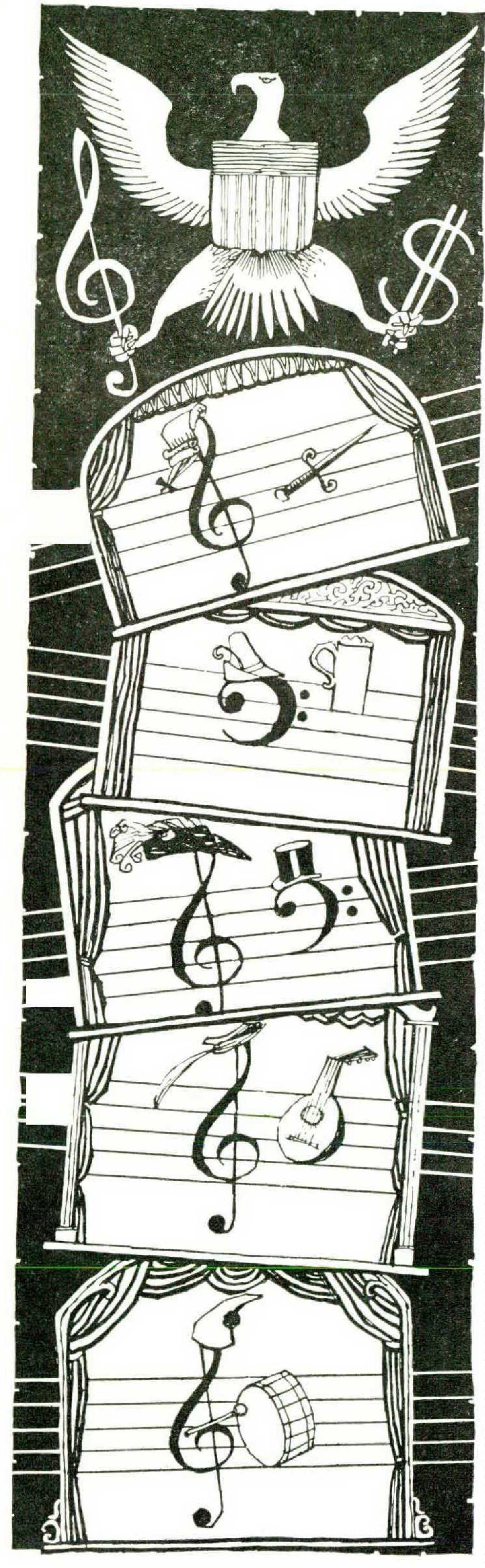
When a newly formed operatic troupe called the American National Opera Company, consisting of well over a hundred singers, musicians, and administrators, begins its first national tour later this month, it will have among its financial backers a novice in the field, the United States government. A grant to the company of S350.000, awarded by Roger L. Stevens’ National Council on the Arts, marks the federal government’s first major venture in underwriting opera. It also marks the culmination of a determined campaign by an energetic and adventuresome Bostonian named Sarah Caldwell to find backing for her concept of an operatic enterprise on a national rather than a local basis.
Miss Caldwell, who has been producing and conducting opera in Boston for the last ten years, is known as a lady impresario with ideas. But none opens up such limitless possibilities as the one of bringing the government into the opera business. Both the sum of money and the degree of involvement are, of course, trifling when compared with the massive official subventions which enable European opera companies to flourish. Yet no other American opera company has ever been accorded such a sense of governmental interest, not to say partnership, and Miss Caldwell is hopeful her enterprise may open up a new operatic era throughout the nation.
Certainly she has done exactly that in Boston, a city musically renowned before her advent largely for its great symphony orchestra. Her Opera Company of Boston, playing in the Back Bay Theater, a former movie and vaudeville palace, has attracted national attention for its imaginative performances of such modern works as Arnold Schoenberg’s Moses und Aron, Alban Berg’s Lulu, and Luigi Nono’s Intolleranza, and such antique novelties as Rameau’s Hippolyte et Aricie — most of them American premieres.
Miss Caldwell, a generously built woman with a ready laugh‚ was born in Maryville, Missouri, and began her musical life as a violinist at the University of Arkansas. But when she arrived in Boston in 1943 to attend the New England Conservatory, opera monopolized her interest, until she founded her own troupe in 1957. She denies reports that she does everything for the Opera Company of Boston, from painting the scenery to selling the tickets, but she acknowledges that she gets into quite a few aspects of the business. She picks the singers, auditions the instrumentalists, researches the music, makes the translations, conducts, directs, proselytizes, and, most important of all, raises money. “What I like about opera is its variety,” says Miss Caldwell, in what would seem to be an understatement.
Her new American National Company will attempt to fill the void left by the demise this year of the Metropolitan Opera National Company, a troupe of young singers established in 1965 by the Met, apart from its regular operations. Two years of coast-to-coast operations by the Met’s junior company resulted in a succès d’estime but a faute d’argent: excellent reviews throughout the country were accompanied by a deficit of $2 million. Finally the parent Metropolitan in New York, itself in a financial crisis created by its move to Lincoln Center, reluctantly abandoned its offspring.
Miss Caldwell is taking over some of the Met National Company’s singers, though not enough to make her troupe in any way a continuation of the old one. She will have a substantially larger company, including an orchestra of sixty-three. Her repertory will include during the first half of the season Puccini’s Tosca, Verdi’s Falstaff, and Berg’s Lulu; later on Wagner’s Die Meistersinger and a double bill of Mascagni’s Cavalleria Rusticana and Leoncavallo’s Pagliacci will be added.
Although her company is basically a young American group, it is seasoned with a sprinkling of veteran artists, including several from abroad. Peter Glossop, a highly regarded English baritone, will sing some of the Falstaffs (the American Donald Gramm will do the others), and the Tosca will be Marie Collier, the Australian soprano who scored a success at the Metropolitan in New York last season in Mourning Becomes Electra. Miss Caldwell expects to add even more big guns on her invasion of the hinterlands during the second year.
Europe has been a major source of American singers for her. Some 600 Americans are singing opera today in Germany alone, and Miss Caldwell estimates she auditioned 150 of them, winding up with “eight or ten” signed to contracts.
“Our artistic pattern in this country has been such that many of our artists have had to go abroad for a life in art, in opera,” she said, as she talked about her objectives in a small New York office set up for the company. “An American singer in Munich inevitably becomes part of the life there. He is part of that house, he drinks warm Coca-Cola, he becomes a German singer. He is robbed of a chance to become part of an American company, an American style, with a face of its own.”
To achieve her “American style,” Miss Caldwell and her co-conductor, Osbourne McConathy, will coach the singers intensively in acting and movement as well as in music. She is even thinking of instituting a training table to assure proper diet, she said jokingly. Thanks largely to the federal grant, she will be able to afford a solid month of rehearsals and previews when the company starts work at Clewes Auditorium in Indianapolis, its initial base.
So far some thirty cities across the country have contracted for appearances by the company during the season’s first half from midSeptember to early December. Each is putting up a guarantee averaging $10,000 a performance, with bookings handled by the S. Hurok office. Admission prices will be strictly up to the local sponsors. Miss Caldwell disclaims a “ticket philosophy” of her own, saying only that she’s well aware of the sometimes conflicting problems of reaching a mass audience and of keeping local impresarios solvent. She left no doubt that economic considerations were going to be crucial at the start; even the question of whether the company plays in New York, she said, will be determined strictly on financial grounds. Individual cities have the right to select the operas they will hear; Tosca is most in demand, but Falstaff is not far behind, and the Hurok office reports a surprising demand for Lulu, Berg’s drama about a prostitute who winds up being murdered by Jack the Ripper. “It’s a battle between sex and atonality, and evidently sex is winning out,” commented a Hurok spokesman.
At the mid-season point in December, Miss Caldwell and her troupe will interrupt their tour, which is being made in three buses and a convoy of cars and station wagons, for a prolonged stay in Boston. There the two final productions of Meistersinger and Cavalleria and Pagliacci will be prepared. When she was asked whether the American National Company had not, in effect, swallowed up the Opera Company of Boston, Miss Caldwell replied that Boston, which will see the full complement of her new productions, would now be getting better opera than it had had previously. “That’s the moral, ethical, and artistic justification for doing this,” she said, “whether for Boston, or Indianapolis, or Sioux City, or Lansing.” However, she is also hopeful of putting on one or two additional productions specifically for Boston. She has other ideas for Boston, too‚ including a new opera house, seating perhaps 2000 people and capturing “the intimacy of sound and stage” of European opera houses. She obviously is going to have to make some kind of new arrangements in Boston, for the cavernous 3500-seat Back Bay Theater where she has been playing is scheduled to be demolished next year.
Building new opera houses, like creating new opera companies, represents an awesomely formidable task in America today. If Sarah Caldwell is hopeful the jobs can be done, it is because she has confidence in herself and in the future vitality of opera. She is among those who have taken the lead in finding new approaches to an ancient art form, as in a recent production of Stravinsky’s The Rake’s Progress which she staged in “Mod” style. In her new company she will seek to develop new combinations of music and theater, utilizing closedcircuit television, films, projections, and similar devices. And from this, she hopes that not only a new American production style but a new American musical literature will eventually grow. “I’m sure all this will happen,” she says. “Whether we can make it happen is really the question. At least maybe we can carry the idea forward a little.”
Historically‚ it remains a fact that no touring opera company has ever really put down lasting roots in this country. From the old San Carlo troupe, which used to tour with basic Italian repertory‚ to the recent Met National Company, none has survived. The main Metropolitan’s annual spring tour is merely an addendum to its regular New York season, and undertakings such as that of Boris Goldovsky’s traveling company are usually limited to a single opera year. An element of local pride and support has hitherto seemed essential to maintain a major company, whether in the municipalities of Germany and Italy or in such American cities as New York, San Francisco‚ Chicago, and Miss Caldwell’s own Boston.
Miss Caldwell’s answer is to attempt to create local roots in the various cities in which she plays, as a supplement to the support she has gained on a wider front from government and foundation grants. She has already found such backing in Boston, of course, and major support has also been forthcoming from Indianapolis. She is hopeful that governmental and industrial sources in the other cities where her company plays will contribute similarly. In fact, survival of the project may well be dependent upon such support, because she estimates that by the middle of the first season she will need another $500,000 to keep going.
One other thing troubles her — the name of the troupe. “American National Opera is awkward,” she said. “One of the secretaries the other day suggested we shorten it up to ‘Amnatop.’ But that doesn’t exactly sing, does it? And in opera, if it doesn’t sing, what’s the use?”
Record Reviews
Elgar: The Five “Pomp and Circumstance” Marches; Froissart Overture; Elegy for Strings; Sospiri
Sir John Barbirolli conducting Philharmoma and New Philharmonia Orchestras; Angel S-36403 (stereo) and 36403
Sir Edward Elgar contributed almost a second national anthem to Britain in the broad and majestic “Land of Hope and Glory” theme of his “Pomp and Circumstance” March No. 1. And even if he never came up with anything quite so memorable in the four marches that followed, he nevertheless always maintained the same high standards of British workmanship and dignity. The five marches (written over a span from 1901 to 1930) make a noble and imposing set of pieces, ingeniously orchestrated, and in this recording‚ impeccably conducted by Sir John Barbirolli along with several other short works. “Pomp and Circumstance” No. 1 has appeared in so many versions and guises that it comes as a revelation to hear it played just as Elgar originally imagined it.
Bernstein’s Greatest Hits
Leonard Bernstein conducting New York Philharmonic; Columbia MS-6988 (stereo) and ML-6388
There’s more imagination in the labeling of this record than in the contents. Bernstein’s Greatest Hits might suggest to a reasonable person a sampling of the composer’s best products. Instead we are given only the Candide Overture plus the likes of Tchaikovsky’s “Waltz of the Flowers,” Herold’s Zampa Overture, Grofé’s “On the Trail,” and similar chestnuts. Bernstein’s greatest hits, forsooth! “Lennie’s Leftovers” would have been as catchy a title, and told the story more accurately.
Vivaldi: The Four Seasons
Leopold Stokowski conducting New Philharmonia Orchestra; London SPC-21015 (stereo)
Whether the composer of this recording is called Leopold Vivaldi or Antonio Stokowski, it is evident that some sort of a merger of musical styles has taken place. Eighteenthcentury baroque has been treated to resemble twentieth-century modern; or, more properly, nineteenth-century romantic; accents are laid on thickly, ritards are exaggerated, and the musical texture turned to plush. The recording is the newest entry in London’s superstereo “phase 4” series; Stokowski has already shown he is at home in the world of sound spectaculars, but poor Vivaldi seems like a lost soul in this company.
Ravi Shankar in New York
Ravi Shankar, sitarist, with Alla Rakha, tabla, and Shyam But-Nagar, tamboura; World-Pacific WPS-21441 (stereo) and WP-1441
My own tastes in Indian music haven’t progressed much since the days of Chandu the Magician, but I must confess a growing tolerance for the exotic, twanging effects produced by Ravi Shankar and his colleagues. However, I, for one‚ find a certain similarity setting in after a while, and feel little sense of the ecstasy evidently conveyed to increasing numbers of Western listeners. In any event, this record contains three ragas, two morning and one evening‚ played with obvious authority, and transmitted with clear and resonant sound.
Messiaen: Three Short Liturgies
Marcel Couraud conducting Chamber Orchestra of Radiodiffusion Française and Choeurs de la Maîtrise, with Yvonne Loriod, piano, and Jeanne Loriod, Ondes Martenot; Westminster-Music Guild MS-142 (stereo) and MG-142
Olivier Messiaen‚ the contemporary French composer, has spoken of his musical style as “a rainbow of rhythms and harmonies.” and it is a phrase which aptly fits these Trois Petites Liturgies de la Présence Divine. The work fairly shimmers with odd combinations and overlappings of sound, in which the Ondes Martenot, a twentieth-century electronic device much favored by Messiaen, contributes its distinctive timbies, along with celesta, vibraphone‚ Chinese cymbals, and other bizarre instruments. In the midst of all these, a unison soprano choir contributes a quality of lyricism, innocence, and exaltation. Few modern liturgical works are as haunting.
Vachel Lindsay Poetry
Read by Nicholas Cave Lindsay; Caedmon TC-1216 (monaural)
Listening to Nicholas Cave Lindsay read his father’s poetry is a unique experience. He chants, croons, declaims, and when he comes to a poem like “The Congo,” fairly explodes. And yet he knows when to retire into calm quietude, as in his reading of such dignified and moving works as “Abraham Lincoln Walks at Midnight” and “The Eagle That Is Forgotten,” the famous tribute to John Peter Altgeld. Perhaps most memorable of all is the sly and fanciful “What the Hyena Said‚” full of insinuating imagery about “moon worms” and those on earth who make gold their quest.
Gershwin: Porgy and Bess (highlights)
Kenneth Alwyn conducting orchestra and chorus, with Lawrence Winters, Isabelle Lucas, Ray Ellington, and others; Heliodor HS-25052 (stereo) and H-25052
This is Porgy by a roundabout route, for the recording was made in England, though with Lawrence Winters, the most renowned recent exponent of the role, providing the needed authenticity. Indeed, the performance as a whole is surprisingly strong, with Ray Ellington a rascally Sportin’ Life and Isabelle Lucas a sweet-voiced Bess. Most of the familiar highlights are here, but even more could have been included had not space been wasted on the rather scrappy overture and a totally unnecessary orchestral postlude after the “I’m on my way” finale.
Stars of the Silver Screen, 1929-1930
John Boles, Dolores del Rio, the Duncan Sisters, Gloria Swanson, Lupe Velez, and others; RCA Victor LPV538 (monaural)
Not everything is pure gold in this sampling of Victor s vintage files of 1929-1930. Some of it is, rather, sheer brass‚ as in Sophie Tucker’s “He’s a Good Man to Have Around” and George Jessel’s “My Mother’s Eyes.” But almost everything is calculated to start the nostalgia flowing, with an ease that only Pavlov’s dog could appreciate. Dolores del Rio almost makes one weep over “Ramona” (still a good song, that); Gloria Swanson pipes her way through “Love, Your Magic Spell Is Everywhere”; Charles King delivers a light and tripping “Broadway Melody”; Helen Kane squeaks out “He’s So Unusual.” One thing about popular singers of those days: you certainly could tell them apart. The worst song in the collection, and it’s so bad it’s easily worth preserving, is something called “Mr. and Mrs. Sippi,” a perfectly atrocious imitation of “OI’ Man River,” which Everett Marshall‚ who had a fine baritone voice, pours out in stentorian style.
A Régine Crespin Song Recital
Régine Crespin, soprano, with John Wustman, pianist; Angel S-36405 (stereo) and 36405
In an era when sopranos are supreme, Régine Crespin manages to retain a niche as one of the most versatile and vibrant practitioners of the craft. In this collection she ranges through Schumann’s Liederkries cycle and a group of French songs by Fauré and others. Some French singers have an uncanny affinity for German lieder, and Crespin’s Schumann certainly marks her as of this select group. Among the French songs, I made at least one discovery, a suave and charming Creole lullaby by Henri Sauguet from an opéra bouffe called Le Plumet du colonel. Miss Crespin sings it beautifully, as she does almost everything else on the record.