India's Holy Men
Once every twelve years the sun, the moon, and Jupiter meet in the zodiacal sign of Aquarius the Water Bearer. Hindus believe that this celestial event enhances the power of the Ganges to wash away sins, and so millions of peasants and thousands of holy men meet for a huge ritual bath. The convocation, called the Kumbha Mela (“Festival of Aquarius”), moves between four holy cities; in February, 1966, it took place in Allahabad, where the Ganges flows into the Jumna.
The Indian press reported that 12 million Hindus had attended the festival at some time during the month, but gave the event little
I traveled to Allahabad, despite discouraging warnings from several Indian friends. A professor at the university there, who housed me, forbade the members of his family to attend. These people felt that the size of the crowd made the Mela dangerous — if you managed to avoid disease, there was still a good chance of being crushed in a riot. further coverage; perhaps the journalists too were worried about their health.
Celestial bath
I arrived with hundreds of peasants on the congested third-class train, and rode into the city on an ikka, an open horse-drawn vehicle built for three or four people but usually carrying eight or ten. The wide avenues were packed with peasants and holy men trekking to the water. Vehicular traffic was at a standstill. People had been coming and going all month. Along the road peddlers were selling grain for the travelers’ bread: high pyramids of beige and white pellets, displayed on scarlet, purple, and orange tissue paper. A sign, the first among the stalls, announced “Bhang Store,” and a crowd was pressing up to the counter to buy hemp pipe tobacco, hemp cigarettes, and hemp green fudge candy, all for less than a penny.
Near the river the street opened into a vast camping ground. Here saddhus (holy men) had set up booths, from which they sold sacred dyes (mainly saffron, a fragrant mustardgold, but also crimson, orange, white, and ash-blue) and tiny multicolored velvet purses. Almost at the water’s edge, squatting barbers were relieving squatting clients of all their hair.
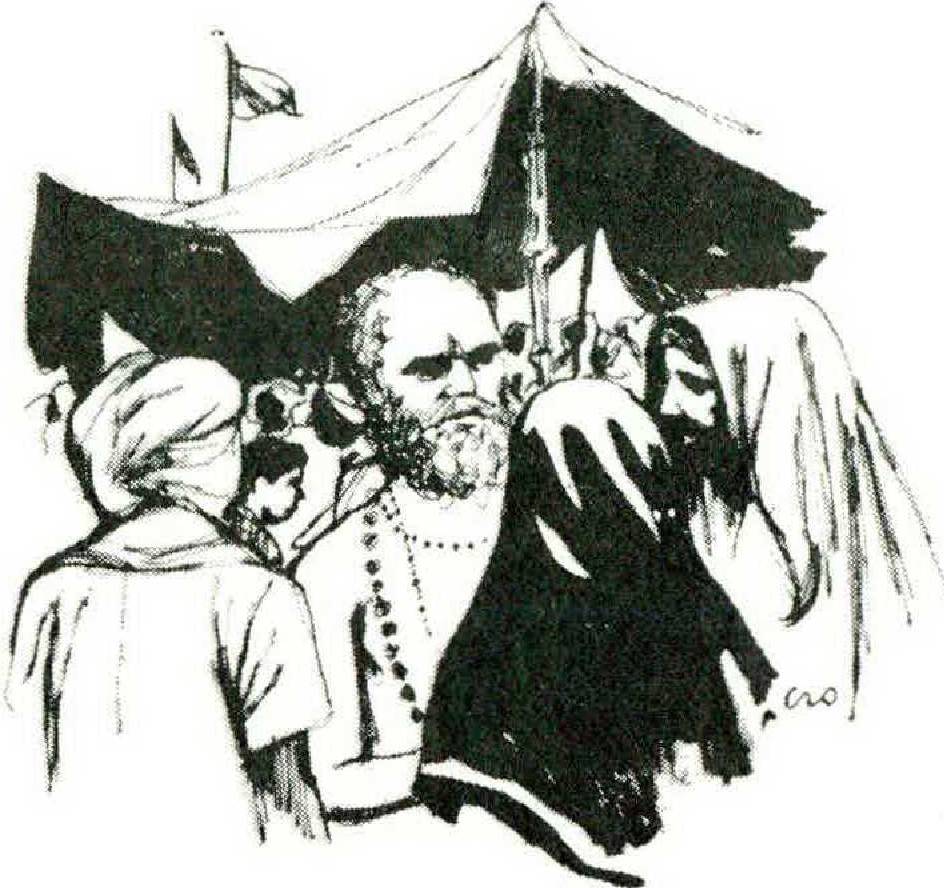
Among the travelers’ camps certain saddhus had set up display tents. When I looked into one, a chubby middle-aged woman with the familiar good humor of a Sunday school teacher (later she said she taught physics before putting on the saffron robe) promptly ushered me in. She introduced me to her guru, an enormously fat man in a starched saffron robe, who sat at the back of the tent beside a painting of baby-faced iridescent pink and blue gods. He handed me his printed calling card: he was Srimat Swami Shree Advaitanandaji, head of a saddhu organization (a chain of orphanages and schools) called the Bharat Sevashram Sangsha.
Saddhu guru
Advaitanandaji spoke perfect English. He showed me a thick book, Solace, of letters to his “spiritual daughter,” Sadanandamayee — and nodded paternally at my hostess, who blushed. He outlined his religious principles, which resembled those of lay bourgeois Hindus: he believed that eating meat enflamed the passions, that war with Pakistan was unfortunate but necessary, that an Indian child’s first obligation was to study hard and get a degree, that faith in God and celibacy were necessary for ethical behavior.
All the while the guru spoke, slowly and with heavy eyelids, more smiling, thick-set women in saffron appeared and disappeared on various housekeeping errands. Finally he excused himself for lunch. I was taken to Advaitanandaji’s chamber, a side tent with a saffron-dyed mosquito net. There I was given lunch, an immense quantity of white rice and vegetables, with gummy frieddough candy for dessert, while Advaitanandaji dined on the same elsewhere. Before I left, the women sold me a copy of Solace, and instructed me to look up certain yogis who were “very popular with Westerners.”
On the way down to the beach, a handsome gray-haired yogi camped along the road invited me to share his tea and greasy cookies. He was dressed in old, worn saffron robes. He said he was a Brahman, but went on to make fun of the “fat, rich sort of Brahmans.” Like the woman I had just met, he too was an “adult dropout.” Twenty-five years ago he quit his job as clerk in a government office and went off to the Himalayas, where he roamed around with a guru “here, there, everywhere.” After that he moved to Benares, where he had been living for the past few years. Ever since that day when he gave up all his dependents, he said, he had been “completely happy and free.” He told me about an important Bombay politician who had done the same thing — simply disappeared one day, put on saffron, and went off to say his beads along the Ganges.
Pleasure and ritual
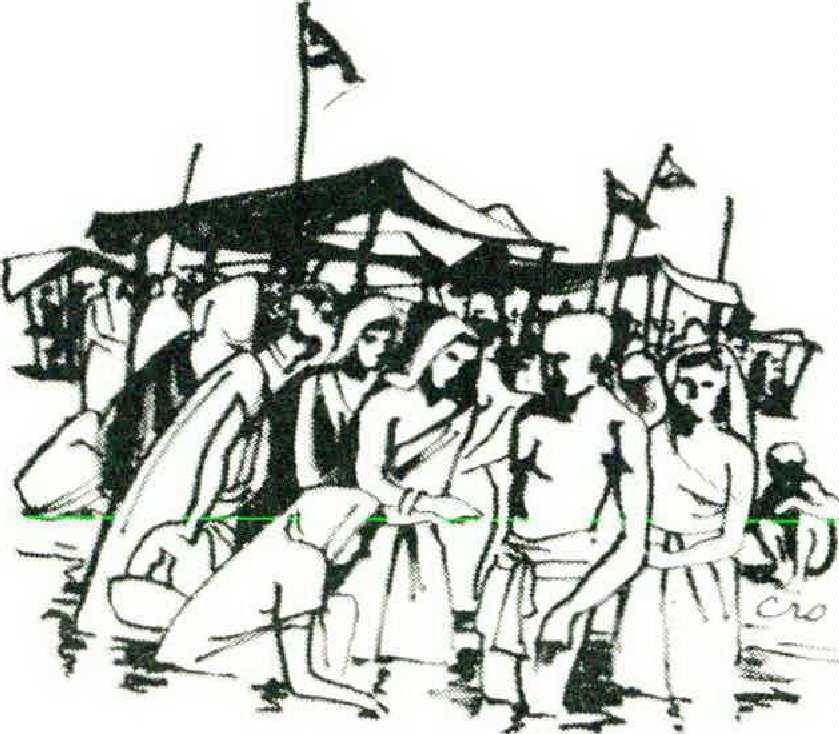
The shore was mobbed with peasants. Clusters of men, women, and children moved about together, dressed in the colors and styles of their native places. The pilgrims were cooking their midday meal, praying in small shrines near the water, or wandering in search of a spot to camp. Along the waterfront hundreds were taking the ceremonial dip: they bathed clothed, soaping and rinsing through wet cloth, then exchanged wet garments for dry ones with an agile maneuver, and quickly yielded their places to others. Many drank from the river. Had they been less solemn and businesslike, the scene might have begun to resemble a popular American beach on the Fourth of July.
Here and there, however, a child, unconscious of the difference between a pleasure swim and a ritual bath, played between the water and sand. An older boy chased some water buffalo exuberantly, smacking them with a stick. Two young women stepped into the water and removed their shirts; their bodies were lovely but they were unselfconscious, and the men nearby did not stare.
I crossed one of the many footbridges to the far shore of the Jumna, where saddhus — nearly naked, in flowers and jewelry — blanketed the beach. I had expected them to be repulsive, pallid from indoor prayer and malnourished from their avoidance of meat, fish, and eggs; instead, I found them strikingly handsome. Many were broad-shouldered, narrow-hipped; their skin was tanned and oiled; they stood and moved gracefully, like the Hindu gods in fresco cave paintings and temple sculpture.
One bare-chested young man, bald except for the long lock at the back of his head which identified him as a Brahman recluse, leaned on a rail, looking into the water, perfectly still: statuesque, classic beauty. Even many old men were just as handsome, their healthy, lean bodies adorned with lush white hair and beards.
A group of saddhus in their teens or twenties were running through the sand, slapping at an elephant. One with bright orange curls cavorting some distance from the others suddenly ran over and leapt deftly onto the elephant. They wore loincloths and garlands of yellow, orange, and white flowers. Some had white powder all over their bodies and orange stripes on their foreheads.
They had matted their hair into buns with dung.
When I looked at them with curiosity, they at once became ardently friendly. They hugged me and led me forward with their arms around me. They lifted me onto their elephant, explaining in Hindi that this was one of the beasts that had brought them to the Mela from their home in Hard war, and jumped on all around me. Together we crossed the long beach, the youngholy men laughing euphorically all the time.
“Tyagi" odyssey
They were tyagis (“wanderers”), they explained, not nagas (“naked ones”), or sannyassis (“beggars”), or yogis (“deep breathers”). They lived in a band of “many many tyagis,” they said, with their maharaj (“leader”). We were going now to their camp on a far sandbar, where several tyagi troupes had gathered.
The elephant walked for nearly an hour through a never-never land of tens of thousands of men just like these — mostly young, lean, tanned, wearing loincloths and jewelry. The tyagis were working on various tasks, some cooking their lunch, some applying the blue dust and orange paint or fixing their hair into dull, strawlike buns, some just conversing or strolling around. Everyone looked relaxed.
We stopped, finally, at some motley striped circus tents, the focal point of the open-air camp. Inside one, thirty or forty women in ordinary saris were squatting around a fire to make the tyagi leaders’ bread. Asked who they were, my companions smilingly shrugged them off, saying that the women of the countryside cooked and cleaned for them voluntarily. “Different women come and work, then go.” Inside another tent, two splendidly costumed and bejeweled little girls were singing and dancing in honor of the god Siva. A tyagi audience stood around casually, listening, talking, moving in and out. Under another spangled canvas roof a few dozen holy men sat in a closely packed circle on an ornamental rug, leisurely passing marijuana pipes between them.
My hosts hasted to the tent of their maharaj, eager to show me to him and him to me. As we ducked under colored hangings to enter, other holy men motioned that I should take off my shoes, but the tyagis accompanying me waved them off with a chuckle at their orthodoxy and propelled me forward.
The maharaj was sitting on a rug in an alcove of the tent, surrounded by other tyagis. Though the late afternoon sun haloed him and obscured his face, I could see he was white-haired, large, and powerfully built, as weatherbeaten and tough as a camel driver. At his feet sat a beautiful woman in a silk sari.
He had just been conversing with the men around him, yet he seemed pleased by my visit. He asked me the usual questions — when I came to India, where I’d been, what my business was, what I liked about the country —and could not get over my answering him in Hindi. He loaded me with guavas ,and milksweets, and told my hosts to take me to meet “some other maharajs.”
We made the rounds of the different leaders. Each gave me hearty greetings, a word of wisdom (“Man needs peace,”said one), and gifts of fruit and sweets. All assumed I had come to the Ganges to wash away my sins, like themselves, and were happily impressed by the distance I had traveled.
Joining up
The young tyagis said that many of them had joined the troupe when they were twelve or thirteen. One was given to the band by his widowed, impoverished mother. Another ran away from school one day on a whim. A tiny boy, fantastically dressed in bright yellow and purple, squirmed fearfully behind an older man when I noticed him, then peeked out with a defiant answering stare. His protector laughed at his shyness and explained that his parents had abandoned him to the saddhus who sat by the temple in their village, who had in turn delivered him to this group.
I asked the tyagis what they thought of their lives, and they responded with the enthusiasm of Little Leaguers. They declared they were very happy. All were sure they would be, and wanted to be, tyagis for the rest of their lives. Asked how they spend their time, they replied, “Only worship,” but they said it with such ebullience that one guessed that “worship” included traveling, festivals, music and dance, marijuana, and village women. Instead of despising them as social parasites, the villagers throughout India love them, and gladly give them food, clothing, shelter, and entertainment.
The young man with orange hair said he had been all over India by elephant, and would like to go to America and see the tyagis there.
I told him regretfully that there
were none. But he brushed off this information with the perfect assurance that he knew better, that there must be.
Babaappears
The tyagis referred me to Deorahawa Baba (baba meaning “father,” an appellation given only to venerable, solitary holy men), reputed to be 150 years old.
After two hours of walking back past all the tyagis, I came finally to the last outpost of habitation along the beach: Deorahawa Baba’s tiny hut, on stilts. About 100 people were bunched in a knot under his balcony waiting to see him, in the meantime exchanging stories. One man knew an eighty-year-old man who said Deorahawa Baba was old and bearded when he himself was a child. Another man said Deorahawa Baba received an enor-
mous amount of mail addressed simply “Deorahawa Baba, India,” which he never answered. Another said Deorahawa Baba could fly, that he had once won a bet by beating some tourists across the country.
The sun had just set; this group had been waiting for the holy man since lunchtime. Someone said Dcorahawa Baba had been just nearby in the Ganges all that time, treading water.

The sun’s last rays turned the river to a delicate, iridescent pink; then it went silver in the moonlight. The sand felt cool and silken underfoot. Naked holy men were taking their dips in the evening water; one drew the symbol (Om) in the sand. The stars came out. Deorahawa Baba’s crowd waited, perfectly patient. A man stepped to the center of attention, and like a camp counselor, started leading everyone in a comforting monotony of religious chants: Om,jai Ram,siddhi Ram, jai jai Ram (“Lord, hail Ram, straight Ram, hail hail Ram”)
over and over endlessly, until a few more hours had slipped away.
Suddenly the holy man appeared on his balcony, bare-chested, skinny, gnarled, and leaned down toward us. The people were overjoyed — they called him, blessed him, shouted questions, begged his blessing, implored him to throw them some of his sacred food. The wizened baba surveyed the crowd, and then, with a playful, mocking expression on his lips and in his eyes, threw an orange, a guava, and several pieces of candy quickly into my hands, the one silent, surprised American. Then he vanished. The faithful were vociferously disappointed. The next and last anyone saw of him was a streak across the sand, as the spry old man, diaper-clad, dashed out of his hut and away from his admirers.
On the slim chance that he would make another appearance that night, the crowd did not disperse. Only when Deorahawa Baba’s lieutenant, a stout man in a city suit who said he was a plainclothes policeman, shouted at them that they must leave did they go, reluctantly.
American tyagis
Since Indian culture has come into style in the avant-garde of America and Western Europe, a small, steady stream of young artists and poets, drug-users, adventurers, and dropouts are making Hermann Hesse’s “Journey to the East.” They like the scene in India, by which they mean more than just the cheap, legal, and abundant hemp products.
The hip “world-travelers,” as they are often called, generally come to India with few possessions and little money (some unabashedly beg and steal); they ride on wooden-seated long-distance buses or overcrowded third-class trains; they eat rice and hot chili peppers and (contrary to Peace Corps admonitions) drink the water at dingy roadside tea stalls; they wear cheap Indian clothes and jewelry; they sleep wherever they can, on the ground outdoors or the floors of railroad stations; they make pilgrimages to the Himalayas and holy cities — in short, they behave exactly like Indian holy men.
One twenty-one-year-old hipster from New York, red ribbons wound through his shoulder-length hair, went around the subcontinent giving away LSD. When a clever ten-yearold orphan tried to pick his pocket, he adopted the boy, and the two continued on their travels together.
Hipsters can sit for hours around a campfire with the saddhus, singing prayers to Ram or Ganesh and smoking ganja. With low-caste servants or poor Brahman musicians they joke all night, drinking milky tea and chewing betel.
West meets East
Such behavior endears the “worldtravelers” to the Indian masses. Orthodox Hindus place a high value on detachment from family, job, and possessions, and consider the solitary, itinerant life a noble one. “Dropping out,” whether from school or adult responsibilities, is not only universally approved, but actually prescribed (to all good Hindus) by ancient scripture.
The young migrants are also the first accessible Westerners most peasants have ever known — the first who do not make an issue of their food, clothing, and comfort, who are not obsessed with money and desperately fearful of getting cheated, who are not highly conscious (having been briefed by upper-class Indians) of their “place.” Even those Indians who bear a highly developed grudge against the West (for example, Communists), who resent past British imperialism and suspect future American designs, cannot dislike the world-travelers, who are so plainly without racist, colonialist, or even nationalist sentiments.
When an unkempt LSD-user from Berkeley — his wife, child, and teaching position abandoned “for no reason” a year before — wandered into an ashram (a communal settlement and work camp for Gandhi-followers), the Indians there practically deified him. They fed and clothed him willingly, and begged him to stay and meditate alongside them. The reception seemed appropriate to the California boy; he stayed a few months and then moved on.
The peasantry does the hipsters the favor of not thinking them bums, and the hipsters reciprocate by not thinking the peasants miserable. Instead of dwelling upon the poor diet, bad sanitation, poverty, and disease of the Indian masses, the bohemians dig the style of peasant life. They appreciate their flamboyantly colored clothes, the flowers, incense, and gaudy spangles that adorn their homes and temples, and their explosively spicy food. They admire their lack of concern for time, money, and the Protestant work ethic. They see a resemblance between the teasing play of the peasants, the hedonism of the holy men, and their own refined self-indulgence.
Hip meets Hindu
When hippy meets peasant shopping for turned-up-toe slippers in a dirty bazaar, and the two smile warmly at each other, hippy feels that the peasant’s smile touches upon the last point of his own irony, his own cool.
With an aesthetic rather than moral outlook, hipsters delight in the chaos of a poor village street: the mixed odors of flowers, incense, supper fires, and dung; the cacophony of blaring radios, car horns, animals, and human voices; the continual struggle for space between bullock cart, bicycle-rickshaw, horse-carriage, motor scooter, and car. Such confusion might disconcert a Western bourgeois, but to a hipster it is a model “happening.” The latest “media-mix” experiments back home are only imitations of the sensory overload of the actual Indian environment.
The impact of this cultural sympathy can be felt in the United Stales. Some leaders of the psychedelic movement tried (unsuccessfully) to adopt a Benares saddhu, Avatar Meher Baba, as their special guru. Hippies who had gotten high only on Western hemisphere marijuana have been introduced to Indian ganja, bhang, charas, and hashish. Little magazines such as San Francisco’s City Lights Journal have published work in English by the young Calcutta poets. Holy men’s journals have also appeared in English, like Parahamsa Yogananda’s Autobiography of a Yogi and lama Lobsang Rampa’s The Third Eye.
Yoga and Indian dance lessons are advertised abundantly in hippy newspapers, and little shops on both East and West coasts sell Indian incense, hookahs, Buddhist prayer wheels, Hindu beads, and statues and posters of the gods. On Third Avenue in New York’s Lower East side, an Indian baba operates from a storefront, and a coterie of neighborhood youth meets to pray and sing with him.
On the other side of the world, Indians of low caste and social class, a cultural “out group” despite their number, have met in the “out of it” world-travelers the first Westerners they like. And the grubbiest, most directionless dropout, an embarrassment to his family and an untouchable in his own country, finds his niche in India: a holy man.
— Faye Levine