Thomas Wolfe Arrives
What hit the country in October, 1929? The stock market crash, yes. But what else? A literary whirhrind out of Asheville. North Carolina. by way of Harvard and Brooklyn. His name teas Thomas Wolfe, and his first book, LOOK HOMEWARD, angel, struck the American scene like few novels before or since. From Andrew Turnbull’s excellent biography THOM AS wolfe, to be published in February by Scribner’s, we offer this account of the writer’s leap to a fame that he enjoyed for but a few years — until his death in 1938.
by ANDREW TURNBULL
MAN PERKINS, Scribner’s great editor, first heard the name Thomas Wolfe in September. 1928, when Madeleine Boyd, a literary agent, who had come to see him on other business, kept bringing up “a wonderful novel about an American boy” which was seeking a publisher. His curiosity aroused, Perkins asked to see it. and she agreed to send it on condition that he read every word. Although delighted with the opening pages — a description of Eugene’s father as a boy watching Lee’s ragged horde march on Gettysburg — Perkins was disappointed by the ensuing section about Gant’s life before he settled in Altamont. He went back to other matters, delegating the reading to a lieutenant, who presently drew his attention to the scene where Ben Gant, the undertaker, and the doctors are conversing in the greasy spoon. Perkins now dropped everything and read straight through the manuscript, knowing when he finished that it had to be published whatever the difficulties, and he anticipated the worst — especially after Wolfe’s first letter from abroad which told of having his head bashed and his nose broken at the Oktoberfest in Munich.
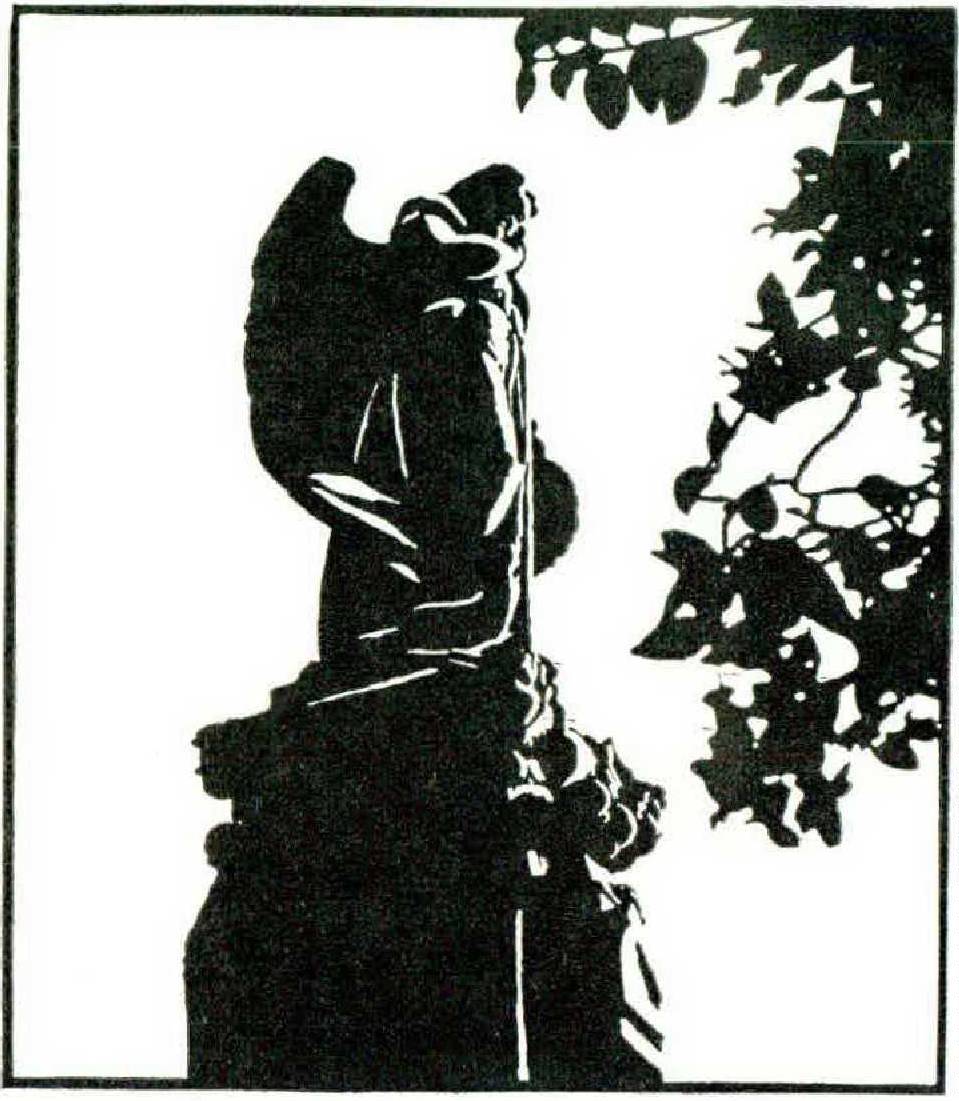
On January 2, 1929, when Perkins glanced up from his desk to see Wolfe’s giant frame filling the doorway, he was reminded of Shelley, who also had a disproportionately small head and wild hair and a luminosity of expression. Visibly trembling, Wolfe took off his coat and sat down as this mild-mannered New England-looking gentleman, with almost no preliminaries, began discussing the scene in O Lost where the madam buys a stone angel from Gant for the grave of one of her “girls.”
“I know you can’t print that,” Wolfe broke in. “I’ll take it out at once, Mr. Perkins.”
“Take it out?” The blue eyes looked offended. “Why, it’s one of the greatest short stories I’ve ever read!”
Perkins said he had been reading it aloud to Hemingway the week before, and he thought Scribner’s Magazine might buy it, whereupon Wolfe jumped to the conclusion that this little bit was all they wanted, and his heart sank. But then Perkins went on to speak of the book as a whole and of problems arising from its length and lack of coherence, and when Wolfe saw that Perkins was seriously interested, he talked wildly of cutting this and that, only to have Perkins reply in a well-bred half whisper with a faint rasp to it, “No, no — you must let that stay word for word — that scene is simply magnificent.” Referring now to a sheaf of handwritten notes, Perkins went over the manuscript in detail, and for the first time Wolfe felt he was getting criticism he could really use. The parts Perkins suggested cutting or altering were invariably the least interesting and essential, while the parts Wolfe had thought too earthy or profane for publication Perkins urged him to keep.
At the end of the conference Wolfe was told to go home and think it over, and five days later he came back with an outline of his contemplated revision. When he asked Perkins if he might say something definite about publication to a dear friend — meaning Aline Bernstein — Perkins smiled and said he thought so, that their minds were practically made up. On his way out of the office Wolfe ran into John Hall Wheelock, the poet who was also a Scribner editor; Wheelock said he hoped Wolfe had a good place to work — “you’ve got a big job ahead” — and Wolfe reeled out of the building in a drunken glory, knowing that his book would indeed be published. Scribner’s is at Forty-eighth Street, and when Wolfe came to his senses, he was on Onehundred-and-tenth, with no memory of how he had gotten there. He spent the next week in a delirium that reminded him of the Stephen Leacock character “who sprang upon his horse and rode madly off in all directions.” He would be sitting in the Harvard Club staring stupidly at the publisher’s letter of acceptance, when suddenly he would get the urge to rush outside and walk up Fifth Avenue for miles, pausing now and then to inspect the unsigned contract and the uncashed $450 advance which lived in his breast pocket. On January 12, having worked off some of his buoyancy in a fortyfive-page screed to Mrs. Roberts, he finally got down to work. (Mrs. Roberts, his former teacher and the fairy godmother of his youth, on hearing the news, had written Tom, “Good Lord, Boy, my heart thrills so I can’t think. ... It had to come, but I never dared to hope that it could come to you so young. ... I should think the stars would just be swarming about you so that they bump into each other, and knock off great swirls of star dust.”)
THOUGH Tom and Aline were back together and the prospect of being published had made him easier to live with, he had taken an apartment by himself at 27 West Fifteenth Street, not wanting to merge with her as completely as before. A few years later she would write a story picturing a typical day in this Indian summer of their love. It is spring, and going to Wolfe’s apartment, she finds him sprawled across the bed in trousers, shirt, and shoes, his face spangled with sweat, his hair glistening, his shirt damp. Beside him is a coffee cup whose unmatching saucer overflows with cigarette butts. Scattered about the floor are more butts, sprinklings of ashes, odd socks, a collar or two, several neckties, and myriad books — some open face up, some open face down, some piled together. She kisses him awake, saying, “Your neck is all sweaty, you smell like a little baby out of its nap, you smell like musty books and I love them!” Holding her tight and trying to draw her back into sleep with him, he answers, “You smell like goose grease, all Jews smell like goose grease, but you smell like a flower too, a fresh dewy flower just out of the bathtub.”
Wolfe has a lunch date with Perkins, and Aline has bought him a blue polka-dot tie which is “going to make that new blue suit hum, and all the lunch you don’t spill on the suit you can sop up with the tie. You tell your friend up on Fifth Avenue that he had better bring an extra fifty cents along to feed the clothes.”
Wolfe explains how he happens to be sleeping fully dressed. He had worked till five that morning, when two friends from Asheville had turned up with a bottle of corn liquor, and after a few drinks it had seemed only fair to show them his new suit. He had put on the trousers — then one of the friends had phoned his girl, and they had another drink because she was angry. Wolfe had tried to pacify her. “Think of all the girls,” he said, “who are never called up at 5:30 A.M., all the girls who are never called up at all! How the hell would you like to be one of those girls?” When his friends had left, he had fallen asleep reading a poem of Herrick’s, and opening the volume now with Aline at his side, he says, “Listen to this, my dear, how beautiful, they can’t do it any more. That ungainly minister in his country parsonage, writing about a little child, about the little child’s faith.”
Aline lies very still, transported by his reading, until she remembers his appointment. She tells him to shave and bathe, while she makes his coffee.
“Right you are,” he says, springing to life. “You’re not right often, but this is one of the occasions. Coffee is the correct word, coffee and no bath. The papers will carry tomorrow morning, ‘Mr. Thomas Wolfe introduced a novel custom for breakfast yesterday. He had coffee and no bath. Mr. Wolfe is the son of Mrs. Julia Wolfe of Asheville, well known in real estate circles.’ ”
“If you will kindly move your great hulking frame away from the sink,” Aline interrupts, “I will fill the kettle and make the first item of the new-style breakfast.”
In the midst of shaving at the dish-laden sink, Wolfe cranes around to see what Aline is doing and drips lather on his new pants. The hot water is running, and the stream catching the edge of a plate spurts fine beads down his leg. His mind is a battlefield. He wants to stay and lunch with Aline, he wants to go uptown and lunch with Perkins, he wants to walk uptown, he wants to ride up on the bus, he wants to take a taxi and dash up to the door, he wants to stay home and write, he wants to lie on the bed and hold Aline close to him, he wants to tease and torment her and make her cry, he wants her to go away and leave him alone, he wants to stand by the window and let his soul float out into the infinite, he wants to think about all the books he is going to write, he wants a long drink of gin that is in the closet where Aline won’t be likely to see it, he wants to live in everyone’s house and find out what they are like.
At the last minute Aline notices that a sleeve of his new jacket reposing on the floor has taken a little drink of coffee from a used saucer, and having cleaned it as best she can, she hustles him out the door only half an hour late for his appointment.
To KEEP him solvent until his book appeared, Wolfe was working part time at N.Y.U. He had one section of English Composition and was marking papers in a Bible course as well; “the hated teaching now become strangely pleasant,” he wrote Mrs. Roberts. Musing on his possible access of fortune, he told the student who was typing the revision of 0 Lost, “I wouldn’t know how to spend more than $6,000 a year. I’d like to have ten thousand books. I’d like to spend about a thousand dollars a year for books [and have] a two or three room apartment with a Negro chef about forty years of age — I love to eat, you know. I shall marry at seventy-three. Life is too short to be mixed up in nasty complications with other people. A shack on a sea cliff in summer. Then Europe perhaps once a year, a few months at a time, living liberally. Two thousand dollars is a sufficient sum for that. But it all depends on the success of the book, and if it should fail, it would hurt terribly.”
By the end of March he had finished the revision to his satisfaction but not to Scribner’s, for the manuscript he brought back was only eight pages shorter than the original. His cuts had been virtually nullified by additions, and Perkins realized he must step in or the job would never get done. So began their collaboration; during the next two months they met at Scribner’s in the evening to decide what should be left out. Though they haggled at times, Wolfe for the most part accepted Perkins’ suggestions with good grace, grumbling to friends, however, that “those bastards at Scribner’s told me they’d publish my book and now they want to tear it to pieces.” Once he pounded up the stairs to Madeleine Boyd’s fourth-floor apartment bellowing, “Madeleine, they’re cutting the balls out of my novel!” and the French hairdresser on the second floor went to Mrs. Boyd wringing his hands and saying, “My ladies, my ladies — they are shocked — can’t you do something?”
Legend exaggerates the extent of the editing. In the end eleven hundred typewritten pages were cut to about eight hundred. To give the story the unity of unfolding through Eugene’s memories, the father’s pre-Altamont existence, which Perkins had found slow going, was omitted, as were Wolfe’s digressions on politics, morals, and religion, and the histories of minor characters were thinned. Rambling sequences, such as Eugene’s career at the state university, were condensed, and one important transposition was made: Gant’s homecoming trolley ride through Altamont was shifted from Part II to Part I for greater impact. Here and there, gutter words were euphemized, and a few of the coarser passages were toned down. But in his original “Note to the Publisher’s Reader” accompanying the manuscript, Wolfe had said that it did not seem to him the book was overwritten and that what came out “must come out block by block and not sentence by sentence,” and so it occurred. Perkins’ editing was chiefly a matter of architecture, of eliminating chunks so as to give harmony and proportion to the whole. He didn’t tamper with the actual writing, which in his estimation bore the signature of a great artist. He asked for a better title, however, and Wolfe drew an inspired one from the couplet in “Lycidas”:
And, O ye Dolphins, waft the hapless youth.
A month later, when Wolfe visited the Scribner art department to see the first printed sample, or dummy, of his book, the two young women who worked there were nonplussed by the colossus who ducked his head and thrust his shoulders sideways to get through their door, talking all the while in an eager, resonant stammer to Perkins, who was leading him along. After the introductions, Wolfe sat down and immediately rose again on hearing an ominous creak. “D-do you mind?” he said. “I th-think I’d better try another chair.” When one of the girls pushed forward a substitute of solid oak, he thanked her as if he were being offered a golden throne. His suit was rumpled, there were spots on his tie, and he kept thrusting his fingers through his slicked-down hair, causing it to stand up in oily little anchovies, but his warmth and his delight in the occasion made one forget his peculiarities. When the dummy was brought out — a few printed pages with the blue binding and rainbow-hued wrap of the first edition — his huge hand clamped around it and held it at arm’s length. After gazing at it in silence, he said to Perkins, “Yon know, it’s like a m-miracle. Six months ago if anyone had s-said I’d be holding my own book — a p-printed book right here in my own hand — I’d have t-told them they were crazy.”
Early in June the manuscript went to press, and the last part of July he and Aline took a cottage in Maine where he slept on a porch surrounded by spruce woods, with the ocean lapping twenty-five yards away. He fished off a rotten wharf and walked along the shore road of Boothbay Harbor by moonlight. His days were spent correcting proof, and in the process of making the final version deeper, fuller, and truer to himself, he interpolated so many things that the printer’s surcharge came to $700, which by rights he should have paid, but Scribner’s absorbed it. Now that he was doing the work he loved, his whole life seemed miraculous. A boy from the mountains born in a strange, wild family, he had gone beyond the mountains and known the state, had gone beyond the state and known the nation, had attended its greatest university and worked in its greatest city and traveled beyond the seas. “Because I was penniless and took one ship instead of another,” he wrote Wheelock, “I met the great and beautiful friend who has stood by me through all the torture, struggle, and madness of my nature for over three years.” And now, to top it all, a fine publisher was bringing out his book, a sample of which appeared in the August issue of Scribner’s Magazine. “An Angel on the Porch,” Gant’s interview with the madam which Perkins had admired, was offered as “the first work of a new writer about whom much will be heard this fall.” Wolfe expected the story’s publication to be accompanied by convulsions of the earth, falling meteors, and a general strike, but a few friends mentioned it and that was all.
In September he went home — his first visit for over two years, his last for eight to come — and as the giant worm of the train twisted through the slashed, red gorges up into the mountain fastness whence he had begun his trek across the world, his feelings were a mixture of fatality and elation. He had made good; he was a credit to his community, still blissfully unaware of its impending exposure at his hands. In Asheville everyone was cordial and rooting for his success. He wrote Perkins that in his family “we get one another crazy — I’ve been here a week and I’m about ready for a padded cell. But no one’s to blame.” His reluctance to discuss his book made his sister, Mabel, fear, she later confessed, that it was “one of those boring philosophies or criticisms or a book on the Negro Mulatto subject.” She doubted that ten Ashevilleans would read it, even after Tom took her aside to say he had written some things people weren’t going to like and that next time he came home it would probably be incognito. But he hoped Mabel would understand and realize that he had tried to do his best.
As an insurance against the oblivion that awaits most first novels, he went on teaching at N.Y.U., for though his heart was “beating a roll-call against [his] ribs,” he thought it “just as well, perhaps, to have an anchor that will keep me on earth, unless I go into the balloon service permanently.” In his classes he paced back and forth with the same brooding intensity, his eyes blazing when he was moved, which was most of the time. One day he came in exulting that “they’ve given me a whole window at Scribner’s” — referring to the bookstore’s display of Look Homeward, Angel — and thereafter part of every hour was devoted to behind-the-scenes anecdotes about its reception.
FOR A man, what can compare with living with a dream and realizing it after long struggle? In Wolfe’s case, coming as he did from a comparatively simple, unlettered background, the romance of the printed word intensified the rapture of literary success. Though the first review of Look Homeward, Angel in the New York World made fun of its “musings over destiny, fate, love, ah me, ah me,” the all-important ones in the Sunday Times and Herald Tribune were such unqualified raves that Perkins ordered a second printing. At which point Wolfe was brought up short by repercussions from home.
Asheville had been reading his book as confession or autobiography, which in a sense it was. In the original version of 0 Lost, the members of his immediate family had been called by their real first names, although before publication all were changed except Ben’s, Grover’s, and W. O.’s, the three who had died. In many cases the names of subordinate characters pointed to their flesh-andblood counterparts; thus Horace Williams was Vergil Weldon in the novel, French Toms was Tom French, Roy Dock was Guy Doak, and so on. When Perkins had voiced alarm about the family’s naked portrayal, Wolfe had said, “But Mr. Perkins, you don’t understand — I think these are great people who ought to be told about,” and Perkins realized that, in the profound sense, Look Homeward, Angel was transcendingly a work of the imagination. He had never had an author who gave such a sense of creating a universe ex nihilo, as in the first book of Genesis. More seer than reporter, closer to reality than to actuality, Wolfe couldn’t help transmuting everything he touched. “There is scarcely a scene that has its base in literal fact,” he had said in the “Note to the Publisher’s Reader.” “The book is ... a fiction that grew out of a life completely digested in my spirit, a fiction which telescopes, condenses, and objectifies all the random or incompleted gestures of life — which tries to comprehend people, in short, not by telling what people did, but by what they should have done.”
Though his characters invariably took off from persons he had known whose mannerisms were recognizable in the finished portrait, he infused them with his own vitality, and by heightening this trait and suppressing that, he distorted his models in a way that made them truer to the human condition. In this respect he was the source and root of his characters, their lives flowed from him, and the country at large welcomed Look Homeward, Angel as a powerful and original work of art. Asheville, however, which had given the potter his clay, reviled it as malicious gossip.
On the street, at clubs, bridge parties, teas, and social gatherings of every kind, Look Homeward, Angel was Asheville’s major topic in the weeks following its appearance.
“Have you read it?”
“Isn’t it awful?”
“Such a terrible thing to write about his own people!”
“He’s a mad genius.”
“Did you recognize _?”
“Now that Tom mentions it, I remember quite clearly — ”
And the person would go on to certify as historical fact some peccadillo which Wolfe had made up out of whole cloth. Soon he was getting anonymous letters which began, “Sir: You are a son of a bitch,” and an old lady he had known all his life wrote him that though she had never believed in lynch law, she would do nothing to prevent a mob from dragging his “big, overgrown karkus” across Pack Square. His mother, she said, had taken to her bed white as a ghost and would never rise again.
Actually, Julia was behaving with her usual fortitude. “I don’t object,” she told Fred and Mabel. “He can paint me up like old Carolina Peavine [a local beggar woman] if he can make a success of his writings,” If Julia was hurt, she concealed it and brushed aside those who sought to commiserate with her.
For example, the woman who phoned her and said, “I knew Tom when he was a little boy, and I always liked him.”
“Yes,” said Julia expectantly.
“And I know you always tried to bring up your family the best you could, but Mrs. Wolfe —”
“Well, thank you,” Julia cut it. “It’s very nice of you to say that. Tom’s doing fine, and we’re all well. Goodbye.”
Recalling the incident in later years, she would shake her head and laugh. “I knew what she was trying to say, but I tell you, I just didn’t give her a chance.”
Mabel was less controlled. She felt that Tom had blackened their origins, and she suffered acutely when some of the women at her club cut her because of the book. Presently she rallied, writing Tom that he had put them on the map and that she would sell her ticket to heaven for a little of the recognition he was receiving. Fred, too, when he got over the initial shock, sided with Tom and was able to joke about it in a letter. He said that in the next book he hoped Tom wouldn’t write “so damn deeply. Look Homeward, Angel gave me a few headaches trying to fathom out Greek Mythology and Egyptology. And don’t lose everything. [In] your first Book everything was lost. In the next hope you cry out, Eureka! I have Found it.”
Hardest hit of all was Margaret Roberts. Tom had tried to prepare her when, after reading “The Angel on the Porch” in the August Scribner's, she had written him that she feared the story would distress his family. Wincing at the rebuke, he had started to answer that her letter seemed false and sentimental to him, that she was being a little too consciously “the fine woman,” and that she no longer thought of him as he was, but as the boy she had known. Then he reconsidered, and putting the letter aside, he had written her another saying she was “one of the high people of the earth, with as little of the earth in you as anyone I have ever known — your understanding is for the flame, the spirit, the glory — and in this faith you are profoundly right.” But he added that anyone who was offended by what seemed to him “a very simple and unoffending story” would have much stronger feelings when the book came out.
That fall she was suffering from a toxic goiter which almost killed her, and she chanced to be alone in the house when she heard the postman deposit what she knew was Look Homeward, Angel inside the screen door. As she went to collect it, her heart was beating so loud and fast that she thought it would leave her body. Joyfully, she took the book back to bed with her, and by chance it fell open at the chapter about the North State Fitting School, which she read with mounting anguish. Then, as she laid it aside feeling hurt and helpless, she noticed the inscription: “To Margaret Roberts, who was the Mother of my Spirit, I present this copy of my first book with hope and with devotion. Thomas Wolfe, October 15, 1929.”
What pained her most was the portrait of her husband, who had been satirized as a leaden oaf given to inane, whining laughter and to stroking himself and others with chalky fingers, a description which shocked her the more because it had never occurred to her that Wolfe’s attitude toward her husband was substantially different from his attitude toward her. When Wolfe had been with them the month before, he had talked congenially with Mr. Roberts and had given her no warning, and now she felt betrayed. The rest of the novel, when she mustered the strength to read it, bore out her first impression of ruthlessness, and although in writing Wolfe she tried to do justice to his artistry, her conclusion was, “You have crucified your family and devastated mine.”
He answered with what she later called “a short dear letter,” saying he had shown hers to Perkins, who pronounced it that of “a splendid person.” In February, when some of the dust had settled, he wrote her again trying to meet her objections. He said that the bitterness in his book had been aimed not at individuals but at the structure of life, which seemed to him cruel and tragically wasteful. Angry Ashevilleans were claiming that Look Homeward, Angel had been written to pay off old scores, and indeed some of his characterizations may have begun that way. (A friend to whom he had read the early chapters of O Lost remembered him pausing to gloat, “His real name is ——._Do you know what that son-of-a-bitch did to me once? Well now, just wait till he sees this!”) And yet the end product had little to do with revenge or petty malice. As he wrote Mrs. Roberts, “My book was called up from the lost wells and adyts of my childhood — for twenty months that experience blazed and was shaped and fused into a mold of my own creation — my own reality. . . . Do you think that if the reality in my book was only the same reality that walks the streets I would take the trouble of writing at all?”
Mrs. Roberts wanted to send him a more understanding letter, which in her weakened state it took her months to compose. Then, feeling it was inadequate, she didn’t mail it, and for a long time there was silence between them.
IN LATER years he liked to remember that October, 1929, the turning point of his career, had also been a turning point for the nation, Look Homeward, Angel's publication having coincided with the Wall Street Crash. That autumn stock prices stopped rising, indicating that the supply of speculators buying for an increase was exhausted, and since ownership on margin now became meaningless, large numbers rushed to sell in a snowballing action that wrecked the market and inaugurated a decade of depression. The economy might be toppling, but Wolfe, whose gains during the boom had been intellectual and spiritual rather than financial, was going on. He was, indeed, just hitting his stride.
Across the nation Look Homeward, Angel got superlative reviews, the best of any first novel in several years. The critics compared Wolfe to Whitman, Dostoevsky, Rabelais, Melville, and Joyce, and Ben’s death to that of Madame Bovary. John Chamberlain in the Bookman called Look Homeward, Angel “a rich, positive grappling with life,” adding that “no more sensuous novel has been written in the United States,” while the New Yorker thought that Wolfe’s “expose of the boy’s soul, in all its idealism and obscenity, makes Dreiser’s youths seem like Frank Merriwells.” Of the personal tributes, none meant more to him than Edwin Greenlaw’s. The Renaissance scholar who had taught him at Chapel Hill said the novel didn’t contain a shoddy line, and that he would go back to it now and then — “Something I don’t do very often with modern books.” Fellow authors, that most exacting class of critic, were quick to recognize a new power in their midst. Hugh Walpole, visiting this country, said of Wolfe in an interview, “Let America awake to him, for he has the making of greatness.” And James Boyd wrote Perkins, “I have an uneasy feeling that the little fellows had better move over for this bird. But whether I mean the little fellows on Parnassus or on Blackwell’s Island I don’t yet know. I only know somebody’s got to move. And on personal grounds there’s no writer I’d rather move over or down for myself. Although there will be no question of volunteering. It will be a case of the brewer’s big horses.”
Wolfe had never gotten enough mail to satisfy him, and now he was glutted with effusions from remote places. A clergyman in Portage, Wisconsin, thanked him for “breathing on the valley of dry bones” and making them “bloom and dance.” A mother in Santa Fe wrote him that in the faraway gaze of her seven-year-old son she recognized the questing spirit that had been frustrated in her and prayed it might carry on. “Why, I do not know because the questing is pain. But that is life, the life you have made us feel — inevitable, beautiful, deep-rooted in the past.” Wolfe heard from a trainman who had been inspired by Look Homeward, Angel to finish his novel called Sidetrack, which told of the human wrecks who cling to railroading. (Drawn by the subject, Wolfe met this man and tried unsuccessfully to interest Perkins in his work.) There were invitations from women to come to tea, cocktails, dinner, whatever suited him, sometimes with the polite addendum that he bring Mrs. Wolfe if such there be. An actress wanted to introduce him to a young playwright of her acquaintance. “I’m sure you would find much in common. He has the same zest for life that is in you and your grand book.”
Around New York, Wolfe was a phenomenon. There had never been anything quite like this giant Ariel with the policeman’s shoes and the unshorn locks that swirled low on the nape of his neck in a Byronic ringlet or two. His sprawling disarray was appealing in its ingenuousness; so much was happening to him that he simply didn’t care whether his tie was straight or his coat and pants matched. When asked to dinner he would dominate the evening with intimate outpourings as wide as the horizon, though he was shy too, and easily hurt, blanching with anger at the supercilious smiles if, for example, he sopped up his gravy with a piece of bread. Like Robert Burns come to Edinburgh from rustic seclusion, he had an unimpeachable sense of his own dignity and worth.
It didn’t take him long to weary of the speaking engagements, the autographing parties, the celebrity hounds, and the high-strung women who said they had wept over Look Homeward, Angel and wanted to be a part of all that beauty. He complained of the Park Avenue ladies who threw themselves in his arms, but if they hadn’t, he would probably have complained of that too. He was clear on one thing, however: that his importance had nothing to do with money or social position or the current brouhaha. He remained immovably centered in his work. Look Homeward, Angel, he noted, had taken him “approximately 500 days (and nights) of writing, revising, correcting, with an average of five hours a day of actual composition. From ten to fifteen cups of tea and coffee a day and from 40 to 60 cigarettes, from 6 to eight miles a day walking about the room or up and down the streets of Europe and New York, during which I thought constantly about the book. Months and months of thinking about it from the time of waking until the time of sleeping. I hope to repeat this process about 20 times during my life.”