Yaw Manu's Charm: An Atlantic "First"
by Ayi Kwei Armah
NOW that he is in prison, some people are afraid even to say that they knew Yaw Manu. He has become a leper. That’s because he was caught, not because these people shun evil. After all, everybody knows that it is impossible for an honest man to become rich, and yet the rich are respected. I often think that this our world is full of traitors, Judases who are your friends as long as things are going well for you, but turn your back or have something go wrong, and they will be there betraying you, insulting you, and saying that they don’t know you, they have only heard your name somewhere. The evil that men do lives after them, so to speak.
I am not ashamed to say that Yaw Manu was my friend. We went to elementary school together from class one to standard seven, ten years in the same village Catholic school. He was very serious, always thinking of winning a big scholarship and going to England for further studies, even though he wasn’t our first boy. In fact he wasn’t even one of our clever boys. We were forty-five in our class, and he was about twentieth in the big tests. Yet he was never discouraged. England was always in his head. It was in him like a disease, eating him and making him live only in the future, far away from us all and everything around him. First he wanted to go to Achimota or Mfantipim or one of the really famous secondary schools, where they only take one hundred students a year, all first and second boys from the town schools. Yaw Manu tried when we were in standard five and failed the Common Entrance. In standard six he tried again and failed again. Our standard seven teacher told him to choose a smaller school for which it would not be necessary to sit the Common Entrance. He said the same thing to all of us who wanted to continue our education, even the first boy. Manu didn’t like the idea of going to an unknown college, but in the end the teacher brought him to his stomach senses.
We studied hard for the big examination at the end of the year, and also prayed hard. The girls made Saint Philomcna’s cords with white, blue, and red threads for us to wear around our waists for luck, and we even got the Dutch priest to bless all our cords for us when he came to visit our village. We were very lucky, because he came only once a year, and some years not at all. We also remembered to get Hausa charms from a maalam who lived near our village, because we knew that even though white magic was very strong, black magic was even stronger if it wasn’t badly used. We all agreed that if we could combine the two, nothing could stand against us, although at first some of the clever boys were worried and said that magic worked sometimes by addition and at other times by subtraction, and that if we added black magic to white magic we might get subtraction instead of addition; in which case everything would be lost. This disturbed us a bit, until our prayer leader, a very old boy with a big body and an even bigger voice, proved that this was all nonsense by asking, “What about multiplication and division?” We all laughed at that.
Then the smallest boy in the class, who was really a dwarf and a very good joker, asked, “And long division?” We laughed louder at this; in fact I wept with laughing so much that day. So we went on making plans, and forgot about subtraction. Some of us wanted the maalam’s charms to be given to the priest for blessing, but our first boy warned us that it was a bad idea, because priests and witch doctors never ate from the same bowl, so to speak. We said that this was a pity, but we also decided that since discretion was the better part of valor, so to speak, we would not give our maalam’s charms to the priest to bless after all.
When the priest came and blessed our cords, he said that it was very important to have the protection of Saint Philomena and Saint Anthony of Padua, the friend of animals, and Jesus Christ and Mary full of grace, and many other big saints, but we must never forget that God and the saints would help us only if we worked hard and helped ourselves in the first place. This speech of his caused a lot of trouble among us because we all knew the catechism by heart, and with our little knowledge, although we did not want to boast or disagree with the white priest, still we knew that something was wrong with what he had said. Of course we did not argue with him while he was talking to us, but as soon as he was gone a serious argument broke out. You see, the catechism said that although as human beings born of women we could never save ourselves, yet if we only had faith we could level mountains. That is exactly what the catechism said; but here was this priest telling us that faith was not enough. Our clever boys could not agree on the correct approach. Some said that it was well known that the —big examination was inhumanly difficult, so only faith could bring success. The other group said that God would never come down to take anybody’s examinations for him since he was very busy keeping his only eye on Mary sitting on his left-hand side and on Jesus sitting on his right-hand side. This was a disrespectful thing to say, but then these were rough boys who never went to church, and the teachers were afraid to cane them on Monday mornings when the church-attendance register was read.
About three months before the examination, a strange man had come from the nearest town saying that he had a cousin who worked at the Examinations Council in Accra and that through this cousin of his he had obtained some tips which he was willing to sell us. We had arranged a very secret meeting with him in the bush, and there we had each given the man sixpence in return for twenty questions with long, learned answers, full of impressive big words, written, he said, by some secondary school teacher in Accra who had lately gone mad with too much intelligence. Brain fag, he called this disease, which is brought on by too much cleverness.
WELL, now we had these precious rumors and the answers. The only thing remaining was to chew, pour, pass, and forget. I mean all we had to do was to chew every word thoroughly, so that on the day of the big examination we could pour all this amount of stuff onto the paper, pass the examination, and forget everything after that. Simple. Were we now to stop chewing the tips just because we knew God was on our side? Some decided to put their entire faith in God, Saint Philomena, Saint Anthony of Padua, who loved animals, and the Muslim maalam. Yaw Manu was one of these believers.
From night till morning they prayed, and in the daytime they fasted. They suffered terribly, but they liked it, because they despised those of us who ate regularly, and the more their bellies ached with hunger, the more they became convinced that God was helping them. They burned long Indian candles wrapped in black ribbons, and the urine smell of incense was always on them. On our classroom floor they drew a large Star of David, with little crosses in all the corners, and “SAX ET SARAT, BE YE OUR GUIDES” written boldly at the bottom. In the middle of the star they set a glass of clear water, and when everything was ready, they would step outside and catch some little boy and bring him in, trembling all over. First they would ask him if he was seven years old. I think the catechism says that children of less than seven are less corrupt than those over seven. If the child was over seven, he was beaten a little and sent away. But if he said he was six or something like that, then the thing to do was to ask him if he had ever slept with a woman. You know, not like sleeping with his mother, but the real thing. The question was important because the star and the crosses and the water were for calling Saint Anthony to speak to us, and only a virgin boy was useful for that purpose. A child who had already seen the secrets of womanhood would be beaten quite severely and sent away, but a pure boy would be told to stoop there in the middle of the floor and look into Saint Anthony’s glass of water.
“What do you see?” our prayer leader would ask, his voice stern.
“Nothing,” the boy would say, looking harder.
The prayer leader would clear his throat and say, “Close your eyes”; a long pause, then, “Open your eyes. Now what do you see?”
“Nothing yet,” would come the uncomfortable reply.
“Look harder. Can’t you see a man in black holding a cross?”
After a moment the little boy would say, “Oooooh, I can see him now. Yes, he is wearing a black . . .” A quick kick in the buttocks, and the boy would be thrown out, because we knew that Saint Anthony was white magic, and therefore only wore white. If the little boy saw the real Saint Anthony, then he was told to turn his eyes away from the glass, put his ear to it, and listen to his message.
“Is Saint Anthony speaking now?” the leader would ask in the still silence.
“Yes, Saint Anthony is speaking now.”
“What language is he speaking?” The correct answer was not Fanti, since the saint only spoke English. At first I found it difficult to understand how a boy could understand what was said if Saint Anthony only spoke English, but the prayer leader explained to me that the saint had the power to make anybody understand him if he chose to, and that this was a mystery and a miracle like the Fifteen Mysteries of the Rosary of which the catechist spoke during the benedictions in October, and also like the miracle of Christ turning water to champagne at the wedding.
“Will all of us pass?” the leader would ask.
“Saint Anthony says no,” the little boy would reply after a while.
“How many failures?”
“Saint Anthony says three.”
For some reason the number was always three. The three boys who were usually at the bottom of the class would pray very hard, and fast harder. Yaw Manu, even though he was not one of these three, also prayed and fasted with them. He was a very careful boy.
On the day of the big examination, we all went to early morning Mass. The catechist gave his speech about crossing the rivers and bridges of life, and all the way from the church to the examination hall we formed a slow procession, singing “Lead, kindly Light.” Examination day was always a holiday, and the other schoolchildren and the women of the village stood by the wayside and said admiring words and “May the Good Friend go with you” to us. Some wept, and we all cast our eyes downward, for we knew that indeed we were descending into the valley of death.
“WHEN the results came in December, we were told that nineteen of us had failed. Actually this was very good for our school because every year more than half of our standard seven boys failed. Even though our teacher tried to look sad and disappointed as he read out the results to us, it was plain that his mournful look was for the benefit of those who had failed, and that in his belly he was quite happy. Later we met by ourselves and tried to explain why more than three had failed. Our prayer leader, who was himself among the failures, became very angry and said that it was all because some of us had not fasted and prayed well enough, and that the extra failures were only bearing upon themselves the sins of the careless ones. In fact he became so angry that I was happy when the meeting broke up after the singing of “Lead, kindly Light.”
Both of us passed, I mean Yaw Manu and myself, and the next year we went to the town to attend the small secondary school.
I do not like to talk about those five years I spent in the secondary school. Nobody had any friends there, and the work was very hard. The priests who taught us made us go to chapel every morning, and there were evening prayers every day. I was very unhappy, but Yaw Manu was happy. All the priests liked him because even though he was a poor student, he was the best Catholic in the school. He seemed to live in the chapel. In the very first year he became an altar boy. How he learned all those Latin sentences was a mystery to me because he found it difficult to chew his history notes. Whenever I saw him he had one of those little missals in his hand, and was repeating the Latin words that altar servers use. He would screw up his face, and the funny words would roll out: “Ad deum qui laetificat juventutem meam. . . . Quia tu es Deus, fortitudo mea, Quare me repulisti. . . .”
The Church became something between us, and Yaw Manu did not really like me anymore, but to me he was always a friend and a brother. I am also a civilized man and a Christian, but I think Sunday is enough for people to be holy; otherwise the Good Lord would not have bothered to set apart the other six days for ordinary work. I think it was the Church that caused Yaw Manu to fail the Cambridge School Certificate Examination, which we took in form five. It is well known that these examinations, being set in England, are extremely difficult, and it is no disgrace to fail them. I myself was lucky to get a grade three. But I still think Yaw Manu could have passed the School Cert, if he had not spent so much of his time at the altar. Of course the priests liked him so much that they let him stay another year to try again, which is something I am sure they would not have done for a boy like me; but it is also well known that once you fail the School Certificate, it will take a miracle to pass it after that.
I did not return to my village after I got my certificate, but came to Sekondi to seek employment, and that is how I got my job in the British Bank of West Africa. I wrote to Yaw Manu, and he sometimes replied, though not very warmly.
That year Yaw Manu failed again. He went to his priest friends and told them that if they would favor him with one more year, this time he would definitely pass. The priests told him that he was the best boy they had known, and they knew that God would always be with him if he continued to be good. Then they said they were really sorry, but they could not let him stay another year. They told him that the Lord Jesus Christ had never been to a secondary school, and had certainly never been given the chance to take the Cambridge School Certificate Examination; that Peter, the first Pope, was a simple fisherman, and also that Saint Joseph, the father of God the Son, was only a poor carpenter. Now I say that Yaw Manu was a good Christian, a very good one indeed, and so he knew all this. Still, he had the desire to make himself a big man in the world, especially to go to England to pursue his education. He was very disappointed that he couldn’t stay another year, but there was nothing he could do about it, so he came to Sekondi to look for employment. The manager of the bank hired him without too much trouble.
IAM the last person to expect anybody who works in a bank to be happy, but I must say that even I found Yaw Manu’s behavior surprising. Not that he did not work well; in fact, the opposite was true. His books were always the neatest, and he was never late, not even once, and unlike the rest of us, he took sick leave only when he was actually sick. But he never joked or laughed when everybody else did, and believe me, we bank clerks have some very funny things to say about the way people live. There were all these funny people, dirty, ugly people who look far from rich, and they had these fat balances in the bank, and the only thing we could do when we thought of such people having all that money when we needed it so desperately was to laugh. But Yaw Manu never laughed with us, not even at the woman who was so afraid of losing her money that she came to us every week and asked to count it. And there were some very laughable things happening even among ourselves. For instance, when the manager first told us we would have to wear ties when at work, we grumbled, saying that this was the Gold Coast, hot Africa near the equator, not cold England in the Arctic Sea. We actually said that, and this manager of ours didn’t get angry; he just laughed and said England was not Eskimo country, and we also laughed very loudly, I don’t know why. But not Yaw Manu. He kept on adding up his neat rows of figures. And then when we saw that because of the ties we had on all these rich people were beginning to call us “Sail,” we joked about it a lot and laughed, but Yaw Manu kept silent.
I remember at another time something very funny happened. You see, we all brought our food to work because the bank was in European Town and so we couldn’t go home at twelve to eat. We knew it was shameful to carry food plainly through the streets like illiterates, so we all had big tobacco tins in which we put our food. With a matchbox on top of a tobacco can and a pipe between our teeth, each of us looked very respectable, like a graduate. Now one day one of us, James Sackey, who bluffs so much that we call him “Yankee-Yankee,” was coming to work when, just outside the bank, a small boy hit him with a bicycle. It was nothing serious, but you know Sekondi people: even before Sackey was down, a small crowd was rushing to see the accident. Then the man fell, He tried to hold on to his tobacco tin, but it also fell down, and what do you think fell from it? Groundnut stew. Oh, the crowd laughed and laughed. We also laughed when he came in. But not Yaw Manu.
I don’t think it was the work or the bank itself that made him unhappy. In fact he didn’t seem to care for the bank at all. The truth is that he was working too hard, studying at home and hoping to take the London matriculation. I found this out when I visited him in his room. He was always studying when I went to see him. On the wall above his desk he had a sign that said something about great men. I can only remember the last two lines:
Were toiling upwards in the night.
And indeed, that was what Yaw Manu was trying to do. He told me proudly that he was paying for two correspondence courses from England, one called Rapid Results College and the other Bennett College. He explained to me that though most people took one at a time, he was taking both so that things would go faster. He was also subscribing to a magazine from England called Psychology, which would give him confidence plus the secrets of success and health. He even gave me a copy of Psychology to read. I was impressed with it. It had many big words, and I had difficulty understanding it. Yaw Manu said this was only because I had not been reading it regularly.
“Look,” he told me, pointing to a large can in his meat safe. “Bemax. That’s what I drink to clear my brain. It’s very powerful, so it’s very expensive. It’s for brainworkers. I get very tired working all night, but I drink that, and I am all right for work in the day. Of course I take brain pills like Pro-Plus and things even more powerful. I order them from England, and they are very expensive.”
I wondered whether this would not affect his health.
“Oh, no,” he said. “I have ordered this.” He showed me a catalogue with all sorts of pictures and pointed to one showing ropes and bars and many queer things. “From America. Charles Atlas, you know. A sound mind in a sound body, so to speak.”
Yaw Manu stopped going to church when he came to work in Sekondi, and did not talk so often about the goodness of God. I thought that would make him easier to live with, but I was wrong. He still talked distantly, like a priest or a catechist, but only about things no one could understand, and I felt uncomfortable listening to his new ideas. He said he had new beliefs, but when I asked him about them, he would use big words like “positive” and “rationality” and “strategic effort.” His room was full of books and papers and those pills that he said were so good for his brain. The bottles came with testimonials from doctors in England to prove their power: pictures of silent men in long white coats holding test tubes and other instruments to the light.
In spite of all this, Yaw Manu failed his examinations again and again. He said nothing about them, but it was easy enough to guess what was happening. Every six months he would ask for a day’s casual leave, and that was how we knew about the examinations. After that he would come back to work, and for about a month he would be quiet and superior, like a man with a great secret; but nothing ever came of it in the end. If he had passed the examinations, he would immediately have asked for promotion, or at least an increase in his salary, but he remained in the same position all the time he was with us, and his salary increases were the usual ten shillings we all got at the end of every year. That is why he had to borrow so heavily to pay for all those pills and books and exercises. Some people, talking like wise men from the East, have asked why Manu did not borrow from the bank itself instead of going to the moneylender with his heavy rates of interest. These are childish questions, clever on the surface but having no experience behind them. We who work in the bank are supposed to arrange our affairs as neatly as we do the affairs of the bank. What would the manager think of us if he knew that we could not live within our means? Maybe Yaw Manu was a fool to take those courses and buy those books that cost so much, and to buy the pills too, but since he was only trying to advance himself, he was not wrong to go to the moneylender. Many young men borrow money in that way to advance themselves, and when they are promoted, it is not too hard for them to pay back what they owe.
It is a great pity that Yaw Manu’s pills did not clear his brain and help him to pass his examinations. He continued to study hard right up to the end. Perhaps if he had relaxed a little now and then, he would not have grown so thin and weak. After all, all work and no play makes Jack a dull boy, so to speak. It’s bad enough to have to study so hard, but no girls, no drinking, no dancing: that’s an impossible life for any young man to lead.
I WILL never agree that Yaw Manu was mad. Those who say he was mad have little experience. Some people have even said it was brain fag, the disease caused by too much cleverness; as if Yaw Manu were clever enough for that.
They are sending him to the asylum in Accra, like a real madman. Perhaps if I did not know him better, I also would think him mad. I must say that if you look at his behavior from the outside, it is hard to see the truth about him. That was the mistake of the reporter from the Daily Graphic. He told the truth about Yaw Manu’s outside behavior, but that was not enough to give the real truth. I have carried that article with me since the day after the trial, and even though there is nothing false said in it, I am dissatisfied whenever I read it:
SEKONDI, 14 June. At the Magistrate’s Court today a 26-year-old Bank clerk was sentenced to three years — in the Mental Asylum. Throughout the proceedings, the accused, one Yaw Manu, did not once open his mouth. Counsel appointed by the Crown on his behalf pleaded guilty while asking for leniency on the grounds that the mental balance of the accused was plainly disturbed.
According to Prosecuting Witness Mr. J. D. McCarthy, District Manager of the British Bank of West Africa, Market Street Branch, Sekondi, the said Yaw Manu had been an employee of the Bank for a period of just over 18 months. During that time he had behaved himself excellently, and had been well known as a punctual, serious, neat, and careful clerk. Until the 6th of May last, the accused was said to have done nothing to arouse anyone’s suspicions.
At 2:27 P.M. on May 6th, Mr. McCarthy said, while he was balancing the Bank’s books after hours, he saw Mr. Manu, the accused, take twelve bundles of currency, totaling £1150. The accused, continued the Witness for the Prosecution, then made his way out of the Bank premises; he did not seem to have heard the shouts of the witness, and when the latter attempted to block his exit, he extricated himself “slowly and silently, but very firmly, with extraordinary strength. He did everything as if he were in a trance,” added Mr. McCarthy.
The accused is said to have gone home after the theft. Because of the accused’s strange behavior, Mr. McCarthy said, he had hesitated to notify the Police, but “waited to see what would happen the next day. Primitive Psychology is a hobby of mine, and the chap’s behavior struck me as deuced interesting.”
The Magistrate at this point reprimanded the Witness for not having notified the Police immediately, a correction which seems to have been accepted in good spirit. The case continued.
The day after the theft, according to the Witness for the Prosecution, the accused came back to work, “and acted as if nothing had happened.” It was only then that the Police were called in. The accused had tried to slip past the Police “again as if he were in a trance,” and had had to be subdued by force. His home was later searched, and the missing £1150 found intact.
Official sources indicate that the accused will be treated as a special case and be sent to the Mental Asylum in Accra.
Now, there is nothing wrong with that report, but I say it is not enough. The article does not even mention the fact that Yaw Manu took the money at accounting time. Every two weeks we have to bring all the books in order. We sit for hours adding up rows and rows of figures, first the black and then the red. To those who have it, it is all money to be used, but to us it is figures upon figures, like soldier ants swarming through our heads and giving us not a moment of peace. I have often spent my nights just dreaming of these figures. One moment they are ants crawling through me and eating my poor brains to little bits and mashing it all to build their Hill with.
I must say that I have often thought of things I could do if I had half the money some people have. All of us talk of this sometimes, and I know that each of those working in the bank would have gone to England to study if only he had enough money. We were all honest men, with no great debts, and yet we were sometimes heavily tempted. And as for Yaw Manu, though he was honest enough, in fact more honest than even I, he had his pills and books and courses to pay for, and he wanted to go to England more desperately than any other young man did, and besides that, the moneylender was crying for his very blood.
I WAS not there myself the day he stole the money. Only our manager was present. Usually, we were all in a hurry to get home after two o’clock, but Yaw Manu often stayed behind, so I for one found nothing strange in his behavior at that time. I remember, however, that when I left, Yaw Manu was in the lavatory, and that he had been there for rather a long time.
The day after the crime, Yaw Manu did something unusual. He came in late. Not only that — he was whistling as he came in. As soon as he sat down he was called into Mr. McCarthy’s office, and we whispered among ourselves that perhaps at last he was going to be promoted.
When we heard Yaw Manu’s voice loudly shouting insults at the manager, we knew something was very wrong. Soon Yaw Manu marched out of the office, looking very angry and saying repeatedly, “I’ll teach you not to call me a thief!”
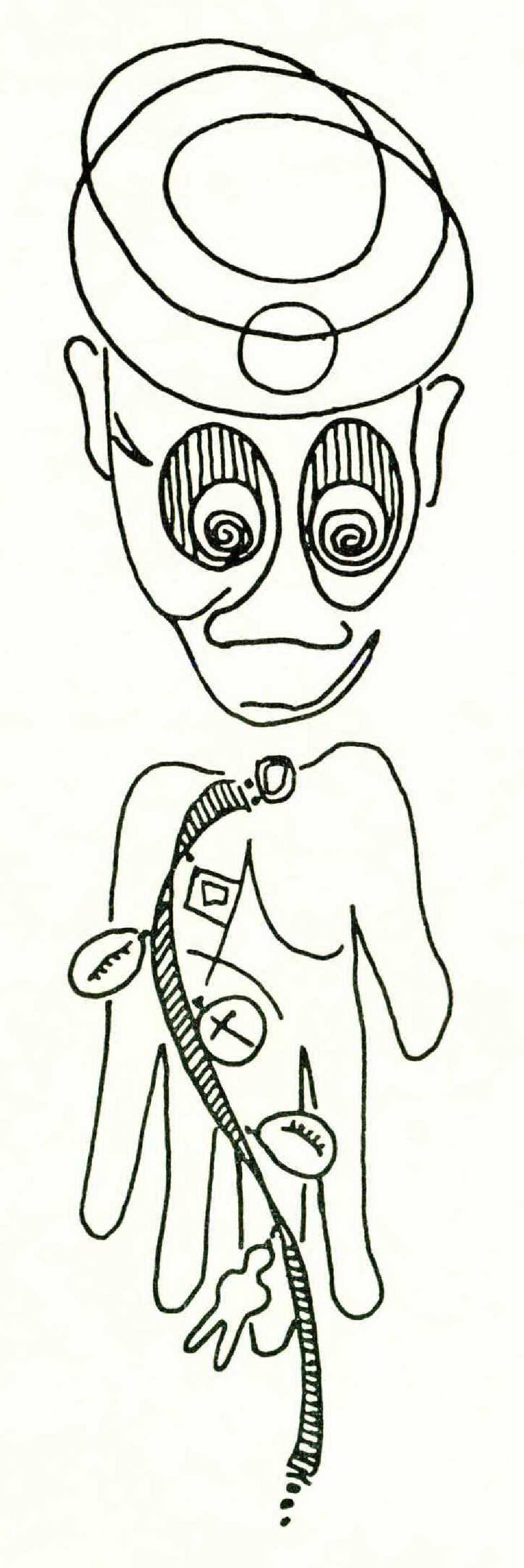
Mr. McCarthy came out after him, his face all red. He asked someone to call the police, and told us not to let Yaw Manu leave the bank or go to his counter. It was then that Yaw Manu remembered that I was his friend. He looked at me, and told me something in Fanti. He said I should look into the left corner of his drawer, and I would find something there. This thing I was to take into the lavatory. I did everything as he instructed me to do it, like his good friend. What I found in the drawer was a bangle, made of leather, with cowries and little talismans attached to it. I took it to the lavatory, and a moment later Yaw Manu went in there.
When he came out of the lavatory he looked completely different. He was so silent and serene, like a priest when he is walking toward the altar. He did not seem to see anybody or to hear anything as he walked past us to the door. The police had come by now and wanted to ask Manu some questions; but he did not seem to notice anything. He just tried silently to go past them into the street, and when they tried to stop him gently, he pushed them away in a strange, quiet way, like slow-motion films. That is what Mr. McCarthy meant when he said those things about Yaw Manu being in a trance. Manu struggled with the police until they broke his arm and held him down, and all through this he said nothing at all.
I visited him as early as possible in the police station. He had been beaten rather hard, and could not talk very long, but he gave me the bangle and told me to take it to a certain maalam, whose address he gave me.
“Tell him I did everything he told me to do, but it did not work,” Yaw Manu said, looking away from me. I told him I would do whatever he asked me to do, since a friend in need is a friend indeed, so to speak.
“And don’t forget to ask him to give you back my twenty-five pounds,” he added.
When I entered the maalam’s dark, musty room, he greeted me like a long-expected brother even before I could see him properly. He took both of my hands in his, stared long at my palms, and said heavily, “Ah, my friend, plenty devil follow you; plenty plenty devil.”
I told the maalam I had not come to find out anything for myself, but to return Yaw Manu’s charm and get back the money he had paid for it. I gave the man the bangle, and he squinted at it. I could see better now, and I looked at the maalam as he studied his bangle through half-shut eyes. His eyes were enormous; his eyelids slipped wetly over and away from the huge balls while he spoke through lips so dry and old he had to wet them constantly.
“You savvy what dey inside dam juju?” he asked, fixing his eyes on me. I shook my head.
“Bring shilling; I go tell you.” Curiosity won, and I gave him a shilling. When he had the shilling safely in his hand, he said, “Bring twenty-five pounds. I go give you.” I kept myself from laughing and told him I could only decide to buy it when I knew what kind of charm it was. He looked at me suspiciously for a moment, closed his eyes, and in a funny, singsong tone, began: “Dis ting, like you wear am for you arm like so, and you say some word way I fit teach you, man no fit see you. You fit do anytin, no man fit see you. You fit steal, you fit kill self, no man fit see you. You and air be one, like so. You like dam juju?”
It made me angry to see this man try to fool me too, so that when I spoke, my voice was so loud he opened his eyes in surprise. “Look, maalam, my friend told me to let you know that he had tried all your tricks, and they hadn’t worked.” By the time I had finished speaking, the man had become calm again, and his eyes were closed.
“He go wrong someplace. He do sometin wrong, my friend. Dis juju no miss. He do sometin wrong, my friend.” He repeatedly told me of the virtues of the charm, urging me to buy it and make myself invisible with it.
“My friend,” he kept saying through those wetted lips, “you no want money? You fit be rich. Like you wear dam juju, no man fit see you. You fit do anytin. Com’, coni’, my friend. I reduce for you. Twenty pounds.”
I shook my head. I had already decided to go to the police.
“Look, my friend,” he persisted, “eighteen pounds.”
I was at the door, and he was at my elbow. “Fifteen pounds, my friend.” I was out in the street.
At ten pounds, my friend, I was already halfway to the police station. This is the first time I am going to be mentioned in the Daily Graphic. People will read the words of someone called the witness for the prosecution, but how many of my old classmates will know that I am the one? I wonder.