The Surprise: An Atlantic "First"
THE university was a nice place to be in summertime then, a nice warm place that a lot of people might have thought was hot, but what to me was a good clean healthy feeling you could feel clear through your body when you walked across the street, or anywhere in the sun. The campus was where you could feel it best, where the sun seemed to fall with just the right amount of heat, just the right intensity. I always saw a lot of people in a strain walking from one building to another, but I knew what was wrong with them, you could see it on their faces. They were resisting the heat, that was it. Not me. I never was stupid. I knew about things like heat and resistance and friction. Friction was what you had to avoid, you see, because friction creates an unpleasant heat, the kind of heat you see people making ugly faces over. I never allowed my system to resist sunlight and heat that way because I knew it had nothing to do with temperature. My clothes were always loose anyway, and I welcomed the heat — the kind of heat that was good and healthy, the kind of heat you move around in. A man without funds likes hot summer days. It’s winter that’s hard.
The campus was the best place for a walk all right, because of the number of well-watered oak trees everywhere you looked. They were large enough to have stretched away from the ground, but they were not so large as to be magnificent. Magnificent trees are all right, but a man without funds can’t muster up a very close feeling for them. It’s the same way with friends. Magnificent people don’t make the best friends for a poor man for the same reason. I had a girlfriend named Ginny then, who was sometimes magnificent.
I think those oak trees on the university campus looked a lot like what olive trees would look like if olive trees grew larger than they really do. Yes, if you were drawing an olive tree and had a tendency to draw it lovelier than it actually was, and larger, you’d be drawing a picture of those oak trees on campus. They weren’t too shady, and underneath them the grass and the sidewalks were always dappled in spots where the sun broke through the shade in the daytime.
I lived only a block from the campus then, in a one-room garage apartment that had no garage underneath it, only four wooden stilts for support. I suppose you could have parked a car underneath it, it you could have driven through the yard to the side of the boardinghouse. Maybe it actually had been a garage apartment at one time, but what it was when I lived there was a single room tacked to the second story of a thirty-room boardinghouse, and it was called a garage apartment because the only way to get in it was up an old wooden set of stairs that swayed like they were held together by rope.
There were two windows in the room, and through the front one was an uninterrupted view of the university tower. I didn’t have a shade on the top half of that window, and I could look out it anytime and see the big round clockfaces on top of the tower. The window pulled down from the top, and I left it open for a breeze and used it day and night anytime I wanted to tell time. From where I lived, the tower wasn’t very far away, but because of the way the old house was situated I was at catercorners to it, and in order to tell the time sometimes, I had to read one hand off the part of the clockface I could see on the left and the other hand off the clockface I could see to the right. I had developed this ability to tell catercornered time over a period of several months, and I never knew anyone else who did it as a regular habit. A man without funds makes his way the best he can.
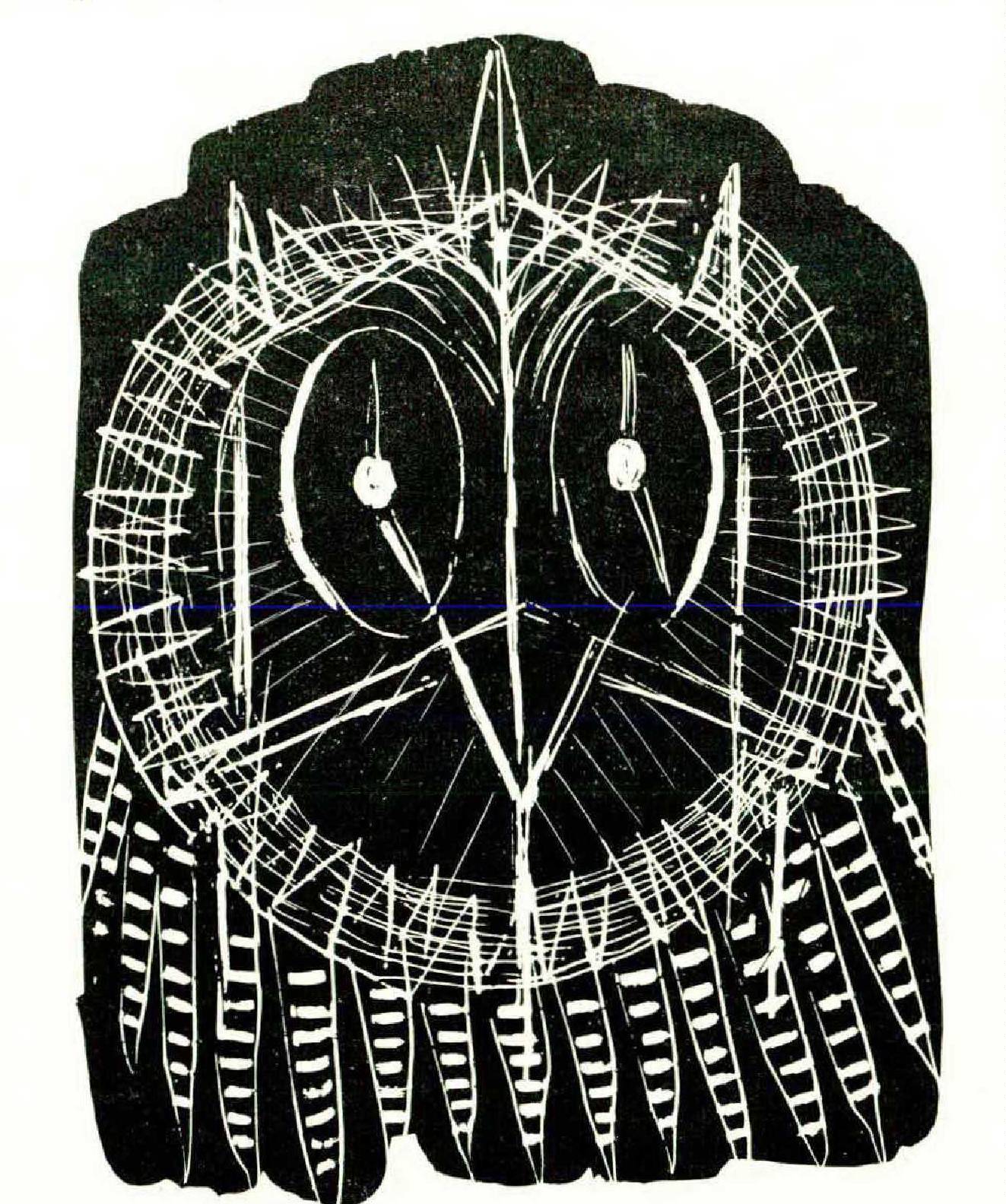
That tower was something to look at, even then. It was like looking up at a huge ugly bird staring down at you with two big bulging eyes that glowed in the dark. It was like an owl whose head and neck someone took and stretched until the eyes nearly popped out, and the way the corner of the observation deck jutted out, it made you think of a beak. You could tell time in that bird’s eyes, I used to think, and then I would have confusing dreams of an owl perched on top of every building in town, going whooo every hour on the hour.
Ginny didn’t like it in my apartment at night because I wouldn’t cover the window. She had never noticed it before, but after I told her the tower looked like a bird, she couldn’t look at it from any angle without getting a chill. It frightened her, she said, and indeed she did look frightened the times I noticed her lying in the dark staring at the tower through the window. But I couldn’t help it. It was nice to have the time out your window whenever you needed it. It was also necessary to have the top hall of the window open in order for my cooling system to be effective. Because the kind of heat I could never stand is the static heat of night, the heat of dead burned-out air. It’s the kind of heat you would have in your throat if someone were strangling you. I never could blame the average man for working for a living and owning things like TV’s and air conditioners. I had a fan myself.
The circulation of air in my room was carefully arranged. My fan was stuck in the window behind the bed, in the lower half, and it blew across the bed and the room and rebounded upward on the opposite wall, sucking in as it did fresh air from the upper half of the window facing the clock. If the lower half were open, it would merely blow my fresh air out the window, but Ginny could never understand this. She only thought in single layers.
I tried to stay on top of things all that time, a man without funds has to. In the heat of July my cooling system was doing the best it could, but it still needed elaboration, so I perfected a second step to my established procedure. It was a combination of the physical and the mental, this step was, and I was very proud of my ability to master it. Every night I soaked a towel and stretched out naked on the bed with the wet towel on top of me and the fan blowing across my body. The trick was in the timing. After a few minutes I would become chilled, and as soon as all the symptoms had appeared, I took off the towel and pulled a blanket over me, having created the illusion of being cold. I was quite proud of being able to fool myself consciously, but Ginny never understood the complexity of it.
But matters are never settled, are they? Nothing seems permanent anymore. Ginny claimed it made the bed wet. Since she refused to participate in the wet towel, the blanket was naturally too warm for her. Ginny didn’t mean to be a handicap to me; in fact, she actually wasn’t since I thrive under the threat of such minor challenges. So in an effort to be cooperative I put myself in a frame of mind to seek new and even more refined means of maintaining a satisfactorily cooled lodging.
That was how I met Pie then — because of Ginny. Otherwise I would have been happy with the way things were, and the ice might never have caught my attention.
He looked like a Mexican boy about fourteen years old, but the man who ran the place told me one afternoon he was past his thirtieth birthday. I knew right away he hadn’t much mind. Except for a rather limited power of speech and a strangely phenomenal memory which was intertwined with a conception of time, his skull might just as well have been stuffed with cheese. I’d never heard of anything like the way he responded to time, though. He couldn’t have looked at a watch or a clockface and told you what the hour was, but he had a builtin system for doing the same things every day at exactly the same time. Fred, the man he worked for, told me, “That’s why they let him out of the school. Nothing can happen to a guy like that. He wouldn’t hurt nothing, and you know damned well just what he’s going to be doing at any second. You can set your watch by knowing when he goes to take a crap every day, I swear.”
Ginny was rehearsing a play or something the night I saw him first. I don’t really know what she was doing, but she was always around the Little Theater memorizing things to say to me when she saw me next. I was walking up and down the streets and on the campus. That was all I ever did then, walk, absorbing or casting away all the idiocy it had been my privilege to witness during the day. There was a beer joint down the street from where I lived, a small squat building that looked like an exaggerated sand house made by children with a bucket at the beach. I must have walked down the alley behind it a hundred times, but that night I was passing just after closing, and inside the kitchen they were cleaning up and getting ready to go home. I heard the sound of the ice slushing out onto the pavement, and about six hundred things happened inside my head. I was like that then, sort of like a flesh-and-blood computer. Everything around me fed into my system and was instantaneously rejected, held for later consideration, or penetrated my consciousness for immediate action. Without funds, you have to be this way.
That ice meant a lot to me, quite a lot, and I realized instantly how important it was. I didn’t think in terms of comfort or in terms of pleasing Ginny. What was important was that I was refining my system even more, I was carrying on my twenty-four-hour-a-day project of getting by. That was all there was to it. It was as simple as that — staying alive.
I was picking up the largest chunks and dropping them into a pasteboard beer carton when he came back out with another bucketful. He saw me just as he was dumping it and almost froze in the halfbent position he was in. I didn’t say a word, and after a minute or so he turned around and went back inside. I could see one of the clockfaces on the tower from where I was, and I was very careful to mark the time. It would be necessary to be early. The ice wouldn’t last long on the hot pavement.
Ginny didn’t come that night, and it almost made me angry. I was anxious to show her my cool air. She’d have a look of admiration on her face all right when she saw it. I hoped that wherever she was she was hot and sweating and wondering about me, thinking how nice and cool it would be under a wet towel. She’d never believe about the ice. It was something she’d have to see and feel. I stayed awake until after the ice melted and turned into warm water, calculating the length of time it took a panful of ice to melt under a fan.
THE next day I caught myself wondering whether or not Ginny would come around again, and I realized what the ice was doing to me. I caught myself in time, all right. It was one thing to worry about Ginny while the fan was blowing over chunks of ice, but it was another thing the next morning when all that was left in the pan was stale water. It was essential that I watch myself from now on, I decided. This was just the sort of frame of mind Ginny was waiting to pounce on. She was looking for something she could help me with. I spent the day walking in the sun and picking up soft-drink empties until I had sixty-six cents’ worth, which I used to buy ground meat and beans with. I already had a big sack of rice.
Ginny came up the stairs before I was finished eating. It was like I could feel the weight of her pulling the little room forward against the supports. Sometimes she knocked on the door, and sometimes she didn’t. I was sitting in the dark, eating, and I could see her standing against the black dots the screen made against the streetlights behind her.
I put my bowl down and opened the screen for her and turned on the lamp.
“Why do you sit in the dark?” she asked.
“It got dark while I was sitting here,” I told her.
She poked at my dish. “Did you have anything to eat?” she asked. “Anything decent?”
I didn’t want to talk about food. I wanted to hurry the time and get the ice under that fan.
“We had a meeting at the Little Theater last night, she said. “Dr. Grimes from the university was there.”
Good,’ I said. “It was nice and cool here last night.”
“You don’t know who Dr. Grimes is, do you?”
“Who?”
“Dr. Grimes, from the university.”
“Who’s he?” I said.
“He’s a psychiatrist. He’s interested in people,” she told me. “He’s a wonderful person, and he’s interested in Little Theater because he thinks it helps us understand and help each other.”
“Good,”I said, but I wondered, how smart is he? That was the sort of thing I had been wondering about people lately. How smart are they?
“Will you stay with me tonight?” I asked. “I have a surprise for you.”
“I have to go to a party,” she said. “Will you go with me? I want you to meet Dr. Grimes sometime.”
Sure, I said. “If we can go late and leave early.”
Perhaps I shouldn’t have said that because I knew it would make her mad. She knew why I liked to go late. People got drunk or high, and I liked to take food outside and hide it. I liked to take an empty bottle with me and fill it up with their wine, too. But I wanted to leave early so I could get the ice and surprise her.
“You’re like a vulture,” she snapped. “My friends know that’s the only reason you come,” she said. “If you’d only talk to people and try to understand them, you’d be better off.”
She was in a destructive mood, typical of civilization. All I wanted was to get the ice and put it in the pan and let the fan blow on it. That was all.
“I better not go then,” I said.
“All right, damn you,” she said.
She got up, and I followed her down the stairs and out to the sidewalk before she stopped and looked at me. I could see the reflection of the streetlights blurred in her eyes. She turned her head and some of her hair slipped down into her face, and she brushed it back with a snap of her hand. She was walking again, and I was almost beside her.
“What do you want?” she said after a while.
“Nothing,” I told her.
“Then what are you doing?”
“Now, you mean?”
“Yes, what are you doing now?” She was walking fast, not looking at me, not looking at anything.
“Walking with you,” I said. “I don’t even know where you live, you know. I thought I’d walk with you a way.”
“I’m not sorry about anything,” she said.
I didn’t understand her at all. After a while she turned up a walk into a boardinghouse that looked like all the other old houses students live in near the campus, and when I stopped, she looked over her shoulder and said, “Bye.” I crossed the street and went onto the campus, looking up at the tower and marking the time. From where Ginny lived, the tower was catercornered too — a big, ugly bird with clock hands in his eyes. I didn’t feel anything particular except that I was doing something Ginny didn’t like. But I couldn’t worry about that. Wait till she saw that ice.
Later, the Mexican boy had the can full of ice, and I asked him who he was.
“Pie,” he said, but I didn’t understand what he meant. I’m that way too, just like all the people in the world. I don’t hear what I don’t expect sometimes. “Pie,” he said, “Pie, Pie, Pie.” He made a circular motion with his hands and scooped an imaginary slice out of it, and I knew what he meant.
“Pic,” I said.
“Pie, Pie, Pie.”
I tried to explain to him about the ice. There was still August and September to go through, and I thought we might as well come to a quick friendship if I was going to depend upon him for cool nights. All the while I talked he stood in front of me with a stupid grin. Some sort of a little fire seemed to burn behind his eyes. I didn’t know then about his being a human clock, but I did know right off he wasn’t quite ordinary. He looked too happy to be what he obviously was, a dishwasher and general kitchen swamper. He stood there grinning stupidly with his hands hanging down, the way an animal used to climbing would. His teeth were bucked, protruding the way comics who are trying to caricature Orientals make theirs stick out.
“Pie,” he said, and took my hand wolfishly in both of his, shaking it with a great deal of excitement.
“You my friend,” he stuttered.
I realized he hadn’t heard a word I said about the ice. Ginny would probably not be there anyway, I thought, but it didn’t matter so much about her. When you’ve refined life to a higher than ordinary plane, it has to function that way irrelevant to personalities. I wanted that ice in the pan every night, so I told him I would be his friend and visit him each night if he would save the ice for me. He understood that at once.
Ginny stayed away from me for another week, but I had my panful of ice and got to know Pie better. He told me the ice came from the big cooler they kept the beer in and that every night it was his job to drain the cooler. He was the dishwasher in the joint, all right. He asked me to bring him a chocolate pie sometime, and I said I would. You’d be surprised how cool and relaxing it can be on a hot night lying in bed with your fan blowing across a panful of ice water.
Then suddenly one evening Ginny came back.
I knew it was her coming up the stairs, and I wanted the time to disappear. I couldn’t tell her about the ice, she had to see it and feel it.
She looked in through the wire and spoke from outside. “I had to see if you were still alive,” she said. “I had to make sure you hadn’t starved or that this place hadn’t fallen to pieces.”
I opened the door for her, and she stood outside and waited for me to say something before she came in.
“Come in,” I said.
“When have you eaten last?” she said.
People like Ginny can’t understand. I manage to eat. I pay twenty dollars’ rent a month. It’s nothing for a man without funds to get by if he’s alert. I asked her to sit down. It would be a while before I could get the ice, and I had to keep her there.
“How have you been?” she said, without sitting down.
I told her I was fine.
“I can’t stay long,” she said. “There’s a party at my house. Some very nice people are there. I came to get you.”
“Will you come back with me?" I said.
“There’s a lot to eat and drink,” she told me. “You can have all you want.”
I WENT to the party with her. It was at the same place I had walked with her to the other night. Inside was nice and pleasant, and there was an air conditioner in one of the windows. I didn’t eat very much, and I only took what wine I was drinking, which is never very much. Ginny sat me down in a chair and brought a dark-looking man who was almost middle-aged and sat him down next to me. She introduced him as Dr. Grimes, and we got into a talk. He was very interested in how a man without funds makes it, but after a while he began to look bored. But I knew Ginny wanted me to talk to him, so I did. A few sacrifices befit a man on occasion. I wanted to see the look on her face when I unloaded the ice in the pan. That was all I thought about the whole time I talked and that was what I was thinking when I remembered I couldn’t be late or the ice would all be melted. I found Ginny, and she told me what time it was, and my stomach doubled up inside. Without giving the secret away, I tried to explain that I had to leave. I couldn’t tell her why, it would spoil the surprise. It was something she would have to see and feel.
“I can’t leave now,” she said.
“I have to go now,” I told her. “It’s something special I have for you. But I have to go now, or it won’t be there.”
There was a moment of hope on her face, like she had all of a sudden decided that I knew what I was doing and could help her if she’d let me. Then the dull look came back. “What is it?” she asked.
“I can’t tell you.”
She pushed me to the door and followed me outside. She looked nice and not too much like an advertisement standing under the porch light with a wineglass in her hand and the noises of the party behind her. I get sights and sounds mixed up sometimes. The porch light gave her hair a halo.
“You phony,” she said. “You’ve got nothing to say, nothing to do. I thought you needed help, but nothing would help you. You’re not an intellectual or anything, you’re just a bum. A goddamned bum.”
I looked over the rooftop and caught a look at the tower clock. I’d have to run to make it. “Please come over when you’re finished here,” I said. “I have a surprise for you, but I have to hurry.”
She slammed the door, just like that.
I got there just in time. Pie was standing around as if he didn’t know what to do with the bucket of ice without me there to pick it up.
“My friend,” he said, taking my hand. Then I talked to him as we picked out the biggest pieces. It was the same stuff he always talked about. He was full of talk about his father, who he said was a policeman in San Antonio. He always talked about the bus his father put him on, the bus that brought him to the state hospital. That was where Pie lived. The man that owned the beer joint Pie washed dishes in told me Pie was the same thing as a trusty at a jail. He had a work pass.
“When I think about him,” Pie said, “it makes me hurt somewhere.” He put wet hands against the front of his shirt. “He don’t care nothing about me,” he said. “He don’t care nothing.”
The man told me they called him Pie because he had a passion for it, a sort of erotic attraction to anything sweet and covered with meringue. The guy he worked for liked to talk about him. “He’s like a damned clock,” he told me. “Craps, does everything, at the exact same time every day. Takes him the same amount of time to do it too. The little bastard can’t even tell time, either, that’s the hell of it. I pointed up to the tower clock one day and said, ‘Pie— what’s that?’ Know what he said? A bird. Get that would you, a bird!”
“I still see his face and hurt,” Pie said. “He didn’t look like nothing when he put me on the bus. He looked like the man who brings the beer in the boxes. He didn’t look like nothing.”
“How long ago was that?” I asked him.
“He don’t care nothing about me,” he said.
Ginny didn’t come. She would never come, I decided, thinking that there was something peculiar about how I couldn’t get her to sec that ice after it was because of her I got it in the first place. I sat in bed awake knowing she wasn’t going to come, feeling the air from the fan growing less and less cool as the ice melted. It was because of her I met Pie. In the dark he looked like a kid fourteen or so, but the man he worked for told me he was over thirty. I thought about his wet hands against the front of his shirt. Everyone knows the heart is only a pump, though. The tower looked like a bird to him too. That was a surprise.
I WAS a block away from the campus the next afternoon when I first heard the shots and the sirens. It scarcely penetrated my consciousness. Shots and sirens were nothing to be curious about around a university campus — I expected they had something to do with football. Then people began running up and down the streets around me. The sirens got louder, and there were more of them, and when I got to the shops across the street from the campus I realized everyone was hiding behind buildings in groups.
“They’re mad,” someone said, “Jesus Christ, someone’s gone mad.”
I watched and listened and found out the shots were coming from the tower. From where I was I saw a woman struck down and a window behind her busted. Police and ambulances were running everywhere.
“Jesus Christ!” someone said. “What in God’s name is happening!”
I saw the woman being dragged into the store where the window was busted. Three shots splattered concrete where the woman had lain just as her feet disappeared inside.
“God, someone do something!” someone said.
You could see the puff of smoke first every time a shot barked from the tower. And then you could see little wisps of dust against the tower when the police returned the fire. I’d never seen anything like it. Someone had gone to the top of the tower and was firing in all directions. I’d never seen anything like it. I could have been lying in bed and watching the whole thing through my window.
It seemed to go on for hours, but I saw the huge ugly clock eyes above the observation deck where the shots were coming from and realized it couldn’t have been over half an hour since I heard the first shot. I didn’t know what to do — it was more than I could think over. I was walking, and I heard someone shouting how many people were already dead. The shots and sirens were all around me, but what was that to a man on the way back to his room. There was already more to think about than I could handle, and it wouldn’t do me any good to stand and look. The police would finally kill whoever was up there, I knew that. Or he’d jump off, and I didn’t want to see it. I was walking back to my room. The surprise was over, there was only a little shock. It didn’t surprise me at all that some poor bastard was on top of the tower shooting people.
I heard the sirens and the guns but didn’t pay any attention and kept walking until I passed the beer joint where Pie worked. People were shouting at me. I heard their shouts but didn’t understand what they were saying. It was like a lot of people moaning. Then I saw them. They were huddled behind some parked cars, waving their arms wildly at me. There was an ambulance there.
“Get out of the street, you crazy bastard!” a man yelled at me.
I turned and saw the tower over my head, realizing they were afraid I’d be shot. Suddenly, I was too. It would be hell, I thought, pure hell. I ducked behind the ambulance, but no one shot at me. There was a blood-soaked sheet covering a man on a stretcher behind the ambulance. The attendants were both covered with blood and looked as if they were suffering from heat stroke. I helped them lift the stretcher and the sheet got caught under one of their feet and was pulled off. It was Pie lying on the stretcher. His face was unmarked, and the first thing I realized was that I could see the thirty years in his face. His chest was exploded where the bullet struck him. He was as dead as I could ever imagine anyone to be.
“Come on, fellow,” the attendant said, shoving the stretcher past me. “We’ve got a lot of work to do.”
They pushed me out of the way and shut the doors and drove off, and then someone pulled me down behind a parked car.
“You’ll get it standing in the open like that,” he said. “That poor kid was plugged while he was emptying the garbage. I saw it.”
Pie was like a human clock. What did a madman on the tower have to do with a bucket of garbage?
I got up and walked down the street and up the stairs to my room. The water from last night’s ice was still in the pan. I lay down on the bed and watched the tower, watching the minute hand moving around the clockface while the shooting and the sirens went on. Sometime that afternoon it all stopped. The shooting must have stopped before the sirens, but I didn’t know. It just stopped, and occasionally I would hear someone outside talking or I’d hear somebody’s radio, and bits and pieces of what had happened ran across me. I just lay there on the bed, and after a while the sun went away and it was dark. The tower was illuminated now, and I looked out the window at it, knowing it would be a long time before my computerlike mind had organized, filed, and understood its information. I was looking at the tower, but I couldn’t tell catercornered time anymore. I just saw a big ugly bird.
I felt the room being tugged a little and saw Ginny against the screen. She called my name, and I answered her before she let herself in. She sat down on the side of the bed and started crying. She was holding onto my hand in the dark.
She just cried for a while, telling me occasionally how worried she had been for me. After a while she sat up straight and talked.
“I’m sorry about last night,” she said. “Dr. Grimes told me to be firm with you. This afternoon made me realize how sorry I was I said those things.”
She was squeezing my hand hard, and I didn’t know what she was talking about.
“Are you all right?” she said suddenly. She reached over and turned the lamp on. The light didn’t even hurt my eyes.
“Are you all right?” she said.
I nodded. In the light I could see the panful of water and the still fan. Ginny began squeezing my hand and then fell across the bed on top of me. She was crying again.
“Oh, God,” she said, “what is happening to the world?”
“I don’t know,” I answered her quite honestly.
“He killed fourteen persons, and there are some who aren’t expected to live. Just shot everyone he saw.”
She cried some more and stayed like that for a while and then began smoothing my hair with her fingers. She stopped to turn out the light.
“I’m sorry about last night,” she said. “We can’t talk about today. We can’t, please.”
“OK,” I told her.
“Did you really have a surprise for me?” she said after a while.
“Yes,” I told her. Maybe she did need to talk about last night, I decided. That was OK with me. I didn’t have to talk about anything to understand. Then I remembered the surprise. It didn’t exist now. It was nothing but a pan of warm water.
“Tell me about it,” she said, almost crying.
“I can’t,” I said. “I really can’t. It was something you’d have to see and feel.”