Pictures of Fidelman
A Story by Bernard Malamud
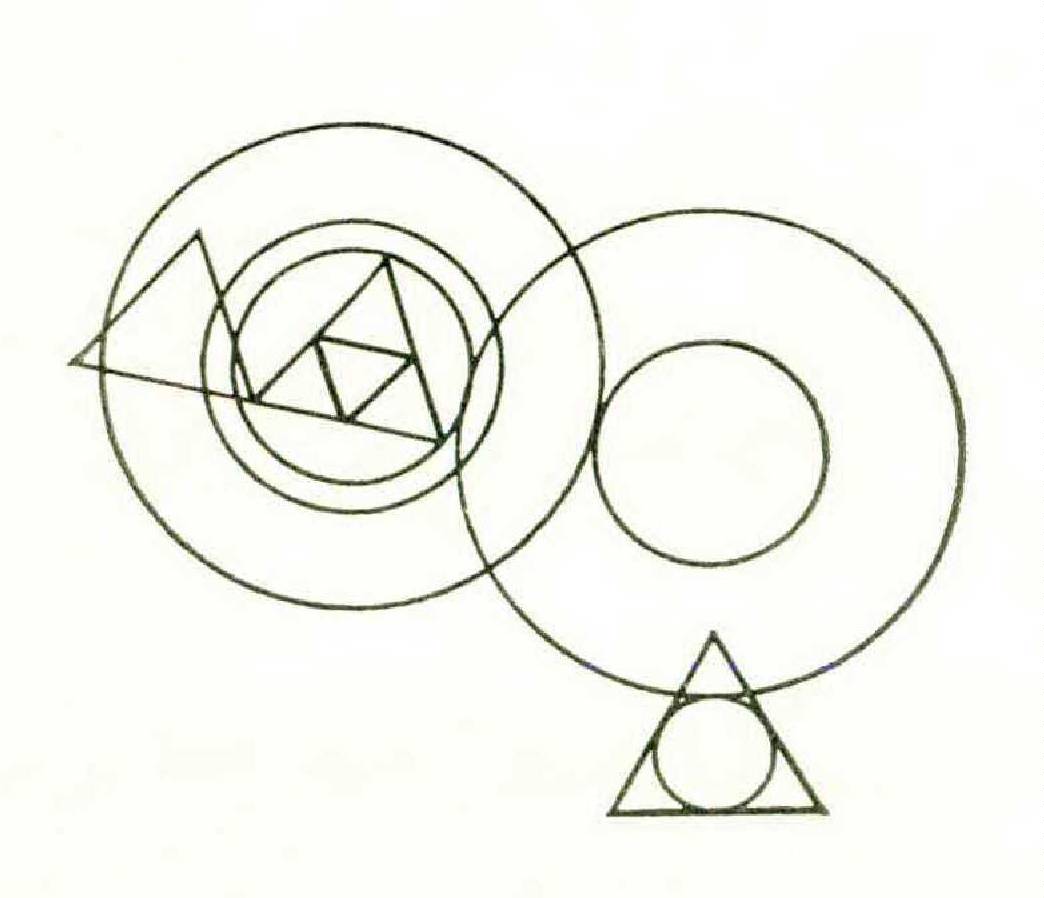
FIDELMAN pissing in muddy water discovers water over his head. Modigliani wanders by searching by searchlight for his lost statues in Livorno canal. They told me to dump them in the canal, so I dumped them. Ne ha visto? Niente. How come that yellow light works underwater? Hashish. If we wake we drown, says Fidelman. Chants de Maldoror. His eyeless face drained of blood but not yellow light, Modi goes up canal as Fidelman drifts down.
Woodcut. Knight, Death and the Devil. Dürer.
Au fond il s’est suicidé. Anon.
Broken rusting balls of Venus. Ah, to sculpt a perfect hole, the volume and gravity constant. Invent space. Surround matter with hole rather than vice versa. That would have won me enduring fame and fortune and spared me all this wandering.
Cathedral of Erotic Misery. Schwitters.
Everybody says you’re dead, otherwise why do you never write? Madonna Adoring the Child. Mater Dolorosa. Madonna della Peste. Long White Knights. Lives of the Saints. S. Sebastian, arrow collector, swimming in bloody sewer. Pictured transfixed with arrows. S. Denis, decapitated. Pictured holding his head. S. Agatha, breasts shorn clean, running enflamed. Painted carrying both bloody breasts in white salver. S. Stephen, crowned with rocks. Shown stoned. S. Lucy tearing out eyes for suitor smitten by same. Portrayed bearing two-eyed omelet on dish. S. Catherine, broken apart on spiked wheel. Pictured married to wheel. S. Laurence, roasted on slow grill. I am roasted on one side. Now turn me over and eat. Shown cooked but uneaten. S. Bartholomew, flayed alive. Standing with skin draped over skinned arm. S. Fima, eaten by rats. Pictured with happy young rat. S. Simon Zelotcs, sawed in half. Shown with bleeding crosscut saw. S. Genet in prison, pictured with boys. S. Fidel Uomo, stuffing his ass with flowers.
Still Life with Herrings. S. Soutine.
He divideth the gefilte fish and matzos.
Drawing. Flights of birds over dark woods, sparrows, finches, thrushes, white doves, martins, swallows, eagles. Birds with human faces crapping human on whom they crap.
Wood sculpture. Man holding sacrificial goat. Cubist goat with triangular titties. Goat eating hanged goat.
The enigma of Isador Ducasse. Man Ray.
In this time Fidelman, after making studies of the work of Donatello, in particular of the Annunciation carved in stone for the church of S. Croce, the S. George in armor, with all the beauty of youth and the courage of the knight, and the bald man known as II Zuccone, from figures in the facade of Giotto’s Campanile, about whom it was said the sculptor, addressing his creation, would cry out, Speak, Speak: In this time the American began to work in original images dug into the soil. To those who expressed astonishment regarding his extraordinary venture, Fidelman is said to have replied, Being a poor man I can neither purchase nor borrow hard or soft stone; therefore, since this is so, I create my figures as hollows in the earth. In sum, my material is the soil, my tools a pickax and shovel, my sculpture the act of digging rather than carving or assembling. However, the pleasure in creation is not less than that felt by Michael Angelo.
After attempting first several huge ziggurats that because of the rains tumbled down like Towers of Babel, he began to work labyrinths and mazes dug in the earth and constructed in the form of jewels. Later he refined and simplified this method, building a succession of spontaneously placed holes, each a perfect square, which when seen together constituted a sculpture. These Fidelman exhibited throughout Italy in whatsoever place he came.
Having arrived in a city carrying his tools on his shoulder and a few possessions in a knotted bundle on his arm, the sculptor searched in the environs until he had come upon a small plot of land he could dig on without the formality of paying rent. Because this good fortune was not always possible, he was more than once rudely separated from his sculptures as they were in the act of being constructed, and by the tip of someone’s boot, ejected from the property whereon he worked, the hollows then being filled in by the angry landowners. For this reason the sculptor often chose public places and dug in parks, or squares, if this were possible, which to do so he sometimes pretended when questioned by ofiicials of the police that he was an underground repairman sent by the municipality. If he was disbelieved by these and dragged off to jail, he lay several days recuperating from the efforts of his labors, not unpleasantly. There are worse places than jails, Fidelman is said to have said, and once I am set free I shall begin my sculptures in another place. To sum up, he dug where he could, yet not far from the marketplace where many of the inhabitants of the city passed by daily, and where, if he was not unlucky, the soil was friable and not too hard with rock to be dug. This task he performed, as was his custom, quickly and expertly. Just as Giotto is said to have been able to draw a perfect freehand circle, so could Fidelman dig a perfect square hole without measurement. He arranged the sculptures singly or in pairs according to the necessity of the Art. These were about a braccio in volume, sometimes two, or two and a half if Fidelman was not too fatigued. The smaller sculpture took from two to three hours to construct, the larger perhaps five or six; and if the final grouping was to contain three pieces, this meant a long day, indeed, and possibly two of continual digging. There were times when because of weariness Fidelman would have compromised for a single braccio piece; but in the end Art prevailed and he dug as he must to fulfill those forms that must be fulfilled.
After constructing his sculptures, the artist, unwinding a canvas sign on stilts, advertised the exhibition. The admission requested was ten lire, which was paid to him in the roped-off entranceway, the artist standing with a container in his hand. Not many were enticed to visit the exhibition, especially when it snowed or rained, although Fidelman was heard to say that the weather did not the least harm to his sculptures, indeed, sometimes improved them by changing texture and volume as well as affecting other qualities. And it was as though nature, which until now was acted upon by the artist, now acted upon the Art itself, an unexpected but satisfying happening, since thus were changed the forms of a form. Even on the most crowded days, when more than several persons came to view his holes in the earth, the sculptor earned a meager sum, not more than two or three hundred lire at most. He well understood that his bread derived from the curious among the inhabitants, rather than from the true lovers of Art, but for this phenomenon took no responsibility since it was his need to create and not be concerned with the commerce of Art. Those few who came to the exhibit, they viewed the sculptures at times in amazement and disbelief, whether at the perfect constructions or at their own stupidity, if indeed they believed they were stupid, is not known. Some of the viewers, after gazing steadfastly at the sculptures, were like sheep in their expression, as if wondering whether they had been deceived; some were stony-faced, as if they knew they had been. But few complained aloud, being ashamed to admit their folly, if indeed it were folly. To the one or two who rudely questioned him, saying, Why do you pass off on us as sculpture an empty hole or two? the artist, with the greatest tact and courtesy, replied, It were well if you relaxed before my sculptures, if you mean to enjoy them, and yield yourself to the pleasure they evoke in the surprise of their forms. At these words he who had complained fell silent, not certain he had truly understood the significance of the work of Art he had seen. On occasion a visitor would stop by to compliment Fidelman, which he received with gratitude. Eh, maestro, your sculptures touch my heart. I thank you from the bottom of my own, the artist is said to have replied, blowing his nose to hide the gratification that he felt.
There is a story told that in Naples in a small park near the broad avenue called Via Carraciola, one day a young man waited until the remaining other visitor had left the exhibit so that he might speak to the sculptor. Maestro, said he most earnestly, it distresses me to do so, but I must pray you to return to me the ten lire I paid for admission to your exhibit. I have seen no more than two square holes in the ground and am much dissatisfied. The fault lies in you that you have seen only holes, Fidelman is said to have replied. I cannot, however, return the admission fee to you, for doing so might cause me to lose confidence in my work. Why do you refuse me my just request? said the poorly attired young man, whose dark eyes, although intense and comely, were mournful. I ask for my young babes. My wife gave me money so that I might buy bread for our supper, of which we have little. We are poor folk, and I have no steady work. Yet when I observed the sign calling attention to your sculptures, which though I looked for them I could see none visible, I was moved by curiosity, an enduring weakness of mine and the cause of much of my misery. It came into my heart that I must see these sculptures, so I gave up the ten lire, I will confess, in fear and trepidation, hoping to be edified and benefited although fearful I would not be. I hoped that your sculptures, since they are described on the banner as new in the history of Art, might teach me what I myself must make in order that I may fulfill my desire to be great in Art; but all I can see are two large holes, the one deeper by about a braccio than the other. Holes are of no use to me, my life being full of them, so I beg you to return the lire that I may hasten to the bakers shop to buy the bread I was sent for.
After hearing him out, Fidelman is said to have answered, I do not as a rule explain my sculptures to the public, but since you are an attractive young man who has turned his thoughts to becoming an artist, I will say to you what your eyes have not seen, in order that you may indeed be edified and benefited.
I hope that may be so, said the young man, although I doubt it.
Listen before you doubt. Primus, although the sculpture is more or less invisible it is sculpture nevertheless. Because you can’t sec it doesn’t mean it isn’t there. As for use or uselessness, rather think that that is Art which is made by the artist to be Art. Secundus, you must keep in mind that any sculpture is a form existing at a point radiating in all directions; therefore since it is dug into the Italian earth the sculpture vibrates overtones of Italy’s Art, history, politics, religion; even nature as one experiences it in this country. There is also a metaphysic in relation of down to up, and vice versa, but I won’t pursue that matter now. Suffice to say, my sculpture is not unrelated, though not necessarily purposefully, to its environment, whether seen or unseen. Tertius, in relation to the above, it is impossible to describe the range of choices, conscious or unconscious, that exist in the creation of a single sculptured hole. However, let it be understood that choice, as I use the word in this context, means artistic freedom, for I do not in advance choose the exact form and position of the hole; it chooses me. The essential thing is to maintain contact with it as it is being achieved. If the artist loses contact with his hole, than which there is none like it in the universe, then the hole will not respond and the sculpture will fail. Thus I mean to show you that constructs of a sculpture which appear to be merely holes are, in truth, in the hands of the artist, elements of a conceptual work of Art.
You speak well, maestro, but I am dull-witted and find it difficult to comprehend such things. It would not surprise me that I forgot what you have so courteously explained before I arrive at the next piazza. May I not therefore have the ten lire back? I will be ever grateful to you.
Tough titty if you can’t comprehend Art, Fidelman is said to have replied. Fuck off now.
The youth left, sighing, without his ten lire, nor with bread for his babes.
Not long after he had departed, as it grew dusk, the sculptor took down the banner of his exhibit and gathered his tools so that he might fill in the sculpture and leave for another city. As he was making these preparations a stranger appeared, wrapped in the folds of a heavy cloak, although winter still hid in its cave and the fields were ripe with grain. The stranger’s nether limbs, clothed in coarse black stockings, were short and bowed, and his half-concealed visage, iron eyes in a leather face, caused the flesh on Fidelman’s neck to prickle and thicken. But the stranger, averting his glance and speaking pleasantly, yet as though to his own hands, and in the accent of one from a foreign land, graciously prayed the sculptor for permission to view his sculpture, the effect of which he had heard was extraordinary. He explained he had been delayed on board ship in the bay and apologized for appearing so late in the day. Fidelman, having recovered somewhat from his surprise at the stranger’s odd garments and countenance, is said to have replied it made no difference that he had come late so long as he paid the admission fee.
This the stranger did forthwith with a gold coin for which he neither asked nor received change. He glanced fleetingly at the sculpture and turned away as though dazzled, the which the sculptor is said to have wondered at. But instead of departing the exhibit now that he had viewed it, however hastily, the stranger tarried, his back to that place where the sculpture stood fixed in the earth, the red sun sinking at his shoulders. As though reflecting still upon what he had seen, he consumed an apple, the core of which he tossed over his left shoulder into one of the holes of the sculpture, an act that is said to have angered Fidelman although he refrained from complaint; it may be because he feared this stranger was an agent of the police, so it were better he said nothing.
If you’ll excuse me, said the stranger at last, please explain to me what mean these two holes that they have in them nothing but the dark inside?
The meaning lies in that they are as they seem to be, and the dark that you note within, although I did not plan it so or put it there, may be thought of as an attribute of the aesthetic, Fidelman is said to have replied.
So what then did you put there?
To wit, the sculpture.
At that the stranger laughed, his laughter not unlike the bray of a young goat. All I saw was nothing. To me, if you’ll pardon me, is a hole nothing. This I will prove to you.’ If you will look in the small hole there is now there an apple core. If not for this would be empty the hole. If empty would be there nothing.
Emptiness is not nothing if it has form.
Form, if you will excuse me my expression, is not what is the whole of Art.
The hole with an h?
No, with a w.
One might argue that, but neither is content if that’s what you intend to imply. Form may be and often is the content of Art.
You don’t say?
I do indeed.
The stranger spat on both of his hands and rubbed them together, a disagreeable odor rising from them.
In this case I will give you form.
Since the stranger stood now scarce visible in the dark, the sculptor began to be in great fear, his legs, in truth, trembling.
Who are you? Fidelman is said finally to have demanded.
I am also that youth that he is now dead in the Bay of Naples, that you would not give him back his poor ten lire so he could buy bread for his babies.
Also? Are you not also the devil? the sculptor is said to have cried out.
I am also him.
Quid ego feci?
This I will tell you. You have not yet learned what is the difference between something and nothing.
Bending for the shovel, the stranger smote the horrified fidelman with its blade a resounding blow on the head, the sculptor toppling as though dead into the larger of the two holes he himself had dug. He-whom-Fidelman-did-not-know then proceeded to shovel in earth until the sculpture and its creator were extinguished.
So it’s a grave, the stranger is said to have muttered. So now we got form but we also got content.
Collage. The Flayed Ox. Rembrandt. Hanging Fowl. Soutine. Young Man With Death’s Head. Van Leyden. Funeral at Ornans. Courbet. Bishop Eaten by Worms. Murillo. Last Supper, Last Judgment, Last Inning.
I paint with my prick. Renoir. I paint with my ulcer. Soutine. I paint with my paint. Fidelman.
One can study nature, dissect and analyze and balance it, without making paintings. Bonnard. Gouache. Unemployed Musician. Fiddleman.
Painting is nothing more than the art of expressing the invisible through the visible. Fromentin. Indefinite Divisibility. Tanguy. Definite Invisibility. Fidelman.
I’m making the last paintings which anyone can make. Reinhardt. I’ve made them. I like my paintings because anyone can do them. Warhol. Me too.
Erased de Kooning Drawing. Rauschenberg. Erased Rauschenberg, de Kooning. Lithograph. Eraser. Fidelman.
Modigliani climbs and falls. He tries to scale a brick wall with bleeding fingers, his eyes lit crystals of heroin, whiskey, pain. He climbs and falls in silence.
My God, what’s all that climbing and falling for?
For art, you cretin.
Thunder and lightning.
Portrait of an Old Jew Seated. Portrait of an Old Jew in an Armchair. Rembrandt. It beats walking.
Then I dreamt that I woke suddenly, with an unspeakable shock, to the consciousness that someone was lying in bed beside me. I put my hand out and touched the soft naked shoulder of a woman; and a cold gentle little woman’s voice said: I have not been in bed for a hundred years. Raverat. The rat killer. Rembrandt. Elle m’a mordu aux couilles. Modigliani.
Mosaic. Piazza Amerina, Sicily. IVth Cent. A.D. All that remains after so long a time.
Susskind preacheth up on the mountain, a piece of green palm branch behind his head. (He has no halo, here the mosaic is broken.) Three small cactus plants groweth at his bare feet./ Tell the truth. Dont cheat. If its easy it dont mean its good. Be kind, specially to those that they got less than you. I want for everybody justice. Must also be charity. If you feel bad give charity. Must also be mercy. Be nice, don’t fight. Children, how can we live without mercy? if you have no mercy for me I shall not live. Love, mercy, charity. Its not so easy, believe me.
AT THE bottom of the brown hill they stand there by the huge lichenous rock that riseth above them on the top of which is a broad tree with a twisted trunk./ Ah, Master, my eyes watereth. Thou speakest true. I love thy words. I love thee more than thy words. If I could paint thee with my paints, then would my heart soar to the gates ot heaven. I will be forever thy disciple, no ifs or buts./ This is already iffed. If you will follow me, follow. If you will follow must be for Who I Am. Also please, no paints or paintings. Remember the Law, what it says. No graven images, which is profanation and idolatry. Nobody can paint Who I Am. Not on papyrus, or make me into an idol of wood, or stone, not even in the sand. Dont try, its a sin. Here is a parable: And the Lord called unto Moses and spoke to him, Moses, come thou on this mountain and I will show Myself so thou mayst see Me, and none but thee; and Moses answered: Lord, if I see Thee, then wilt Thou become as a graven image on mine eye and I be blind. Then spake the Lord, saying, Thou art my beloved Son, in whom I am well pleased, and for this there is no Promised Land./ What’s the parable of that? Its more a paradox, Id say./ If you dont know its not for you./ Tell me, Master, art thou the Living God? Art thou at least the Son of God?/ So we will see, its not impossible./ Art thou the Redeemer?/ This could be also, I’m not sure myself. Depends what happens./ Is thy fate ordained?/ I act like I Am. Who knows my fate? All I know is somebody will betray me. Don’t ask how I know, I know. You dont but I do. This is the difference./ It is not I, Master, I will never betray thee. Cast me out now if thou believest I speak not the TRUTH./ What happens will happen. So give up your paints and your brushes and follow me where I go, and we will see what we will see. This we will see./ Master, tis as good as done.
Fidelman droppeth into the Dead Sea all his paints and brushes, except one. (A piece of the blue sea is faded.)
(In this picture) As Susskind preacheth to the multitude, on the shore of the green sea of Galilee where sail the little ships of the fisher men, as even the red fishes and the white fishes come to listen at the marge of the water, the black goats stand still on the hills, the painter, who hideth behind a palm tree, sketcheth with a coal on papyrus the face and figure of the Master./ If I could do a portrait of him as he is in this file I’ll be remembered forever in human history. Nobody can call that betrayal, I dont think, for its for the good of us all./ My child, why do you do that which I forbade you? Dont think I cant sec you, I can. I wish I couldnt see what I see, but I can.
The painter kneeleth on his knees. (A lew tesserae are missing from his face, including one of the eye, and a few black stones from his beard.)/ Master, forgive me. All I meant to do was preserve thy likeness for a future time. I guess it gotteth to be too much for me, the thought that I might. Forgive, forgive in thy mercy. Ill burn everything, I promise, papyrus, charcoal, a roll of canvas I have hid in my hut, also this last paintbrush although a favorite of mine./ Listen to me, there are two horses, one brown, the other black. The brown obeys his master, the black does not. Which is the better horse?/ Both are the same./ How is this so?/ One obeys and the other does not, but they are both thoroughbreds./ You have an oily tongue. If I cant change you I must suffer my fate. This is a fact./ Master, have no further worries on that score, I am a changed man down to my toenails I give thee my Word.
Fidelman speaketh to himself in a solitary place in Capernaum./ This talent it is death to hide lodged in me useless. How am I ever going to make a living or win my spurs? How can I compete in this world if both my hands are tied and my eyes blindfolded? Whats so moral about that? How is a man meant to fulfill himself if he isnt allowed to paint? Its graven image versus grave damages to myself and talent. Which harms the most there is no doubt. One can take just so much./ He gnasheth his teeth. He waileth to the sky. He teareth his cheeks and pullcth out the hairs of his head and of his beard. He butteth his skull against the crumbling brick wall. On this spot the wall is tained red with blood./ Satan saith Ha Ha.
As Susskind sat at meat he spoke thus. Verily I say, one of you who eats now at this table will betray me, dont ask who./ Idis followers blusheth. Their faces are in shades of pink. No one blusheth not. Fidelman blusheth red./ But if he knows, it cant be all that wrong to do it. What I mean is Im not doing it in any sneaky way, that is, for after all he knows./ He that has betrayed me once will betray me twice. He will betray me thrice./ Fidelman counteth on his fingers.
He is now in the abode of the high priest Caiaphas./ (Here the mosaic is almost all destroyed. Only the painters short-fingered pale hand survives.) Fidelmans heavy hand is filled with thirty-nine pieces of silver.
The painter runneth out to buy paints, brushes, canvas.
On the Mount of Olives,appeareth the painter amid a multitude with swords, staves, and lengths of lead pipe. Also come the chief priest, the chief of police, scribes, elders, the guards with dogs, the onlookers to look on. Fidelman goeth to the master and kisseth him full on the lips./ Twice, saith Susskind./ He wept.
He hath on his head a crown of rusty chain links. A guard smiteth his head and spitteth on his eye. In mockery they worship Sussking./ Its a hard life, he saith./ He draggeth the beam of the cross up a hill. Fidelman watcheth from behind a mask.
12 12 12-12 12 12 12 12 12 12 12 12 12 12 12 12 369 369 369 369 369 369 369 369 369 369 369 369 veyizmirveyizmirveyizmirveyizmirveyizmirveyizmir 12369 12369 12369 12369 12369 12369 12369 12369
Fidelman painteth three canvases. The Crucifixion he painteth red on red. The Descent from the Cross he painteth white on white. For the Resurrection, on Easter morning, he leaveth the canvas blank.
P
tOtem
L
E
Suss
King
Je vous emmerde. Modigliani.
Oil on wood. Bottle fucking guitar? Bull impaled on flagpole? One-eyed carp stuffed in staring green bottle? Clown spooning dog dung out of sawdust? Staircase ascending a nude? Black-stockinged whore reading pornographic book by lamplight? Still life: three apple cores plus one long gray hair? Boy pissing on old man’s shoe? The blue disease? Balding woman dying her hair? Buggers of Calais? Blood oozing from ceiling on foggy night?
Rembrandt was the first great master whose sitters sometimes dreaded seeing their portraits. Malraux. I is another. Rimbaud. 1. Watercolor. Tree growing in all directions. Nothing nameable taxonomically speaking, like weeping willow with stiff spotted leaves, some rotted brown-green. Otherwise stylized apple-green-to-gold leaves. Not maple or sycamore same though resembling both, enlarged, painted to cover whole tree from roots to topmost spotted leaf. The leaves are the tree. Branches like black veins, thins to thicks, visible behind or through leaves. No birds in tree, not rook or raven. Impression is of mystery. Nothing more is seen at first but if viewer keeps looking tree is cleverly a human face. Leaves and branches delineate strained features, also lonely hollow anguished eyes. What is this horror I am or represent? Painter can think of none, for portrait is of a child and he remembers happy childhood, or so it seems. Exactly what face has done, or where has been, or knows, or wants to know, or is or isn’t experiencing, isn’t visible, nor can be explained as tone, memory, feeling, or something that happened in later life that painter can’t exactly recall. Maybe it never happened. It’s as though this face is hiding in a tree or pretending to be one while waiting for something to happen in life and that something when it happened was nothing. Nothing much. 2. Triptych. Woodcut. It’s about forbidden love. In the first black-and-white panel this guy is taking his sister in her black-and-white bathrobe. She squirms but loves it. Can be done in white-and-black for contrast. Man Seducing Sister or Vice Versa. The second panel is about the shame of the first, where he takes to masturbating in the cellar. It’s dark so you can’t see much of his face but there’s just enough light to see what he’s up to. Man Spilling Seed on Damp Cellar Floor. Then here in this third panel, two men doing it, each with his three-fingered hand on the other’s maulstick. This can be inked darkly because they wouldn’t want to be seen. 3. Then having prepared it for painting he began to think what he would paint upon it that would frighten everyone that saw it, having the effect of the head of Medusa. So he brought for that purpose to his room, which no one entered but himself, lizards, grasshoppers, serpenis, butterflies, locusts, bats, and other strange animals of the kind, and from them all he produced a great animal so horrible and fearful that it seemed to poison the air with its fiery breath. This he represented coming out of some dark rocks with venom issuing from its open jaws, fire from its eyes, and smoke from its nostrils, a monstrous and horrible thing iqdeed. Lives of the Painters. 4. Figure; wood, string, and found objects. Picasso.
Incisore. The cylinder, the sphere, the cone. Cézanne. The impact of an acute angle of a triangle on a circle promises an effect no less powerful than the finger of God touching the finger of Adam in Michaelangelo. Kandinsky.
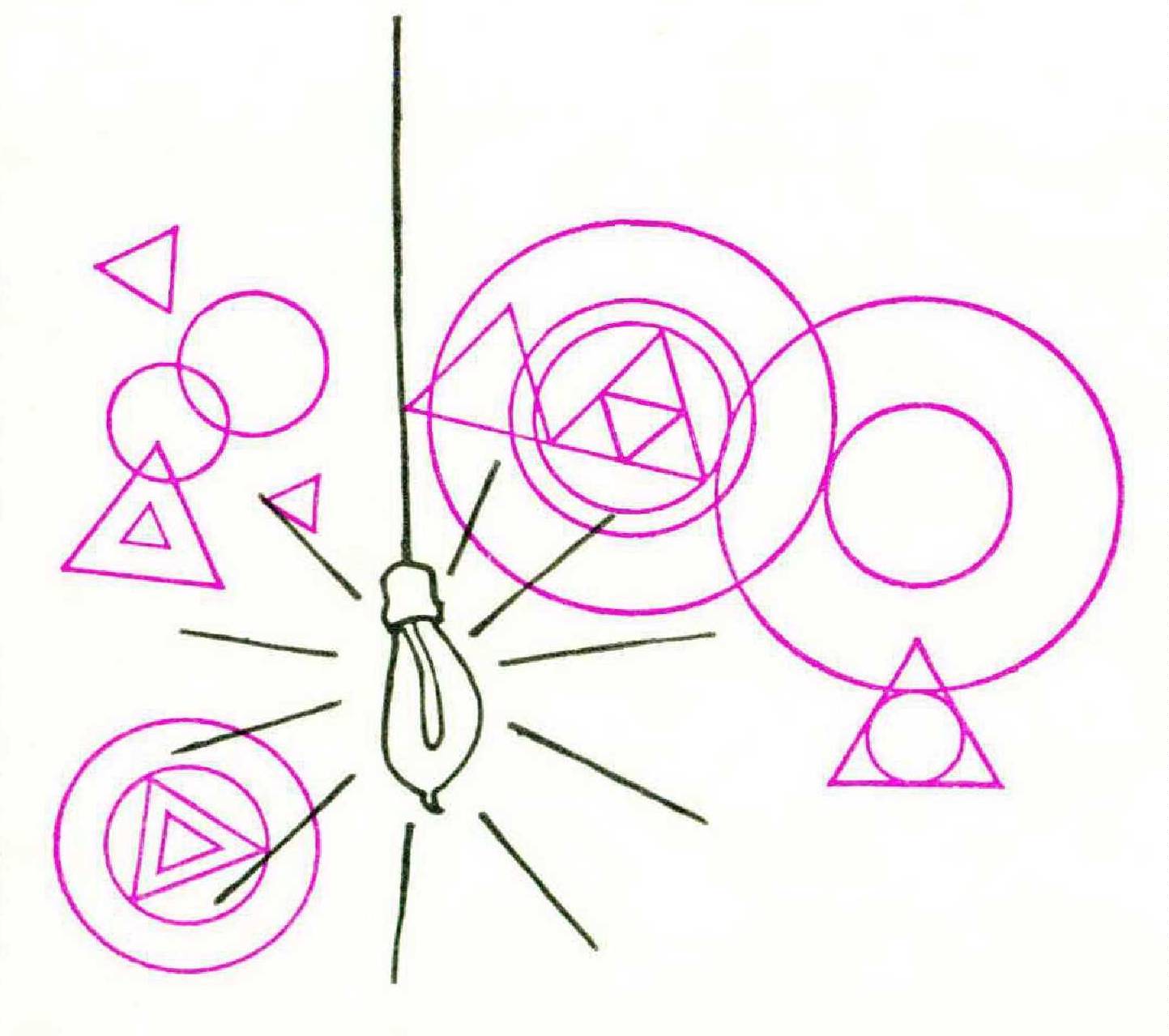
Fidelman, etcher, left a single engraving of the scries called A Painter’s Progress. Originally there were six copper plates, drypoint, all with their prints destroyed, how or why is not known. Only a single imperfect artist’s proof entitled “The Cave” survives. This etching represents a painter at work, resemblance to whom easily may be guessed. Each night, according to a tattered diary he had kept for a while, he entered the cave in question through a cellar he had the key to, when all the lights in the old clapboard house, several boards missing, were out, curtains thickly drawn over each narrow window. The painter in the etching worked all night, night after night, inch by slow inch covering the rough limestone surface of the voluminous cave at the end of a labyrinth under the cellar, with intricate designs of geometric figures; and he left before dawn, his coming and going unknown to his sister, who lived in the house alone. The walls and part of the roof of the huge cave that he had been decorating for years and years and estimated at least two more to go before his labors ended, were painted in an extraordinary tapestry of simple figures in black, salmon, gold-yellow, sea-green and apricot, although the colors cannot of course be discerned in the three-toned engraving — a rich design of circles and triangles, discrete or interlocking, of salmon triangles encompassed within apricot circles, and sea-green circles within pale gold-yellow triangles, blown like masses of autumn leaves over the firmament of the cave.
The painter of the cave, wearing a leafy loincloth as he labored, varied the patterns of the geometric design. He was at that time of his life engaged in developing a more intricate conception of circles within circles of various hues and shades including copper red and light olive; and to extend his art further, of triangles within triangles within concentric circles. He drove himself at his work, intending when his labor was done to climb the dark stairs ascending to his sister’s first floor and tell her what he had accomplished in the cave below. Bessie, long a widow, all her children married and scattered across the continent, her oldest daughter in Montreal, lived, except lor occasional visitors, mostly the doctor, alone in the old frame house she had come to as a young bride, in Newark, New Jersey. She was at this time ill and possibly dying. Nobody he could think of had told her artist-brother, but he figured he somehow knew. Call it intuition. It was his hope she would remain alive until he had completed his art work of the cave and could at last see how it had turned out.
Bessie, he would say, I did this for you and you know why.
Fidelman worked by the light of a single dusty one-hundred-watt bulb, the old-fashioned kind with a glass spicule at the bottom, dangling from a wire from the ceiling of the cave, that he had installed when he first came there to paint. For a long time he had distrusted the bulb because he had never had to replace it, and sometimes it glowed, like a waning moon after he had switched it off, making him feel slightly uneasy and a little lumpy in the chest. He suspected a presence, immanent or otherwise, around; though who or why, and under what circumstances, he could not say. Nothing or nobody substantial. Anyway, he didn’t care for the bulb. He knew why when it began, one night, to speak to him. How does a bulb speak? With the sound of light. Fidelman for a while did not respond, first because he couldn’t, his throat constricted; and second, because he suspected this might be he talking to himself; yet when it spoke again, this time he answered.
Fidelman, said the voice of, or from within, the bulb, why are you here such a long time in this cave? Painting — this we know — but why do you paint so long a whole cave? What kind of business is this?
Leaving my mark is what. For the ages to see. This place will someday be crowded with visitors at a dollar a throw. Mark my words.
But why in this way if there are better?
What would you suggest, for instance?
Whatever I suggest is too late now, but why don’t you go at least upstairs and say hello to your poor sister who hasn’t seen you in years? Go before it is too late, because she is now dying.
Not quite just yet I can’t go, said the painter. I can’t until my work is finished because I want to show her what I’ve accomplished once it’s done.
Go up to her now, this is the last chance. Your work in this cave will take years yet. Tell her at least hello. What have you got to lose? To her it will be a wonderful thing.
No, I can’t. It’s all too complicated. I can’t go till I’ve finished the job. The truth is I hate the past. It caught me unawares. I’d rather not see her just yet. Maybe next week or so.
It’s a short trip up the stairs to say hello to her. What can you lose if it’s only fourteen steps and then you’re there?
It’s too complicated, like I said. I hate the past.
So why do you blame her lor this?
I don’t blame anybody at all. I just don’t want to see her. At least not just yet.
If she dies she’s dead. You can talk all you want then but she won’t answer you.
It’s no fault of mine if people die. There’s nothing I can do about it.
Nobody is talking about fault or not fault. All we are talking about is to go upstairs.
I can’t I told you, it’s too complicated, I hate the past, it caught me unawares. If there’s anything to blame I don’t blame her. I just don’t want to see her is all, at least not just yet until my work here is done.
Don’t be so proud my friend. Pride ain’t spinach. You can’t eat it so it won’t make you grow. Remember what happened to the Greeks.
Praxiteles? He who first showed Aphrodite naked? Phidias, whose centaur’s head is thought to be a self-portrait? Who have you got in mind?
No, the one that he tore out his own eyes. Watch out for hubris. It’s poison ivy. Trouble you got enough, you want also blisters? Also an electric bulb doesn’t give so often advice so listen with care. When did you hear last that an electric bulb gave advice? Did I advise Napoleon? Did I advise Van Gogh? This is like a miracle, so why don’t you take advantage and go upstairs?
Well, you’ve got a point there. There’s some truth to it, I suppose. I might at that, come to think of it. As you say, it’s not everybody who gets advice in this way. There’s something Biblical about it if I may say. Furthermore, I’m not getting any younger, and besides I haven’t seen Bessie in years. Plus I do owe her something, after all. Be my Virgil, which way to up the stairs?
I will show you which way but I can’t go with you. Up to a point but not further if you know what I mean. A bulb is a bulb. Light I got but not feet. After all, this is the Universe, everywhere is laws.
Fidelman slowly goes up the stone, then wooden, stairs, lit generously from bottom clear to top by the bulb, and opens the creaking door into a narrow corridor. He walks along it till he comes to a small room where Bessie is lying in a sagging double bed.
Hello, Bessie, I been downstairs most of the time but I came up to say hello.
Why arc you so naked, Arthur? It’s winter outside.
It’s how I am nowadays.
Arthur, said Bessie, why did you stop writing for so long? Why didn’t you answer my letters?
I guess I had nothing much to write. Nothing much has happened to me. There wasn’t much to say.
Remember how Mama used to give us an apple to eat with a slice of bread?
I don’t like to remember those things anymore.
Anyway, thanks for coming up to sec me, Arthur. It’s a nice thing to do when a person is so alone. At least I know what you look like and where you are nowadays.
Bessie died and rose to heaven, holding in her heart her brother’s hello.
Flights of circles, cones, triangles.
End of drypoint etching.
The ugly and plebeian face with which Rembrandt was ill favored was accompanied by untidy and dirty clothes, since it was his custom, when working, to wipe his brushes on himself, and to do other things of a similar nature. Jakob Rosenberg.
If you’re dead how do you go on living?
Natura morta: still life. Oil on paper.